
32 destinations chosen entrely subjectively

Where To Go in Germany – Part 1 – History of the Germans
Transcript
A very, very merry Christmas to you all.
As you are still awaiting your presents, mine has already arrived, which is the chance to make this show. Despite all my occasional moaning and groaning about how much work it is, I have never enjoyed anything as much this. Who could have imagined that digging through often dusty books and articles and trying to put together an interesting and compelling narrative together for a discerning audience was that much fun. And the reason I can do all this is you, the listeners and patrons of the History of the Germans Podcast. So thank you, thank you and thank you.

Now let’s get to your Christmas present. I had promised you 5 to 10 places I particularly love and that are not on the standard itinerary for a trip to Germany. But when I shortlisted the places I particularly like, I noticed a bit of a pattern. They were all within a limited range, basically near places I had lived or that have some link to my family. That is human, but not exactly helpful. Because if you want to go to Germany and for some inexplicable reason choose not to spend all your time in either Hamburg or the sunniest, most beautiful and culinarily attractive area that is Baden, then this episode would be profoundly useless to you.
I clearly needed some discipline. The plan is now to go through each Bundesland and point out two places, one that is a genuine must-see, and the other a place fewer people go and that is still interesting in its own right. That makes it 32 locations plus 2 bonus ones where I will fully indulge myself by dragging you into deepest Tauberfranken. And I know that still leaves room for enormous bias, in particular when it comes to the larger or richer Lands. But note, this is my Podcast and a choose when I want to.

Still it is a lot. And I can imagine that you may want to play sections on one or two places you really like to your friends of family as a way to convince them of the wisdom of going to Germany. So to make it easier to find, I will set up chapters for each Bundesland. If you listen on a podcast app like Spotify, you can go to the episode details, find the chapters and navigate to the bit you want to listen to. Alternatively, you can go to the episode webpage on my website at historyofthegermans.com, where you find the transcript again with headlines for each Bundesland. The order of progress is alphabetically, again hoping this helps you find things.
Baden Württemberg – Heidelberg and Freiburg
And so, without any further ado, let’s begin with the alphabetically and in any other aspect first Bundesland on the list, Baden Württemberg.
Heidelberg
And the must see place there, no ifs, no buts, is Heidelberg. As I had mentioned before, it is here where I went to school, went through the trials and tribulations of adolescence and am therefore completely unable to be objective. But then, this is objectively one of the 10 most beautiful cities in Germany, its settings, architecture, history is just stunning.

Sure, it is an absolute tourism hotspot. But most of them are day trippers who leave for Frankfurt airport before nightfall. In the evenings this is still a city for the locals and students and you can get a decent meal and lovely glass of the excellent Palatinate wine even on the central square and the street that leads down to the Alte Brücke. We did talk about Heidelberg, its castle and university in episode 189 and 190 already, so check those out before you go.
If you happen to stay a bit longer in the city, you may want to go up the Heiligenberg the hill opposite the town. You can follow the Philosophenweg, a 2km walk that provides stunning views of the city and holds reminders of the 19th century philosophers and writers who had made Heidelberg famous.

If you climb further up, you come past the monasteries that once owned the surrounding lands before the counts Palatine arrived and built their capital here, and finally you get to see the Thingstaette. Opened by Joseph Goebbels in 1935 as the home to the Reichsfestsiele, the Nazi equivalent to the Salzburger Festspiele. It is an open air stage, allegedly inspired by Greek and Roman theatres. But that is where the comparison ends. The acoustics were terrible and complex amplification systems had to be installed so that the actors could be understood. The plays and events staged there were meant to induct the people into the National Socialist faith. It is much smaller than the Reichsparteitagsgelande in Nurnberg, but it still conveys some of that mishmash of Greco-Roman, medieval and Nordic elements that were used and abused to foster the Nazi ideology. Post war the place fell into disrepair and staged some of the coolest raves in the eighties and nineties…home to a very different German spirit.

And since we are here, you could also take a short train ride to Schwetzingen. The palace there was one of the houses the counts palatine moved to once the Schloss in Heidelberg had been destroyed in the War of the Palatine Succession. Its park, rather than the palace itself is the main attraction, featuring the classic far reaching baroque axes you would expect but also a more natural garden in the English style with dozens of follies, including bathhouses, temples, pavilions and of course the famous Schwetzinger Mosque.

It is here, that in 1668 the Count Palatine Carl Ludwig ordered his gardeners to plant white asparagus for the princely table. This king of vegetables was a delicacy only available to the very rich who could afford the complex process of growing the plants under mounts of sand. It became more widely available when Max Basserman, a local entrepreneur established large scale agricultural production and found a way to keep them fresh in tins. White Asparagus is a German obsession, with various locations claiming to produce the highest quality, though of course Schwetzinger has to be the best. As I said, this is an entirely biased and subjective episode. So if you have never tried it and you are coming between Mid April and St. Johannis or June 24th, give it a go. Not everyone gets why it is so special, but once you have fallen for it, you will wait every year for Spargelzeit.

As for my second recommendation in Baden-Württemberg, I was torn simply because there is so much. We talked about Stuttgart and Tübingen in episode 190 and 192, Karlsruhe in 191, Ravensburg in episode 193 and of course Constance and its council in episodes 171 to 174. It then boiled down to the monastery in Maulbronn, one of the best preserved Cistercian abbeys in Europe and the city of Freiburg. And as this is an entirely subjective show, Freiburg it is.
Freiburg im breisgau
The city founded by the dukes of Zähringen in the 12th century (see episode 15) became the administrative center of the Habsburg ancestral lands, known as Further Austria. It has its university, which as you may have heard me mention, I attended, and which is still going strong.

Freiburg does not impress with oversized castles or dramatic location. Its charms are on a more human scale. Its main square, the Münsterplatz is pure delight. In its center rises its gothic Cathedral, that had been built as a parish church and hence has just one, not two towers. Nor is it the tallest steeple, but, according to Jacob Burckhart, the most beautiful spire in all of Christendom. It is so compelling that when the church of St. Lamberti in Munster, one of the city’s most venerable and largest, needed a new church tower, they built an almost 1:1 replica of the Freiburg Minster. It is also one of the few major gothic church towers in Germany that were completed during the Middle Ages. Cologne, Ulm and Regensburg all sport 19th century spires.
The interior is of course impressive with its high Altar by Hans Baldung Grien and the gothic sculptures inside and out. But is again the human scale of everything that makes Freiburg so lovely. Sitting outside in one of the wine bars on the Münsterplatz, preferable the stalwart, Oberkirch and drinking a glass of the truly excellent Baden wine is hard to beat. We would go there as students, nursing a tiny glass and hoping one of these old duffer would turn out to be an alumni of the university who would happily foot the bill for the evening in exchange for reminiscing of his or her student days. And today, when I go, I am that old duffer and I pay for drinks and tell stories that only I find really interesting. It’s the circle of Life…

And do noy forget, you are in the epicenter of German fine dining. Baden cuisine can easily hold its own against the Alsatians on the opposite shore of the Rhine. The climate that provides more days of sunshine than anywhere else in Germany provides the produce needed to satisfy a demanding clientele. The city itself boosts 5 Michelin star restaurants and the surrounding area another 20 or so. If you go north from there to the small town of Baiersbronn, which can claim to be amongst the places in the world with the highest density of Michelin stars per head in the world, including two three star restaurants. I personally do not care that much about going to 3 star restaurants. But I do believe their presence elevates standards across a whole region. And that results in restaurants that receive what I believe to be the much more desirable Michelin award, the Bip Gourmand. That is given to restaurants that offer excellent quality food at reasonable prices, which is right up my street. If I could pass on one tip that makes life better, it is to download the Michelin guide app and seek out restaurants with the Bip Gourmand. It has never failed me and brought me to truly exceptional places. I am not paid to advertise this, this is simply a tip from me to you. And – you may have guessed – Freiburg and the Black Forest is chocker block full of Bip Gourmand restaurants.
Bayern – München and Regensburg
Enough about what Americans would call “my home state” and go across to Bavaria. You may know by now that my relationship with Bavaria is, to say it politely, ambivalent. But that may be nothing but envy of this blessed land. Or, to be more historically accurate, Bavaria is at least two lands, Bavaria and Franconia, and arguably the Upper Palatinate and Upper Swabia are also under Bavarian occupation.
Munich
When it comes to the absolute must sees in Bavaria – Bavaria, the answer has to be, as much as it pains me – Munich. If like me your spiritual homeland in Hamburg, then Munich is just wrong in any conceivable way. The ostentation, the language, the fashion, the undisguised arrogance… up here in Hamburg we look down on people in a much more sophisticated manner.
That being said, Munich is stunningly beautiful. My favourite thing is to go for a run early in the morning through the Englischer Garten and finish off under the arcades of the Hofgarten giggling at the pomp and pathos with which the 19th century frescoes depicted the high points in the history of the House of Wittelsbach. The rest of the Residenz, one of Europe’s largest palace complex is definitely well worth visiting, in particular the treasury.


And once you are worn out of courtyards, state rooms, corridors and theaters, take a quick look around the corner at the Old Court, where my favorite Wittelsbach, Ludwig the Bavarian lived. Whilst he was really powerful, interesting and consequential, his palace is positively minuscule compared to those of his lesser descendants. Just saying…

I would not dare making a list of places to go in Munich, simply this is ultimately down to your interests and style, all possible variations thereof can be catered for. The Old Pinakothek hosts the art collection of the Bavarian rulers, who had been buying, inheriting and stealing stuff for centuries, the Lenbachhaus is home to masterpieces by the German expressionists and the Deutsches Museum is where you can hear all about Fortschritt durch Technik.

There is one art museum I would add to the list that few people go to, and that is the Villa Stuck. Franz von Stuck, whose house and atelier the villa was, was Germany’s most celebrated artist in the late 19th century. His art oscillated between Jugendstil, the German version of Art Nouveau and symbolism. These striking pictures often diving into mild eroticism and dark myths has gone quite comprehensively out of fashion. But that may not last forever. Fashion changes, even when it comes to older art. I can remember a world where hardly anyone had heard about Caravaggio. And these late 19th century artists, the Pre-Raphaelites, the Nazarener and Symbolists might be on the way up. So grab the chance to be able to say that you had been to Villa Stuck long before everybody else went.

Ok where to go after Munich. Of course none of you would dare – or dare to admit –to visit that abomination in the foothills of the alps, that cardboard grandeur built by a pseudo absolutist who sold his country to fund his architectural fever dreams. There are 20,000 castles in Germany and you go for that one? Cinderella’s castle in Disneyworld is more authentic.
Ok, if it isn’t Neuschwanstein, then where. We have already covered a number of must-sees in Bavaria in separate episodes, Nürnberg in episode 153, Rothenburg ob der Tauber in episode 193, Augsburg in Episode 194 and Landshut in episode 197.
Regensburg
Let me break a lance for Regensburg. When I said Heidelberg is one of and not the most beautiful city in Germany, the place I thought about was Regensburg. Like Heidelberg, it old town suffered only little damage in World War II, which is a rarity. What you will find very often in Germany is that the area around the great cathedral or town hall is made up of late 20th century structures, not all of which have aged well. The reason for that is not that Germans were keen to tear down the old and build the new in its stead, but that almost all cities had been bombed to the ground. Not the worst impact fascism had, but probably its most constant reminder.

In Regensburg you can see what a grand late medieval city looked like. Its stone bridge, built in the middle of the 12th century had seen first Konrad III and then Barbarossa setting out for their respective crusades. Its cathedral is another masterpiece of Gothic art. And from 1594 onwards the estates of the Holy Roman Empire gathered here in the town hall of Regensburg, from 1663 in a permanent session.

This is where imperial laws were passed and conflicts between the different sates resolved, probably more effectively than they are given credit for. And there is the palace of the Thurn and Taxis family, the imperial postmasters, who gave their name to my favorite means of transport.
But the reason Regensburg is special is not the individual attractions, but the coherence of the whole city. There are so many corners that have literally remained unchanged for 500 years allowing you to fully immerse yourself in the world of the medieval free cities. And if you take into account how much bigger and richer Nürnberg or Augsburg were at the time, you can get an idea of the scale and beauty of these late medieval trading hubs.

Another interesting aspect of Regensburg is that the city, despite remaining the seat of a catholic bishop and home to three imperial abbeys, was a major center of the protestant faith offering sanctuary from religious prosecution and spearheading missionary activities. The two communities lived side by side for centuries which led to a duplication of institutions like schools, churches, hospitals and the like. There were several free imperial cities that operated on that basis, a sign that religious tolerance isn’t solely an invention of the 18th century and thrived even in Bavaria.
Since we go about these things in alphabetical order, our next stop is as far as you can get from Bavaria, not geographically, but culturally, and that is of course Berlin, the home of people Bavarians call ”Saupreiß”.
berlin
What is there to see in Berlin? Pointing things out in the capital is a real problem for me, or more precisely two interrelated problems.
The first issue is that my favorite places in Berlin have closed. one permanently, the other temporarily. The Pergamon Museum where you can go through the market gate of the roman city of Millet and then the Ishtar gate of Babylon before hitting the Altar of the Hellenistic city of Pergamon, well that museum is closed at least until 2027 and only scheduled to fully reopen in 2030.


My other favorite was the Tacheles, an artist community that squatted in a former department store and proudly displayed a Mig 21 Russian fighter jet in the courtyard and other not quite health and safety compliant works. That lasted for a surprisingly long time, but closed in 2012 and has now been turned into luxury apartments, one of which recently sold for a cool 10 million Euros. Another sign that the times when artists and tech firms came to Berlin for its cheap rents and amazing spaces are over.

But even without the Pergamon and the Tacheles, there is no shortage of world class art in Berlin. From Nefertiti to Bruce Naumann, everybody is in Berlin. Check out not just the Museums but also the private galleries that make Berlin the capital of contemporary art in Europe.
The other problem I have with Berlin is that things move so fast. In most German cities not just the main historic sites, but even the restaurants and bars barely change. The top nightclub in Munich is still the same it was in the 1980s. In Berlin though, things move far to fast for me to keep up.
But I have a solution to this problem. Its name is Jonny Whitlam. He is a tour guide in Berlin and a fellow podcaster and on whose show, History Flakes, I have appeared before. Jonny really knows his stuff and is great fun to have around. I put a link to his website in the show notes.

Brandenburg
Surrounding Berlin is Brandenburg, and again the must see place here is without a doubt Potsdam, the true capital of Prussia. Yes Berlin was the official capital, but Potsdam is where Frederick II spent his evenings chatting with Voltaire and the intellectuals of the Berlin Academy and his mornings in very different exchanges with his strapping guardsmen.

As you travel from Berlin to Potsdam you cross the Glieniker Bruecke, the place where the US and Soviets exchanged their spies. There you enter a landscape of interconnected lakes and royal and imperial palaces from the forbidding Neues Schloss built solely to prove that Prussia was not bankrupt after the 7-years war, Sansouci, Friedrich II’s pleasure palace, Babelsberg a 19th century beauty and Cecilienhof, where the Potsdam conference consigned Prussia to the scrap heap of history.

Having seen this, the most appropriate thing to do then would be to seek the very beginnings of the state of Brandenburg-Prussia. So head for the Spreewald, famous for its intricate network of natural canals, lush forests, and wetlands, often called Germany’s “bayou”. It is also home to the Sorbs, one of the few remaining communities of Slavic peoples who once occupied the entirety of the lands between the Elbe and the Polish border. You can visit the Slavic castle of Raddusch, a replica of the circular fortresses that Albrecht the Bear found so hard to overcome, he had to resort to murder and complex back room dealing to get in, as we have learned in episode 106.
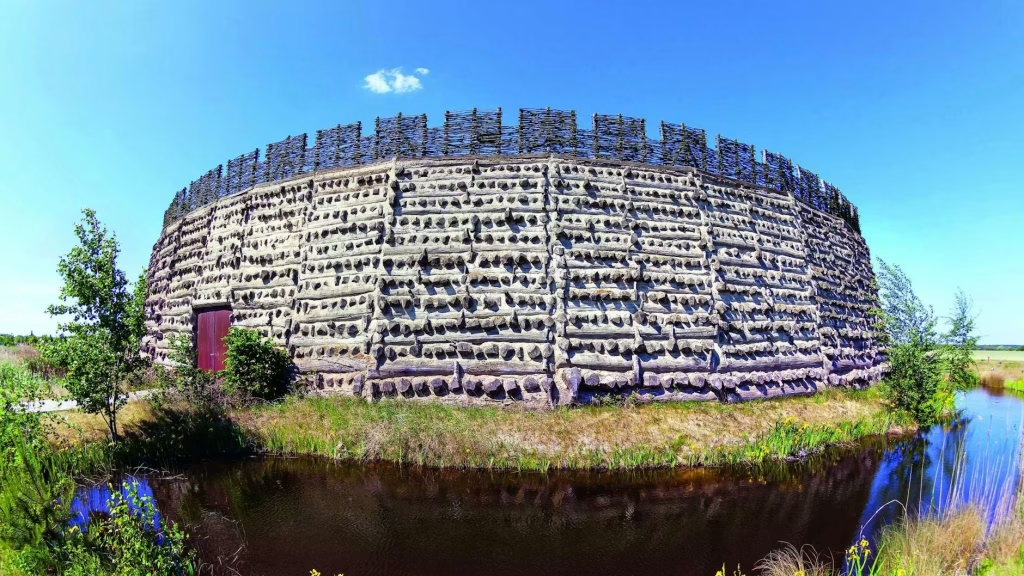
The other things you should do in the Spreewald is go on a boat trip through the canals, buy some of the exceptional pickled cucumbers, as regularly featured on my favourite Instagram account, DDR Mondbasis.
Bremen
Still stuck with the letter B, we are moving on to the smallest of the Bundesländer, Bremen. Small, but perfectly formed. The Rathausplatz with the ginormous statue of Roland, the Dom, the town hall and the Schütting is one of the greatest ensembles of Hanseatic architecture.

Do not be fooled by the peace and serenity of the location. Bremen’s history is a ruthless and bloody one, as we have seen in episode 126.
And underneath the Rathaus, in the Ratskeller you find one of the oldest wine cellars in Germany, which you would not expect so far north. All that goes back to a privilege from 1330, that reserved the right to sell wine for the city council. Like all monopolies, it did not initially strive for quality, so for centuries the citizens of Bremen could only choose between two kinds of wines, the common and the better. That may explain why Bremen turned into the home of world famous breweries like Becks and the main Coffee traders in the country. Still, things improved over time and now you will be offered the choice of 650 different German wines in the Ratskeller and you can gaze at the oldest still unopened wine barrel in the country, containing some I am sure delicious 1653 Rüdesheimer Riesling.


Bremen is, as I mentioned small and perfectly formed, which means everything is close by. So do not miss the Boettcherstrasse, just around the corner from the Rathaus. Built between 1922 and 1931 on the initiative of Ludwig Roselius, a coffee trader, it is a rare example of architectural expressionism, a structure that tries to replicate the ideas and aesthetics of the Blaue Reiter in a three dimensional medium.


The state of Bremen is actually two cities, Bremen and Bremerhaven. Now I cannot honestly recommend a visit to Bremerhaven, unless you want to see the place where some of your ancestors embarked on their journeys to New York, Rio de Janeiro or Buenos Aires.

What makes Bremen really special – at least for me – are the people. They have that Hanseatic openness with a brilliant dry sense of humor and charm.
Hamburg
As much as I love Bremen, if I ever were to move back to Germany, I would move to Hamburg, no two ways about it. Germany’s second city fits me like a glove. It has the space and the sky, the doorways are made for people of stature, they drive nice but not ostentatious cars, their sensibly sized houses are decorated in the best possible, not the latest fashion and they sport that healthy glow that comes from summer holidays spent on bracing walks on the north sea beaches.

The downside of all that style and restraint is that Hamburg cannot offer much in terms of splendid palaces, massive art collections or cathedrals with Puttos dripping from the ceiling. Tourists come and walk through the Speicherstadt, the world’s largest warehouse district, built along canals, entirely from brick between 1883 and 1927. At its end you find the Hafen City, one of Europe’s largest urban regeneration projects that culminates in the Elbphilharmony, a truly spectacular concert hall overlooking one of the five largest harbors in the world.

Much of the old city that once must have looked like Lübeck or Bremen vanished in a massive city fire in 1842 and then in the Hamburg Firestorm in July 1943. But what you see today has been built in the 19th century and then again in the late 20th, all – as one would imagine – in discreet elegance.

The best way to enjoy the true beauty of the place is by taking an Alsterdampfer, a passenger boat that takes you round the two lakes in the center of the city. You get to see canals and bridges, of which Hamburg claims to have more than Venice, the graceful white washed villas where perfect children playing on the grass that leads down to the water’s edge. Get off at Alte Rabenstrasse and grab a seat at Bodo’s Bootssteg, a waterside bar, order an Alsterwasser, beer with lemonade, stare into the sun and feel happiness.

Hessen – Kassel and Marburg
This is where I would love to end on, but the tyranny of the alphabet pushes us on. We have barely covered 6 of the 16 Bundesländer and the next one is Hessen.
If you come by plane, you will most likely arrive in Frankfurt, making this city an inevitability. But not a bad one at all. Frankfurt was one of the three “capitals” in inverted commas of the Holy Roman Empire. The Golden Bull determined that all emperors had to be elected in Frankfurt, a process that took place in a side chapel in the church of St. Bartholomew nowadays called the Kaiserdom. This goes back even further to the Franks of Merovingian and Carolingian times who elected their kings on the hallowed ground of their homeland, Franconia. The election was followed by a celebratory dinner in the Kaisersaal of the Römer, the houses that form the medieval town hall, whilst the people were given the greatest of delicacies, the sausage that became known as the Frankfurter.

And in 1848 Frankfurt witnessed the very first freely elected German parliament holding its constituent session in the Paulskirche. This first stab at democracy did not succeed, but at least we tried.

There are some great museums in Frankfurt, but if you want to go a bit further afield, I recommend two cities, Marburg and Kassel.
Kassel – Wilhelmshohe
Let’s start with Kassel, once capital of the landgraves of Hessen-Kassel. Whilst their old palace had disappeared in 1811, the grandest of the monuments of these otherwise monumentally awful rulers draws all the views, the Bergpark Wilhelmshoehe. 2.5 square kilometers of baroque and English garden design on a hillside that is overlooked by a 40 metre tall pyramid on its summit, which in turn is crowned with an 8.5m tall golden statue of Hercules. Beneath it runs a water feature that comprises a Baroque water theatre, grottos, fountains, two hydraulic organs, and several waterfalls. Water tumbles down the 350m long great cascade into the of course great pond, from where the once tallest fountain in the world sprays water 50 metres into the sky. That is what selling your soldiers to the highest bidder gets you.

The best time to visit Kassel is during the Documenta, an art exhibition that takes place every 5 years, always creates all sorts of controversies with resignations and accusations as only the art world can produce. Visitors and artists give this otherwise rather sedate town a particular buzz, a counterpoint to the overwhelming impression the Bergpark gives you.

MArburg
At the other end of the spectrum is Marburg, like Kassel once a capital of the Landgraviate of Hessen. Some cities have a university, Marburg is a university. During term time ancient medieval streets have a much more youthful flair than the surroundings would suggest.

And it was also once the home of Saint Elisabeth of Hungary, wife of Landgrave Ludwig of Thuringia. Those of you who support the show can listen to a whole episode about Elisabeth of Thuringia, whose life story of persistent abuse by her confessor is amongst the saddest stories about medieval piety I can think of. The Teutonic knights built a magnificent church over her grave, the Elisbethenkirche, and in 1236 once the apse was constructed her body was translated there. Emperor Friedrich II served as one of her pallbearers, a sign of the recognition she enjoyed a mere 5 years after her death.

We covered her daughter’s fight for her son’s inheritance and the creation of the state of Hessen in episode 186. Another descendant of Saint Eisabeth, landgrave Philipp, in the spirit of the reformation had her remains dug up and sold them off to catholic princes.
Niedersachsen – Hildesheim and Rammelsberg/Goslar
The next Bundesland on the list is Niedersachsen, Lower Saxony, or as we would call it, Saxony. Now in most cases the capital of the state is often a must see destination or at least in the top 10. Niedersachsen is the exception. Hannover, apart from a claim to speak the cleanest form of Hochdeutsch is sadly not very exciting.

Hildesheim
What is exciting, at least for history geeks like us is Hildesheim, the see of my favourite ballsy bishop, Bernward of Hildesheim. He was the tutor and later advisor of Otto III and rescued his lord when he rushed into an angry mob of Romans, brandishing the Holy Lance.

But beyond personal bravery he was also an enormously cultured man. From high nobility he advanced quickly through the ranks of the church but his true passion was mathematics, painting, architecture and the manufacturing of liturgical objects in silver and gold. And once placed on the bishops’ throne he embarked on a massive building program.
He left behind two masterpieces of Ottonian architecture, the cathedral of St. Mary and the church of St. Michael. St. Mary holds the greatest treasures, namely the St. Bernward doors, coast in Bronze around 1015 and completely unique in scale and quality of decoration.

And the column of St. Michael, where Bernward had Trajan’s column replicated in Bronze only that instead of Imperial armies, loot and prisoners of war, it depicts scenes of the old testament.

St Michael’s cannot offer the same level of treasures, despite featuring a rare ceiling made from 1300 pieces of wood and again extremely rare. But since St, Mary was rebuilt after Bernward’s death, St, Michael is clearer expression of the bishop’s architectural ideas. As the Unesco World Heritage convention acknowledged, quote: St. Michael’s is one of the rare major constructions in Europe around the turn of the millennium which still conveys a unified impression of artistry, without having undergone any substantial mutilations or critical transformations in basic and detailed structures. The harmony of the interior structure of St Michael’s and its solid exterior is an exceptional achievement in architecture of the period. Of basilical layout with opposed apses, the church is characterised by its symmetrical design: the east and west choirs are each preceded by a transept which protrudes substantially from the side aisles; elegant circular turrets on the axis of the gable of both transept arms contrast with the silhouettes of the massive lantern towers located at the crossing. In the nave, the presence of square impost pillars alternating in an original rhythm with columns having cubic capitals creates a type of elevation which proved very successful in Ottonian and Romanesque art.” End quote

Rammelsberg/Goslar
So where did all the money come from that allowed bishop Bernward to create his grand churches. For that we may want to go to Rammelsberg in the Harz Mountains where you can visit the silver mine that once provided the material wealth that propelled Otto the Great and his successors to the top of the political pyramid in western europe. The miners and engineers that worked there in the 10th century passed their knowledge on to their sons who spread out across europe, bringing crucial skills to Saxony, Tyrol, Bohemia, Hungary, Sweden and, and, and; laying the foundation for the metal bashing industry that still forms the bedrock of the country’s economy.

And whilst there, you go to the other side of town and visit the Kaiserpfalz in Goslar, home of Emperor Henry III and his intended permanent capital.

Mecklenburg-Vorpommern – Schwerin and Mecklenburgische Seenplatte
And now we get to the 9th Bundesland in the alphabet and last one for today, Mecklenburg Vorpommern. And here the capital is a must see, Schwerin.

Like Hamburg, there is a lake in the centre of town, but that is where the comparisons end. On an island sits a castle like no other. When the dukes of Mecklenburg commissioned a complete remodelling of their main residence in the middle of the 19th century, they pulled out all the stops. This is often called the Neuschwanstein of the North, but that can only be an insult. Neuschwanstein was a stage designs inspired by the operas of Richard Wagner, Schwerin was built on the walls of an actual castle that dates back to the 10th century and by some of the greatest historicist architects, Gottfried Semper, best known for the Semperoper in Dresden. The family that once reigned there is no less unusual.

As you enter, you pass underneath a giant statue of Niklot, the pagan Slavic leader of the Obodrites and opponent of Henry the Lion. We covered his life and story in episode 104 and the broader conflict between the Saxons and the Obodrites in episode 101. Niklot’s descendants once converted to Christianity, became the dukes of Mecklenburg who played a major role in Northern European history. And this was their home. Sure the 19th century embellished things and the decorations are ludicrously over the top, but that is also its charm.
Wismar, Stralsund und rügen
What else is in Mecklenburg-Vorpommern? There are the Hanseatic cities of Wismar, Stralsund and Rostock that had made their regular appearances in the episodes about the Hanse and are well worth visiting for their brick gothic architecture. Wismar is the best preserved, whilst Stralsund gives you access to Rugen and its fantastic sandy beaches. By the way, Anglo-Saxons have a false impression of the Baltic, expecting its water to be very cold, they even use the term Baltic to denote freezing. Nothing could be further from the truth. Given the see is shallow and does not pull in much icy Atlantic water, it warms up quickly in summer, making Rügen, Hiddensee, Usedom, Heiligendamm and so forth ideal places for summer holidays by the seaside, in particular when you have small children to cater for.

And if you want a truly perfect holiday, charter a sailboat or bring your own. I did that two years ago and cannot wait to get back.
Mecklenburger Seenplatte
But there is one trip I have not done and that is still on my list, and that is sailing through the Mecklenburger Seenplatte, the system of interconnecting lakes between Berlin and the Baltic shore. There are allegedly over 1000 lakes and inland waters here, some quite busy, but also still many that are quieter. You can charter a sailboat or a motorboat from one of the dozens of charter companies and set off. The boats are tiny and not at all luxurious, but you can anchor in a secluded bay, go for a swim and sleep on deck looking at the stars. That would be my kind of thing.

So, we worked through 9 out of 16 Bundesländer, which means we are not yet finished. But I am. So, if you have been listening in bed whilst the kids are rustling about the living room in search of presents, get up and smell the Turkey.
As for me, I have already got my presents since we Germans do it on the evening of the 24th. All I have to do today is get up, pack the kids in the back of the car and drive to my lovely in-laws for Goose and even more presents. Though as I said, the greatest of them all has already arrived.
So, thank you all so much for listening and supporting the show. And have a very merry Christmas. I will be back with the second instalment next week.
Thank you for this wonderful Christmas gift.
Marilyn Melvey Jimenez Mmelvey@gmail.com 2068545510
Thanks you!! and a lovely christmas..
Thank you, Dirk. Coincidentally, I returned yesterday from a few days in Heidelberg. It was as beautiful and interesting as you have described.
Happy Christmas to you.
Darrell Osborne
Sent from Outlook for Androidhttps://aka.ms/AAb9ysg
Thank you very much for your long standing support. It is really appreciated. Have a great Christmas..
Very nice!.. and a good way to integrate all this is probably by driving .. ferienstrassen.info/alle-routen/ .. there are Alleenstrassen (like that leading into Reichenau Island) and Fachwerkstrasse, Märchenstrasse, Alpenstrasse, Weinstrasse, Romantikstrasse .. Spargelstrasse 🙂
https://mapservices.eu/nefos_app/frontend/page/ferienstrassen/de?type=2039#overview,2039
I’ve been to most of them! Germany is a beautiful place and the people are wonderful. Can’t wait to go back!
Thank you Dirk and a very merry Christmas. My love and I are planning a trip to Germany and this is a LOT of helpful guidance.
Greetings from Frankfurt. Yes, it was an inevitability! I truly appreciated having the “travel blog” transcript to reference for our unexpected long layover in Frankfurt on our way home in Portland, Oregon from Amman, Jordan.