


The Burgundian Wedding, 1477

Ep. 217: Maximilian I (1493-1519) – When Mary Met Maxi – History of the Germans
Transcript
Hello and welcome to the History of the Germans: Episode 217 – The Lucky Marriage of Maximilian and Marie
How often have you heard this phrase “Let others wage war; you, happy Austria, marry”. It goes back to a whole string of marriages, first Maximilian of Habsburg married the heiress of the duchy of Burgundy, then his son married the heiress of Spain and finally his grandson married the heiress of Hungary and Bohemia. And bish bash bosh, an empire is created in the horizontal.
That is nice and neat but not at all true. Sure the marriages happened, but not in the way at least I have been told. There was a lot more drama and a lot more agency than you think. For a whole six months Maximilian, the Last Knight in his shining armour, left Marie of Burgundy to fend off invasions, revolutions and conspiracies on her own. She was imprisoned, her ministers were hanged and she was told marriage to a 7-year old hunchback was her only way out. How she managed through that and found herself in the very first truly passionate marriage we have heard about in the History of the Germans Podcast, well, that is what we are talking about today.
But before we start a quick question. I have been given an opportunity to organize a History of the Germans trip down the Main and Rhine at the end of June, beginning of July. Is this something any of you would be interested? If so, let me know. That would help me enormously in making a decision.

And as always, I want to thank our patrons, who have signed up on Historyofthegermans.com/support and whose generosity keeps this show going and going advertising free; they are: Stepan P., Michael McG, Tom T., Lorie C., David L. and Heidi K.
And with that, back to the show.
Last week we ended on the 21st of May, 1477 when Maximilian, archduke of Austria, son of emperor Friedrich III, who had just tuned 18, his head full of tales of chivalric romance, of Lancelot and Percival, Tristan and Roland donned his silver breastplate and rode out of Vienna to rescue a damsel in distress, who by pure coincidence also happened to be the richest heiress in Europe.

Every story of valiant knights and virtuous ladies needs a monster, a dragon or some villain who throws obstacles in the way of the great hero that he needs to overcome to prove himself worthy of her love. When Maximilian had his journey to Burgundian power turned into a rhymed novel, these villains were three and their names were Fürwittig, Unfalo and Neidelhart.
Out here in the real world, the villain was only one, King Louis XI of France, and he acted not out of low cunning, but for completely understandable political motives. Nor did he die by the executioner’s hand, as Fürwittig, Unfalo and Neidelhart did in Maximilian’s tale.But in one way the Theuerdank is true to events, the creativity that Louis showed in his schemes to thwart Maximilian was more than a match for his three-headed fictional avatar.
But I am getting ahead of the story.
Maximilian sets out from Vienna on May 21st, as I said, but Charles the Bold had died on January 5th, that was more than four months earlier. And it would be the beginning of August before he entered the de facto capital of the Burgundian state in Ghent. What happened in the meantime?
Well, quite a lot actually.
News of the battle of Nancy spread quickly across Europe. But initially the news were contradictory. Participants of the battle had seen Charles ride off on his great charger El Moro, and nobody had seen him fall. It took a few days before his body was identified. And even then, it was impossible to believe that the Great Duke of Burgundy, whose image, if it could have been reproduced by modern means, would have graced the bedrooms of teenage boys and girls from Aragon to Albion, that the chivalric hero of the age, was actually dead.

King Louis XI of France was probably the first of the key protagonists to receive the news. He had established a courier service for government post in 1464, and that service had brought him the news about the battle of Nancy within just 3 days, his riders having covered a distance of 450km.
Therefore just 3 days after the reckless duke had bitten the snow, Louis XI set his plan in motion.
Louis had been expecting the defeat of Charles in his wars with the Swiss for a while now. It was his money and his diplomacy that had encouraged the creation of the League of Constance, the defection of Rene of Lorraine, and paid for the Swiss mercenaries at Nancy. After Grandson and Murten it was clear that Charles was badly mauled, his resources much diminished and hence a window of opportunity had been opening up. Therefore, even before Charles final battle had begun, Louis had already mustered an army in Champagne and Picardy, ready to march into the duchy of Burgundy and into Franche Comte when the time came. And now the time had come.
Officially Louis marched into Burgundy just to keep it safe for his beloved cousin who was so sadly missing. And when the next courier arrived and told him Charles had actually died, the king of France, giddy with excitement, went on to stage two. It was always clear that upon the demise of the last Burgundian duke, his heir would be his daughter Marie. And Marie, Louis declared could not inherit the duchy of Burgundy, which – as per Salian law, could only be passed down in the male line. The fief was vacant and the king of France’s army came to take what was rightfully his. What Louis argued as a reason to occupy Franche Comte, which was still an imperial, not a royal fief, well, whatever. He had guns and men and that should be enough for now.
Louis XI has received a lot of bad press, in particular in the German and English speaking world. Sir Walter Scott summarized him as follows: “That sovereign was of a character so purely selfish—so guiltless of entertaining any purpose unconnected with his ambition, covetousness, and desire of selfish enjoyment—that he almost seems an incarnation of the devil himself, permitted to do his utmost to corrupt our ideas of honour in its very source. Nor is it to be forgotten that Louis possessed to a great extent that caustic wit which can turn into ridicule all that a man does for any other person’s advantage but his own, and was, therefore, peculiarly qualified to play the part of a cold hearted and sneering fiend.” Machiavelli had only one criticism of Louis XI, that he replaced his national infantry with the Swiss mercenaries he regarded as unreliable.

A true villain then.
Before we jump on the bandwagon and regard Louis XI as President Snow trying to break up the star-crossed lovers, we should take a step back and look at Louis and his Kingdom of France in the broader political context of the 15th century.
Louis XI was born in 1423, at a time when his father, the dauphin Charles had been disinherited by his own mother and his crown been promised to an English king. Anglo-Burgundian armies occupied Paris and were inflicting defeat after defeat on the man they called “the king of Bourges” after the rather modest capital of his shrinking territory. When Louis was six, he met Joan of Ark and it was only her divine intervention that made the gradual recovery of the royal house of Valois and the kingdom of France possible. What remained in the personal and institutional memory of the French Kingdom was the notion that the English can be pushed out of the country even if they win all the battles as long as they are alone. An alliance between England and Burgundy however, that could take down the Royal family, even the kingdom itself. And what are the chances God would once again send a 13-year old peasant girl to save the day. Therefore no king of France could sleep soundly as long as there was a powerful state on their eastern border. When Louis XI attacked Burgundy hours after receiving news of his distant cousin’s defeat, it was not just greed for territory and wealth, but an act of preventive self-defense.

And the sneakiness, the double dealing, the paying of agents and hidden allies – well it wasn’t cricket, but then, he was fighting for the survival of his dynasty that had nearly been wiped out 50 years earlier.
O.K. the state of the Grand Dukes of the West had to go, but how could that be done?
Well the first step was to take over the southern part, the duchy of Burgundy and the Franche Comte, which happened within just days. But these were the economically and militarily less significant parts and also disconnected from the main territory. So how to get hold of the rest?
There were a couple of cities in what is today the regions of Picardie, Pas de Calais and Ardennes that had been part of the lands of Charles the Bold, but, like the duchy of Burgundy, were to revert to the crown in case of the absence of a male heir. And so Louis dispatches several of his lords to negotiate with the citizens about a handover, and as always provided them with bags of cash to facilitate the process.

But at some point it was clear that he would run into some form of resistance. The question is, what to do then.
Option one was to simply use brute force and invade Flanders, Brabant, Hainault, Luxemburg and afterwards Holland, Seeland and Guelders.
Option 2 was to compel the heiress, Marie of Burgundy to break the engagement with Maximilian and marry her to his son, the future king Charles VIII.
Both options had their difficulties. Marie was 20 and Charles VIII only 7 years old and rumored to be extremely ugly. Louis acknowledged that problem and would have offered Marie the alternative of marrying a French prince of more suitable age and appearance.

But even that would not have resolved the other issue, that Marie was engaged to the son of the emperor Friedrich III and that most of her lands were imperial territory. The insult to the empire that would result from the broken engagement and the French expansion deep into the imperial lands could once again galvanize the princes as it had happened during the Siege of Neuss.
So, not as easy a run as some suggested. But definitely an easier run than the brute force approach. Taking all the Burgundian lands from a defenseless princess and without legal justification, that was going to raise even more eyebrows, let alone armies.
Decisions had to be made quickly, since any time now the pesky Habsburg prince could show up in Flanders with a massive imperial army and the game would be up. So Louis did all of it, all at the same time.
He opened negotiation with Marie and her mother, Margaret of York about a potential marriage to his son. At the same time his armies began encircling cities who had not immediately succumbed to French money, flattery or legal arguments.
As for the cities beyond the reach of his guns, he instructed his envoys to bribe city councils, and where that failed, incite revolt. One of these envoys was Olivier le Daim, count of Meulan, a particularly colorful character. Born to humble parents in a village near Ghent, he had sought his fortune in Paris, where he became a barber. By some unclear mechanism, he got into royal service as the valet and then barber of the king. That was quite a responsible job, since the barber was the only man who was allowed to approach the king with an open knife. It was also well paid given the propensity of the age to hire assassins. He makes an appearance in Vicor Hugo’s Hunchback of Notre Dame: quote This barber of the king had three names. At court he was politely called Olivier le Daim (the Deer); among the people Olivier the Devil. His real name was Olivier le Mauvais, aka Olivier the bad.

Skimming the main sources about Olivier the Bad I am not sure that he really was that bad. He was extraordinarily loyal to his king, which is not a surprise given his elevation from barber to baron, but I have not seen an allegation that he was doing the king’s dirty work, the poisoning and murdering, so common in the Renaissance. Which suggests his real crime was rising too high, and when Louis died, Olivier was immediately hanged by the nobility for insolence, ending in the same mass grave as Esmeralda.
Anyway. Olivier was given the most important job, which was to go to Ghent and either convince Marie to marry little Charles VIII of France or, should that fail, stir up things in this legendarily rebellious city. As you can imagine Marie did not yield to the charms or arguments of the royal barber, which is why he concentrated on plan B.
Ok, we have Louis XI bribing and fighting his way into the Grand Duchy of the West, but what was the heir to the Burgundian lands up to?
The anonymous chronicle of Flanders said quote: “And his daughter Marie was left, young and without experience, burdened with so heavy an inheritance that no man would have dared bear it.” This is one of those quotations that is both entirely accurate and utterly misleading. Inexperienced is often equated to naïve, amateurish and hence in dire need of a someone who takes decisions on her behalf. But it could also simply mean that so far she had been kept away from the affairs of state and hence had not experienced what it meant to rule. But she might be a fast learner.

I will leave the judgement to you, whilst I will first talk about why Burgundy in 1477 was a “heavy inheritance” and then tell you how she handled it.
The state of Burgundy had not emerged organically as a product of cultural affinity, but was purely a product of the ambitions of a cadet branch of the French royal family. Its lands straddled the border between the kingdom of France and the Holy Roman Empire. Parts of it, namely the duchy of Burgundy itself, the Artois and most of Flanders were fiefs of the king of France, whilst Brabant, Hainault, Holland, Seeland, Friesland, Limburg, Liege, Utrecht, Guelders, the Franche Comte and Luxemburg were imperial fiefs. Some regions spoke French, other various dialects of low German. There were the great textile manufacturing cities like Ghent, Ypres, Arras, Tournai and the trading hubs of Bruges, Antwerp and Amsterdam, but also large sways of food producing countryside. Some regions were used to tight control by the duke, such as Hainault, others had almost complete independence, like Friesland, in some regions there were long standing feuds like the cods and hooks in Holland, others acted in unison. If you have even just a cursory understanding of Belgian politics, you get the picture.
The grand dukes had been working for a long period trying to forge these diverse components into one coherent and contiguous state, like France and England and Portugal etc. Under Charles the Bold this long held dream was about to become reality. Charles policy had three main components, one was to establish a land bridge between the duchy of Burgundy in the south and the Low countries in the North, that is why Lorraine became one of his key obsessions. The second element was the crown of a kingdom of Burgundy. Like Karl IV had done with the St. Wenceslaus crown in Bohemia, Charles believed by creating a crown as a symbol of his state, he could tie his nobles, cities, even peasants to an idea, a political concept, something that transcended the personal loyalty to him as their duke. And part three of the strategy was to centralise power in his territory. He sidelined the courts on the level of his various duchies and counties and either linked them to or replaced them by a high court in the town of Mechelen. He did the same with the fiscal administration and strengthened central government function, headed by his chancellor.

None of these policies were popular with the proud cities or the estates of his duchies and counties. They pushed back against the ever increasing tax burden that Charles imposed to fund his wars of expansion. They balked at the expense of the court, the splendour of which shifted from a source of pride for the locals to a symbol of extortion. But what they really objected to was the suppression of all their individual rights and privileges, the freedoms they had accumulated over centuries.
These objections had fuelled endless revolts, including those in Dinant and Liege. Charles response had been to burn both cities to the ground and kill its citizens by the hundreds and thousands. At which point Charles needed to build up an ever larger army to both fight abroad and suppress his opponents at home. Which increased the tax burden even more, which in turn accelerated the centralisation policy, which in turn fuelled the anger and resentment against the regime. Which led to more repression, more expense for military forces and so forth and so forth.
When Marie confirmed her father’s death almost a month after the battle of Nancy, all this anger and hatred broke through to the surface. Preachers called the demise of the duke, Gods punishment for his excessive tyranny and it is surprising that the mob did not celebrate it by lighting bonfires and partying through the night.
Almost immediately after the announcement that Charles was definitely dead, the Estates General, aka the assembly of all the powerful people in the Low Countries came together. They did recognise Marie as the legitimate heir to all the lands of her father. But, the centralised state of Charles the Bold was to be dismantled, the court in Mechelen abolished, fiscal authority returned to the estates in the individual duchies and counties, all ancient rights and privileges of the cities to be confirmed and their right of resistance should the ducal government exceed their prerogatives recognised. Marie’s role had become that of a symbol of the state with limited power. But, the good news was, that a least the state continued to exist.
The city of Ghent, the largest agglomeration in the Low Countries, probably even the largest city north of the Alps, became the epicentre of political unrest. The fall of the duke and the broad re-arrangement of responsibilities and powers encouraged the middle classes, the artisans and their guilds to demand more influence in city politics, and in particular protection against the emerging protoindustrial manufacturers of cloth. Young men were now roaming the streets and pulling former Burgundian officials out of their houses and beat them up, sometimes strung them up on lampposts. Well not lampposts since they did not exist, so whatever posts they may find.

Faced with this chaos, Marie gave in to the demands of the Estates General and granted the Grand Privilege which reset the political situation to a fictitious time before the centralisation efforts of the Burgundian dukes. If she had thought this had resolved issues, she was sorely mistaken. Wherever she travelled in the following weeks, she was made to sign similar decrees, handing over her rights as duchess or countess to the estates.

On the positive side, apart from a general recognition of Marie as heir, was that the estates raised troops to defend the borders of Marie’s patrimony. This slowed Louis down, but did not stop him. Cities and fortresses negotiated with the king of France and often times swapped sides as support from Ghent was arriving much slower than the bags of gold from Paris.
Hanging over all of this was now the question who should join Marie and her lands in Holy Matrimony. Louis, as we have already heard, had put forward his son, the hunchbacked dauphin Charles. There were also some other chancers around, one being the duke of Cleves who offered his lands as a neat way to round up the Burgundian territory, then another von Cleves who had no land, but was apparently quite handsome and a childhood friend of Marie’s. Marie’s mother briefly suggested her brother, the duke of Clarence, he who later ended up drowned in a barrel of malmsey wine. And then there was Maximilian.

But it was not entirely Marie’s decision. Now that the Great Privilege had been signed, the Estates General demanded their say in the negotiations. So there were two delegations negotiating with Louis XI, one comprising Marie’s chancellor, Willem Huguonet and one of her courtiers, Guy d’Humbercourt as well as another delegation made up of the representatives of Ghent and the estates. When the city delegation came to Louis, he saw them as rabble, the typical rebellious folk from Ghent. He was not really interested in doing a deal with them. Instead he used the opportunity to blow up Flanders for good. He showed the city delegates a letter from Marie’s hand that said in no uncertain terms, that she would only accept terms negotiated by her chancellor and 3 other named individuals. Any arrangements made with the city were of no import to her. As it happened, that was pretty much the opposite of what she had told the Estates General.
News of that, what the people of Ghent variously called deception, betrayal and treason, set the streets alight. Huguonet, Hambercourt and the two others named in Marie’s letter were dragged to the main square, tried for treason and convicted. Marie immediately pardoned them to save their lives, but the pardon was disregarded. All four were hanged on April 3, 1477.

Now the whole of the Burgundian state blew up. Whoever had shown sympathies for Charles’ policies in the past was deposed and sometimes tried and hanged. In Holland the ancient civil war between Hooks and Cods resumed. The artisans and sometimes the mob took control of several towns.
Marie became a prisoner in her palace in Ghent. Her mother and closest adviser was sent away. Communication with the outside world became difficult. Marie’s lady in waiting smuggled one letter out to her betrothed, young Maximilian in Vienna, that he should come as quickly as possible, since otherwise quote: “I would have to do things that I would never voluntarily want to do” end quote.
Young Maximilian meanwhile was stuck back in Vienna. As we heard last week, the king of Hungary and his tremendous and tremendously expensive standing army was preparing to attack Austria. Hunyadi may have received some generous support from Louis XI, though this may not even have been necessary. The Raven King wanted Austria for his grand central European empire.
One can imagine Maximilian being torn between his loyalty to help his father defending their homeland against a hugely threatening, powerful invader, whilst at the same time his fiancée, daughter of his childhood hero was in dire straits, held prisoner by ruffians and attacked by a slippery, scheming French king. It was not an easy decision.
He sent a delegation headed by his protonotary, Dr. Georg Hessler to Ghent to discuss the detail of the marriage contract. Hessler had been closely involved in the negotiations since Neuss and was familiar with all the details. He was by the way another commoner playing a crucial role in these events, just like Olivier the Bad, the French royal barber and Willem Hugueonot, the executed Burgundian chancellor. This is a period of history where society is much more permeable than it had been even just a 100 years earlier and equally more permeable than it would be 200 years later. All these men could rise to incredibly powerful positions on merit alone. This did of course not happen on the back of territorial princes diving deep into predecessors of Adam Smith or John Stuart Mills. The reason they promoted these often highly educated and incredibly bright men, was because they were unencumbered by connections to the leading aristocratic families and they were fiercely loyal, two things the nobles never were.
Hence Dr. Georg Hessler led Maximilians embassy to Burgundy. But though ambitious commoners drive events, the external veneer still had to be embellished by great nobles. So with him came the archbishop of Trier, the bishop of Metz, the Count Palatine Ludwig of Veldenz and 300 riders, their armour polished so as to blind the Ghenters with their reflection.
Instead of leaving these men waiting, as would have been quite common, Marie welcomed them warmly on the doorstep. Once indoors, the bishop of Metz begins the formal proceeding announcing Maximilian’s intention to marry the gracious lady of Burgundy. He handed over a letter with a diamond inside as a sign of how serious the Habsburg takes this suit. That would normally kick off a procedure that went on for weeks of hard negotiation over the details of apanage, the dowry, the morning gift, the rights of the groom, yada, yada, yada.
This time, the venerable bishop had barely finished his little speech praising Maximilian’s great qualities as husband, warrior and prince, when Marie interrupted him and went – o.k., let’s do it. Like right here and right now. Everyone looked round confused. No, no, her father had said Max was a sound guy and since he told me to marry him, I will marry him. Can we get on with it now?
And indeed, the next evening Marie of Burgundy and Maximilian of Habsburg were married by proxy. Ludwig Count Palatine stood in for Maximilian and in an attempt to make this as permanent as possible, the couple shared a bed for the night, though obviously separated by an unsheathed sword, and presumably a sentry guarding the lady’s honour.
Meanwhile Hessler wrote back to his master saying, get here asap. Do not think about the cost, this is going to be so worth it. The Low Countries alone could throw up 1.2 million guilders per year. For comparison, the imperial title produced just 20,000 and Austria maybe 200,000. And of course with all the bedding of duchesses business, the honour of Austria and the archducal family was now at stake. Come, come, make haste.
The Austrian delegates were doubly keen on the swift arrival of their lord, since the febrile situation in the low countries could easily turn against them and they could join Mrss. Hugueonot et.al. whose bodies were still swinging on the gallows.
Because something quite unexpected had happened. The arrival of the imperial delegation had created a sudden shift in the public opinion. 3 months of exposure to French aggression had caused doubts amongst the citizens of Ghent and the Estates General as to whether the king of France would be an upgrade to Charles the Bold and would respect their ancient freedoms. A quick scan of what was going on in France itself revealed that Louis XI was no less keen on centralisation than the Burgundian dukes, just did not burn down his own cities that often. And the chaos in the streets, the rebellious artisans and renewed fighting made the leading merchants and landowners distinctly uncomfortable. Then news spread that Louis had brought in 4,000 men with sickles and scythes to cut down the harvest, in an attempt to starve out Ghent, Ypres and Bruges. Rumours of hangings and broken promises inside French occupied cities did the rest. Seeing the 300 armoured riders coming in through the city gates reminded them that French Blue wasn’t the only colour.
As the wedding was announced, the people began shouting Kaiser, Kaiser and Maximilian, Maximilian. The garrisons of St. Omer, Aire, Conde and Valenciennes took heart and stood up to the French tide. The remnants of Charles’ army trickled back from Lorraine and replenished the garrisons. The state of Burgundy was back.
Their hope now rested on Maximilian, and even more so, his father Friedrich III, to bring in the mighty armies of the Empire. They had seen this army before, when it had appeared before Neuss. Its knights, hardened in dozens of feuds, the infantry with their pikes that had fought in the Mainzer Stiftsfehde, the Princes war, the Soester Stiftsfehde, and innumerable now forgotten wars. And let’s not forget that what is now Switzerland was still part of the empire, and these men of Grandson, Murten and Nancy, as the Burgundians had so painfully learned, were invincible.

All eyes turned south, where any minute now the young prince would appear and throw out the French and bring peace, a peace where the ancient freedoms are preserved, just as they are in the rest of the Holy roman Empire.
Maximilian, hearing of the 1.2 million gulden, the support from the local populace and the physical attribute of his betrothed, set off in May. But it took him 3 months before he entered the great city of Ghent.
What has he been doing in the meantime? Well, the problem was that Maximilian understood full well what Marie and the Burgundians expected him to bring as a morning gift, aka a massive army of German supersoldiers. And he also knew that his father, under attack from Matthias Hunyadi, could not give him a massive army of German supersoldiers, in fact he could not spare a single man. All Friedrich could do was to call in favours, officially bestow the imperial fiefs on Marie and wish his son and soon to be daughter in law the best of luck.
Maximilian now travelled from one court to the next begging for men and money to defend the western border of the empire against the machinations of the French. But success eluded him. Louis had been busy bribing German princes not just to refuse help, but to stake their own claims. The king of Bohemia demanded Luxemburg, the Wittelsbachs Holland, Seeland and Hainault and even cousin Sigismund of Tyrol, Maximilians closest surviving relative said no, whilst counting the 50,000 gulden Louis XI had given him and which he would undoubtably waste on more girls and guns.
Maximilian arrived in Ghent at the beginning of August 1477 with just 1,200 horse, many of those bought with Burgundian money. But many mighty princes and archbishops accompanied him and he himself was the business. Atop his palfrey, clad in white over his silver and gold armour, 18 years old, not really handsome, but physically strong, with a determined face, he appeared, as one chronicler said, like an angel descending from heaven. And Ghent did return the favour. The streets were covered in flowers, triumphal arches had been erected, the burghers hung their hugely valuable tapestries from their balconies and everywhere people shouted You are our duke and prince, defend us or, most unusual for the rebellious Ghent, one banner read, “Whatever you tell us to do, we will do it”.

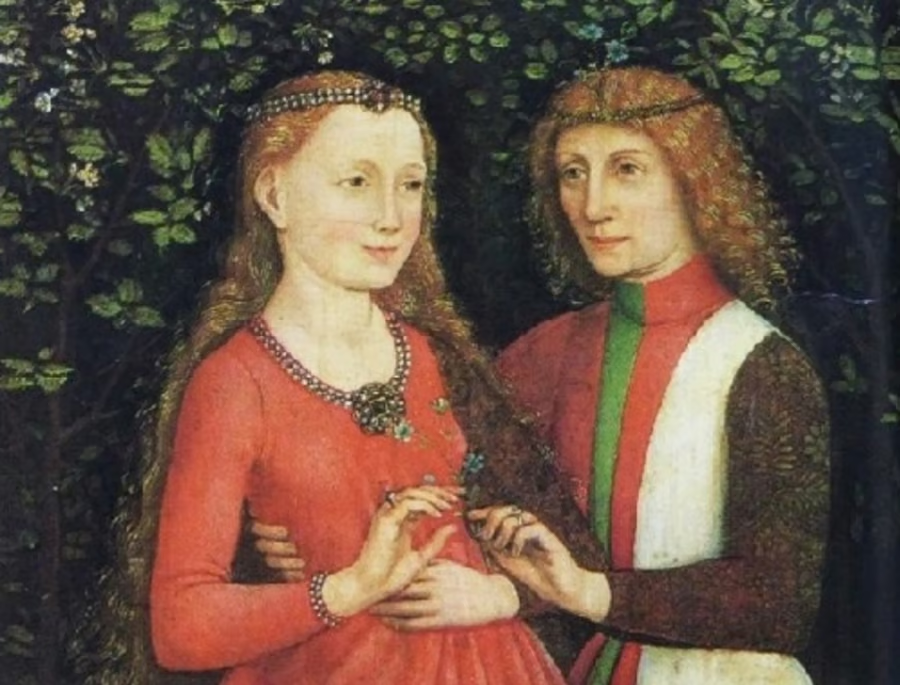
Straight from the procession, Maximilian headed to Ten Walle, the ducal palace. Having passed through a line of torches he for the very first time encountered his bride. The reception now followed Burgundian court protocol with long speeches, praising each other’s lineage and fecundity. And then we move into something our boy from Styria may not have expected. His intended mother in law told him that Marie had hidden a carnation close to her heart, the symbol of pure love and good luck. To which he may have responded, oh, yeah, cool. But then his mother-in-law insisted that he should go and get it. Question mark, question mark? Maximilian had, had girlfriends before, but he was not used to opening lady’s corsets in public. But that is exactly what the archbishop of Trier now suggested he did….There is a Netherlandish picture of Maximilian in the Kunsthistorische Museum that shows him as a young man, holding a carnation , and frankly, looking utterly bewildered.

They got married the next day in a, by Burgundian standards, modest ceremony. The ongoing war, impending famine and the mourning period for Charles the Bold prevented a full display of the splendour of the greatest of the late medieval courts.
But that was not necessary, because these two, Maximilian and Marie hit it off like we have never seen before in a princely wedding. Maximilian wrote back to his friend, Prüschenk, and forgive me if I do this in German, but it just works that much better, quote: Ich hab ein schöns, froms tugendhafftigs Weib,….und dank Gott. Sie ist ..von leib klein, viel kleiner als die Rosina und schneweiss; ein pruns Haar, ein kleins Nasl, ein kleins heuptel und antlitz, praun undt grabe Augen gemischt, schön und lauter; dann das unter heutel an augen ist herdann gesenkt, gleich als sie geschlaffen hiet, doch es ist nit wohl zumerckhen. Der Mund ist etwas hoch doch rein und rot. Sonst vieler schöner Jungfrauen alls ich all miein tag einer gesehen hab, und frölich“ end quote.

I would like to translate that, but I can’t. Let’s just say that he describes all her little minor imperfections and then says that she is the most beautiful woman he has ever seen. And for all his life he will profess his love to her. She appears in all his pseudoautobiographies as the lady he aspires to be worthy of, he has her depicted as the virgin in his altarpieces, in portraits, forever young, forever beautiful.

But there was none of that detached admiration thing that runs through chivalric literature. She was smart, decisive, and in these first months after her father’s death had shown enormous resilience, so he trusted her judgement. They worked together, and they played together. Both of them were mad about hunting, tournaments, music and dancing. She would ride along chasing boar, stag, fox and cheer him on when he was jousting with an opponent, danced with him at the mummeries he so loved. They were made for each other, and within barely a year she gave birth to a son, Philipp, named after her grandfather and the founder of the Burgundian dynasty.

So, all was great. Tu Felix Austria, Nube. All of Burgundy is now gone to the Habsburgs, the road to an empire where the sun never sets is wide open.
Well, don’t we forget something here? Ah, the army that Maximilian was supposed to bring. Where is that? Well, nowhere to be seen. All he had brought were 1,200 men against Louis XI’s army of 20,000 well trained and well equipped forces. And Louis was not going to give up on Burgundy. He could not. As long as Burgundy exists, every French king is in mortal danger. The war will go on, and next week we will see whether Maximilian can do more than woo an heiress. I hope you will join us again.
And those of you who feel for poor Maximilian who had to bow his head in shame, admitting to his beloved wife that unfortunately, he does not have the money and the power that she had expected, remember, you can put him back in the saddle at least here on this podcast. You know where to go and you know what to do.