
Rothenburg ob der Tauber and the Ravensburger Grosse Handelsgesellschaft
Amongst the few perks the head of the General State Archives of Baden enjoyed were the occasional inspections of libraries across the country. It allowed for journeys away from the office and occasionally came with the invitation to dinner at the splendid castle or monastery.
And in 1911 few could rival with the honor of being invited to Schloss Salem, the home of Prinz Max von Baden, heir to the Grand Duchy. It is likely that Dr. Karl Obser – who held the post as head of the archives in that year – did enjoy his time in this stunning baroque abbot’s palace not far from lake Constance. But he was there not just for pleasure but also for work.
Though Salem had once been one of Southern Germany’s greatest Cistercian monasteries and had hence held a vast library and archives dating back to the 12th century, most of that material had long been shipped up to Karlsruhe. Therefore, expectations to find something exciting were modest.
But Dr. Obser was clearly a thorough archivist and left no shelf untouched or bookcase unopened. In an attic room with a broken window, he came across a drawer that must have been left open a long time ago as it had become home to a family, most likely to generations of families, of sparrows. Still Dr. Obser saw a few sheets of paper underneath the nest and investigated.
What he discovered were 1,825 sheets of paper holding the accounts of the Great Ravensburg Trading Company from 1450 to 1526. He had stumbled upon the most significant documentation of late medieval trading in the Free Imperial cities ever found.
The Great Ravensburg Trading Company was the largest single firm in Germany before the houses of Fugger and Welser reached their peak in the 16th century. Its accounts are a unique window into the way long distance merchants operated in this period, what wares they traded and what they thought was acceptable and what was unacceptable behavior.
This as well as the story of Heinrich Toppler, the dominant politician of Rothenburg ob der Tauber is what we are going to look into in this episode.

A narrative history of the German people from the Middle Ages to Reunification in 1991. Episodes are 25-35 min long and drop on Thursday mornings.
“A great many things keep happening, some good, some bad”. Gregory of Tours (539-594)
HotGPod is now entering its 9th season. So far we have covered:
Ottonian Emperors (# 1- 21)
– Henry the Fowler (#1)
– Otto I (#2-8)
– Otto II (#9-11)
– Otto II (#11-14)
– Henry II (#15-17)
– Germany in 1000 (#18-21)
Salian Emperors(#22-42)
– Konrad II (#22- 25)
– Henry III (#26-29)
– Henry IV/Canossa (#30-39)
– Henry V (#40-42)
– Concordat of Worms (#42)
Early Hohenstaufen (#43-69)
– Lothar III (#43-46)
– Konrad III (#47-49)
– Frederick Barbarossa (#50-69)
Late Hohenstaufen (#70-94)
– Henry VI (#70-72)
– Philipp of Swabia (#73-74)
– Otto IV (#74-75)
– Frederick II (#75-90)
– Epilogue (#91-94)
Eastern Expansion (#95-108)
The Hanseatic League (#109-127)
The Teutonic Knights (#128-137)
The Interregnum and the early Habsburgs (#138 ff
– Rudolf von Habsburg (#139-141)
– Adolf von Nassau (#142)
– Albrecht von Habsburg (#143)
– Heinrich VII (#144-148)
– Ludwig the Bavarian (#149-153)
– Karl IV (#154-163)
The Reformation before the Reformation
– Wenceslaus the Lazy (#165)
– The Western Schism (#166/167)
– The Ottomans (#168)
– Sigismund (#169-#184
The Empire in the 15th Century
– Mainz & Hessen #186
– Printing #187-#188
– Universities #190
– Wittelsbachs #189, #196-#199
– Baden, Wuerrtemberg, Augsburg, Fugger (#191-195)
– Maps & Arms (#201-#202)
The Fall and Rise of the House of Habsburg
– Early habsburgs (#203-#207)
– Albrecht II (#208)
-Freidrich III (#209-
Ravensburg, and you are very much forgiven if you cannot place it on the map, is today a town of 50,000 in the far south eastern corner of Baden-Württemberg between Friedrichshafen, home of the Zeppelins, and the city of Ulm and its majestic church tower.
If you have heard of it, it may be because of Ravensburger, the publisher of puzzles and boardgames, but you would not have associated it with any great mercantile or commercial activity.
Nevertheless, in the 15th century it housed the headquarters of a company that held a near monopoly in the trade between Spain and the empire and in certain wares, namely linen and a special cloth variously called barchent, bombast or fustian.
Before we get into Ravensburger and the Grosse Handelsgesellschaft, we need to put the whole region into the context of the free imperial cities of the 15th century.
Trading routes of the HABW_11_03_Ravensburger_Handelsgesellschaft.jpg (4957×3535)
The music for the show is Flute Sonata in E-flat major, H.545 by Carl Phillip Emmanuel Bach (or some claim it as BWV 1031 Johann Sebastian Bach) performed and arranged by Michel Rondeau under Common Creative Licence 3.0.
As always:
Homepage with maps, photos, transcripts and blog: www.historyofthegermans.com
If you wish to support the show go to: Support • History of the Germans Podcast
Facebook: @HOTGPod
Threads: @history_of_the_germans_podcast
Bluesky: @hotgpod.bsky.social
Instagram: history_of_the_germans
Twitter: @germanshistory
To make it easier for you to share the podcast, I have created separate playlists for some of the seasons that are set up as individual podcasts. they have the exact same episodes as in the History of the Germans, but they may be a helpful device for those who want to concentrate on only one season.
So far I have:
Salian Emperors and Investiture Controversy
Fredrick Barbarossa and Early Hohenstaufen

Transcript
Hello and welcome to the History of the Germans: Episode 193: The Trade and Tribulations of the Free Imperial Cities, which is also episode 9 of Season 10: The Empire in the 15th century.
Amongst the few perks the head of the General State Archives of Baden enjoyed were the occasional inspections of libraries across the country. It allowed for journeys away from the office and occasionally came with the invitation to dinner at the splendid castle or monastery.
And in 1911 few could rival with the honor of being invited to Schloss Salem, the home of Prinz Max von Baden, heir to the Grand Duchy. It is likely that Dr. Karl Obser – who held the post as head of the archives in that year – did enjoy his time in this stunning baroque abbot’s palace not far from lake Constance. But he was there not just for pleasure but also for work.
Though Salem had once been one of Southern Germany’s greatest Cistercian monasteries and had hence held a vast library and archives dating back to the 12th century, most of that material had long been shipped up to Karlsruhe. Therefore, expectations to find something exciting were modest.
But Dr. Obser was clearly a thorough archivist and left no shelf untouched or bookcase unopened. In an attic room with a broken window, he came across a drawer that must have been left open a long time ago as it had become home to a family, most likely to generations of families, of sparrows. Still Dr. Obser saw a few sheets of paper underneath the nest and investigated.
What he discovered were 1,825 sheets of paper holding the accounts of the Great Ravensburg Trading Company from 1450 to 1526. He had stumbled upon the most significant documentation of late medieval trading in the Free Imperial cities ever found.
The Great Ravensburg Trading Company was the largest single firm in Germany before the houses of Fugger and Welser reached their peak in the 16th century. Its accounts are a unique window into the way long distance merchants operated in this period, what wares they traded and what they thought was acceptable and what was unacceptable behavior.
This as well as the story of Heinrich Toppler, the dominant politician of Rothenburg ob der Tauber is what we are going to look into in this episode.
But before we start – ah, no, today I cannot be bothered. You already know how and why to help the show on historyofthegermans.com/support. So all I want to do is celebrate those amongst you who have already taken the plunge, namely: Edgars Z, Georg W.(D), Ben G., Paul M., Oblomov, Wade S., Tracy M. and from the other side of the galaxy, Lord Vader.
Ravensburg, and you are very much forgiven if you cannot place it on the map, is today a town of 50,000 in the far southeastern corner of Baden-Württemberg between Friedrichshafen, home of the Zeppelins, and the city of Ulm and its majestic church tower. If you have heard of it, it may be because of Ravensburger, the publisher of puzzles and boardgames, but you would not have associated it with any great mercantile or commercial activity.
Nevertheless, in the 15th century it housed the headquarters of a company that held a near monopoly in the trade between Spain and the empire and in certain wares, namely linen and a special cloth variously called barchent, bombast or fustian.
Before we get into Ravensburger and the Grosse Handelsgesellschaft, we need to put the whole region into the context of the free imperial cities of the 15th century.
Most people associate the idea of free imperial cities with Hamburg, Bremen, Lübeck, maybe Cologne, Frankfurt and Nürnberg. These were indeed free cities, but they are geographical outliers. There were hardly any north of the Main River. Few of the Hanse cities were free and imperial cities, in part because they weren’t in the empire, like Danzig, Riga or Reval, or because they were never given immediacy, like Stralsund, Wismar and Rostock.

In actual fact the highest concentration of free imperial cities was in a corridor from Nürnberg to Lindau and then from Rottweil to Heilbronn. These include places that epitomize the idea of the German medieval towns, like Rothernburg ob der Tauber, Dinkelsbühl, Nördlingen, Schwäbisch Hall, Schwäbisch Gmünd, Memmingen, Kaufbeuren, Kempten, Lindau and Ravensburg. The largest amongst them were Nürnberg, Augsburg and Ulm, with Regensburg being the easternmost outpost and Strasbourg and Offenburg the ones furthest West.

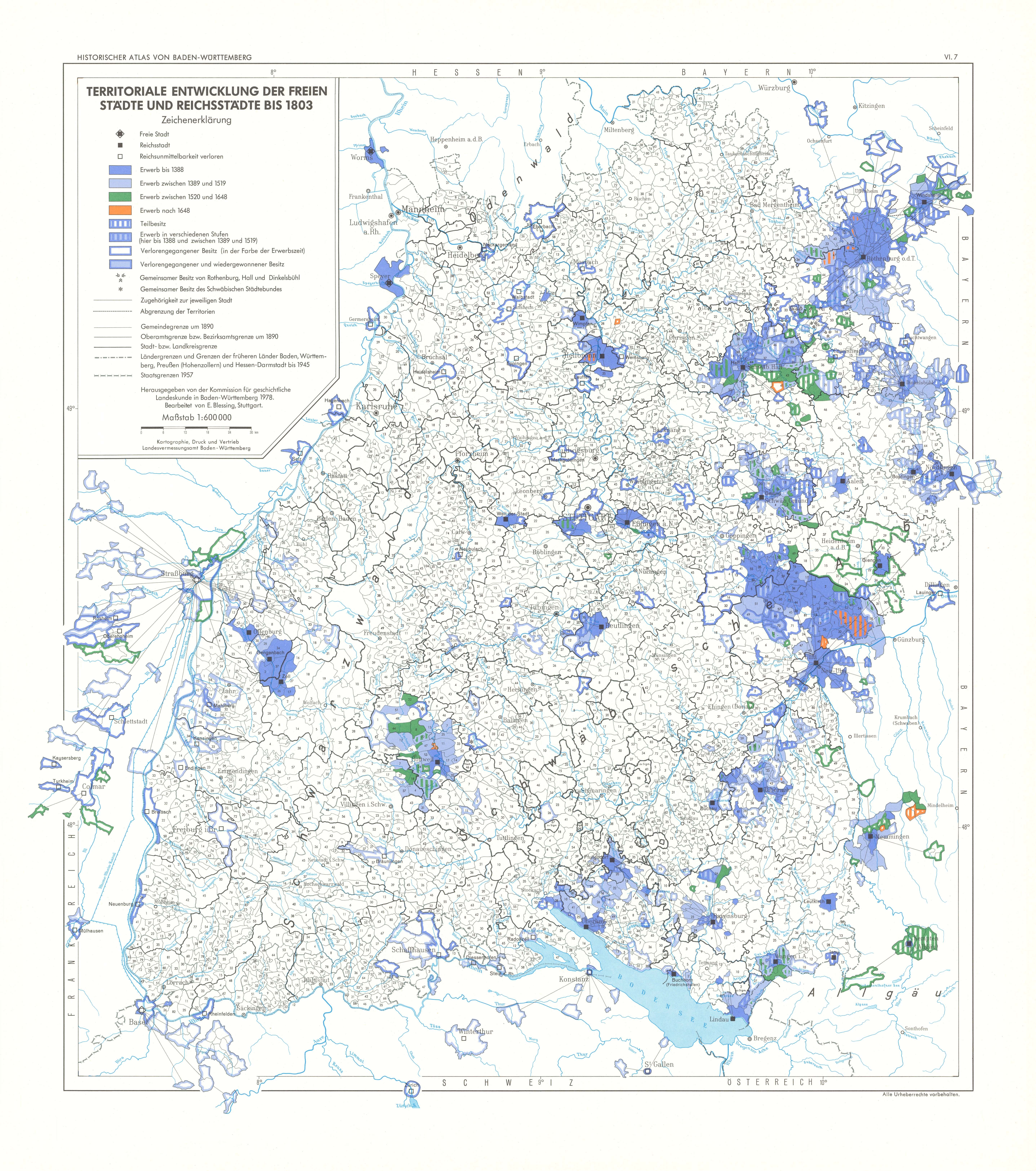
Which begs the question, why are they all concentrated in this area?
That goes back, again, to the Hohenstaufen. Many of these places, like for instance Rothernburg ob der Tauber, Nürnberg, Dinkelsbühl, Schwäbisch Hall and Schwäbisch Gmund were founded by the early Hohenstaufen as a line of defence for their duchy of Swabia against the House of Welf. If you want to catch up on that conflict, go back to episodes 45 following, the reign of Konrad III.

When the Welf lost their possessions in Swabia and Bavaria, the military significance of these places for the imperial dynasty diminished. Still these foundations enjoyed sponsorship by the Hohenstaufen, turning into the economic heartland of their territory. For instance Schwäbisch Hall became one of the biggest financial contributors thanks to the salt brine that poured out of the local sources. This saline solution had a concentration of 4 to 8%, making it the largest and most effective source of salt in the region. The city also specialised in minting the Heller, one of the smallest coins, worth half a Pfennig. A German expression to say that someone had paid his dues in full, is “Auf Heller und Pfennig” = all down to the smallest fraction.

Politically these cities were tossed into an interesting situation when the Hohenstaufen fell between 1250 and 1268. They had been founded or controlled by the imperial family, either in their function as emperors or in their function as duke of Swabia. With the duchy of Swabia having disappeared, they had only one feudal overlord left, the emperor. Which made them de facto free imperial cities, though the formal recognition happened sometime between the reigns of Rudolf von Habsburg and Ludwig the Bavarian.
Another inheritance from the Hohenstaufen period were the elites, the patricians. They were in the main descendants of the ministeriales, the serf knights that made up the garrisons of the castles. Their ranks were occasionally refreshed by new arrivals either poor people climbing the ladder or by patricians from other cities moving across. These patricians socialised in their own drinking halls and religious confraternities. Membership in those often granted access to the city council and facilitated shared commercial endeavours. Over time many patricians abandoned mercantile activity and lived the life of minor nobility, including the castles, the jousting and the ostentatious clothing.
Below them ranked the artisans. They ranged from very wealthy, specialised trades which served high class customers like gold and silversmiths, spice and wine merchants, sword makers and miners at the top and the weavers usually at the bottom. The more common crafts in the middle like smiths, tanners, butchers, dyers, tailors, bakers, carpenters, clothmakers, retailer and saddlers, they often formed guilds to promote their interests. In some places, the patricians prevented them from organising themselves, because guilds tended to demand involvement in city politics, which often ended up in bloody conflicts.
Being a free imperial city is nice, because it means you are effectively free to do what you want, without having to deal with a territorial prince. But it is also a dangerous position to be in, because the institution that is supposed to protect you and that you pay some taxes to, the empire, is often unable to provide defence against rapacious dukes and bishops.
I guess that many of you will at some point visit Rothenburg ob der Tauber, and if you have not put it on your list, you should. It is the mother of all cute half-timbered cities in Germany, its Plönlein house making twice daily appearances on social media and its city wall still forming the outer perimeter of the place.

But in the 14th and 15th century, Rothenburg was anything but cute, nor were their elites or neighbours.
The dominant figure in the city’s history was Heinrich Toppler. If you drive up to Rothenburg, you may come past the Topplerschlösschen, arguably the first summer house built by a commoner since the days of ancient Rome.

Toppler had been mayor of Rothenburg between 1373 and 1407, though not continuously since the constitution of the city limited terms to one year and prohibited contiguous terms, like the consuls in ancient Rome.
It is not quite clear how Toppler became immensely rich. He was born to a relatively new family, his grandfather had come into town from the countryside and made some money trading in cattle and pork, enough to buy a house in the best neighbourhood. Heinrich’s father was admitted to the city council and Heinrich himself joined him there with his brother and brother-in-law sometime in the 1370s.
In 1380 he married Barbara Wernitzer, the sole child of the then richest man in town. He clearly invested this money wisely. His fortune increased from 2,000 gulden in 1370 to 31,000 gulden in 1407. But what exactly he did is a bit unclear. The debt register of the city of Rothenburg mentions only small debts owed to him. That suggests for one, that he wasn’t a banker and secondly, that his mercantile activity too was limited. Otherwise, he would have owed or owned a lot more trading debt.
He seemingly focused on real estate, of which he accumulated vast quantities, sometimes out of bankruptcies at very moderate prices. All this took place during a time when the city of Rothenburg was expanding its territorial footprint dramatically. Not through military conquest but usually by acquisition. Local nobles who had fallen on hard times sold lands and rights to the city to pay back loans or other debts. To what extent the astute patricians outsmarted the local nobles in their financial dealings in order to acquire their lands is up to speculation. But what is not up to speculation is that by 1480 the city had built a 62 km long border defence around their 350 square km territory. This defence consisted of three walls and two ditches; the walls being constructed mainly of impenetrable hedges. There were nine towers where travellers could enter the protected lands of Rothenburg after having paid their dues and had their wares inspected.

Given Toppler was mayor during the time and the engine behind the territorial expansion, it is not unfair to assume that he picked some of the juiciest pieces for himself. Though we would today regard such behaviour as illegal, it was not part of the accusations levelled at him later in life, and they put all sorts of things to him.
Toppler was not only the main administrator of Rothenburg in this period, he was also its main military commander and diplomat. And this time, the 14th and 15th century, was turbulent for most of these cities. The local princes were on the rise, trying to gobble up smaller cities, like the counts of Wurttemberg did as we heard in last week’s episode. At the same time the nobles, former vassals and ministeriales of the Hohenstaufen were reeling from the aftereffects of the Black Death that had undermined their financial viability. Some turned to banditry, some became mercenaries and others joined knightly associations. These associations, like the St. Jörgenschild, became regional powers.
To deal with these threats, Toppler negotiated the participation of Rothenburg in the Schwäbische Städtebund, the league of Swabian cities. City leagues had been explicitly prohibited by the Golden Bull but nevertheless formed at regular intervals as cities pulled together to push back the princes and the knightly associations.
Toppler established a particularly close relationship with king Wenceslaus the Lazy who turned from a foe of the cities to its champion. Episodes 163 and 165. Thanks to Toppler’s astute management of affairs, Rothenburg and the bund itself managed to avoid severe repercussions following the defeat at the battle of Döffingen in 1388, which Toppler had participated in.
Shortly after King Wenceslaus the Lazy was deposed in 1400, Toppler went into retirement. His relationship with the new king, Rupprecht of the Palatinate was not what he had with Wenceslaus.
In that period, he began forming a broader network into the other cities in the area. After his first wife had passed away, he married a lady from nearby Nördlingen in 1392, who was in turn related to several important patricians in Donauwörth, Augsburg and Munich. In 1405 he married his son and his daughter into two of the major families of Nürnberg.

During Toppler’s absence from the levers of power, Rothenburg ran into politically hot water. By 1406 the Swabian League, that alliance of mutual support amongst the cities had largely been dissolved. Rothenburg as one of the northern cities was most at risk from its two neighbours, the Hohenzollern Burggrafen of Nürnberg and the prince bishop of Würzburg. Both disliked the territorial expansion of Rothenburg and just generally would have liked to gobble up the wealthy city.
Rothenburg had so far managed to play these two adversaries out against each other, but that game came to an end in 1406. The Burgraf provoked the city by citing it before his own imperial court in Nürnberg. Rothenburg rejected the authority of the court of the Burggraf and in return cited the Burggraf in front of their own lawcourts. Result: happy lawyer, anxious citizens. King Ruprecht of the Palatinate who had the say in such matters sided with the Burggraf and threatened to put the city under the imperial ban.
At which point the city council called Toppler back in the hope he could resolve the situation. Toppler did two things. One was that he prepared for the now likely military confrontation. He ordered provisions to be brought into town and reinforced the city fortifications. And then he tried to find allies. Finding those amongst the various largely defunct city alliances prove difficult. So in his despair, he sent his brother as a delegate to king Wenceslaus, the deposed king, in the hope of getting some help from there. Wenceslaus had been trying to get back onto his throne for a while, had found some supporters, but as we know from the previous season on the Reformation before the Reformation, his personal failings, aka the constant boozing, and his weak hold over Bohemia made all these ideas just pie in the sky. But pie in the sky was all the only sustenance Toppler could muster.
On July 17th, 1407, the Burgraf, who had agreed some sort of profit sharing with the Bishop of Würzburg, attacked Rothenburg. He broke through the fortifications that surrounded the territory and captured the outlying castles. But when he got to the city, the inhabitants were forewarned. As we mentioned many times before, capturing a city before firearms were invented, worked either by surprise, or required a long siege, starving out the defenders. Thanks to Toppler’s foresight, the city was ready for the onslaught and well provisioned.

That dawned on the Burggraf, and he was willing to negotiate. 6 weeks after his invasion the two side signed a ceasefire. The ceasefire left Rothenburg with a number of onerous obligations. However, the peace agreement signed 4 months later after mitigation by king Ruprecht was a lot more favourable to the city. The Burggraf was not given any money to cover the cost of his army which left him in financial difficulty. The city and was released from the imperial ban but had to bear the destruction of its castles, lands, and crops. So, just a big waste of money, with a side dish of famine.
But there seem to have been some side agreement. Because seven weeks after the peace treaty Heinrich Toppler was thrown in jail. There was a trial, though we have no documentation of what he was explicitly accused of. His enemies had captured three letter that proved that he had negotiated with king Wenceslaus, which could be seen as high treason against king Ruprecht of the Palatinate. There may have been other accusations, such as that he was trying to make himself a dominus, a dictator of the city. There is a legend that he gambled with the Burgraf over ownership of the city, an idea that come from his coat of arms that showed two dice.
And in a totally uncorrelated sequence of events, the city received an imperial court order that Toppler’s massive fortune was to be handed over to the king, a king they called Ruprecht of the empty pocket behind his back,
On an unknown day Heinrich Toppler died in prison, either decapitated or simply left to die of thirst. His body was brought to the church of St. Jakob where he was buried in the chapel he had built for his family. Having had premonitions that things may go badly, he had sent most of his moveable fortune to his children in Nürnberg. His descendants survived the purge and established families that thrived well into the 17th century, not in Rothenburg though, but in Nürnberg. His summer house, the Topplerschlösschen passed through several patrician families in Rothenburg and is still in private ownership, but it can be visited.

What we can take from this story are several things. One, that these patrician elites across these free imperial cities were often connected through links of marriage. And that families occasionally moved from one place to another, acquiring citizenship and standing fairly quickly. That not all patricians were merchants, in fact many lived lives as warriors and diplomats rather than as traders. And finally, that politics were cutthroat, leaving even the most competent of mayor’s dead in a cell, when political exigencies required it.
Which now gets up to the main topic of today’s episode, the Grosse Ravensburger Handelsgesellschaft.
Ravensburg as mentioned earlier lay at the southernmost end of this corridor of free imperial cities established by the Hohenstaufen. And it was not even a Hohenstaufen foundation. Ravensburg was established by the Hohenstaufen’s enemies, the House of Welf. But when Welf VI made Frederic Barbarossa his heir, Ravensburg, like all of his Swabian property passed to the imperial family and when they fell, became a free imperial city.

But then, as now, Ravensburg was a much smaller place then Constance or Ulm, and a less advantageously located one to boot. Constance lay at the connection between the upper and the lower lake where a bridge crossed over into Switzerland, the only bridge for a long way in either direction. Ulm was the last navigable point on the Danube, making it the ideal stopping off point for an East-west trade all the way to Hungary. Ravensburg lay inland on one of the many trade routes in the region, not exactly the obvious choice for the by far largest trading firm in the whole of the German lands.

The year of foundation for the company is usually given as the year 1380. However, the reality is more likely a gradual transition rather than a one-time agreement.
At the heart of the early phase are three individuals, Henggi Humpis who was from Ravensburg originally, Rudolf Mötteli from Buchhorn, modern day Friedrichshafen on the lake Constance and Lütfried Muntprat from Constance. The Mötteli family acquired Ravensburger citizenship in 1375, whilst the Muntprat came in no earlier than 1411.
All three families had been trading for a long time before they joined forces. They benefitted from the main trading routes of the region, of which there were basically four main ones.
The first was the transalpine route across the Gotthard, Simplon and Splügen passes to Milan and from there to the main Mediterranean ports of Genoa and Venice. Then there was a land route west via Constance, Zurich, Berne, Geneva, Lyon and from there into southern France or Spain. An eastern route followed the Danube from Ulm, all the way to Vienna and Hungary. And finally, there was the Northern route to Frankfurt, Cologne, Antwerp and Bruges.

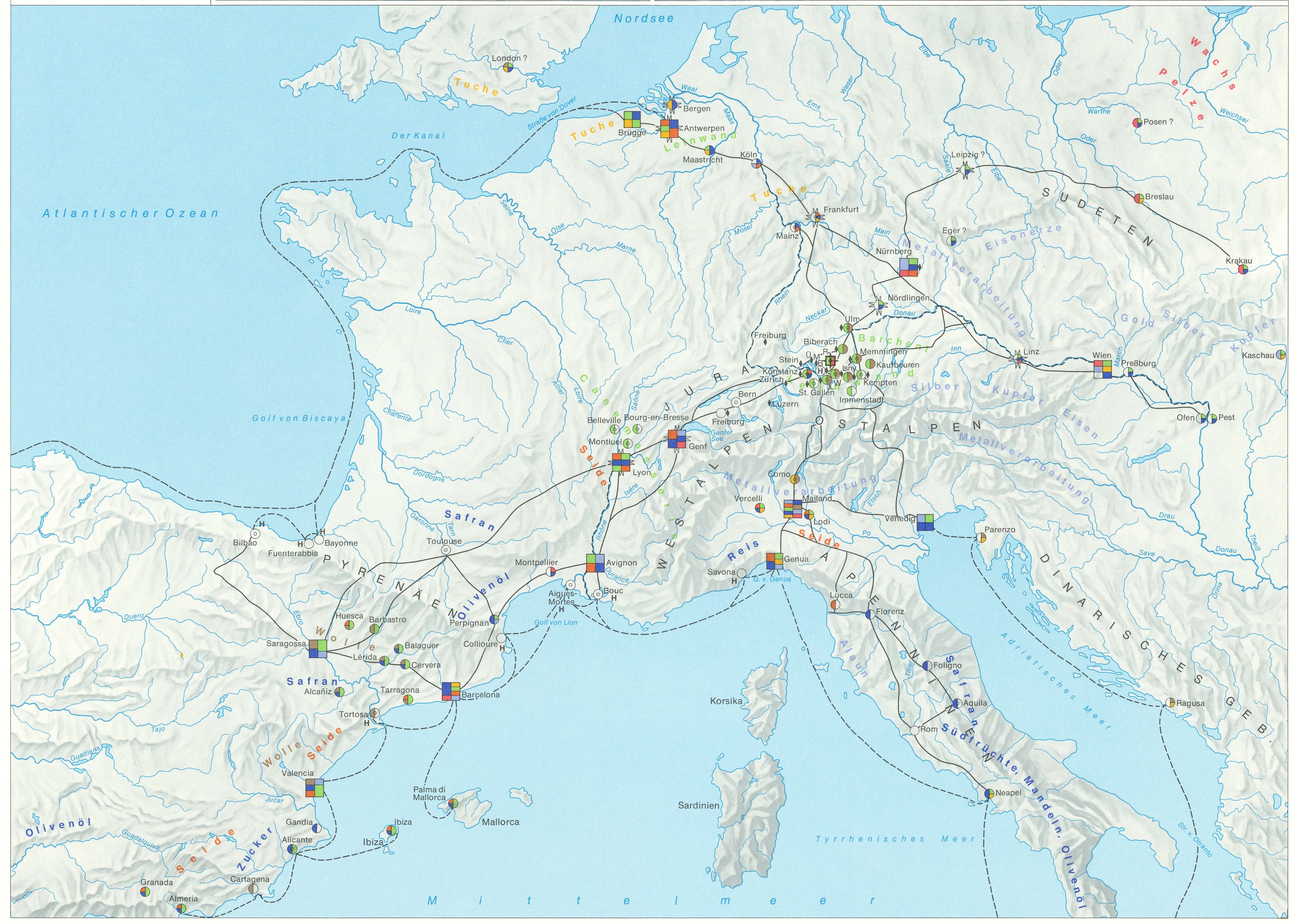
The challenge for these trading houses was the same we encountered in our discussion about the Hanseatic League. Merchants who wanted to scale up could no longer travel with their merchandise as had been the case in the early Middle Ages. They stayed at home in their counting houses and kept an eye on the wares that flowed back and forth across their network of correspondents and clients. And once that is the business model, two things matter more than anything else, trust and information.
Merchants need to know what goods are in demand at the destination and what prices are at the point where they want to procure them. And they need to trust the people who act on their behalf, the apprentices or shippers who travel with the goods and the agents who buy or sell the goods on their behalf.
In the Hanse system, this problem was solved through an elaborate surveillance operation. Each merchant would have several correspondent agents in each city that he or she would trade with. These correspondent agents would not only keep an eye on the market, but also on the behaviour of the other correspondents. That way a merchant would know fairly quickly if say the creditworthiness or honesty of one of his agents was placed in doubt. And the higher a merchant rose within their city, the more access he would gain to information. As a member of the city council, he would hear about the state of negotiations with kings and princes, where pirate activity was most intense and what would be done about it etc. And finally, long standing relationships, intermarriage and the fact that Hanse traders all spoke Low German created trust between the participants in that network.
The downside of that model is that it keeps the average size of the firms comparatively small. If every merchant has to split their orders amongst several agents to maintain the surveillance system, neither of these agents can become dominant. And vice versa. If you want to dig into this system and its underpinnings, check out the season on the Hanseatic League, specifically episodes 119 and 120.
The southern German trading system was built on a very different model, a model developed earlier in Italy. The great Italian firms relied heavily on networks of agents employed directly by the firm, and most often members of the family. These agents held a stake in the firm and were hence incentivised to procure accurate information and try to achieve the best possible prices.
The main constraints to this model were the number of family members and trustworthy business partners one could recruit. That is likely one of the reasons the three firms of Humpis, Mötteli and Muntprat joined forces in Ravensburg in the early 15th century. They all had been extremely successful merchants, but growth has hit a wall as they had run out of individuals they could send out as their representatives. By pooling their resources, they could establish a much larger network of agents than they could set up individually. Another key benefit was that the combination reduced competition, increased pricing power with suppliers and customers and reduced risk.
This was a real company, meaning the partners would put in capital in the form of cash or wares and would in return receive dividends proportionally to their share of the capital. Membership quickly expanded beyond the three families, bringing in roughly 40 to 90 further usually smaller partners. They came from all over the place, from Wangen, Isny, Lindau, Memmingen, Costance, Biberach, Ulm, Nördlingen, Freiburg and Fribourg as well as Lucerne. Most partners were active in the company, often as agents abroad. They would get their expenses covered and received an additional bonus based on their trading performance.
The company would do a full account of the books every three years to determine the dividend payments and bonuses. This happened under the supervision of the three regents, effectively the management board. This is again a difference with the Hanse, where the accounts were only done once, upon the death or bankruptcy of the merchant.
One of the regents tended to be in Ravensburg at the headquarters on Marktsrasse 59 where the books were kept, whilst the other two were travelling, inspecting the counting houses or accompanying particularly valuable shipments.
Which gets to the question, why did they choose Ravensburg instead of the much larger and better positioned Konstanz where the Muntprat family came from. The answer lies most likely in the more stable political situation. Following the great Church Council that had lasted 4 years from 1414 to 1418, Constance experienced a prolonged period of internal conflict between patricians and artisans and between the major families. Ravensburg had found a more stable balance between patricians and artisan interests that kept disruptions to a minimum.
In terms of trading goods, one of the key products were textiles, namely linen and what is called barchent or fustian. Linnen is made from flax, which grew all over the area north of lake Constance. Barchent as it is called in German or fustion as it is known in England was a heavy, hard-wearing cloth made with a cotton weft and a linen warp. Meaning that on a loom, the vertical yarn is made from linen and the horizontal yarn that is the one that travels back and forth, is made from cotton. The advantage of that technique is that fustian was hard wearing and at the same time more flexible than pure linen. And we still wear a type of fustian, which we call Denim.
In other word, this was not a top end luxury product, but a very useful one, specifically for the working classes from Flanders to Saragossa. Another advantage was that it could be produced on small looms by peasants during the winter months, providing them with an extra income.
I have not found an analysis of how well this was working out for the peasants making the Fustian or linen. But historically this kind of piece work was a form of pretty merciless exploitation. And given that in case of the fustian, the buyers were also delivering the cotton, the labourers were almost completely dependent upon these merchants.
So, margins in this business must have been pretty good. What further helped margins was that in some markets, like for example Barcelona and Saragossa the Ravensburgers gained a monopoly on these kinds of textiles. But shipping it all the way to Flanders and Hungary where they had competition seemed to have worked as well. The Handelsgesellschaft established strict quality controls for their textiles that ranked the product into three levels and were marked with one, two or three crowns.
The other export from Ravensburg was paper. One of Germany’s earliest paper mills opened in 1407 and was again held to high quality standards, making it popular and competitive with the Italian luxury paper Gutenberg had insisted upon.
The return shipments concentrated more on luxury items, for example from Spain silk, rabbit furs, wool, pearls, coral, olive oil, almonds, dates, figs, raisins, cumin, wine, indigo, and very importantly sugar and saffron. Sugar, usually purchased in Spain and Saffron from Spain and Aquilea in Italy became one of the hallmarks of the Ravensburger Gesellschaft. Again, their seal of quality was widely recognized and commanded a significant premium.
At some point they even opened a sugar factory near Valencia. In Italy they again bought spices and fruits, but also weapons, nails and other metalwork, which Milan was particularly famous for. On their returns from Flanders, they brought the fine woolen cloth that was in demand all across Europe. And they participated in the great local trades, the copper, tin, pots and pans from Nürnberg and Bohemia and they went to the fairs of Nördlingen and Frankfurt.
Their trade was not just operating on a hub and spoke basis. They would ship Spanish products directly to Cologne or Antwerp and buy textiles in Bourg-en-Bresse for sale in Spain.
It was a truly pan-European operation on a scale few northern trading houses could compete with. There is again a map of their trading network on this episode’s webpage, the link to which you find in the show notes. It made its partners, in particular the three founding families immensely rich. To put that into context. Heinrich Toppler at his peak was worth about 31,000 gulden. The Möttelins capital in the society was 150,000 gulden, the Humpis brought in 131,000 gulden and the next one down had 100,000, so the company as a whole accounted for many multiples of what the King of Rothenburg possessed.
Which gets us to the question why the company ultimately dissolved in 1530. As always, there are many reasons.
One was that after the death of one of the founders, Henggi Humpis, several members fought over the post of regent, the board membership. And this was not a polite fight with occasional harsh words, this could get physical with attempted kidnappings and incarcerations of the clients of the other side.
But by that time several original members, including the extremely wealthy Mötteli family had already left the company. They had disagreed on strategy in Spain and went to St. Gall where they founded a new organisation. Meanwhile competitors like the Diesbach-Watt families and later the Vohlin-Welser from Memmingen competed aggressively. In 1477 another group of Partners left to set up their own shop that became known as la Chiqua, the little Ravensburger Company.
Another fatal blow came with the shift in trading patterns during the age of exploration. Vasco Da Gama found a way to India, disturbing the route spices moved and after Columbus sugar production moved to the Caribbean.
But the true weakness was the inherent conservatism. The Great Ravensburg Trading Company was very much still a medieval institution. When one of their associates opened a printing press in Saragossa, the first in Spain, some of the partners objected to the point that they left. And the company observed the strict ban on usury the church still insisted upon. That barred them from any outright banking activities except for money transfer and letters of credit. When the Fugger and Welser with their willingness to fund the great princes and emperors and their expansion into the new world come on to the scene, the Ravensburger stood no chance.
In around 1530 the Great Ravensburg Trading Company appears to have ceased to operate. Some of the founding families kept staying in trading, but mostly they turned into landed gentry, having converted their mercantile wealth into castles and manor houses.
Which begs the question, how come the accounts of the society were found covered in bird droppings in the home of Prinz Max von Baden in 1911. As it happened, the last accountant of the company did take all the old account books with him when he shut up shop on Marktsrasse 59 in Ravensburg. He kept them at home, probably out of sentimentality, something his son and grandson shared. At least to the point that when said grandson joined the Cistercians at the great monastery of Salem, he took the papers along and deposited them in the monastery archives. There they were registered as “useless old trading documents” and put into a drawer in a dark corner. And when that drawer was opened by accident or on purpose, the swallows moved in. And thanks to their care, we now have this extraordinarily detailed account of a late medieval trading operation, a truly unique document.
In the faint hope that this podcast will not end up in a dusty corner of the internet, covered in AI bird droppings, I would appreciate any help you can give the show. That does not necessarily mean financially by going to historyofthegermans.com/support, but also by leaving a review, a comment on social media or Spotify, YouTube or whatever you can think of could bring in new listeners.
See you again next week when we may or may not talk about the richest or maybe not the richest man who ever lived.
I am enjoying the podcast Dirk. I linked to this episode in a our economics blog (that supports our textbook) at . I hope it generates more listeners for you.
Thank you so much – these are the things that really work!