
Three components that make a territory in the HRE successful
The counts, dukes and ultimately kings of Württemberg had risen to the top by winning the genetic lottery. Their eldest sons tended to be competent, some even extremely so, their wives brought in dowries and sometimes entire counties, and they ruled for long enough that the next generation took over when they were ready.
But all that falls apart in the 15th century. They are suddenly afflicted with the disease of dynasties; states being inherited by babies and buffoons, some of them managing to be both. That would normally be the death nail for a noble House, but not this time.
The Landtag, the Estates of Württemberg step in to protect the fledgling state, deposing buffoons when necessary and ruling on behalf of the babies. This is one of the lesser known and even more extraordinary political histories in europe and well worth listening to.
And as a bonus we also investigate why the region around Stuttgart, Mannheim, Karlsruhe and Freiburg has become a hub of technology and precision engineering, an area where there was no coal, no mining or any other natural advantage – except for the wine – no seriously, it was the wine.

A narrative history of the German people from the Middle Ages to Reunification in 1991. Episodes are 25-35 min long and drop on Thursday mornings.
“A great many things keep happening, some good, some bad”. Gregory of Tours (539-594)
HotGPod is now entering its 9th season. So far we have covered:
Ottonian Emperors (# 1- 21)
– Henry the Fowler (#1)
– Otto I (#2-8)
– Otto II (#9-11)
– Otto II (#11-14)
– Henry II (#15-17)
– Germany in 1000 (#18-21)
Salian Emperors(#22-42)
– Konrad II (#22- 25)
– Henry III (#26-29)
– Henry IV/Canossa (#30-39)
– Henry V (#40-42)
– Concordat of Worms (#42)
Early Hohenstaufen (#43-69)
– Lothar III (#43-46)
– Konrad III (#47-49)
– Frederick Barbarossa (#50-69)
Late Hohenstaufen (#70-94)
– Henry VI (#70-72)
– Philipp of Swabia (#73-74)
– Otto IV (#74-75)
– Frederick II (#75-90)
– Epilogue (#91-94)
Eastern Expansion (#95-108)
The Hanseatic League (#109-127)
The Teutonic Knights (#128-137)
The Interregnum and the early Habsburgs (#138 ff
– Rudolf von Habsburg (#139-141)
– Adolf von Nassau (#142)
– Albrecht von Habsburg (#143)
– Heinrich VII (#144-148)
– Ludwig the Bavarian (#149-153)
– Karl IV (#154-163)
The Reformation before the Reformation
– Wenceslaus the Lazy (#165)
– The Western Schism (#166/167)
– The Ottomans (#168)
– Sigismund (#169-#184
The Empire in the 15th Century
– Mainz & Hessen #186
– Printing #187-#188
– Universities #190
– Wittelsbachs #189, #196-#199
– Baden, Wuerrtemberg, Augsburg, Fugger (#191-195)
– Maps & Arms (#201-#202)
The Fall and Rise of the House of Habsburg
– Early habsburgs (#203-#207)
– Albrecht II (#208)
-Freidrich III (#209-
The counts, dukes and ultimately kings of Württemberg had risen to the top by winning the genetic lottery. Their eldest sons tended to be competent, some even extremely so, their wives brought in dowries and sometimes entire counties, and they ruled for long enough that the next generation took over when they were ready.
But all that falls apart in the 15th century. They are suddenly afflicted with the disease of dynasties, states inherited by babies and buffoons, some of them managing to be both. That would normally be the death nail for a noble House, but not this time.
The Landtag, the Estates of Württemberg step in to protect the fledgling state, deposing buffoons when necessary and ruling on behalf of the babies. This is one of the lesser known and even more extraordinary political histories in europe and well worth listening to.
And as a bonus we also investigate why the regions around Stuttgart, Mannheim, Karlsruhe and Freiburg have become hubs of technology and precision engineering, an area where there was no coal, no mining or any other natural advantage – except for the wine – no seriously, it was the wine.
The music for the show is Flute Sonata in E-flat major, H.545 by Carl Phillip Emmanuel Bach (or some claim it as BWV 1031 Johann Sebastian Bach) performed and arranged by Michel Rondeau under Common Creative Licence 3.0.
As always:
Homepage with maps, photos, transcripts and blog: www.historyofthegermans.com
If you wish to support the show go to: Support • History of the Germans Podcast
Facebook: @HOTGPod
Threads: @history_of_the_germans_podcast
Bluesky: @hotgpod.bsky.social
Instagram: history_of_the_germans
Twitter: @germanshistory
To make it easier for you to share the podcast, I have created separate playlists for some of the seasons that are set up as individual podcasts. they have the exact same episodes as in the History of the Germans, but they may be a helpful device for those who want to concentrate on only one season.
So far I have:
Salian Emperors and Investiture Controversy
Fredrick Barbarossa and Early Hohenstaufen

Transcript
Hello and welcome to the History of the Germans: Episode 192: Württemberg, or How to Build a Success, which is also episode 8 of season 10 – the Empire in the 15th Century
The counts, dukes and ultimately kings of Württemberg had risen to the top by winning the genetic lottery. Their eldest sons tended to be competent, some even extremely so, their wives brought in dowries and sometimes entire counties, and they ruled for long enough that the next generation took over when they were ready.
But all that falls apart in the 15th century. They are suddenly afflicted with the disease of dynasties; states being inherited by babies and buffoons, some of them managing to be both. That would normally be the death nail for a noble House, but not this time.
The Landtag, the Estates of Württemberg step in to protect the fledgling state, deposing buffoons when necessary and ruling on behalf of the babies. This is one of the lesser known and even more extraordinary political histories in europe and well worth listening to.
And as a bonus we also investigate why the region around Stuttgart, Mannheim, Karlsruhe and Freiburg has become a hub of technology and precision engineering, an area where there was no coal, no mining or any other natural advantage – except for the wine – no seriously, it was the wine.
But before we start let me uncork a Nebuchadnezzar of gratitude for all the patrons who keep this show on the road by signing up on historyoftyhegermans.com/support. And specifically I want to thank: Christian Wencel, Carrie, Jakob of the CrookedShade with a big apology for the delayed response to his super-nice message, Andreas, Lin, Stuart Eaves and Kurt who have already signed up.
And then I wanted to point you to another independent history podcast. Daniele Bolelli’s History on Fire has been around for neigh on a decade but has not lost its footing. Daniele is a university professor, so everything is meticulously researched and sourced. And then there is the drama! He looks for the places where history and epic collide, there is always a lot of passion, humor and immersive storytelling, with a sprinkle of martial arts. His recent episodes are about D’Annunzio in Fiume and it made me hold my breath. The show is History on Fire, and you find it where you have found this show.
And with that, back to the History of the Germans.
Last week we did not get very far on our journey upriver on the Rhine. We went from Heidelberg via Mannheim to Karlsruhe and Baden-Baden. We passed Speyer without a glance at the largest Romanesque church in the world, but then we had given it almost an entire episode in July 2021, that was episode 25 – Konrad II and the Construction of an Empire.

Since we have quite a long journey ahead, we will not spend time climbing up to the castle of Hohenbaden – destroyed by the French – or investigating the remains of Baden’s Roman baths. Instead, we head straight down south. As we get slowly pulled upriver, we can already see in the distance one of the tallest buildings in Europe, the cathedral of Strasburg. The one tower we can see stretching to 142 meters had only just been completed. As of right now, i.e., the year 1454, this is not the tallest tower in Christendom. That would be Lincoln cathedral, and when that collapsed in 1549, it was St. Mary’s in Stralsund, which fell in 1647, leaving this solitary tower as the tallest thing on earth, until in 1847 Hamburg built St. Nikolai, followed by Rouen, Cologne, the Washington Monument, the Eiffel tower and so forth and so forth until the Burj Khalifa in Dubai.

Strasburg was by far the foremost economic hub of the area, a key element in the wine trade shipping barrels to England, Scandinavia and even Poland and Russia. It was the place Gutenberg went to make his millions from pilgrim’s mirrors and soon one of the largest centers of printing and publishing in Europe. Nearby Colmar too was a great trading city and its Unterlinden Museum still holds some of the most magnificent late medieval, early renaissance paintings you will ever see. And in case you are planning your summer holiday, the food is beyond divine.

But that is well known. What is a lot less well known is that the food on the other, the German side of the river is a least as good. Just 60km east from Strasbourg cathedral lies Baiersbronn, a small town of 15,000 souls that can boast two 3 Michelin star restaurants, one 2 star, and in the surrounding area another 4 one- star places, and then much more important, 4 Bib Gourmands. That is more than Chicago. If you do not know what a Bib Gourmand is, look it up, it will change your life for the better.

Given that few restaurant guides have made it down from the 15th century, we do not know where our hungry crew would have gone, but almost certainly the food had been heavenly even then. This is the warmest and most fertile part of modern-day Germany, and, if you add in Alsace, probably the agriculturally richest part of Northern Europe. And as such it was able to sustain fairly small political structures that in other areas would have been subsumed by larger neighbors. We talked about the 101 members of the Schwäbischer Reichskreis last week. Many of these were located in the upper Rhine area, the Black Forest and north of Lake Constance. Where we are now are the lands of the bishops of Strasburg, one of the larger and richer bishoprics, the cities of Strasburg, Offenburg, Colmar, Freiburg and Basel, as well as various counts, abbots and knights.

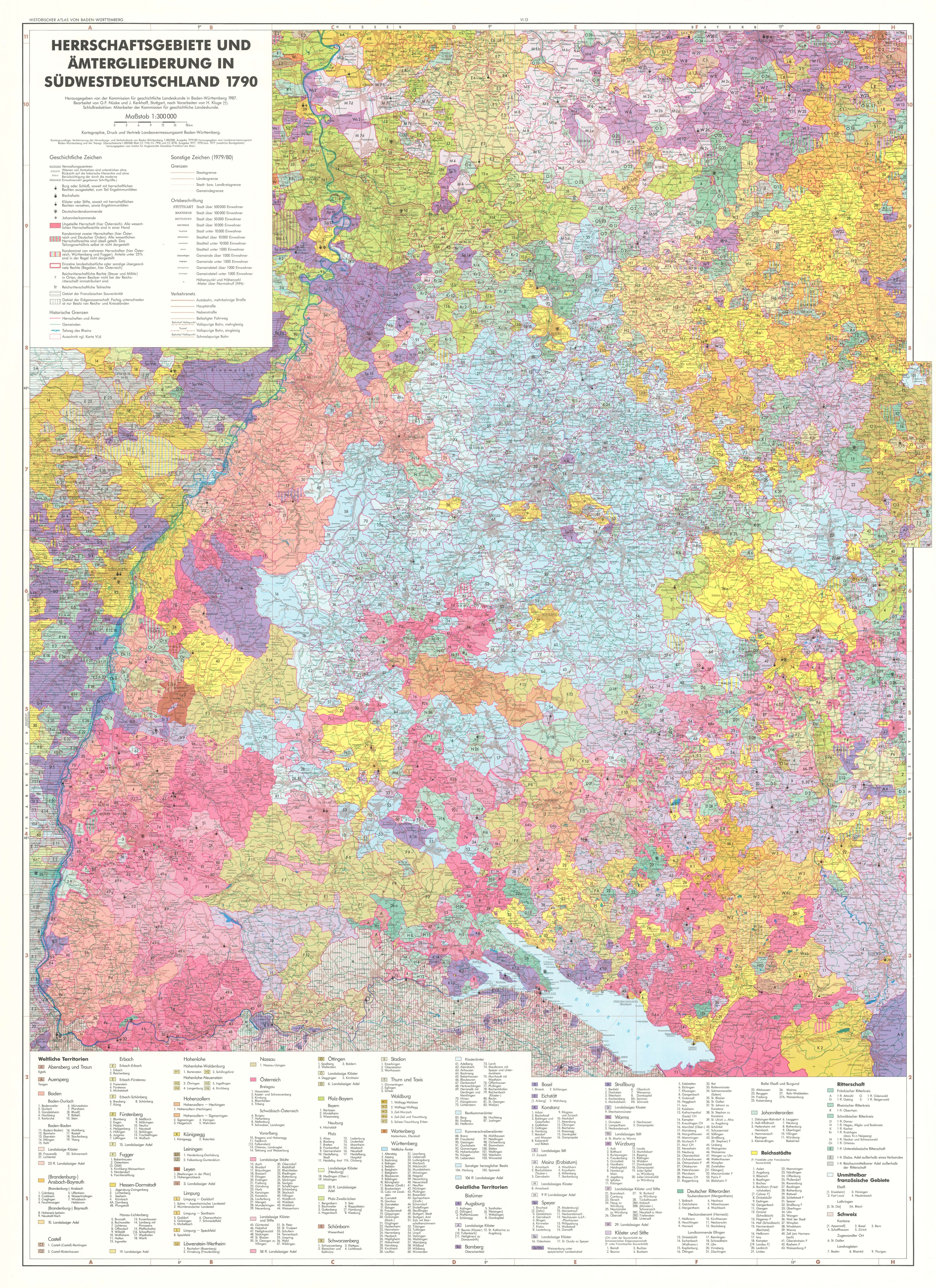
The big power looming over all of them was the House of Habsburg whose ancestral home is not far in the Aargau in modern day Switzerland. This area between Freiburg and Constance was known as further Austria and the Habsburgs held on to it until Napoleon passed it wholesale to the Grand Dukes of Baden.

Further up the Rhine lies the mighty city of Basel, where the great church council, the successor to the Council of Constance had just closed down in 1449. Whilst we covered the Council of Constance extensively in episodes 171 to 174, we have only touched upon the one in Basel when we came to the end of the Hussite wars in episode 183. And with good reason, Basel was not much of a success. We will certainly look at their modest efforts to sort out the decaying catholic church when we get to the season on the Reformation.

For now, we leave this free Imperial city in our rear-view mirror as we continue up the gradually narrowing Rhine, until our journey is rudely interrupted by waterfalls. These are not exactly the Niagara Falls, but at 23 meters height and a water flow of 600 cubic meters, it makes for a decent enough tourist attraction. What it also does is make the citizens of Schaffhausen rich, as we have to unload all our gear and hire local mariners to take us further.

And ever moving forward towards our next stop, Constance, we see looming on our left, the Hohentwiel, once home to the dukes of Swabia whose power had now vanished so completely. Further on, in the midst of the Untersee, the lower lake, rises the monastery of Reichenau, the place where the undisputedly most artistically significant 10th century illuminations had been produced. But now, this once rich and powerful imperial abbey that controlled the entire surrounding area had fallen on hard times and the day when the bishop of Constance took it over was not far.


There is no need to describe Constance to you, I did this before. So, after a brief rest we are now turning up north to meet the family that will soon take over the Hohentwiel and much of the land to the North, the Counts of Württemberg, soon Dukes of Württemberg and ultimately Kings of Württemberg.
The Counts of Württemberg were in almost every conceivable aspect the direct opposite to the margraves of Baden. That even begins with the family background. The margraves of Baden can trace themselves reliably back to the House of Zähringen, i.e., back to 962, and arguably even beyond. And they have the title to show for it. They became margraves as margraves of Verona in the 11th century, they had to drop Verona, but they kept the margrave. A margrave was well above a mere count, automatically a direct vassal of the emperor and hence an imperial prince.
The House of Württemberg may have had some august lineage. There are some archeological remains in their ancestral castle in Untertürckheim near Stuttgart that indicate a close link with the Salian house, Konrad the Red and then Otto of Worms, mentioned in dispatches during episodes 6 and 22.

But once the Hohenstaufen had taken over the duchy of Swabia, these early Württemberger counts were kept well below the line of sight of history or may have died out altogether. I will post a map on the website which shows the possessions of the Hohenstaufen up until 1250. And that shows quite clearly that the area they were based in was Hohenstaufen heartland. The castle called Hohenstaufen was just 50km to their east, and Waiblingen, the place they named themselves after, is just on the other side of what is today Stuttgart.

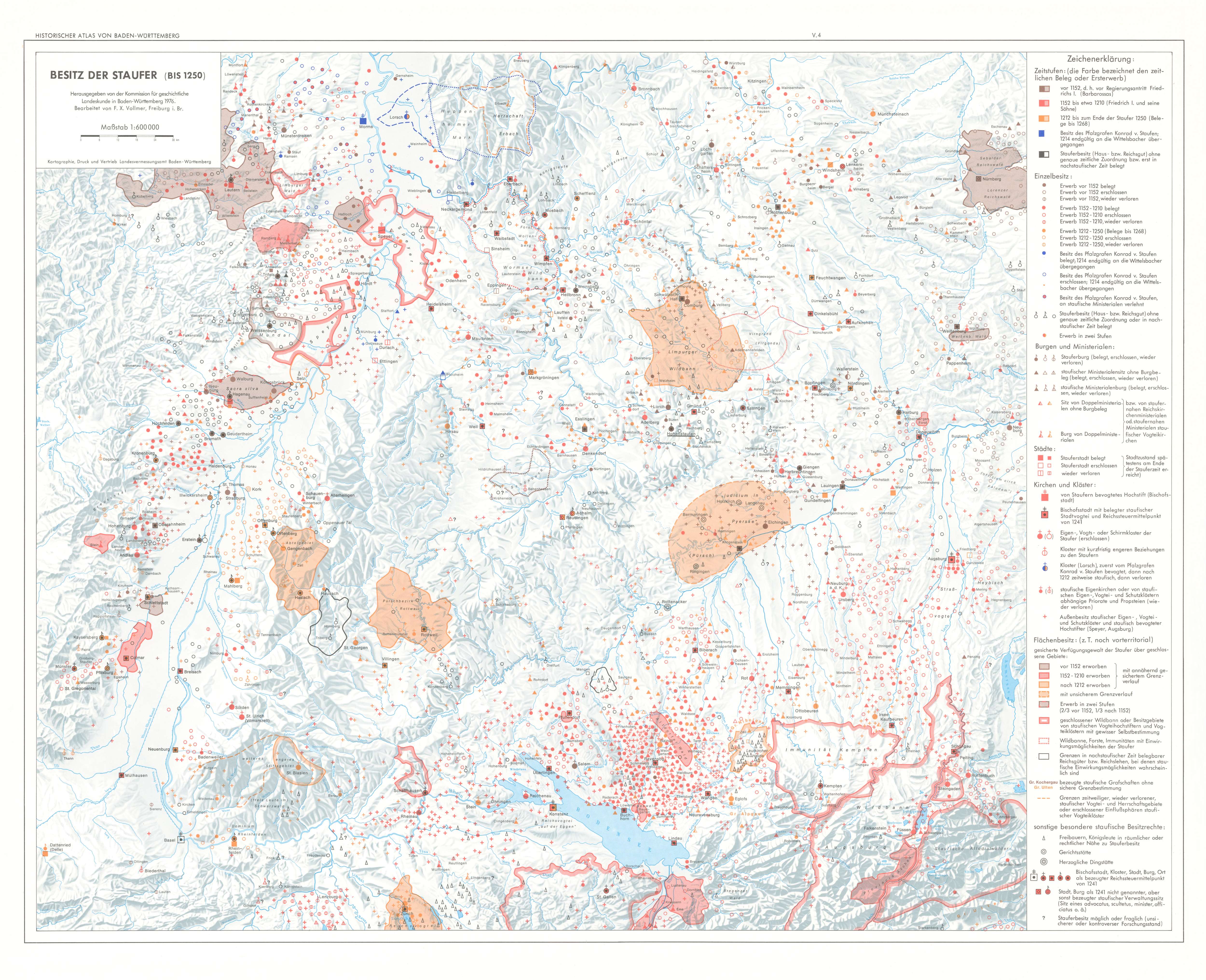
In other words, the Württemberger had been sucked into the imperial vortex and failed to be seen as loyal vassals worthy of sponsorship as the House of Baden had been. So, all throughout this period, they kept their head down, fortified their castle, took on some minor role in the Hohenstaufen administration and waited for their opportunity.
That opportunity came in 1245 when emperor Frederick II was excommunicated and an anti-king, Heinrich Raspe was sponsored by the pope (episode 89 following).
Ulrich I of Wurttemberg teamed up with several other Swabian nobles to take advantage of the situation. When Konrad IV, the son of emperor Frederick II went to confront Heinrich Raspe in battle, Ulrich I and his friends, all of whom had nominally been vassals of the Hohenstaufen, left the camp, leaving young Konrad hanging out to dry.

Ulrich lost no time expanding his territory at the expense of King Konrad IV. It is important to understand how that worked. We are not in the modern age, where a conqueror would attack an enemy stronghold, defeat its garrison and replace it with a new garrison.

In the Middle Ages, all these Hohenstaufen strongholds were held by vassals or ministeriales, not by soldiers subject to military command. Under the feudal law arrangements of the time, a vassal was supporting his lord voluntarily, based on an oath given when he received his fief. But this oath was not unconditional. It could be adjusted or even disregarded if the lord failed in his obligations.
The ministeriales were in principle unfree serfs trained in warfare, meaning they served under command, not voluntarily. But many of these families of ministeriales had been sitting on their castles for generations. They trained like knights, they lived like knights, they married like knights, and they looked like knights, so they were knights. And as knights, they too assumed they had the freedoms of vassals.
What that meant in practical terms was that any vassal or ministeriale who gets attacked, has the option to swap sides, or at least can make an argument that it was legitimate to swap sides. For most of the Hohenstaufen period few, if any, Swabian vassals and ministeriales did take the option to swap sides and join one of the many enemies of the ducal family. They knew that they could rely on support from the dense network of other vassals and ministeriales. They also knew that if they surrendered prematurely, the king or emperor may come down later and throw them out of their castle.
In 1246 this scenario changed fundamentally. First up, the Fronde of nobles led by Ulrich von Württemberg comprised many of the vassals a Hohenstaufen supporter would have expected to come to their aid in case of an attack. And then Frederick II died in 1250. His successor in the role of duke of Swabia was Konrad IV who went to Italy in 1251 never to return. The duchy was left in the tiny hands of 2-year-old Konradin. In other words, retribution for abandoning the Staufer cause became a remote risk.
That is why so many Ministeriales and Vassals opened the gates to their otherwise hard to penetrate castles to Ulrich and his friends. In this period Ulrich acquired the two main seats of the family, Stuttgart and Urach, one by marriage and the other by purchase. But most of his territory, he gained by convincing the local vassals and ministeriales to recognize him, rather than the baby duke Konradin. In 1254 Konradin, or more precisely his regents, accepted the gains he had made in exchange for recognizing Konradin as duke.
Ulrich I ruled the county of Wurttemberg for a further 11 years, until 1265 – continuously expanding his territory.
This was not the first and certainly not the last time that an ambitious man seized an opportunity to build a princely domain. But for it to become a political structure that endured in the family until 1918 and in its name until today, a couple more things are needed.
First up, you need to win the genetic lottery. And not just once and not just in one way. For the next couple of generations, the family needs to produce competent offspring. But it is not enough to have at least one competent child per generation, but that child also has to be the eldest son. And he needs to live for a very long time to make sure his successor is old enough and well trained to take over smoothly. Then that son needs to marry a woman from a family that is losing the genetic lottery, i.e., is dying out. Which puts the whole thing at risk. What happens when these less successful genes percolate within the rising family, cutting down either reproduction or competence? And then there is Mr. Mendel mixing things up anyway.
You can see how becoming a major territorial dynasty is harder than it looks. The typical staying time is around 10 to 15 generations, which is 250 to 400 years.
There is obviously not a lot that one can do about these genetic preconditions. But there are a few options that make success more likely.
Then they set up a system that prevented the division of their territory between their sons. They signed an endless number of family compounds where they committed themselves not to split themselves into insignificance. Their northern neighbors, the counts of Hohenlohe, who had started out in a much stronger position in the 12th century, managed to cut up their territory into more and more sperate entities.

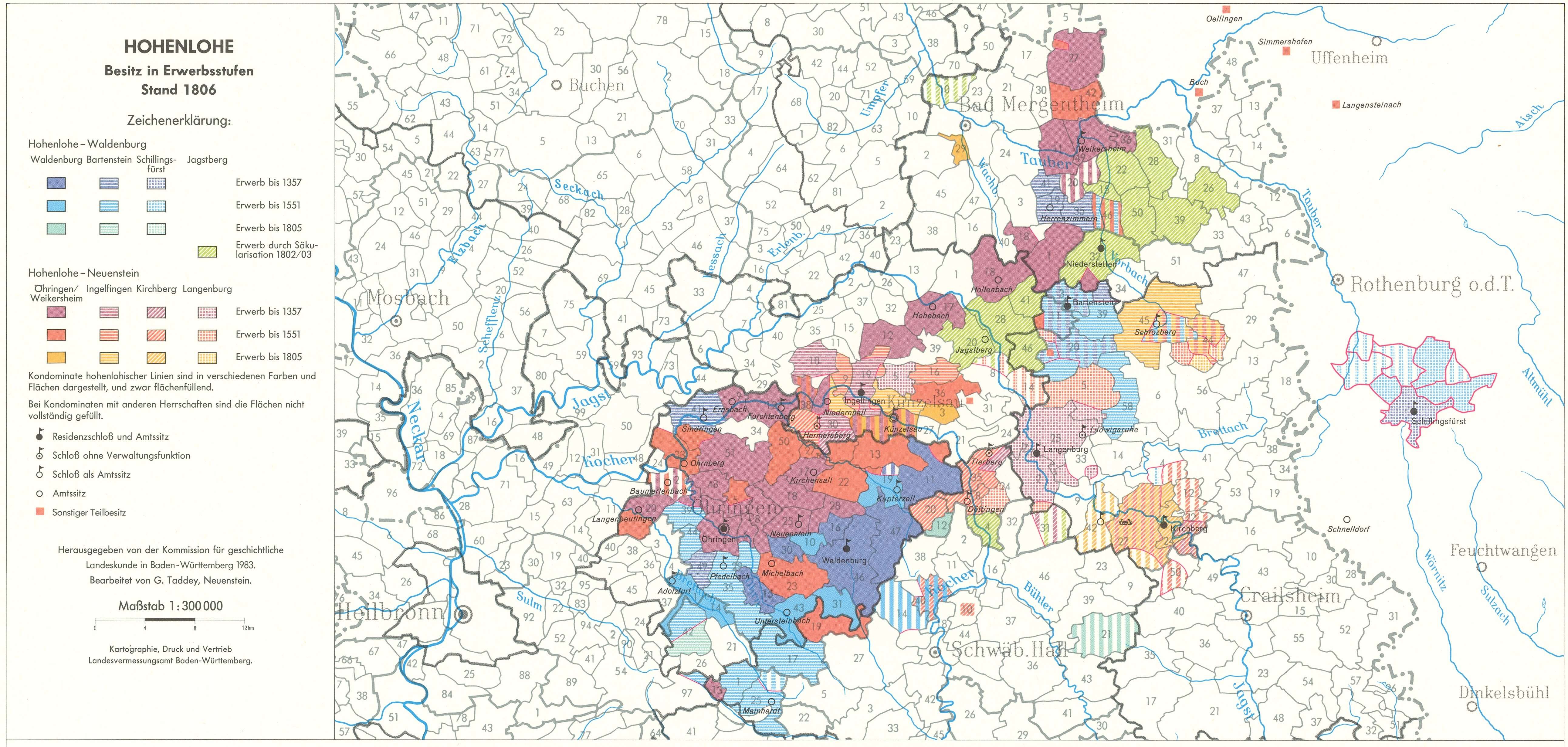
You can today walk from the capital of the principality of Hohenlohe-Niederstetten to their cousin’s main residence in Hohenlohe-Weikersheim in a comfortable 90-minute stroll, and in the meantime you can spot their summer palace along the way. And if you find this too far, you can visit the princely state of Hohenlohe-Bartenstein, another cousin, in an even shorter 60-minute walk.


The next item on the – how to become a king in the empire checklist – is choose your targets wisely. The vagaries of dynasties dying out, power balances shifting and imperial influence rising and falling, there is a huge temptation to seek acquisitions long way from home.
But that should be avoided. The most successful approach is one of block and tackle. You tackle your neighbor, capture some of his castles and lands, and then you block. Block, block, block, and then forward tackle, and again, block, block, block, block, block, block, block, block, block, block, and again tackle. And by doing that rather than jumping all across the playing field, picking up territories here and there, you end up with a contiguous piece of land that is much easier to defend. It also raises your profile amongst the other great landowners, the abbots and abbesses. They do require an advocate, a Vogt who protects them against marauding soldiers and greedy neighbors. A powerful lord who happened to be around a lot is a great choice as Vogt.
So, how did the Württemberger do?
First up, they mostly lived and ruled for a very long time. Ulrich I – 24 years, his successor, Ulrich II – 14 years, Eberhard I – 46 years, Ulrich III – 19 years, Eberhard II: 53 years and Eberhard III – 25 years. That is pretty impressive. But what is even more impressive is that they were all pretty competent.
They established primogeniture very much from the days of Ulrich I. There were situations where younger brothers wanted a division of the territory, but for now that could be avoided.
Then the Württemberger either deliberately or by chance placed hardly any of their male offspring into church roles. So, if an older brother got knocked out in the game of whack-a-mole, the younger one and his sons could take over.
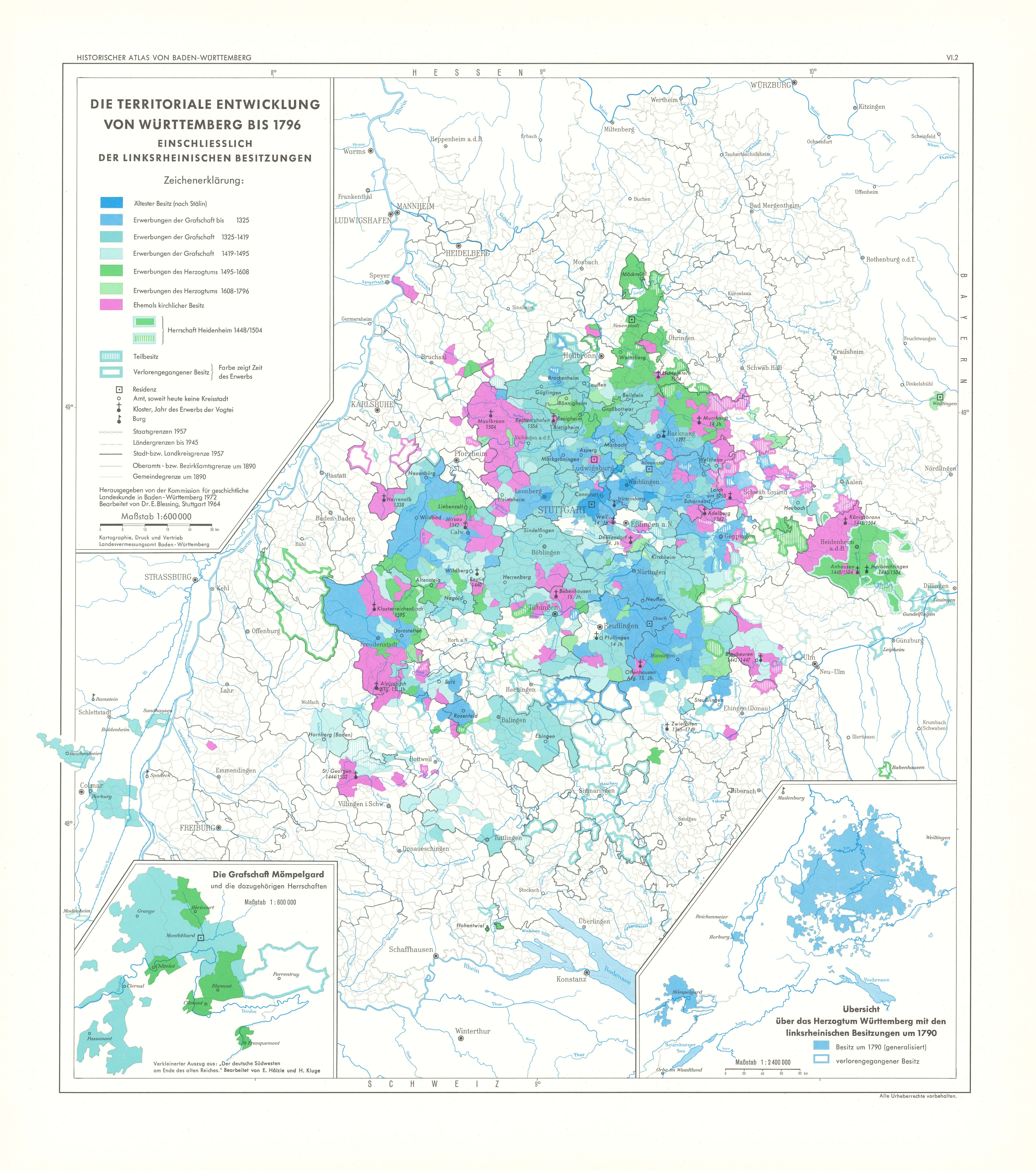
As for the game of block and tackle, they did well, at least in their core territory. Their lands became a coherent block around the cities of Stuttgart, Tübingen and Urach. They even built a defensive border against the Palatinate, the Württembergische Landgraben. Border defenses were rare since lands were usually too fragmented for such efforts to make sense. They existed around major free Imperial cities like Rothenburg ob der Tauber and Schwäbisch Hall, but rarely around princely territories. This wall also acted as a customs barrier, which was one of the count’s most important sources of funds.

From the late 13th and then again in the late 14th century their progress south ran into an even larger and even more coherent political entity, the house of Habsburg.
With the north blocked by the Palatinate and the east by the Bavarians, they looked west, leapfrogging the Badenian cousins and digging into Alsace. Lorraine too came into view, until in 1397 count Eberhard IV married Henrietta, sole heiress of the county of Mömpelgard, or Montbéliard.

That territory, between Besancon and Mulhouse had once been part of the kingdom of Burgundy and therefore part of the Holy Roman Empire. By 1397, when the House of Württemberg took it over, it was half imperial and half subject to the Dukes of Burgundy, causing no end of complications. Montbéliard will remain under Württemberg control until the French Revolution.

If this was the first deviation from the game plan for total domination, things got derailed further when the family no longer won the genetic lottery. Yes, there was still at least one extraordinarily competent heir to come, but what was needed is consistency. Not every one of them had to be a genius living until he was sixty. It is more important to keep the babies and buffoons to a minimum. Spoiler alert – lots of babies and buffoons coming up.
The calamities started with the early death of Eberhard IV, the husband of Henriette of Mömpelgard. Their sons were both minors, so Henrietta led a regency government that was dominated by the local nobility. Once her sons had grown up, they proceeded to split the territory into two, one centered on Urach, one centered on Stuttgart.
Count Ulrich V of Wurttemberg-Stuttgart is the same one we met last week, the one who was defeated in single combat at the battle of Seckenheim. Following this misadventure, Ulrich V and his state were essentially bankrupt but at least not dead.

His brother Ludwig II lasted 9 years as the sole ruler of his half of Württemberg. Then he died leaving behind two sons who were minors. So, regency fell to his wife, Mechthild of the Palatinate, the sister of our friend Friedrich der Siegreiche and driving force between the foundation of Freiburg and Tübingen university. In 1453 her eldest son reached maturity. But since he suffered from epilepsy, he was considered unable to rule. So, the regency continued.
In this vacuum of an incapacitated ruler in Urach and a bankrupt one in Stuttgart stepped Friedrich der Siegreiche. He exerted influence through his sister, the regent in Urach and through his financial hold over the bankrupt Ulrich V. Württemberg was again at risk of being sucked into the vortex of a more powerful state, this time the Palatinate.
Cometh the time, cometh the Landtag. At this crucial point it is not a man or woman that gets up to protect the independence of Württemberg, it is an institution. And this institution is the Landtag, the estates of Wurttemberg.

To explain, we have to look at one more criterion for a successful territorial state, the sense of communal purpose, or you can call it territorial nationalism. In principle a territorial state is nothing other than a collection of properties that happen to be under the control of one person. But as these territories developed, some rulers managed to instill a sense of belonging to their territory. Much of that came into being during the 14th and 15 century and it lasts until today. Germans who identify as Hessen, Badener, Sachsen, Hannoveraner or Preussen are referencing a territory created not by geography, ethnology or ancient culture, but a random collection of lands owned by a single family. And it is a strong sentiment. My grandfather, who was from Baden would every year celebrate the battle of Königgraetz in 1866 as the last day you were legally allowed to shoot at Prussians.
And Württemberg was one of the territories that developed such a sense of belonging and territorialism earlier and stronger than many others. That was in part a function of the contiguous territory.
It had also something to do with the interior structure of Württemberg. Other than their neighbors in Baden, the Württemberger liked to have cities. They liked the economic power they brought. And since most of their income came from customs stations along the main North-South trading route from Italy to the Rhine, they had an interest in their prosperity.
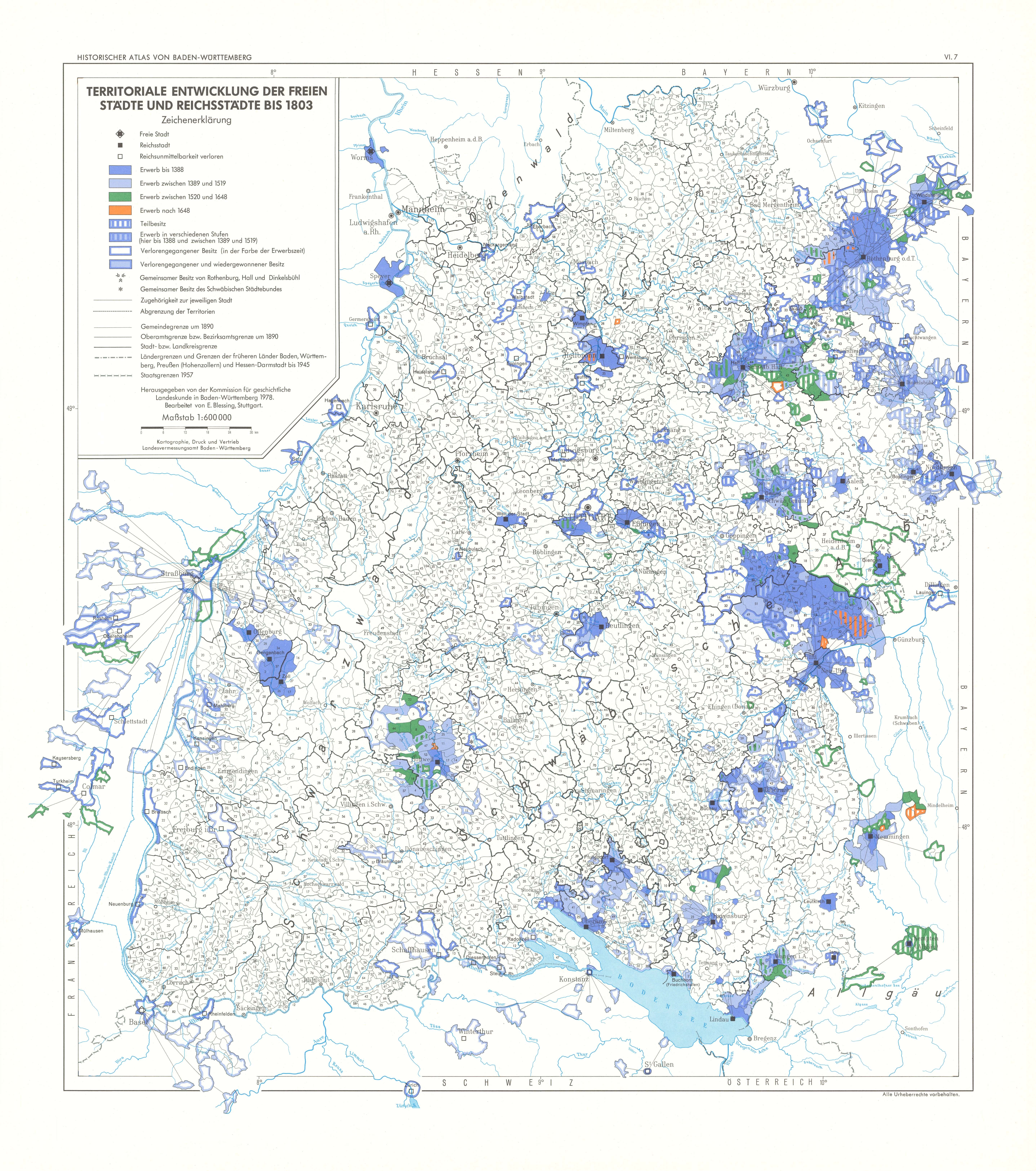
Many of these cities had become free imperial cities after the Hohenstaufen had fallen. So, to incorporate them into Württemberg over time, the counts waged war against them. Where they succeeded, the peace settlement often included the right of the cities to participate in the state decisions. So, from 1316 onwards we know that 8 cities sent their delegates to the Landtag, the meeting of the estates of Württemberg to “advise and support the count”.

The strategy towards the nobility was the opposite. The counts tried at any time to suppress them, to force them to become subjects rather than vassals, and where that failed, left them outside the operation of the state.
The Landtag became the glue that kept Württemberg together during this period when the land was divided between the two lines and ruled by ineffective counts.
And they really stepped into the limelight in 1457 when the epileptic count Ludwig II of Württemberg-Urach died. His younger brother Eberhard V was now count, but only 12 years old. His uncle Ulrich V of the Stuttgart branch became his guardian and de factor ruler of the combined entity. But in reality, he was a puppet of Friedrich of the Palatinate. And if you remember the episode on the Palatinate, such a scenario could easily end in the sudden demise of young Eberhard V and a takeover of Württemberg first by Ulrich V and then by the Palatinate.
To push back the Palatinate, the Landtag staged a coup. Against the wishes of his guardian, the representatives of the cities declared Eberhard V of age. Ulrich failed to raise the resources to suppress the Landtag and had to withdraw.
Eberhard V called im Barte turned out to be one of the most competent of the family. He fostered economic activity, founded the university of Tübingen, married an immensely rich Italian heiress and reformed the bureaucracy. On the negative side of his accounts stood the expulsion and arrest of the Jews in Württemberg.

His main objective was to reverse the division of the territory. In 1482 he achieved that by making a deal with the son of Ulrich V and heir to the Stuttgart branch. The two territories would be rejoined. The childless Eberhard im Barte would run it until his death and afterwards the whole would go to the son of Ulrich, called Eberhard the younger. Under Eberhard im Barte Württemberg reached an extent and wealth that not only rivalled but superseded many duchies. So, in 1495, Eberhard im Barte was elevated from count to duke, and with that the duchy of Württemberg was born. The duchy was made indivisible, and succession was based on strict primogeniture.
And within the duchy the Landtag, the Estates of Wurttemberg gained an important role. They were consulted on decisions over war and peace, and most importantly they held the right to approve new taxes. They were even granted the right to resist the duke in case he breached any to the arrangements.
In terms of membership, there were 14 abbots of the main monasteries, 30 knights and nobles and 120 representatives of the cities. The voting was not by estate, so the prelates, the nobles and the commoners each have one vote, but by all representatives together. That and the unwillingness of nobles and abbots to pay taxes shifted the power in the assembly towards the commoners, mainly patricians in the cities.
Eberhard im Barte died in 1496 a year after the creation of the duchy. His heir was, as agreed, Eberhard the younger, the son of Ulrich V. This Eberhard was no longer younger, he was in fact already an old man, 49 years, when he took over. When he had handed over control of his share of the duchy to Eberhard im Barte he had not only gained the right to inherit the whole but also a generous annual pension. Free from dealing with boring admin tasks he went travelling, picking up expensive habits at the courts of France and Burgundy.

When he took over in 1496, he was remarkably ill-suited for the management of a complex duchy in the crossfire of Habsburg and princely interests. And given his love of bling, he almost instantly clashed with the Estates, the Landtag.
He demanded more money, for his court, his mistresses and an army. The Landtag refused. Words were had, and then, in a completely unprecedented move, the Landtag deposed the duke Eberhard II of Württemberg. The state apparatus, the councilors, administrators, bureaucrats and armed forces agreed. Eberhard II fled to Ulm, appealed to the emperor to put this rebellious rubble under the interdict. The emperor responded by siding with the Landtag and installing a new duke, Ulrich I, who was, again, a minor. But instead of having a regency council made up of nobles, it was a government made up of members of the Landtag, some prelates and nobles but manly commoners who ruled the duchy until young Ulrich was 16.
Ulrich started out as a great hero, gaining victories in the War of the Landshut Succession in 1504 that restored all the losses the duchy had sustained during the Mainzer Stiftsfehde.

But things then gradually went sideways. Ulrich, like many Renaissance princes, enjoyed the good life and felt compelled to show off. His spending on feasts and feuds drained the coffers of the state. In 1513, he had to give major concessions to the Landtag to get them to approve another tax.
This tax then triggered a revolt. This revolt, called the revolt of the poor Konrad, spread like wildfire across the land of Württemberg. To suppress it, he had to again seek help from the Landtag. By then a subsection of the Landtag, a group of roughly sixty interconnected patrician families had formed an association they called the Ehrbarkeit, best translated as the Honorables.

The Ehrbarkeit was willing to bear the cost of the military campaign and pay off all the duke’s debts, in exchange for some massive concessions. On July 8, 1514, duke Ulrich signed the Tübinger Vertrag, the Magna Carta of Swabia. In it he guaranteed the Landtag’s rights to decide taxes. They were given influence on decisions over war and peace, and they could refuse the sale of any ducal territory. Citizens of Württemberg were given the right to due process, and the right to emigrate.

Ulrich did one more thing to cement the new order. In 1515 he went out hunting with his equerry Hans von Hutten. Von Hutten had married one of Ulrich’s mistresses. And when the duke demanded that Hutten would take a back seat in the marriage, Hutten refused. Hutten resigned his role as equerry and planned to leave Stuttgart with his wife. Ulrich invited him to come on one last hunting trip to reconcile their differences. Hutten could not refuse and arrived in light hunting gear, whilst the duke showed up in full armour. Once they reached the forest, the duke sent away his staff and then went after von Hutten. He chased him around a tree, striking him with his sword seven times, five of which in the back. Then he strung him up with his own belt.

That was the scandal that broke the camel’s back. 18 of his vassals revoked their oaths, his wife left him. Hutten’s family sued him in the imperial courts. The poet Ulrich von Hutten, a cousin of the victim, wrote immensely powerful satirical pamphlets about the duke. Ulrich was placed under the imperial ban, and in 1519 the Swabian League invaded Württemberg and duke Ulrich had to flee into exile. He stayed there until he was restored by force of arms in 1534. For 15 years the duchy was again ruled by the Landtag, led by commoners, members of the Ehrbarkeit. When Ulrich returned, he had to confirm the rights of the Landtag and the Ehrbarkeit.
A political structure with a duke constrained by the tax raising authority of the estates was not that unusual. Most territorial states had these. So did in fact France and obviously England.
Where Württemberg differed was a) in the composition of the estates, i.e., being dominated not by the nobility, but by the cities and even at some point peasants and ordinary people, b) in the fact that it retained full control over taxation even during a time when most others succumbed to absolutism. And c) it differed in the sense that it granted rights directly to ordinary citizens.
The rest of Württemberg’s history, which I am sure we will touch upon as we go through the next few centuries were dominated by the conflict between duke and Ehrbarkeit. Dukes tried to suppress it or get past it through imaginative financial shenanigans, but in the end all of these attempts failed. The Landtag and within it the power of the Ehrbarkeit stayed on, until 1805.
Which gets me to the third topic for today. We talked about what it takes for somewhat obscure nobles to become important imperial princes, we talked about how a territory developed its own identity and political structure beyond being just a collection of rights in the hand of one man. And finally, we are now going to talk about the reasons for the economic success of Württemberg.
If you ask any Brit to name a German city other than Berlin or Munich, Stuttgart comes up fairly often. Which is odd, because neither the clubbing scene nor the Christmas markets are much different to the rest of the country. The Cannstatter Wasen may be almost as old and almost as large as the Octoberfest, but few people outside Germany, arguably outside Swabia, have heard of it.
The reason Baden-Württemberg is so well known is the extraordinary cluster of high-end manufacturing in the place. Porsche, Mercedes Benz, Bosch, ZF Friedrichshafen, SAP, Heckler & Koch as well as dozens and dozens of engineering and technology companies are based here. Why there are there today is self-evident. There is a skilled workforce, some excellent technical universities, physical infrastructure and suppliers of key components nearby. The companies are competing fiercely against each other, spurning each other to become better and better, whilst serving a customer base that demands to drive safely at 130 miles around corners.

But the question remains, why did they come here? Yes, Benz patented the first Motorcar in Ladenburg near Mannheim and Gottlieb Daimler together with Wilhelm Maybach created effective engines and later motor cars in Stuttgart. Ferdinand Porsche had worked at Daimler in Stuttgart before he set up his own firm in the city.

But inventor’s personal affinity to a location is rarely enough for industry clusters to emerge.
If you look at the early industrial centres in europe, they are often driven by natural resources, water energy in the English Midlands, coal and iron ore in the Ruhr, Wallonia and Lorraine. Mining in particular can be a catalyst, as it had been in the Ore mountains, in Saxony and Thuringia. And that is not just because of the material they dig up, but also the technologies required bring about specialisations and skills that can be deployed elsewhere. Neither Baden nor Württemberg had much, if any coal, mining or came in early enough to take advantage of water-based energy.

Another driver can be capital. Large cities tended to be places full of rich people, some of whom were willing to support entrepreneurs. So, you find industry springing up in Cologne or Berlin. But Stuttgart, Mannheim, Heidelberg and Karlsruhe were all mid-sized towns, not metropolis full of venture capitalists.
What the region could call upon were the universities, not just the old foundations in Heidelberg, Freiburg and Tübingen but also the technical universities in Karlsruhe, founded in 1825 and Stuttgart founded in 1829.
The Tübinger Vertrag had guaranteed due process since 1514, and the rule of law was further strengthened in the comparatively liberal constitutions of the post Napoleonic period. As we talked about before, the rule of law is an important facilitator of economic growth, reassuring investors that they can get their money back and entrepreneurs that they will be benefitting from the fruits of their labours.
Some argue the fact that Baden and Württemberg were mid-sized state made careers in politics and military unattractive. Ambitious people who wanted to change the world would not find a large enough stage in Karlsruhe or Stuttgart. Hence, they directed their efforts into areas like science and engineering where territorial borders are largely irrelevant.
And finally, we have or may have another major contributor to the success story, one very close to my heart – wine. If you compare maps of ancient wine growing regions and areas of technological innovation in Baden- Württemberg, you see a very clearly discernible overlap.

This triggered two scholars, Thilo Huning and Fabian Wahl, from the universities of York and Vienna to investigate why that may be the case. They produced a paper just 2 months ago, arguing that winegrowing had a material impact on modern economic development in Baden-Württemberg.

I will put a link to the article in the show notes for this episode, but here is what I understand to be their line of argument:
The first point is that in areas where wine was grown, the tradition of sharing inheritance equally could be retained. We should remember that parents have always tried to love each of their children equally and that leaving all the assets to just one on the grounds of seniority and gender is unnatural. This idea is only adopted out of necessity. So, in regions where productivity per acre is low and hence dividing the farm between several children would make each of them unviable, that is where primogeniture takes hold. Henry the Fowler introduced primogeniture in the kingdom of East Francia not out of spite for his younger son, but in order to preserve the viability of his state. The same goes for the counts and dukes of Württemberg.
In the winegrowing areas of Baden and Württemberg we find mostly equal inheritance rights. The issue with winegrowing is that it is extremely labour intensive, seven to eight times greater relative to grains. And wage labour is fairly scarce in the wine industry because vines can be easily and permanently damaged if the pruning, ploughing, and hoeing operations are badly carried out. Hence these had to be family businesses. Moreover, wine is as much about quality as it is about volume, meaning that relatively small plots, if well-tended, can sustain a family. Which in turn means, there is less need to establish primogeniture, forcing younger siblings to fight for themselves.
The labour intensity and egalitarian inheritance rules resulted in a higher population density in wine-growing areas at the dawn of industrialisation. This provided the necessary excess labour force, that was also flexible enough to go back to the vineyard when an entrepreneurial venture had failed.
As an aside, wine was also a very expensive commodity, allowing merchants in the wine-trading cities to make huge profits and build up significant capital. That capital could then be mobilized as venture capital.
Available flexible labour and capital are important factors, but there is something else wine-growing areas benefit from.
Winegrowing is a gamble, creating the need to share the risks. You have a perennial plant that takes decades to reach top quality production, meaning you have no flexibility in terms of crop. If climate changes or markets shift, you cannot nilly willy replace vines with rye. So, when times are tough, you have to take it on the chin. But since your neighbours go through the same hardship, wine-growing villages developed a closer sense of community and an ethos of mutual support.
And that also manifests in the good days. Whilst growing grapes itself is not capital intensive, a wine press, the barrels and cellars are. Wine growers have always and still often do share these costs in the form of collectives. This requires co-ordination, compromise and the development of trust between the members of the society.
In other words, in wine growing areas society is more collectivists, a place where people are willing to co-operate and share resources, both in good and in bad times.
These attributes create trust in individuals and in the community as a whole. Trust is one of the most valuable commodities. When trust is absent, society wastes valuable resources on verification, monitoring, and enforcement mechanisms that could otherwise be directed toward productive activities. All these costs fall away when people trust each other, making the allocation of resources much more efficient. The world bank estimates that 60-80% of the wealth of developed nations is made up of social and institutional capital, i.e., in the trust that individuals and institutions are broadly acting fairly. Now that figure is heavily disputed, but it is not a long shot to believe that a tradition of working collectively and supporting each other makes challenges easier to overcome and saves tons of money on lawyers, forensic accountants, party donations and lobbyists.
Our two scholars, Thilo Huning and Fabian Wahl, are scientists. They deal in facts, not beliefs. So, they measured the correlation between wine growing and economic activity in Baden-Württemberg down to the level of the individual municipality. They collected data on wine growing in the 9th and 17th century as well as at meteorological conditions and compared those to population density, density of firms, nighttime luminosity, distribution of rare given names and various control variables.

I am not very good with the Greeks they come up with, but their conclusion is quote: “This study underscores the role of wine in the shaping of modern Southwest Germany.”
Bingo. So, if you want to lay the foundations of economic growth in a wine-growing area of your choice, get yourself a few bottles and bask in the glow of general goodness. You get the same feeling by the way if you sign up on historyofthegermans.com/support.
And with that, see you next week.