
The rise from minor principality to Grand Duchy
What is it like to be a prince? Well, not quite what it is set out to be, in particular when you are a smaller prince, not in stature, but in land.
The margraves of Baden are such princes. In the 15th century their main territory, a slither of South-West Germany, just 60km long was too small to play on the European, even on the German stage, but too big to escape the need of massive palaces and warfare.
What makes Baden so fascinating is that despite its handicap, it managed to become a medium sized state, one half of Baden-Württemberg. The way there was a long one, involving friendship and loyalty to the death, piratical princesses, alchemy, someone called the Türkenlouis, a sun-shaped city and some skilled diplomacy.

A narrative history of the German people from the Middle Ages to Reunification in 1991. Episodes are 25-35 min long and drop on Thursday mornings.
“A great many things keep happening, some good, some bad”. Gregory of Tours (539-594)
HotGPod is now entering its 9th season. So far we have covered:
Ottonian Emperors (# 1- 21)
– Henry the Fowler (#1)
– Otto I (#2-8)
– Otto II (#9-11)
– Otto II (#11-14)
– Henry II (#15-17)
– Germany in 1000 (#18-21)
Salian Emperors(#22-42)
– Konrad II (#22- 25)
– Henry III (#26-29)
– Henry IV/Canossa (#30-39)
– Henry V (#40-42)
– Concordat of Worms (#42)
Early Hohenstaufen (#43-69)
– Lothar III (#43-46)
– Konrad III (#47-49)
– Frederick Barbarossa (#50-69)
Late Hohenstaufen (#70-94)
– Henry VI (#70-72)
– Philipp of Swabia (#73-74)
– Otto IV (#74-75)
– Frederick II (#75-90)
– Epilogue (#91-94)
Eastern Expansion (#95-108)
The Hanseatic League (#109-127)
The Teutonic Knights (#128-137)
The Interregnum and the early Habsburgs (#138 ff
– Rudolf von Habsburg (#139-141)
– Adolf von Nassau (#142)
– Albrecht von Habsburg (#143)
– Heinrich VII (#144-148)
– Ludwig the Bavarian (#149-153)
– Karl IV (#154-163)
The Reformation before the Reformation
– Wenceslaus the Lazy (#165)
– The Western Schism (#166/167)
– The Ottomans (#168)
– Sigismund (#169-#184
The Empire in the 15th Century
– Mainz & Hessen #186
– Printing #187-#188
– Universities #190
– Wittelsbachs #189, #196-#199
– Baden, Wuerrtemberg, Augsburg, Fugger (#191-195)
– Maps & Arms (#201-#202)
The Fall and Rise of the House of Habsburg
– Early habsburgs (#203-#207)
– Albrecht II (#208)
-Freidrich III (#209-
What is it like to be a prince? Well, not quite what it is set out to be, in particular when you are a smaller prince, not in stature, but in land.
The margraves of Baden are such princes. In the 15th century their main territory, a slither of South-West Germany, just 60km long was too small to play on the European, even on the German stage, but too big to escape the need of massive palaces and warfare.
What makes Baden so fascinating is that despite its handicap, it managed to become a medium sized state, one half of Baden-Württemberg. The way there was a long one, involving friendship and loyalty to the death, piratical princesses, alchemy, someone called the Türkenlouis, a sun-shaped city and some skilled diplomacy.
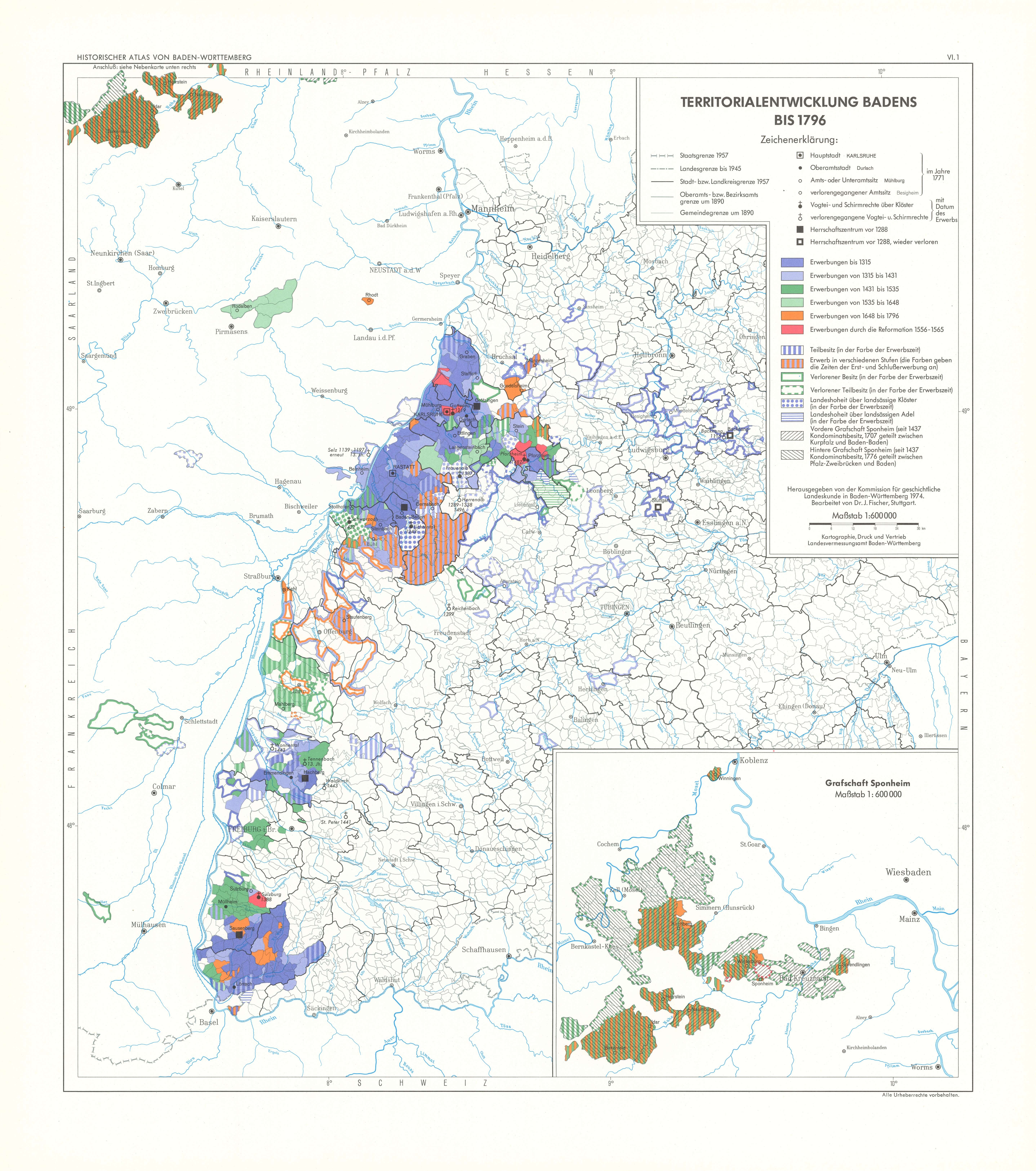
Hyperlink to map of Baden: HABW_06_01.jpg (5750×6500)
The music for the show is Flute Sonata in E-flat major, H.545 by Carl Phillip Emmanuel Bach (or some claim it as BWV 1031 Johann Sebastian Bach) performed and arranged by Michel Rondeau under Common Creative Licence 3.0.
As always:
Homepage with maps, photos, transcripts and blog: www.historyofthegermans.com
If you wish to support the show go to: Support • History of the Germans Podcast
Facebook: @HOTGPod
Threads: @history_of_the_germans_podcast
Bluesky: @hotgpod.bsky.social
Instagram: history_of_the_germans
Twitter: @germanshistory
To make it easier for you to share the podcast, I have created separate playlists for some of the seasons that are set up as individual podcasts. they have the exact same episodes as in the History of the Germans, but they may be a helpful device for those who want to concentrate on only one season.
So far I have:
Salian Emperors and Investiture Controversy
Fredrick Barbarossa and Early Hohenstaufen

Transcript
Hello and welcome to the History of the Germans: Episode 191 – The Margraviate of Baden, also episode 7 of season 10 – The Empire in the 15th Century
What is it like to be a prince? Well, not quite what it is set out to be, in particular when you are a smaller prince, not in stature, but in land.
The margraves of Baden are such princes. In the 15th century their main territory, a slither of South-West Germany, just 60km long was too small to play on the European, even on the German stage, but too big to escape the need of massive palaces and warfare.
What makes Baden so fascinating is that despite its handicap, it managed to become a medium sized state, one half of Baden-Württemberg. The way there was a long one, involving friendship and loyalty to the death, piratical princesses, alchemy, someone called the Türkenlouis, a sun-shaped city and some skilled diplomacy.
But before we start the usual plea for support. Making this show has gone from being a hobby and side hustle to being my obsession and even main occupation. If I want to keep it up and avoid having to set up an additional income stream from piracy, I need your support. There are various options on historyofthegermans.com/support to protect shipping in the English Channel. Special thanks from the Coastguard go to John S., Brian – Gutenberg’s apprentice, Sasha Sirota, Elliot W. J., Michael Dane from Australia, Conor G., Charlie J. and Zachary Levine. By the way, if you are a supporter and you want your full name read out or me saying something silly, send me a note.
And with that, back to the show
After last week’s detour into the history of the German universities, we now alternate back to our journey through the Holy Roman Empire in the 15th century. We are travelling back down to where Mannheim does not yet exist and resume our journey up the Rhine River towards Basle.
As we do this, we are entering one of the most fragmented parts of this ancient political structure that had once been the stem duchy of Swabia, one of only 5 duchies that existed in Henry the Fowler’s kingdom of East Francia.

In the 500 years since Henry’s reign, the duchy of Swabia had been divided into smaller and smaller principalities.
The first time in the 12th century when it broke up into three entities, the Hohenstaufen duchy of Swabia, the duchy of Zähringen in the Southwest and the lands of the Welf in the East.
Frederick Barbarossa and his successors consolidated the Welfish and the Hohenstaufen lands and penetrated the territory with castles and cities. In 1218 the Zähringen dukes died out and their vast territory was distributed amongst the mighty cities like Zurich, Berne and Basle, the Habsburgs and various offshoots of their own family as well as their vassals.

The next atomization happened when in 1268 the House of Hohenstaufen fell under the executioner’s axe.

And as in the case of the Zähringer, it was the cities, the Habsburgs and a brace of more or less powerful counts who seized what had once been the power base of the emperors of the High Middle Ages. In 1521 the imperial constitution recognized 101 different princes, cities and immediate lords in Swabia, more than in any other of the imperial circles.


These 101 territories varied dramatically in size and economic power. The dukes of Württemberg were by far the biggest, accounting for about a quarter of the population, followed by the Margraves of Baden with 8% and the bishopric of Augsburg with 4%, and everybody else was even smaller than that, with the abbey of Heggbach with 600 inhabitants bringing up the back.
Which gets us to the question, how did this work? What room to act did you have as one of these entities? What were sensible policies to follow? How do you come out on top?
There are several ways to approach this issue. One would be to follow chronologically every move of every one of these players, shuffling villages and abbeys back and forth to trace the growth or contraction of each of these territories. This is what I did in my first draft of this episode. But then I read the following sentence out loud: “it is highly likely that even before Rudolf I’s marriage to Kunigunde von Eberstein, property belonging to this family, which had risen from a noble rank and was mainly based on fiefs from Speyer and the inheritance of the Counts of Lauffen, came to Baden. Rudolf also acquired Liebenzell and Alteberstein, today’s Ebersteinburg.”. And that is when I realised that there are various ways of getting rid of listeners, even such loyal listeners as yourselves. 35 minutes of that kind of stuff, and I will be all alone shouting into the podcast ether.
So, I came up with another idea.
We did know who came out tops, the dukes of Württemberg and the Margraves of Baden, because the state is now called Baden-Württemberg. And whilst the dukes of Württemberg are a fascinating subject, the rise of the margraves of Baden was a lot steeper, meaning we may be able to learn more from them.
And we will not go through all the acquisitions and divestments that got them there. That would sound like reading the land registry out loud. If that is of interest, there is a great map available on a website called LEO-BW that shows the territorial expansion of the margraviate of Baden up until 1796. I have put a copy of it in the Maps section of the historyofthegermans.com website, the episode artwork and in the transcript to this episode for you to look at. That should cover this, leaving us with a lot of room to discuss potential strategies for success.

Economic development
The first thing a prince could do is also the most sensible thing to do, he could develop the economy of his territory.
And the margraves of Baden could look to a very successful set of precedents in their own family. They were one of the cadet branches of the dukes of Zähringen. The Zähringer ruled a territory in what is today Switzerland as well as the furthest South West corner of Germany. There they founded important cities, namely Berne, Freiburg in Germany and Fribourg in Switzerland and promoted the growth of Zurich, Murten, Burgdorf, Offenburg, Villingen Schaffhausen and many others.
However, their descendants in Baden were not that interested in the foundation of cities. That may be down to the fact that these cities had a habit of asserting their independence once their economy got going. Mainz, Worms Speyer and the mighty Strasburg all had thrown out their bishops, whilst Freiburg, ungrateful as it was, had kicked out their local count and put themselves under the protection of the Habsburgs.
There was an established opinion that the margraves of Baden had founded Stuttgart in 1219. They did own the stud farm that gave the city its name for a while, but that does not mean they founded a city there. No evidence of a foundation has been found and the originator of that thesis has become subject of some controversy. It would have been so deliciously ironic if that had been true, but probably isn’t.
As a consequence, the margraviate featured just one urban settlement, Pforzheim, which in the 15th century was one of the main residences of the margraves. Pforzheim is today best known as a centre for jewellery and watchmaking. But that only came about when in 1767 the margrave established a jewellery and watch manufacture in an orphanage. Most of the period between the 15th century and 1767, the city was left to fend for itself.
Then there is the Weinordnung of 1495, that prohibited the dilution of wine with all kinds of cheap ciders and fruit alcohol and established fines for the use of sugar, sulphur and poisonous substances. A Reinheitsgebot before the more famous beer purity law of 1516. The margraves claim it was the first of its kind, but there was already an imperial order in 1487 and the more meaningful imperial regulation that came in 1498.
Loyalty
If the House of Baden was not hugely successful in promoting economic activity, there was one thing they were excelling at – loyalty, specifically loyalty to the House of Hohenstaufen. The idea being that loyal vassals were rewarded with more fiefs and could expect favourable imperial court decisions in the regular disputes with neighbours and cousins.
They were there right from the word go! Margrave Hermann III fought with Konrad of Hohenstaufen in his civil war against emperor Lothar III and followed him on the ill-fated second crusade. His son, Margrave Hermann IV accompanied Barbarossa to Italy, fought with him before Milan and at the catastrophic battle of Legnano. He too came along on an ill-fated crusade, the third one, where he also died. The next margrave, Hermann V fought for Philipp of Swabia in these civil wars and joined the Frederick II when he showed up at Constance in 1212.
But the title of most loyal and most romantic of paladins must go to margrave Friedrich I. Barely 18 he followed his best friend and liege lord, Konradin, duke of Swabia and grandson of Frederick II to Southern Italy. Beaten at the battle of Tagliacozzo in 1268 they were imprisoned together in the Castello de Ovo in Naples. Legend has it that the two friends were playing chess when they were told that the king of Sicily had condemned them both to death. They heard the message, looked at each, and resumed their game. This whole story, including this scene became a bit of a cornerstone of German national mythology which also developed some rather unexpected homoerotic undertones. Tischbein painted the scene in 1784. Look at the picture, and you will get what I mean.

So, was it worth it? Well, the last bit that ended with young Friedrich decapitated on the market square of Naples certainly did not. But on the other hand, it could have been the by far most rewarding bet in medieval history. Because Friedrich was not only the heir to the margraviate of Baden, he was also the grandson of the last Babenberger duke of Austria, aka, the golden boy in Tischbein’s picture was in play to become duke of Austria. He did not have the cards though; king Ottokar of Bohemia had already occupied the duchy. But if Konradin had succeeded in Sicily and then returned to the empire like his grandfather had done, thrown out Richard of Cornwall and been crowned King of the Romans, well then the new king would have supported his best mate’s claim on Austria. And if that had happened, then it would have been bye-bye Habsburg and all hail the Badenian emperors.
Ok, that did not work out and instead of world domination, we have a tragic tale of friendship and chivalry. But that does not mean that a century of loyalty had gone unrewarded. The core of the Baden lands, that stretch on the eastern shore of the Rhine from Bruchsal to Baden-Baden was at least in large part given in compensation for services rendered. They also were able to expand their traditional homeland way upriver between Freiburg and Basle, the area still called the Markgräflerland, and they acquired the county of Sponheim, quite a way further north, along the Nahe River.
When the Hohenstaufen fell, the margraves of Baden took over much of what they had held on behalf of the imperial family as their own and added a few bits and pieces, though they were nowhere near as successful in this grab and run as the Habsburgs or Württembergers had been.
Military prowess
So loyalty, sort of tick, but not a huge one. They did all right, but not massively so. Hence, if you cannot get it by charm, can you get it by force of arms?
Well, they tried, once, in 1462 in a conflict that involved almost everyone we have met so far. What I am talking about is – of course – the Mainzer Stiftsfehde.
I have mentioned it several times before, but there was no point in trying to describe it unless we have all the protagonists around the table. That we do now, so here it goes.
On May 6th, 1459 the archbishop of Mainz, Dietrich Schenk von Erbach passed away. He had led the archdiocese for 25 years, 25 years during which they lost again lands and rights to the landgraves of Hesse who had now pushed through Mainz territory almost all the way to the gates of Frankfurt.
When the cathedral chapter proceeded to elect a new archbishop, two candidates were put up, Diether von Isenburg and Adolf von Nassau. Diether von Isenburg gained the upper hand, 4 against 3 votes. He then asked the pope, who was – drumroll – Pius II, formerly Aeneas Silvio Piccolomini, author of fruity prose, friend of the podcast, but also now a conservative hardliner. Piccolomini demanded that Isenburg submits to him, not only as it concerned his activity as shepherd of his sizeable flock, but also in his role as Prince Elector. Isenburg remained non-committal, but Pius II thought he had won and gave him the pallium together with a bill for 10,000 gulden, twice the usual papal tax on newly appointed bishops.

That payment became the crunch point. After his predecessors had lost so much of Mainz territory and income, the new archbishop did not have the money for the standard fee, let alone a double fee.
It also did not help that another papal condition was that he should wage war against the count Palatine. That Isenburg did, not realising that his opponent was none other than Friedrich der Siegreiche, Frederick the Victorious, who was, well, victorious.
That lost battle further reduced the resources of the archbishopric. Which is why Isenburg now outright refused to pay the papal fee. At which point Pius II deposed him and promoted his erstwhile rival, Adolf von Nassau to the archepiscopal throne.

Great result. We now have again two contenders for the most senior prince electorship in the empire, a principality that was already in trouble. So the sharks start circling.
Isenburg secured the support from the city of Mainz, and in an interesting 180 degree shift, the help of his erstwhile enemy, Friedrich der Siegreiche of the Palatinate. Friedrich’s change of allegiance had not come out of a deep conviction on points of canon law, as you can imagine but was brought about by the promise of valuable archepiscopal territory, namely Lorsch and Heppenheim.
Meanwhile Adolf von Nassau too is busy offering generous rewards to nobles willing to support his cause. He was particularly successful amongst the neighbours of Friedrich who feared the continued strengthening of the Palatinate. Duke Ulrich V of Wurttemberg signed up, the bishop of Speyer, Nix von Hoheneck signed up, and then there was the question of whether the Margrave of Baden would sign up too. This Margarve, Karl I, was a sensible, calculating man. He knew the Palatinate was militarily and economically much stronger than his territory. But the margravial family had just hit a temporary pinnacle of power. One of his brothers was the archbishop of Trier, and another the bishop of Metz.
And then news came that Friedrich of the Palatinate was also involved in another, equally sizeable feud in Bavaria, and had left his lands with an army to go to Landshut.
That was it, now or never. Karl von Baden had an alliance of Württemberg, Trier, Speyer, Metz and half of Mainz to go after their overbearing neighbour in the north, who was also out of the country. So, let’s do it.

They gathered their army of allegedly 8,000 and invaded the Palatinate. As per standard procedure, they got busy burning down towns and villages, believing the Count Palatine was away. You can imagine their surprise when they came to the village of Seckenheim, now a part of Mannheim and encountered 300 palatinate riders and 2,000 infantry and the man himself.
It was time to fight. The Badenians called up their 700-800 knights, whilst Friedrich received reinforcements of 300 armoured riders from Mainz. The battle was fierce and lasted all day. As was becoming more common, the deciding factor was the infantry, specifically the militia of Heidelberg who targeted the horses and fought the knights on foot. But there was still good old chivalry going on. The commander of the invading force, duke Ulrich of Württemberg refused to accept the defeat and kept on fighting ferociously. He was then called up for single combat by a knight called Hans von Gemmingen. Ulrich was defeated and taken prisoner, as were margrave Karl von Baden and his brother, the bishop of Metz.

They all had to pay huge ransom and Karl von Baden had to hand over parts of his county of Sponheim and take his city of Pforzheim as a Palatine fief. There was a rematch in 1504 at which Baden was more successful, but that was the end of their ambition to conquer lands.
The true loser in all that was the city of Mainz. A few months later Adolf von Nassau managed to convince some citizens to open the gates to his army. His soldiers pored in, killed a lot of people, including the brother of Johann Fuss, the printer. The next morning Adolf called up 800 citizens, including Johannes Gutenberg and tells them to leave. The city was stripped of its autonomy and rights and was from then on no longer a free imperial city.
But this is not the end of the martial history of the margraves of Baden. They never had the resources to fight a major war, but once they divided their already small lands even further, into Baden-Baden and Baden Durlach that was completely out of reach.

Though they could not fight on their own behalf, they could do so on behalf of others. One who went down this route was Ludwig Wilhelm, Margrave von Baden-Baden. Though he was a reigning prince, he spent his entire life in the service of the Austrian Habsburgs. He fought at the siege of Vienna in 1683 and rose through the ranks during the Ottoman wars, becoming Imperial Field Marshall and supreme commander in the Great Turkish war in 1689. In 1691 he won the battle of Slankamen that secured Hungary for the Habsburgs. All this happened against the simultaneously occurring war of the Palatinate Succession where French troops deliberately devastated South West Germany, and amongst others destroyed Ludwig’s home in Baden-Baden. To save his lands he transferred to the Palatinate front and handed over command in Hungary to his cousin, Prince Eugene of Savoy, who promptly won the battle of Zenta that ended the great Turkish War making Eugene, not Ludwig into a great Austrian hero. Ludwig, affectionately called the Turkenlouis remained in imperial service and was given huge amounts of money, the booty from his wars and a rich heiress. All that was enough for him to build the vast palace of Rastatt, the first of the great baroque German palaces modelled on Versailles.

Splendour
If there is one trait that defines these principalities in the empire, than it’s one-upmanship. Sure, if you are a successful general, by all means go and build yourself an enormous castle, you literally earned it. And yes, if your cousin, successor and rival builds himself an even larger and even more splendid palace in Vienna, aka the Belvedere, then it is a blessing to be dead before it is finished.
But not all imperial princes can be great war heroes. In fact very few were. That did not stop them spending vigorously. The house of Baden has its fair share of tales of profligacy, two of which are quite extraordinary.
The first involves margrave Eduard Fortunat of Baden-Rodemachern (1565 to 1600). Despite his name Fortunatus, he was not a very fortunate man.

Let’s start with his father, Christoph, margrave of Baden-Rodemachern had been the second son of the margrave of Baden-Baden. To avoid another division of this already minuscule territory, Christoph agreed to get an annual pension and a few villages around Rodemachern. If you won’t find it on the atlas, it is because it is now called Rodemack, and is one of the Plus Beaux Villages en France, but not exactly a metropolis. In 1564 he married Cecilia of Sweden, daughter of king Eric XIV. How come a man with a glorious title but not more income than an English squire married a Swedish princess? The only case I can think of went the opposite way, the king of Sweden marrying a German Olympic hostess.
Well, as it happens, Cecilia was a bit of a wild child, having trysts with her brother in law and racking up astounding debts. A margrave with no cash and no questions was a suitable marriage candidate for a promiscuous princess, in fact he was the only marriage candidate.

Unsurprisingly, Cecilia preferred the royal courts of europe to Rodemachern, which explains why Eduard Fortunat was born in London and why Elisabeth I was his godmother. To fund her lifestyle at court his mother employed pirates challenging Hanseatic trade. But this side hustle wasn’t enough to pay for it all and so she piled up debt on a staggering scale. It went so far that her husband had to flee to avoid getting put into debtor’s prison. Well, he still ended up there when he tried to sneak back into the country. He was only released when Elisabeth I covered his debts to avoid a diplomatic clash with Sweden. Cecilia, her husband and son had to leave and moved to Stockholm. There she expanded her pirate fleet and converted to Catholicism. It is all very chaotic, which is why her husband and son left and returned to tiny Rodemachern. When little Eduard is 10, his father died. His mother showed up 4 years later with the Spanish ambassador in tow, giving birth to a girl shortly afterwards.

Everyone in the little castle of Rodemachern is broke. Ceclia’s income from Sweden has been cut because she tried to have her brother, King John killed, which is just not the done thing. The scandal about the little girl also does not help. The Ambassador buggered off. Still, Eduard Fortunat adds a nice palace on his village hill.
Things suddenly brighten up when young Eduard inherits the much bigger margraviate of Baden-Baden. Ok, Baden-Baden is also deep in debt and profoundly mismanaged, but at least bigger than Rodemachern. So it is party, party, party all the way, until Eduard Fortunat’s habits collide with financial realities. His debts are such that most of the income of the margraviate goes straight out to the big bankers, the Fuggers and Welsers. At that point he asks the Fuggers whether they want to buy the margraviate, but they turn him down. So he goes to Brussels to live with mum who seeming had found someone willing to lend her some more cash.
In Brussels our not very fortunate Eduard Fortunat meets Maria von Eicken, a lady of some wealth and beauty, but not of equivalent status to a margrave. He initially tried to fool her into a fake marriage to get hold of her money but not grant her the status of margravine. But she figures it out and pressures him into an official marriage on Schloss Hohenbaden. Where he appears reluctantly and wearing slippers.
And he had a point. This mesalliance – and his profound mismanagement- was taken as the reason for Eduard’s cousins, the Margraves of Baden-Durlach to occupy his territory.
At which point he comes up with a great new plan. He had met two Italian alchemists who had promised him to turn base metal into gold. He takes his last funds and puts them up in one of his few remaining castles, at Yburg near Baden-Baden. Turns out making gold is hard, but they were able to make poison. So they hatch another plan – to poison the Baden-Durlach cousins and take over their margraviate in return. That, I am afraid, that did not work out either. The whole sorry tale comes to an end in 1600 when Eduard the unfortunate, has an unfortunate fall.

A sad story, which now needs to be followed by a more positive, if equally profligate one.
In 1709 the margraviate of Baden was still divided between two the lines, the House of Baden-Baden living in the massively oversized palace in Rastatt, and the Baden-Durlachs who resided in a in the small township of Durlach. Today it takes about 10 minutes to cross either of these states on the motorway.
They were tiny and after the 30-years war, followed by the War of the Palatinate Succession and then the War of the Spanish Succession, all of which involved troops marauding across the Badenian lands, their economies were all pretty much wiped out.
In the case of the margraves of Baden-Durlach, all their homes and castles had been burned down by the French. That is why the new margrave, Karl III Wilhelm decided that he needed a new palace. And he called it Karl’s rest, Karlsruhe in German. I guess the name rings a bell, but if you have never been there, let me explain it to you.
Karlsruhe is the most absolutist city design you can imagine. It was built entirely from scratch. At its centre stands the Schlossturm, the castle tower. From the tower, 32 roads emerge in a straight line, like rays from a sun, reflecting the 32 sections on a mariner’s compass. Three quarters of the alleys go out into the vast hunting forest, whilst in the southern quarter, 8 avenues adorned with buildings stretch out like a fan. Wherever one is in the designed city, one can see the castle tower, the seat of the ruler, a true sun king, only that this king was a mere margrave.

The original design did not designate space for a town hall, nor did the concept recognise any form of representation of the estates. Baden Durlach was so tiny, its cities had shrunk to mere towns and its nobility had been subjected, so that absolutist rule found little resistance.
But again, there is that disconnect between baroque ideal and economic reality. Karl III really wanted to be an absolutist ruler, a benevolent one who moves his little statelet forward, but an absolutist ruler all the same. But when it came to filling up his grand design with actual people, he realised, he needed to give them incentives. Money he did not have, nor was there any industry or university yet. All he could offer was, freedom. So he gave them religious freedom, freedom of opinion, press freedom, within limits of curse, but still, freedom.

So, despite its uberauthoritarian design, it is not an oppressive structure. The palace surrounding the Schlossturm is of course vast, it had to be. The cousins down in Rastatt had just added the Fasanerie to their already immense Schloss and the bishop of Speyer had hired the greatest of German baroque architects, Balthasar Neumann to build his residence at Bruchsal, a mere 25km north, whilst the gigantic block that is the Mannheimer Schloss loomed another 30km further on.
The right man at the right time
Ok now you say, thanks, this is all very amusing, but how did these little margrave with their tinpot statelets and oversized palaces acquire a territory that stretched 260km from Mannheim to the gates of Basel, including most of the Black Forest and the cities of Heidelberg, Mannheim, Karlsruhe, Offenburg, Freiburg and Constance.
There are two ways to tell this story, one is about diplomatic genius, and the other is about being in the right place at the right time.
Let’s do the hero story first.
When Karl III of Baden-Durlach, the founder of Karlsruhe died in 1738, the title went to his grandson, Karl Friedrich who was just 10 years old. He did take over officially in 1746, but most what he did was having a great time, fathering children and losing money playing cards. In 1751 he got married and it seems his wife straightened him out.

From now on he took an interest in the wellbeing of his lands that held roughly 90,000 people. And she got him interested in the latest development in philosophy, sciences and economics. She herself corresponded with Voltaire, received Herder, Goethe, Klopstock Gluck and Wieland at her court. He in turn struck up friendships with the Physiocrats and went to Paris to meet Mirabeau. Pierre Du Pont de Nemours briefly acted as chief minister for Baden.
Karlsruhe became another of the centres of enlightened absolutism in the German lands. He banned torture in 1767 and serfdom in 1783, 30 years after Frederick the Great, but at least he did it. After all some of his colleague were selling troops to the Brits to suppress the American Colonies at the same time.
And then Karl Friedrich inherits. In 1771 the last of the margraves of Baden-Baden shuffles off his mortal coil, and according to a century old arrangement, his lands are reunited with those of his cousin. That now more than doubles the size of his little state to roughly 200,000 peoples.
20 years later the French Revolution and with it the revolutionary wars begin. And Baden, on the Rhine, just across from Alsace was straight in the firing line.
At which point we have to introduce another hero, Sigismund von Reitzenstein. He was a lawyer who had studied at the university of Göttingen and joined the Baden administration in 1788 where he quickly rose up the food chain. Just as an aside, he would later reform the university of Heidelberg along the lines of Göttingen and Berlin as we discussed last week.

In 1796 things came to a head. This is the War of the First Coalition and things are moving back and forth. The French have made gains, but they have also experienced reversals of fortune. Napoleon is an unknown general being given command of the ragtag army of Italy. Jourdain and Moreau are attacking along the Rhine. Baden has to make a choice, stand with the Austrians or submit to the French.
Baden signs a ceasefire with France. Reitzenstein negotiates a separate peace with the French. Not a great one, Baden was to give up its territories on the left bank of the Rhine, about 10% of their total and pay 2 million in compensation. His prince refused to sign it. But a few month later, after the Austrians had caved under Napoleon’s onslaught, he signs on the dotted line.
Meanwhile Reitzenstein had moved to Paris as the envoy of the margraviate of Baden. And whilst there he made many friends, convinced them of Karl Friedrich’s enlightened convictions and general amenity towards the French. At home Reitzenstein kept pushing for ever closer alignment with the French, preventing Baden from joining the war of the Second Coalition, as for instance Württemberg had done.
And in 1803 in the Reichsdeputationshauptschluss the rewards poured in. Baden received territory of the dissolved prince-bishoprics of Speyer and Strasburg as well as several abbeys, and – drumroll – the whole of the Palatinate on the right bank of the Rhine, including Mannheim and Heidelberg. And to top it off, Karl Friedrich received the Electorate of the Palatinate as well.

Capturefile: D:\Daten\Bleckmann_EBV\Scans f??r Projekte\VB BW SSG\VB-BW 10.2006\LMZ496533.tif
CaptureSN: CQ010670.001852
Software: Capture One DB for Windows
But that wasn’t all. Reitzenstein, who had been ill for a while returned to Paris in 1806 and negotiated the real coup, a marriage between the heir of Baden and Stephanie de Beauharnais, Napoleon’s adopted stepdaughter. That marriage only came about in 1807, but in advance of it, Baden received the Breisgau, former Austrian lands in the southwest, including the city of Freiburg. Then the counties of Leiningen and the principality of Fürstenberg. And all the prince bishops and abbeys, places like Constance, St. Blasien and St. Peter that lay in between, they were all incorporated into Baden. When Karl Friedrich died in 1811, his state had over 900,000 inhabitants, up from 90,000 when he set out 73 years earlier.

Reitzenstein did one more thing to protect the state he helped create. In 1813, after the battle of Leipzig, he convinced the new margrave to withdraw his troops and join the anti-French coalition. That was late, but not too late. And definitely not too late for a prince who was also Napoleon’s son-in-law.
Within this story, there is an epilogue. The allied forces demanded that the new margrave divorced his wife, Stepahanie Beauharnais. He refused, not out of love, but out of common decency, which could have resulted in the restitution of land to the deposed counts and princes. Baden was saved by his sister, wife of Zsar Alexander of Russia who intervened on his behalf and the general reluctance to return to the tiny states pre-Napoleon.
Stephanie de Beauharnais had no surviving son. One boy was born but was declared dead soon after. Then, in 1828, a young man appeared in Nurnberg who said he had been raised in total isolation in a darkened cell. Some claimed that this man, who was given the name Kaspar Hauser, was in fact the son of Stephanie de Beauharnais who had not in fact died and was hence the true heir to the Grand Duchy – something for a whole episode I think.

All these stories about diplomatic genius and daring marriages are however only half the story. The underlying reason Napoleon reorganised the states of the Holy Roman Empire was to create entities that were large enough to provide him with viable auxiliary forces, but too small and too divided to stand up against him. And for the South-West, Baden was not just the natural, but the only option to create such a state.
Let’s go through the other principalities in the area. First up, the bishops and abbots are a no go for obvious reasons. Then there is the Palatinate. But the Electors Palatinate had inherited Bavaria in 1777. Bavaria had already gained significantly, so that adding the South West would have made Bavaria far too big.
A major expansion of Württemberg would in principle have been possible. However, the current duke, Friedrich had joined the Second coalition, was the son in law of king George III of England and Napoleon did not like him. Friedrich was an extraordinarily tall and even more extraordinarily obese man, prompting Napoleon to say that he was put on earth to test how far human skin can stretch. Friedrich in return wondered how so much poison could be contained in so small a head as Napoleon’s. No, that was not an option.

The next contender would be the house of Hohenzollern-Sigmaringen. Apart from being a tiny state, this was the Hohenzollern family, linked to the king of Prussia, which also did not work.
And finally, the largest landowner in the south of what is now Baden were the Habsburgs. The area was called Further Austria after all. Giving them more land was explicitly not the plan.
So, by a process of elimination, the Margrave of Baden was the only viable option if Napoleon wanted a medium-sized state in the South-West ruled by a client king, or more precisely a client Grand Duke. Sure Reitzenstein’s diplomacy, Karl Friedrich’s affinity to the French enlightenment, his granddaughters being the wife of Zsar Alexander and the marriage of Stephanie de Beauharnais were helpful, but I am wondering how crucial.
So, here we are. How do you rise from having a tiny statelet squeezed between powerful neighbours and the need to keep up with the palace-building Joneses: be in the right place at the right time, and then do not muck it up.
Next week we will take a look at another one of Baden’s powerful neighbours, Württemberg and follow up on a theory I recently read about how this region, the ancient stem duchy of Swabia became one of Europe’s centres of innovation. Prepare to be amazed.
And in the meantime, why not catching up on some of the topics we touched upon today, namely:
How the Hohenstaufen rose to become dukes of Swabia in episode 43 – All Change, All Change and then how Barbarossa settles the conflict between his family and the Zähringer in episode 50 “Barbarossa Begins”. .
I often guide listeners to episode 91 – the Hohenstaufen Epilogue to relive the end of Konradin and the House of Hohenstaufen, but there is another story that involved the margraves of Baden, the sad story of Frederick II’s eldest son, Henry, the King in Brackets, episode 81.
Then there is the fall of the Zaeringer, the struggle over Austria and the rise of the Habsburgs we discussed in episode 140: Rudolf von Habsburg and the Golden King.
I hope you enjoy those, and if it makes you want to support the show on historyofthegermans.com/support, you know where to find it.
Great episode. Explained a fiendishly complicated history clearly and in a very satisfactory way.