The Recovery of Tyrol and Austria

Ep. 221: Maximilian I (1493-1519) – Taking Back Austria and Tyrol – History of the Germans
Transcript
Hello and welcome to the History of the Germans: Episode 221 – Taking Back Control
After 13 years of fighting in the Low Countries, Maximilian, the newly elected king of the Roman, returns home to a rammed full inbox. There is his cousin, the dissolute count Sigismund of Tyrol who is about to sell out the family fortune to the dukes of Bavaria. The king of Hungary is still occupying Vienna – and there is a new heiress out on the market, Anne of Brittanny.
Some of the issues he tackles together with his now seriously elderly father, the emperor Friedrich III, others are very much his own tasks. In the process Friedrich creates a structurally new political entity, the Swabian League, Maximilian builds a relationship with Jakob Fugger, the money man who will grease the cogs of the Habsburg empire, and once again they fight, one battle after another.
And despite tremendous success, this period from 1489 to 1493, ends with some epic humiliation, not in war, but in love. “No man on earth has ever been disgraced as I have been at the hands of the French” is how he summarised it.
Come along and watch as the plot thickens.
But before we start, let me just mention that once again one of us is taking part in University challenge, the UK version of Quiz Bowl. Being selected to represent your school in this tournament is the highest honor a true nerd can aspire to. So congratulations to fellow listener Kai Madgewick who skillfully captained the Manchester team into the quarter finals. If you want to watch them, you can do that on the BBC iPlayer.
And if you feel like supporting other great nerdy talents by ensuring the continued availability of the “gold standard in German history podcasts” as Google’s Gemini dubs his show, you can do that by signing up as a patron on historyofthegermans.com/support. And thanks a lot to Michael W (D), Sergio R-P, Carlo B., Paul V. and Fiona S. who have who have already done so.
And with that, back to the show…
Recap
Last week we brought the epic story of the war over the Burgundian succession to its end. 15 years of strife left the Low Countries a burnt husk of their former splendor. Maximilian may have won the war on points, but did not leave unscathed.
When he returned to the empire for good, in 1489, he had just turned 31. He had fought the French and unruly cities for most of his formative years and had concluded that his dynasty was in a war for its survival with the French crown and its allies. This was not a medieval war over honor, faith or territory, but a more modern phenomena where either side tried to wipe the other from the face of the earth. And he had learned that such a war could not be fought with a levy of sworn vassals, but required a modern army with disciplined infantry and artillery. At the time such armies were only available as mercenary forces offered and operated by war entrepreneurs whose only loyalty was to their purse. Money was at the heart of war now and money was also Maximilian’s Achilles heel.
At the time Maximilian got engaged to Marie of Burgundy, Dr. Georg Hessler the Austrian negotiator of the marriage contract, wrote back to Wiener Neustadt that the Low Countries alone could throw up 1.2 million gulden per year. After a decade and a half of war, that number had dropped to maybe 200,000, most of which went on debt repayments.
The duchies of Austria, Styria and Carinthia were almost entirely occupied by the Hungarian king Matthias Corvinus, hence there was no revenue to be collected there. The empire itself produced barely 20,000 gulden.
Compare that to Maximilian’s arch enemy, the King of France who collected 4 to 6 million gulden per year in taxes and other revenues.
The Tirolean Inheritance
That being said, the house of Habsburg was not entirely without resources. There was one member who literally sat on a silver mine, good old uncle Sigismund of Tirol.
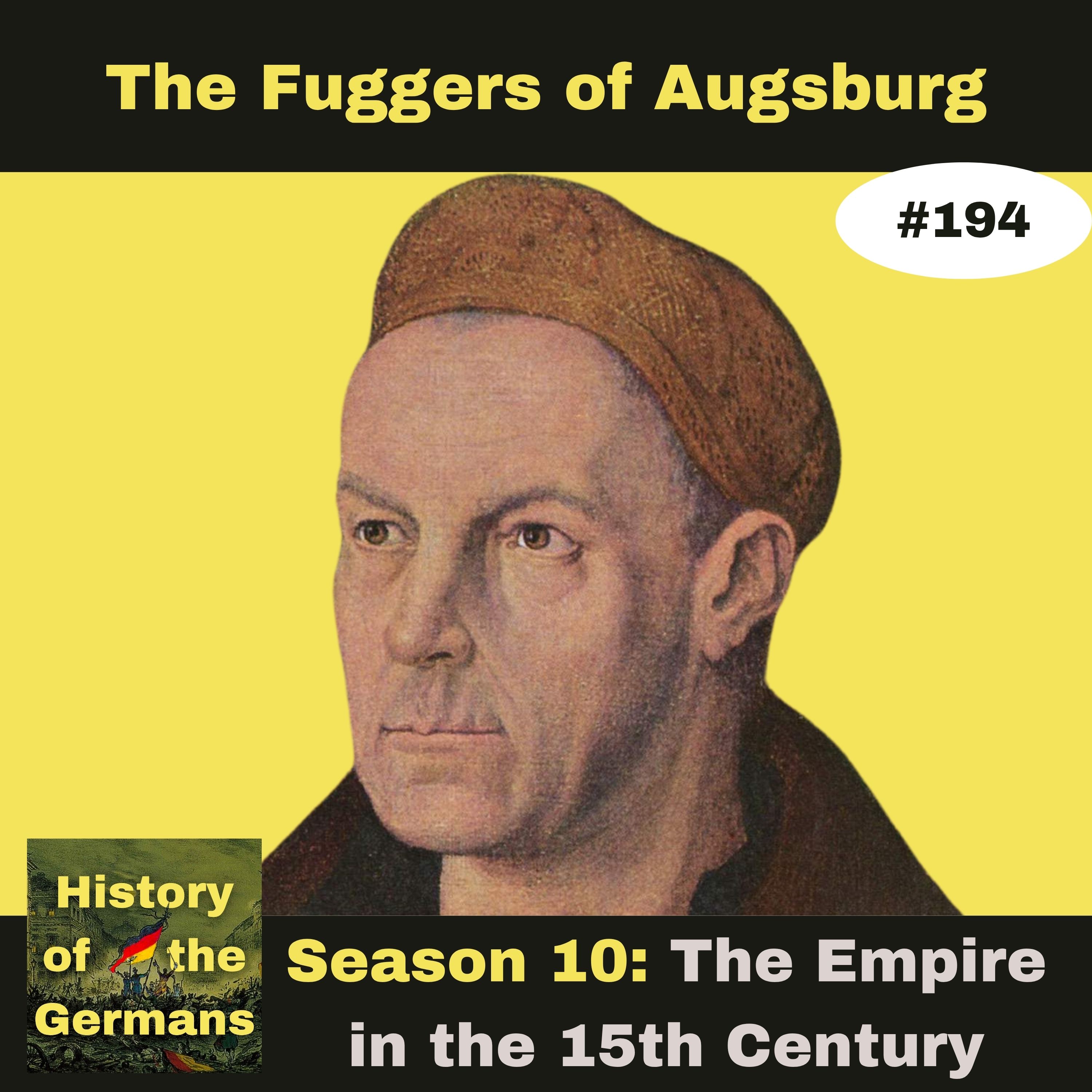
He is a man who needs no introduction, having made his first appearance 27 episodes ago in #194 The Fuggers of Augsburg. This prince as morally bankrupt as he was intellectually impoverished limped along on well and truly his last leg. He was now sixty years old and had run out of possessions he could sell off or mortgage. For forty years he had focused on creating an equal number of illegitimate children, frantically building luxurious castles and pleasure palaces and fighting pointless wars. The last of these was a totally avoidable clash with the Republic of Venice, which comprehensively ruined him even though he had actually won.
To fund his debauched pastimes, he had relied heavily on his friend, duke Albrecht IV of Bayern-Munich. Albrecht had bribed senior members of Sigismund’s entourage and gained an almost complete hold over the increasingly doddery count of Tirol. If you remember episode 197, duke Albrecht’s grand plan was to reconsolidate the territory his ancestor the emperor Ludwig the Bavarian had brought together, and that included the Tirol. And being an excellent steward of his own lands, he had the coin to bankroll whatever madcap idea Sigismund came up with.

As security for these loans, Sigismund mortgaged his lands, first the county of Burgau, a number of courts and then for the risible sum of 50,000 gulden, the whole of Further Austria. When finally all the peripheral lands were pledged away, Albrecht offered the breathtaking sum of 1 million gulden for the whole of Sigismund’s lands, with a clause requiring Sigismund’s heirs to pay off the whole sum in one go before they could take posession.
What all that boiled down to was a full takeover of the Habsburg territory outside Austria itself. If Albrecht had been successful, the Wittelsbachs would have become as powerful, or even more powerful than the Habsburgs. The Tirol was not only immensely rich due to the often mentioned silver mines and the Brenner pass, but it was also strategically crucial. The Tyrol provided the essential land connection between Astria in the east and the ancestral lands on the upper Rhine and Burgundy. If the Wittelsbach could drive a wedge between the two Habsburg territories, the power balance would tilt permanently in their favor. Munich, not Vienna would have become the imperial capital.
This process of gradual encroachment into the Tyrol and further Austria had begun in the 1470s. Albrecht was a patient and prudent player of the game. But still he made a bad mistake. In 1486, around the same time the freshly crowned king of the Romans, Maximilian was showing off the magnificence of the Low Countries to his father, Albrecht bailed out the bankrupt free city of Regensburg and incorporated it into his duchy. He may have thought this was the least offensive thing he had done to the Habsburgs, but Regensburg would become the sweet mustard his enemies will drown him in.
Talking about offending the emperor, Albrecht really knocked it out of the park in 1487. As a frequent visitor to Sigismund’s court in Innsbruck, he was introduced to Maximilian’s sister Kunigunde. Somehow the Bavarian accountant Albrecht burned up in passion for the smart and independent Kunigunde. When he asked her father for her hand in marriage, the emperor Friedrich III had initially been positive. Kunigunde was the Apple of his eye, but on the other hand an alliance with this ambitious and well regarded prince may come in handy one day.
That changed when Friedrich heard about the incorporation of Regensburg into Bavaria. Friedrich had a thing about the rights of the emperor, and removing a free and imperial city from his control was not on. He sent a letter to cousin Sigismund telling him to cancel all negotiations with Albrecht. Albrecht was undeterred and bribed Sigismund’s chancellors to forge this letter into one where Friedrich was gracefully consenting to the marriage. Kunigunde, already smitten by the Bavarian’s charm, was delighted by her father’s consent, and on January 13, 1487 uttered an enthusiastic “yes” in the court chapel of Innsbruck.
Now that was the end of the line. Friedrich III issued an imperial order to unwind all the various transactions with the Wittelsbachs, return the lands to the family fortune and asked Sigismund to dismiss his corrupt councilors. The estates of Tyrol very much agreed with Friedrich III and called a meeting in Hall in August 1487. The hapless Sigismund was confronted with a hostile crowd that accused him of causing unnecessary strife with the emperor, disrespecting his wife and tyranny. He was graciously permitted to accept a sort of temporary retirement, where he handed over the management of his lands to the estates, who in turn would pay his debts and release his property from the Wittelsbachs. All Sigismund asked for was a generous endowment for his misbegetting of bastards. After that was granted, though never paid, Sigismund the desolate count of Tyrol shuffled off the political stage. He abdicated formally in 1490 and Tyrol passed on to Maximilian who made Innsbruck his capital.
Sigismund died a few years later. His last wish was to bathe his hands one last time in buckets of coins to remind him of his nickname, der Münzreiche, he who is rich in coin. But by then he was so poor, he had to borrow the buckets from a local money man.
But that was not the end of this. All these pledged territories had already been handed over to the Bavarians, as was the custom with such credit arrangements. The two Wittelsbach dukes, Albrecht of Bavaria-Munich and his cousin, Georg of Bavaria-Landshut had no intention to hand back all the territorial gains they had made over the previous decades, and hence give up their political ambitions, not even the city of Regensburg.
If the Bavarian dukes had to be forced, the natural tool in Friedrich’s hand would have been the imperial ban followed by a request to the imperial diet to fund the military force needed to execute the ban. But the imperial diet was not a real option at this point. The coronation of Maximilian had kicked off the process of imperial reform for good, and any support from the imperial princes would have required wide reaching concessions from the emperor, something Friedrich III was not prepared to consider.
If they could not pursue it as an imperial action, what about funding their own army using the tons and tons of silver that came out of the mines of Schwaz?
Well, that wasn’t so easy. The way the mining business worked in the 15th century was as follows: The princes owned the silver in the ground as part of the regalia. But they usually lacked the money and the expertise to dig it up. So they granted a license to entrepreneurs who would do all the hard work. Under the terms of the licence the entrepreneur would be required to sell the silver at say 5 gulden when the market value was 10 to 12 gulden. The prince could theoretically sell the silver at market, but they rarely did. They were often so far in debt, they needed money right away, so bankers, like the Fuggers or Gossembrot would offer the prince 8 gulden in advance. This delta, between 5 and 8 gulden, or effectively 25% of the total value of the silver came to the prince, the rest, 45% went to the mining entrepreneur and 30% to the banker.
Sigismund managed to get himself so deep into debt, he pledged the bankers not just the right to buy the silver at 8 gulden, but even the 3 gulden he would normally take home.
Friedrich III and Maximilian had two options. They could cancel Sigismund’s agreements with the bankers, default on the old man’s loans and take the silver and sell it on the open market. That should theoretically bring hundreds of thousands of guldens to the princely purse.
But here is the rub. Who would buy the silver ore? The only people who owned smelters to extract the silver from the ore, were other bankers who had close commercial links across the industry. And they knew that if they took the silver ore, it was only a question of time before the Habsburgs would come to them for a loan and then some other banker would play the same trick on them. So they would politely decline. You do not think that is how that works? Well, just read up about Dan Gertler and his dealings in the Congo, and please use a sensible publication, not the bots.
Plus there was a whole rats’ tale of logistical issues, such as where to find the transport for the ore when all the carts are owned by the bankers, who also maintained the roads etc., etc.,,, And you still need the mining entrepreneurs who themselves had borrowed from the bankers and could be cut off from credit.
The biggest banker to Sigismund in 1487 was none other than Jakob Fugger. His consortium had lent 150,000 gulden, secured on silver from Schwaz. When they saw Sigismund’s fate going down, they opened up lines of communication with Maximilian. Maximilian understood that he was in a bind and acknowledged the claims of the Augsburg bankers. But it would still be a while before they started lending at scale to the man who would become their most famous client.
In other words, Maximilian and Friedrich III may now have princely control over two of the richest lands in Europe, the Low Countries and the Tyrol, but they still had no money and a war to fight. How?
The solution to this problem materialised in the form of the Schwäbischer Bund, the Swabian League. We have encountered these leagues and associations already several times before. There was the Rhenish league that tried to clean up the robber barons on the Rhine, theLeague of Constance fighting Charles the Bold and the most famous and most enduring one, which was of course the Hanse. The Hanse by the way never called itself the Hanseatic League, because as you may remember, under the Golden Bull the free cities of the empire were prohibited from forming such leagues. Nevertheless they appeared regularly throughout the 14th, 15, and 16th century as pressure from the territorial princes mounted.
Apart from cities clubbing together to fend off rapacious territorial lords, there were also the associations of imperial knights and counts. These members of the lower and middling aristocracy had the same problem with overbearing dukes and electors, who were bringing more and more of their class under their direct vassalage. The most famous of these associations of knights was the society of the Shield of St. George that had been around on and off since 1406.
Both city leagues and knightly associations were usually temporary alliances with modest, if any organisational structure.
This new one, the Swabian League that Friedrich III created in 1488, was quite different. Firstly, it was an imperial top down initiative, not a bottom-up one led by knights or cities. Then it brought together two normally not very aligned groups, the cities and the knights. And, it had actual institutions, the league council and the foremen of the league. The council was the main decision making body and comprised 18 to 21 elected councillors. Day to day management of the league was in the hands of the foremen, the Bundeshauptleute – German words always twice as long and thrice as precise. And finally there was a court of the league to adjudicate disputes between league members.
Another major innovation was that the councillors took decisions by majority and they were binding on all members. If you remember, the Hansetag, itself a very important institution, did not have either majority voting nor was it binding on the member cities, unless the council had instructed its representative explicitly to commit them to a particular course of action.
In the Swabian League, if the councillors decided to go to war, the league went to war. Moreover, the league had gone with the times deployed trained mercenary armies, rather than a motley assortment of diverse contingents sent by individual members. The cost of the professional army was borne by members in proportion to their perceived military and economic strength.
A nod to the old world was that the institutions were split in two and later into three. There was a bench for the 20 Swabian cities, who would send one foreman and 9 councillors and a bench for the 450plus knights, who would again send one foreman and 9 councillors.
And the league had associated members, namely the Counts of Wuerttemberg, the margrave of Baden, the archbishops of Mainz and Trier, the margraves of Ansbach and the count of Tyrol, who was technically still Sigismund, but in reality first the estates and then the Habsburgs. These associated princes were – at least initially – not full members and hence excluded from the decision making process. They were later integrated, but formed just one of the three branches, carrying the same weight as either the cities or the knights.
Which begs the question, why would any of the participants be willing to hand over their freedoms to such a rigid institutional structure. This again was a sign of the changing times. As we pointed out in episode 197, the success of the Bavarian dukes, first Ludwig of Bavaria-Landshut and then Albrecht IV of Bavaria-Munich lay in their ability to provide the basic services of the state, peace and justice. Keeping the roads free of brigands, punishing wrongdoers and building the occasional bridge or road did wonders to the willingness of subjects to pay taxes. And that is what their neighbours in the old stem duchy of Swabia noticed and they wanted a piece of it. In fact Albrecht of Bavaria -Munich was the one who set up the first, much more loosely structured league that maintained peace and justice across most of what is now southern Germany.
But by 1488 that league had broken down, in part because of Albrecht’s cousin Georg’s rudeness, but also because the ambition of the Wittelsbachs to become the new dominant power in the empire had become apparent. When Albrecht took over Regensburg, all the free cities in the region and the counts and imperial knights knew that they had only two choices, club together and retain at least part of your autonomy, or be swallowed up by the House of Wittelsbach. That is why they came.
The Swabian League would last up until 1534 and it was a participant in much of what we will discuss in the upcoming episodes.
When the Swabian league was formed in January 1488, all its members were ready and rearing to have a go at the Wittelsbachs. But the war against Bavaria had to be postponed since – as we know – at that exact point in time Maximilian was made a prisoner by the mob in Bruges and Friedrich III had to go north the free his son.
But by 1489 the two monarchs of the empire were both in Tyrol and got to work. The Swabian league mustered an army to regain the lands that Sigismund had passed on to the Wittelsbachs. His cousin Georg caved almost immediately and handed over what he had gained and paid a fine of 36,000 gulden. Albrecht was more persistent. He refused to hand over Regensburg, even tried to hold on to Further Austria, plus he insisted that his wife Kunigunde, the sister of Maximilian, had a claim on Sigismund’s inheritance.
The league members were keen on a fight, the emperor was insisting on the return of Regensburg, two of Albrecht’s younger brothers rebelled, and even an association of Bavarian knights declared a feud against their duke. The only one who did not want all-out war against his brother-in-law was Maximilian.
Maximilian was more interested in a peaceful resolution so that he could go after king Matthias of Hungary who was still sitting pretty in Vienna. The Bavarian drole de guerre persisted until 1492 when Albrecht under pressure from all sides and in view of a League army of 20,000 finally caved. He kept his duchy, Regensburg remained a free imperial city until 1803, and the Wittelsbach’s grand ambitions were smashed.
And lady fortune smiled once again on Maximilian and Friedrich III. Matthias Corvinus, had died on April 6, 1490. And what was even better, he had died without leaving a legitimate male heir. He had an illegitimate son, John, who he had hoped he could get the emperor Friedrich III to legitimise. But that never happened. John never took the Hungarian throne.
Meaning that when Matthias Hunyadi unexpectedly disappeared, the kingdom of Hungary found itself without a king. And without a king, even the worlds most expensive army is vulnerable. Maximilian realised the opportunity, convinced the estates of Tyrol to fund an army of Landsknechte and by the autumn his forces stood before Vienna. Resistance was only sporadic and he took the capital, then rushed after the retreating Hungarians into Styria, entered Hungary December 1490. He besieged and plundered the coronation city that I am afraid I cannot pronounce and moved on to Buda. But that is where the momentum stalled. As always, the money had run out and he could no longer pay his men. The winter had turned out to be extremely hard, supplies could not come down the frozen Danube and the local population enraged by the plundering hordes of mercenaries had grown hostile.
Maximilian withdrew to Austria to a hero’s welcome. Meanwhile the Hungarian magnates had chosen a new king, Wladislaw Jagiello, the man who was already king of Bohemia and whose father, Kasimir IV was king of Poland and Grand Duke of Lithuania. Within a century the descendants of Jogaila, the pagan ruler of Lithuania we met in the season on the Teutonic knights, had become a dynasty that ruled a vast landmass from the Black Sea to the Baltic.
Wladislaw, the new king of Hungary and Bohemia was however not the most impressive scion of the family. He was famous for saying well, well to anything his council of senior lords suggested and the Hungarian nobles joke that he was their king, but they were his lord and master.
Wladislaw, or more precisely the Hungarian lords were willing to make peace. Maximilian acknowledged Wladislaw as king of Hungary, but retained the right to call himself king of Hungary. They signed a treaty of friendship and for the nth time, a Habsburg signed a compact of mutual inheritance rights. Should one of them , aka Wladislaw or Maximilian die without male offspring, the other’s descendant would inherit everything. We are nearly there, only one more contract to go before the Habsburgs can take the Bohemian and Hungarian crowns for real.
To sum it up, that was some major achievement. Maximilian had regained and consolidated all the Habsburg possessions in one hand for the first time in centuries and he has added the Low Countries.
All that is true, but still, the winter of 1490 saw our hero seething with anger. Whilst he had been fighting out there in Hungary, the king of France had humiliated him in front of all of Europe. It is these pesky Frenchmen again. You can understand why he really did not like them.
When Maximilian left the Low Countries in 1489, the war against the cities and against France was not over by any measure. The fighting would go on for another three years. The reason we lost track of that is simply that Maximilian had passed on responsibility for that war to Albrecht of Saxony, an imperial prince and war entrepreneur.
The Low countries were however not the only theatre of this war. When he was mustering his army to go into Hungary, he had pondered an attack on the Franche Come and on Burgundy as an alternative. This was part of his grand plan. You see, Albrecht of Bavaria was not the only one with a grand plan, Maximilian had one too, just grander and more ambitious than his brother-in-law in Munich. But, as the great philosopher Mike Tyson so astutely observed, “everyone has a plan, until the get punched in the face”.
Maximilian’s grand plan was to completely encircle the French king and then gradually squeeze him into submission. To do that he had been building alliances for more than a decade now. He had established close links to the Spanish monarchs, Ferdinand of Aragon and Isabella of Castile. His relationship with the Tudor king Henry VII of England was wobbly given his clear Yorkist sympathies, but for now the interest of the two kings were sufficiently aligned to work together. The third main player in this game was the duke of Brittanny. Britanny at this point was an independent duchy in the North Western corner of France, quite a lot larger than modern day region of Bretagne. Throughout the Hundred Year’s war, Brittany with its Atlantic ports in St. Malo, Brest, Lorient and Nantes had been an important bridgehead for the English and an on and off ally of Burgundy. Maxmilian had inherited this relationship and duke Francois II of Burgundy had been a major supporter in the war against Louis XI and Charles VIII.
In 1488, just when Maximilian was locked up in Bruges, duke Francois first lost a decisive battle against the French and then fell off a horse and died. He left behind a daughter, Anne of Britanny, 12 years old and now suddenly the most desirable heiress in Europe.
And who was the man who desired her most, if not the master of dynastic marriages, the great heiress whisperer, Maximilian of Habsburg. He was not only after a chunky piece of real estate, he was after this specific piece of real estate, as it opened up the chance to fight France on three fronts.
Little Anne was quite excited about Maximilian’s interest, already seeing herself crowned empress by the pope in front of an admiring crowd in St. Peter. Had she listened to the History of the Germans Podcast, she might have thought about that differently.
Maximilian had one advantage over his many rivals, and specifically Charles VIII of France, he was free and single. Charles was – and I am sure you have forgotten about that, because so did I – but Charles was still, despite all the things that had happened in the meantime, engaged to Maximilian’s only daughter Margaret. Margaret had been dispatched, kidnapped, stolen, whatever you want to call it by the French after the peace of Arras in 1482. Margaret had come with an impressive dowry of cities and territories on the western edge of Burgundy. And she had grown up at the French court as the future queen and allegedly content to spend her life with the by no means attractive Charles VIII. Therefore the French party could not offer a crown to little Anne, only marriage to some cousin of the king.
Hence, when Maximilian sent his embassy to negotiate a potential betrothal, his men were well received. Discussions were as always protracted, but in the end little Anne and the imperial faction at her court made up their mind. She liked the crown, and they believed Maximilian’s promise that the army he was gathering with Tyrolian silver right now was going west to protect her and her lands against French incursions.
All was arranged, and Maximilian’s friend the handsome Polheim married little Anne by proxy. Once again a princess spent the night with a man who was not her husband with the lights on and a sword between them.
When Maximilian received the news that down in Brittany everything was ship shape and Bristol fashion, he concluded that he could now take his army to Vienna and leave little Anne for later.
But then, news travel in both directions. Little Anne, who happened to be very young, but not very thick, realised that she was not her suitor’s #1 priority. And Charles VIII realised that his #1 issue wasn’t the dowry of little Margaret, but the risk of an imperial Brittany armed to the teeth in his back.
Charles mustered his forces and set out for Britanny. He knew that nobody would stop him. The Spaniards, Ferdinand and Isabella were busy conquering Grenada, the English did not trust Maximilian, and Maximilian’s army was fighting in Hungary a thousand miles away.
The French took one castle after another and by the autumn of 1491 they stood before Anne’s capital in Rennes.
Anne, abandoned by everybody and at risk of loosing her land, agreed to meet Charles VIII. The two of them had a long chat, at the end of which they agreed terms. A few days later they met again, this time in the chapel of the castle of Rennes where they announced their engagement. You can only imagine the expression on the face of the handsome Polheim, who had only weeks earlier had spent a night with the duchess and had been convinced that he had gotten his boss married. And that marriage should still be valid, since only a papal dispensation could dissolve such a union.
Dispensation or not, Anen of Britanny married king Charles VIII of France on December 6, 1491, her second king husband, but not her last.
Maximilian was apoplectic. He was humiliated, not only because Charles had married who he believed was already his wife, but also because the Frenchman had discarded his daughter Margaret, his fiancée for almost a decade. Maximilian’s hatred for the French deepened even further, if that was at all possible. He told everyone that “No man on earth has ever been disgraced as he had been at the hands of the French”. For the rest of his life he kept a little red book where he noted all the hideous crimes the Valois had committed against him.
Then Maximilian did what a mighty lord had to do in this situation. He once again declared war on France. To do that, he once again needed an army. This time he tried to garner support by stirring up public opinion against the French. He had flyers printed shouting that the bride of the King of the Romans had been abducted – and that the honour of the empire was at stake. This attempt at propaganda did however not stick. When he asked the imperial princes for help, he received not just the usual, njet, but howls of laughter as they recounted the circumstances of his dishonour.
In the end he gathered mercenaries funded by loans backed by Tyrolian silver and at least conquered the Franche Comte. His forces did however not stretch to a conquest of the duchy of Burgundy, because once again, the money ran out. I guess you see the pattern now..
In 1493 the two sides finally came to agree a peace. Charles gave up the Franche Comte, returned Margaret and most of her dowry and recognised Philip the handsome as the heir of Burgundy. In return Maximilian acknowledged Charles and Anne’s marriage, even procured a papal dispensation.
The whole affair was so embarrassing that all documents relating to the marriage of Maximilian and Anne were destroyed. The only trace that prove it ever happened, was a receipt for 13 gold coins that the handsome Polheim had donated to the cathedral of Rennes on the occasion of the blessing of the union between Anne and Maximilian.
This war with France was finally over, the Habsburg lands were reunited in one hand. It is time for peace and reconstruction…maybe for others, not for Maximilian. For Maximilian war was not a way to reach a solution, war was the solution. So the next set of wars is just round the corner, but not now, next week.
And if you happen to have some silver that has gone up by a cool 150% in 2025, why not put some of it to good use – not hiring mercenaries – rather ensuring this show remains independent and advertising free. You know where to go and you know what to do…