Part One of the Imperial Reform (Reichsreform)

Ep. 223: Imperial Reform 1495 – The Diet of Worms History of the Germans

Listen on Spotify

Listen on Apple Podcast

Listen on YouTube

Transcript

Hello and welcome to the History of the Germans: Episode 223 – A Diet of Worms (1495 Edition)

We are now 7 episodes into the action-packed life of emperor Maximilian and he is only 35 years old. We still have another 24 years to go and they will be again full of wars, outlandish schemes, including one where he wants to make himself pope and of course marriages that create an empire. But if you look into German history schoolbooks, the thing that Maximilian is most famous for is what we will discuss today, the Imperial reforms that start in earnest in 1495 and will go through some iterations, before being largely completed in 1555.

Of the 1495 reforms, the Ewige Landfrieden is the most impactful. And it begins as follows quote:

“..from this moment on, no person of whatever rank, status, or condition shall make war on others, or rob, declare feud with, invade, or besiege them, or help anyone else to do so in person or through servitors; or violently occupy any castle, town, market, fortress, village, farmstead, or hamlet, or seize them illegally against another’s will, or damage them with fire or in any other way, or assist by word or deed or in any other way support or supply any perpetrators of such deeds, or knowingly harbor, house, feed, or give drink, aid, and comfort to such persons.”

That sounds great. Who could possibly disagree with that? Why did it take months and months of negotiations to agree this?

Let’s find out.

First up, why was reform suddenly needed?

It is hard to nail down the point in time when things went wrong for the Holy Roman Empire. It might have been as long ago as 1077 when emperor Heinrich IV had to kneel before the pope in Canossa, or was it in 1166 when the last great army of imperial vassals dies in mud and shit outside the walls of Rome. Or was it the sword that murdered Philipp of Swabia in 1208 that was the last of the thousand cuts.

Murder of Philipp of Swabia

But whatever event you choose, by 1495 the empire has been in dire straits for centuries. As friend of the podcast Silvio Aeneas Piccolomini said to the imperial princes “you acknowledge the emperor for your king and master, nevertheless he possesses but a precarious sovereignty; he has no powers; you only obey him when you choose and you are seldom inclined to obey. You are all desirous to be free: neither the princes nor estates render to him what is due; he has no revenues, no treasure. Hence you are involved in endless contests, and daily wars; hence you suffer rapine, murder and conflagrations, and a thousand evils which arise from divided authority.”

…because the endless feuding destroyed the country

When there are no powerful central institutions, law and order collapses. As one chronicler said, when the cat is away, the mice govern as they will. And what these mice liked even more than cheese was other people’s cheese.

Feuding was endemic. There weren’t just the major conflicts like the Mainzer Stiftsfehde or the Princes’ War, there were lots and lots of little fights, in particular in the south, where political power was particularly fragmented. It is the scale of it that is so shocking. Peter Wilson counted  that between 1440 and 1570 there were 278 noble feuds – in Franconia alone. In the first half of the 15th century, feuding destroyed 1,200 villages and the Hussite Revolt a further 1,500. And remember these villages are those that had survived the utter devastation in the wake of the Black Death.  

Looting and pludering from the Housebook of Wolfegg

Now nobody can claim that in the 14th and 15th century the rest of europe was an island of peace where everybody was holding hands and singing Cumbaya. The Hundred years war, the War of the Roses, the battles between the Teutonic Knights and the Polish king, the Reconquista were epic struggles that ruined the countryside in very much the same way as it did in the empire. But all these conflicts were about the consolidation of central power, the king of France against his major vassals, which included the king of England, the king of England against the dukes, the Polish king against an independent state in his midst etc. You get my drift. These wars ended with a victory of the kings, who established strong institutions that did in the end made the roads safe and stopped peasants being assaulted by the local lords. The problem in the empire was that there was no light at the end of the tunnel. One day the Margrave of Brandenburg or the Count Palatine would win some territory, next time duke of Bavaria or the duke of Wurttemberg would take it away from them. There could never be a decisive victory that could bring all this mess to an end.

Feuding and the ensuing misery for the peasant population had been a scourge of the empire for centuries. So, what was it about the 15th century that made the call for reform so deafening  that it could no longer be ignored?

…because the empire is under threat from enemies for the first time

Arguably, there were two, or depending how you want to count, three things that changed during the 15th century.

Firstly, up until the middle of the 15th century, the empire had no natural predators. It may be a mess internally and the emperors were already very weak. But the gap to its neighbouring kingdoms, France, Poland, Denmark, Hungary wasn’t that huge. All these places, as discussed before, were going through a whole lot upheaval themselves. But as they consolidated, the fringes of the empire came under threat. Provence, Dauphine, Franche Comte, Prussia, Holland, the Venetian mainland, and even Austria were gradually swallowed up by these newly consolidated kingdoms.

And the empire is still shellshocked by the outcome of the Hussite wars where crusade after crusade is defeated in ever more humiliating fashion by the Bohemian peasant armies. If the flower of the German knighthood cannot even defeat these unwashed hillbilly’s, what if someone even better organised and even more powerful shows up on the border?

Hussite army led by Jan Zizka

And there was exactly such a new kid on the block, a sort of bodybuilder kid, the Turkish Sultan who was rolling up the Balkans.

For the first time since the Magyar’s had been defeated on the Lechfeld in 955 was there a genuine threat to the very existence of the empire.  

…because the cost of defence of the realm had exploded

These new threats emerged at a time when the cost of warfare exploded. Infantry tactics using pikes could now defeat cavalry and artillery had become a necessity. The best infantry troops were mercenaries, Bohemians, Swiss and German Landsknechte who expected to be paid handsomely. Founding canon was a highly specialised skill, and even a simple field gun cost a multiple of the typical knight’s equipment of warhorse, sword and working armour.

The defence of the empire could no longer be ensured by an occasional raising of the feudal levy. France and Hungary had created standing armies, and so had the Ottoman sultan. The Janissaries counted to about 8,000 to 10,000 men plus the permanent cavalry roughly the same size. And in case of war, the sultan could call on a  multiples of that from the various regional governors, arguably as many as 200,000 men, though logistics meant they could not all be deployed at the same time in one place.

So the empire had to keep pace. In the 12th and 13th century the emperors would take 5 to 10,000 men south, Charles VIII took 30,000 men to Italy and as the Italian wars intensified, armies of 50,000 became the norm.

By the early 16th century one year of campaigning against the Ottomans cost between 1.8m and 3.6m florins and another two decades later, the annual cost of the wars with France ran at 5.4m florins annually. The regular income from the imperial treasury was 25,000 florins though occasional one-off subsidies could be materially higher. An emperor, even if he was a major territorial prince in his own right simply could no longer protect the borders.

Though the full scale of the urgency was not clear to everybody in 1495, it was understood that the current political structure of the empire had run out of road.

..and the Council of Constance had shown a way out

But there were rays of sunshine here too. Feuding and threats to the territorial integrity of the empire had not been the biggest concerns of the people in the beginning of the 15th century. The #1 issue was the great western schism, the fact that there were three popes who had all excommunicated each other and anyone who had followed their rivals, meaning everyone in europe had been excommunicated by at least 2 popes, giving them a 2 in 3 chance of hellfire.

Antonio Baldana: De magno schismate (On the Great Schism)

This massive problem had been resolved by the Council of Constance that sat between 1414 and 1418. This gave people not only hope that even the most intractable of problems could be resolved, it also gave them the tool to do it with. A church council, as we laid out way back in episodes 171 to 174 was the congregation of the faithful whose authority superseded even that of the pope. In other words ideas that had circulated since at least Marsilius of Padua, namely that authority is based on the consent of the ruled, had found manifest expression and prove more effective in resolving the schism than the hapless attempts of kings, cardinals and emperors that went on before.

The debate over Imperial Reform begins

It is no surprise that the serious debate over imperial reform kicked off for good during the later stages of the Council of Basel, i.e. in the 1430s.

This debate is I think extremely unusual, since it wasn’t conducted in the context of gatherings, like imperial assemblies or parliament, as it would have happened in the more centralised kingdoms of France or England. Because Germany was already fragmented into dozens of important centres, some princely residences, some free imperial cities, the debate was conducted in writing. Initially by copying manuscripts by hand, but soon after Gutenberg had invented the printing press, many of these documents were printed and distributed widely.  

Most of these documents begin with an analysis of the dire state of the empire. Here is one commissioned by the archbishop of Trier in 1452 (quote): “… we perceive that there is neither peace nor justice nor prosecution of the law anywhere in the Empire’s affairs. There are many wanton conflicts, disobediences of subjects towards their lords, robberies, arsons, murders, thefts on the roads, feuds and enmities, without any justice or integrity. Neither freedom nor peace is anywhere to be found. Any given prince must defend himself with his own might. When he pursues peace or war in one place, new disputes instantly begin elsewhere. It is constantly necessary for princes, counts, lords, nobles and other good people to prepare for battle, or to pay money to avoid being attacked. It follows from this that the principalities are decayed and ruined through pledging, destruction, base and sinful usury and other day-to-day futile, pernicious, great and severe costs. In the same way, counties, lordships, monasteries and collegiate churches are also reduced to extreme poverty and ruin, and the more prestige and temporal goods they have, the greater the damage they suffer.

From this it also follows that the Roman Empire, the emperor, the princes and all the German nation is now considered the least by all other nations… It therefore seems to me to be necessary to consider a means to raise up the Empire and to put in order the matters of the Empire.”

The analysis was the part that everyone agreed on, it was the solution that was contentious. There are a dozen or so “major” documents that are considered part of this debate and that have influenced the Imperial reform process, though I would assume there were loads more that did not cut as deep.

In a very broad way, they fall into three camps.

Solution 1 – MEGA – Make the Emperor Great Again

In 1437 a paper appears that proclaims to be the “Reforms of Emperor Sigismund”, though it it is very unlikely he actually wrote it. For that the language is a little bit too fruity. The author does not hold back when he lays into the corruption and selfishness of the imperial princes. He is also interestingly very much against the imperial free cities, who he blames for not paying enough taxes. He says that when the heads of the church and the empire are confronted with their injustices, they quote: “turn their arses to us”.  Not quite the tone of the imperial chancery.

His solution was to go back to the great and powerful emperors of the early Middle Ages. The princes, both the temporal and the spiritual ones should return all the lands, tolls, mints, mining rights that had once belonged to the empire. Then the emperor would again have the resources to deliver peace and justice and protect the realm.

This was of course never going to happen. But the “Reforms of Emperor Sigismund” remained in print throughout the 15th and 16th century and enjoyed a lot of support amongst the lower classes, largely because it declared the following – quote: 

“It is an unheard-of outrage – a great, ongoing injustice which ought to be publicized to all of Christendom – that some are so spiritually impoverished before God that they speak thus to their fellow human, whom God has powerfully redeemed and freed: ‘You are my property!’ This is a heathen way of behaving. God has redeemed us from all bonds, and henceforth nobody should haughtily exalt themselves into any position of ownership over another.” End quote

This idea of a renewed imperial power that could right all the wrongs done to the serfs and peasants was an important factor in the various uprisings and finally the Peasant War.

When these proposals were going a bit too fa, there were other, more moderate suggestions to create an effective imperial executive that enjoyed support.

Solution 2 – Let a Dozen Oligarchs Bloom

This position was first articulated in the policy paper, issued by the archbishop of Trier in 1452 that I have already quoted from before.

He proposed that every year the emperor and the electors come together in a city in the centre of the Reich and establish a court. Here all decisions about war, peace and justice were to be taken. As for the inner workings of this court he says quote:  “each and every thing required for this establishment of justice and organization of the emperor’s court should be properly ordained by us, the electors, and the councillors whom we appoint for this purpose”.

The idea here is to set up a sort of oligarchy that runs the empire, keeps the peace, establish a system of courts to resolve disputes, bans feuding and raises armies for the defence of the realm as and when needed. The name for this structure was the Reichsregiment, best translated as the Imperial Government.

In this scenario the emperor was just a senior member of the Imperial Government with some ceremonial duties and maybe the nominal command of the army in case of war.

There are variations to this theme differing around the question of who is going to be a member of the Imperial Government. There were after all a number of very powerful imperial princes who were not electors like the dukes of Bavaria, Wurttemberg, Brunswick, Holstein and the Landgraves of Hesse to name just a few. And these princes were as disinclined to be ruled by the seven electors as they resented imperial interference in their affairs.

Solution 3 – Be More Pope

This proposal originated with Nicolas von Cues, one of the most influential theologians and thinkers of the age. Cues took inspiration from the church councils of Constance and Basel, the events that had given people hope that the difficulties of the empire could be resolved in the first place.  

Nicholas of Cusa

For him, the Reichstag, much like a church council, should represent the constituent parts of the empire, decide the laws and has the ultimate say in how the empire is to be run. The Reichstag should convene annually and a committee formed by the Reichstag should exercise its rights during the time the Reichstag wasn’t sitting.

But Cusanus did not want to replace the emperor with an imperial government, in the same way the church council did not replace the pope. He believed the empire needed a strong executive power to deliver peace and justice. The emperor should command a standing imperial army funded by an imperial tax. He would also direct four imperial vicars based in Brabant, Austria, Milan and Savoy who would administrate four regions or circles of the empire. Next, an eternal peace that banned feuding would be passed by the Reichstag and a system of courts established. Decision of the courts would be enforced by the imperial vicars or the emperor himself.

These are the three options, return to the good old days of Otto the Great, create an Imperial government made up of electors and maybe princes and third, a sort of middle way where we end up with the Reichstag and the emperor working together, one focusing on passing the rules and the other on enforcing the decisions, in particular the ban on feuding and the defence of the empire.

Attempts so far by Trier & Martin Mayr

Fascinating as this debate amongst clerics and intellectuals may be, this does not solve the problem unless somebody does something.

As you may remember from the previous seasons, efforts have been made to bring about imperial reform.

The electors deposed Wenceslaus the Lazy for incompetence and replaced him with Ruprecht of the Palatinate in the hope he would resolve the issue. When neither he nor Sigismund moved things on, they planned to depose Sigismund as well, but failed to agree on a candidate for his succession. Still first attempts at establishing a general imperial tax were made, but petered out rapidly (episode 179).

There was a lot of enthusiasm when Friedrich III come in and established the Kammergericht as an imperial court staffed with professional judges but that had evaporated rapidly. In the 1450s and 1460s several princes, guided by Martin Mayr, attempted to reform the empire by replacing Friedrich III with a more suitable, or malleable candidate. Various names were floated, including Friedrich the Victorious of the Palatinate and Georg von Podiebrad, the king of Bohemia.

But neither of these schemes came to fruition. In the 30 years before the diet of Worms of 1495, the debate had gradually turned into a standoff. The princes demanded action, and in 1467 Friedrich III passed a time limited Landfrieden, or general peace and re- established the Kammergericht. However this did not materially reduced feuding, mainly because the Kammergericht judges often went without pay and Friedrich III lacked the resources to enforce their judgements.

After that things then ground to a complete halt. Every time the estates demanded more significant change, Friedrich III refused to even debate it, at which point the princes refused any help in the various wars and conflicts, except for the most obvious cases at Neuss and when Maximilian was imprisoned in Bruges.

The 19th century came down hard on Friedrich III, blamed the continued delay in German statehood on his intransigence. However, since the princely proposals were usually along the lines of the archbishop of Trier, aka asking for a complete emasculation of the emperor and the establishment of a princely Imperial Government, I can understand why he kept going Njet, or in Austria “na”

Maximilian on the other hand was more inclined to discuss imperial reform. He could see that his father’s strategy had run out of road. He had fought the French on the Western border for a decade and his dream was to go up against the Turks. There was no way he could do that without the support of the imperial estates. And the only way to ensure consistent support from the estates was by establishing new institutions and taxation model.

Therefore, when he was elected in 1486 he gave some subtle or not so subtle hints that he was ready to negotiate. But he could never really act on this since his father stepped in every time Maximilian was about to make concessions.

That is why nothing happened until 1495. But in 1495 Friedrich III, minus one half leg, was safely three feet under and the real discussion could begin.

Convocation of the Diet of Worms

Maximilian called on the imperial estates to assemble in Worms on February 2, 1495. When he did that, he had not intended to make this a debate about imperial reform. All he wanted was a two week get together, at the end of which the estates would grant him two things, an immediate subsidy to raise an army to go after king Charles VIII of France who had invaded the empire in Italy, and ideally a longer term say 10 to 12 year commitment to fund a standing army for the defense against the Turks.

Worms – Haus zur Munze where the Diet met

As usual, Maximilian was late. When he got to Worms on March 18th, there was hardly anyone there. It took another 10 days before enough princes were assembled to form a quorum. Maximilian made a speech, said, give me the money now, it is urgent, the French are already in Naples.

This went down like a lead balloon. The still rather small audience was taken aback by the speech. Maximilian had not mentioned the imperial reform at all. Not a single word, not even  a gentle nod in the general direction. Why, this was the first gathering after Friedrich III’s death. Of course we should discuss the Imperial reform now. They stalled and said we should wait until more princes are here.

April 1495 – The debate begins for real.

It took until April 7th for the 147 participants to make their way to Worms. There were 5 of the 7 electors, 29 temporal princes and 10 spiritual lords had come in person and a further 12 had sent their representatives. Then there were 67 counts and imperial knights and 24 imperial cities present.

By now Maximilian was getting seriously twitchy. He was not prepared for some longish constitutional debate. Literally a week ago his envoys had signed up for the Holy League and his new Italian and Spanish allies expected him to come down to Italy with an army and help trap the king of France in Naples. He also had another couple of irons in the fire. Perkin Warbeck, the Yorkist pretender was recruiting an army for his landing in England. This army was paid for by Maximilian and his mother in law, Margaret of York and was sailing in July of that same year. And there was still a rest of the Burgundian war going on in Gelders, where the French supported a claimant to the duchy.

Maximilian really needed to get this done and quick.

But that was not easy. The princes, bishops, counts, knights and cities who had gathered in Worms believed that it was now or never. Maximilian’s father was dead and the new king should now engage on the long overdue reforms, and moreover, they had him by the short and curly’s. Plus, if they would give him the money now and he defeated the French, went to Rome, got crowned emperor and returned as the victorious hero, it would take decades before they could nail him down again.

So they stalled. They took the imperial funding proposals and pretended they were debating them. But in reality, they discussed what imperial reforms they would demand of Maximilian. After a few weeks of no progress, Maximilian realised that his schedule was no longer achievable. He called the estates, asked them what they wanted and they presented him with a document outlining a range of reforms they wanted to discuss. These looked aspirational, but not excessive and Maximilian reluctantly agreed that the Reichstag would now debate imperial reform.

The decision making process

To understand what happened next, we have to take a quick look at the way the Reichstag makes its decisions.

The Reichstag is not a parliament where everybody is in one room and debates the issues of the day.  The Reichstag is actually three separate colleges, one for the Electors, one for the imperial princes and the counts and a third one for the cities.

The process starts with an imperial proposal that sets the agenda. The proposal goes into each of the colleges, where the members discuss it behind closed doors and vote on their response.

Reichstag meeting 1640

Then the three colleges compare their respective opinions and debate and revise them, until they arrive at a unanimous opinion of all three colleges which is then presented to the emperor. The emperor can then either agree or reject it. If he rejected it, it went back to the colleges and the whole process starts again.

This process took ages!

The process was heavily tilted in favour of the electors and major territorial princes. These two colleges would coordinate their opinions before they would show them to the college of the cities who could then only get smaller adjustments through. Secondly, the smaller entities, the counts, abbots, abbesses and imperial knights had to pool their votes, weighing no more than the vote of one of the princes, and peasants were of course not represented at all.

And the emperor was not allowed to be present at any of these. He was literally hopping mad outside the closed doors as the king of France slipped through his fingers.

And because it was complex and involved a lot of chats in corridors and meetups in side rooms, it required someone to manage the process. Enter stage left, Berthold von Henneberg, archbishop of Mainz.

Berthold von Henneberg

Berthold has been painted as Maximilian’s great adversary who fought for the rights of the estates against a recalcitrant ruler, unwilling to pass any reforms. But that is probably inaccurate. Berthold was, like many other bishops and abbots, very keen on a permanent peace and an effective ban on feuding. As we have seen in the example of Mainz, the largely defenceless church territories were under constant attack from rapacious princes. And he also believed that an Imperial Government would be much better able to achieve law and order than the emperor. But he wasn’t a revolutionary flying the flag of the liberty in the face of tyranny. He was more the guy who brokered the compromise the estates could bring to the emperor.

With all the preliminaries out of the way, we can look at the actual debates. I think the whole process breaks down into three separate phases.

Phase 1  lasted from March 18th to April 27th 1495. In that phase Maximilian pushed for his initial proposal to just give him the money and maybe discuss imperial reform later. That proposal was stalled by the estates. Instead they presented him with a counterproposal, to first discuss a permanent peace, the establishment or revival of the courts, the Kammergericht and the Reichsregiment, the Imperial government.  Once that has been agreed they would be happy to discuss the funding of the army and taxation. Maximilian resented the idea of an Imperial government where the electors had a huge amount of power, but given his position, he agreed to proceed on this basis.

Phase 2 lasted from April 27th to June 22nd. As described above, the Reichstag set-up and process is heavily skewed to the electors and Imperial princes. And the electors and imperial princes know that Maximilian is under massive pressure. So they ransack the sweetshop. What the Reichstag presents on May 18th 1495 was a princely fever dream.

They propose an Imperial Government made up of 17 representatives that would be given full control of the state. They would handle Finance, domestic and foreign policy, defence, law and order, justice and even legislation. In this Imperial government the emperor would have only 3 of the 17 votes. In a particularly misjudged slight, the Habsburg duchies did not have a permanent seat in this government. What enraged Maximilian even more, if that is at all possible, was that the conduct of external wars was taken away from him completely. The Imperial government was to appoint an Imperial Captain who would raise troops, appoint officers, manage logistics and lead in battle.

That would have turned the emperor into a completely powerless figurehead, wheeled out on special occasions looking fancy in his crown and gown.

It also did not help that the proposal came with a whole host of accusations that Maximilian and his predecessors had presided over a century of decay and loss of territory. And since the emperors had let so many lands go, the burden on these who had remained was now exorbitant. So before he asked for more money, he should go and collect the outstanding dues in Provence, the Rhone Valley and the Low Countries.

Obviously there is no way in the world or outside it that Maximilian would sign on to this. They tried to sweeten the deal by granting him 100,000 florins to raise an army but that was less than the 150,000 he had asked for, and as we will see is only paid when it was too late.

When he receive the proposals on May 25th, he called it for what it was, blackmail. He was so angry, he did not respond for almost a month. Instead he acted as if there was no Reichstag going on. He invested Ludovico il Moro as duke of Milan without asking the electors, he negotiated with the Swiss about hiring mercenaries for a war against the French and the Turks.

Having spent weeks jumping up and down outside the council chambers of the Reichstag, now he let the princes walk by his chamber wondering what the king would do next.

It must have been a true feat of self-discipline to not go and beg for money. With every day that passed the chances to meet his international commitments and to catch the king of France were dwindling away. But there was no way he could hand over the crown of the empire to the princes. There is more of his old man in Maximilian that it appears at first sight.

But Maximilian wasn’t idle. He seeded discontent amongst the estates. Not everyone was keen on an all-powerful Imperial government dominated by the Prince-electors. All the smaller entities, the counts, the abbots, the cities, the imperial knights feared quite rightly that they would be swallowed up by the larger territorial princes. But even some of the most powerful dukes, of Bavaria and Saxony were unhappy with the limitations to what was right now almost complete autonomy. Slowly but surely the consensus over a princely oligarchy was falling apart.

The first indication that the princes were about to cave came when they revised their proposals for the permanent peace and the process for the professional court, the Kammergericht. These were all topics where the two sides had a lot of common ground. These proposals then became the basis on which productive negotiations continued for the rest of the Reichstag.  

But on the Imperial government, not a peep until, almost a month later, on June 22 he sent a revised version of the Reichstag proposals back to the colleges. He had taken their text and just simply flipped words, so that for instance the Imperial Government was to be staffed not by the princes, but by people the emperor chose. It would be based, not in Frankfurt, but at the imperial court. Whole sections he did not approve off, like the section on the Imperial Captain, he simply dropped.

All that went back to Reichstag for further debate, which kicks off Phase 3.

We are now at the end of June. The battle of Fornuovo took place on July 8th. Charles VIII was home and dry. Perkin Warbeck’s landing in England had ended in a total disaster. The guy did not even get ashore before his small army was decimated. Gelders could wait another year.

Basically, the power of blackmail the estates had over Maximilian was gone. The ball is now in the King’s court. Now he can use time to force concessions.

On June 28th, the electors and princes give up their idea of an Imperial Government that replaces the emperor. Instead they agree to something called the “Handhabung” that laid down some rules about a governing council and the Reichstag procedure that would soon be revised.

And whilst all this back and forth over power in the empire went on, a few unsung heroes managed to forge an agreement between all the parties involved that would actually stand the test of time. The “Ewige Landfrieden”, the eternal peace which at least formally ended feuding in the empire, the Kammergerichtsordnung, the procedural for the professional imperial court and the Common Penny, the tax that was meant to fund these institutions.

Some of these were real breakthroughs that stayed on the statute book until 1806, others were less successful, but 1495 marked a huge step towards the curious constitutional structure of the Holy Roman Empire that we will discuss in more detail next week. I hope you will join us again.

And as always, if you feel this show serves a purpose that you feel is worth supporting, go to historyofthegermans.com/support where you find all sorts of exciting ways to keep me in my seat chatting about long forgotten empires.

And a big thankyou to Duncan Hardy whose translations of key documents I used extensively in this episode. You can find a link to his excellent book in the travel, maps and books section of my website

The End of the Unversal Empire

Ep. 222: Maximilian I (1493-1519) – Italian Wars and Spanish Marriages History of the Germans

Transcript

Hello and welcome to the History of the Germans: Episode 222 – Italian Wars and Spanish Marriages

The world is a-changing. Maximilian I may still dream of the medieval universal empire where he will lead Christendom in an epic crusade to expel the Turks from the European mainland, even reconquering Jerusalem. Meanwhile his main adversary, king Charles VIII of France unleashed the fury of war in Italy, kicking off a struggle that would last for 50 years and replaced the medieval world of popes and emperors with a system based on the balance of powers.

In the near term, this expedition to conquer the kingdom of Naples triggered not only the outbreak of Syphilis, but also the double marriage between Habsburg and Spain that Maximilian did not want, but ended up being the second of the three marriages that created an empire.

Lots to get through, none of it boring..

But before we start it is once more time for me to go to Augsburg and beg for some more funds to raise and equip my modest podcast set-up. I know that you know that I can never pay it back, other than with my sincere, heartfelt and eternal gratitude. And if you too hanker after such deep felt sentiment, go to historyofthegermans.com/support and join the most generous Mary J H., Barry T., Aleksandar A., Tudor C., Matthew J, Carnicelli and Brett C.

And with that, back to the show.

Last week we saw Maximilian of Habsburg reconquering and consolidating the lands of his family. For the first time in XXXX years, there was only one member of the family who held Austria, Styria, Carinthia, Tyrol and Further Austria. Maximilian had also added Flanders, Brabant, Holland, Hainault, Seeland, Luxemburg and the Franche Comte to the family fortune, most of what is today Belgium, Luxemburg and the Netherlands. Friesland and Gelders would take a bit longer, but came on to the roster eventually.

Habsburg empire in 1547

And then, in August 1493 Maximilian’s father, the emperor Friedrich III expires at the tender age of 77 and after 53 years of keeping the throne of the Holy Roman Empire warm. His health had been deteriorating for a while now and in June his doctors had amputated his sclerotic left leg. This widely documented medical procedure was hailed as hugely successful, though the patient died three months later, allegedly from excessive consumption of melons.

Amputation of the leg of Friedrich III

Friedrich III has been a steady companion of this show for 12 episodes, often in the background, and when in the spotlight it was mainly because he had once more lost a city, a battle, a duchy or a kingdom. He had his highpoint at the siege of Neuss and he could get his son elected King of the Romans, a feat not many emperors had achieved before him. But the low points and disappointments prevailed. Being besieged inside the Hofburg in Vienna by his brother and the burghers of the city was the moment where the dynasty could have failed for good, and his last years as a wandering homeless emperor in name only did little to strengthen the esteem the office was held in.

Over the previous decades the reception of Friedrich III has improved significantly. The 19th century had dubbed him the imperial arch sleepy hat and blamed him for the continued erosion of imperial power. Modern historians see him more as man who tried to maintain as much of the institution as he could, given his limited resources. He was persistent in retaining the imperial prerogatives, even if he was unable to exercise them. He had steadfastly resisted the calls to reform the empire into a loose confederation led by the imperial princes, even when he stood literally with the back against the wall.

This makes a lot of sense to me, in as much as the duchies of Austria, Styria and Carinthia were indeed not enough to sustain a forceful imperial administration. Even more so considering their  geographical location on the eastern edge of the empire.

On the other hand, the 15th century was a time where ambitious and smart men were able to forge kingdoms. Charles VII of France had been disinherited by his mother and father, most of his kingdom had been occupied by English and Burgundian forces and still by the time his son Louis XI died, France was the largest and most coherent power on the continent. Henry VII, the first Tudor king had spent 14 years in exile and carried only a thimble of royal blood and still brought an end to civil war and created a platform on which his descendant could build one of the most successful political entities the world had ever seen. Matthias Corvinus was the son of a hero, but came to the throne as a puppet of the magnates, and turned Hungary into a modern, militarised country. Jogaila, the pagan grand duke of Lithuania, created a dynasty that in 1493 ruled Poland, Lithuania, Bohemia and Hungary.

The empire of the Jagioellons

Friedrich III was simply not like these aggressive, daring men. He was a high aristocrat of the old school who believed that all this power was owed to him because of his lineage or because it had been foretold in the tale of the 95 rulers of Austria, or because Caesar and Nero had singled Austria out for world domination. A.E.I.O.U.

Meanwhile his son Maximilian was one of these aggressive Renaissance gamblers who put everything on red in order to win an empire. He had himself emerged victorious from the war of the Burgundian inheritance having received barely any support from his father or the empire until the very last moment. And as we will see in the upcoming episodes, he would again and again make high stakes bets that just happen to come good.

But at the same time, he was the son of his father. He deeply believed in the sanctity and superiority of the imperial office and the Habsburgs predestination to hold this title until the end of times. He saw his purpose in leading Christendom in its war against the Turks and constantly called crusades aimed at freeing first Constantinople and then Jerusalem. These other kings, the French, English, Polish, Spanish and so forth, they should be subordinate to him once he was crowned emperor.

Just to be clear, he was wasn’t mad thinking these much more powerful rulers would be at his back and call. He saw them more like the Imperial princes, largely autonomous, but in crucial matters of the continent, obliged to follow his lead. His political philosophy was deeply routed in this idea of the universal roman empire.

One incident that shows the state of this universal empire was when he established diplomatic relationships with the principality of Muscovy. At this point Ivan III, the grandfather of Ivan the Terrible went by the title of Grand Prince of Moscow, but occasionally use the term Tsar, as in Caesar or emperor of all the Russians. Maximilian offered him the elevation to king, something he could do in his function as emperor, even emperor in waiting. But Ivan III refused, saying that he was the successor of the emperors of Constantinople and did not recognise the Habsburg as his emperor. Only a small blow to this idea of a universal imperial authority, but too small to be noticed. However, not the last.

As emperor, Maximilian believed that Northern, if not all of Italy was part of his realm. Sure, no emperor had exercised any tangible power in Italy since the days of Henry VII, but formally, Italy was still part of the empire. When the Gonzagas in Mantua, the Este in Ferrara or the Sforza in Milan wanted to take on ducal titles, they looked to the emperor for a patent that made them so. The emperor was also occasionally called on to arbitrate conflicts or to acknowledge lines of succession.

Maximilian, fresh from gaining Burgundy and Tirol, from reconquering Austria and becoming the sole ruler of the empire after his father’s death, now took a closer look at Italy, specifically at Milan.

By 1493 Milan had become one of the most important states in Italy, alongside Venice, Naples, Florence and the Papacy. It had incorporated several of the old city republics that had featured so prominently in the story of Barbarossa and Fredrick II, namely Piacenza, Pavia, Parma, Cremona, Lodi, Novara, Tortona and Alessandria. Its de facto ruler was Ludovico Sforza, called il Moro, the son of the great condottiere Francesco Sforza who had taken the duchy over from the Visconti family.

Ludovico ruled on behalf of his nephew Gian Galeazzo Maria, but was very keen to become duke in his own right. The only person who could do that legally and formally, was now Maximilian. In exchange for recognising his position Ludovico offered Maximilian two things he needed desperately at this point, money, and a wife. Money is something Maximilian always needed, in particular if the sum offered was 400,000 gulden, roughly twice his annual income at the time. And Maximilian needed a wife. This whole affair of the heiress of Brittany, little Anne, had left a bad aftertaste.

Map of Italy in 1494

Maximilian had shouted from the rooftops that his bride had been abducted by the perfidious French king Charles VIII, but in 1493 had made peace and was now busy brushing the whole affair under the carpet. The best way to achieve that was another high profile marriage that makes him look as if he had rejected Anne, not the other way around.

So, on March 16, 1494 Maximilian married Bianca Maria Sforza, the niece of Ludovico il Moro. Despite her beautiful name and vast riches, Maximilian lost interest in her very quickly. She turned out to be a little bit thick, a bit too fond of sweats and jewels and just generally not great company. So, this time, Maximilian does not fall in love with his spouse. What he had instead was a regular supply of mistresses, some of whom bore him children, though it is unclear how many. Wikipedia counts 15, contemporary sources say 8. Several in any case, though he did not have any children with Bianca Maria Sforza.

Profilbildnis Kaiserin Bianca Maria di Galeazzo Maria Sforza (1472-1510)

The year 1494 did hence start off not too bad. He got married, he got money from his new ally in Milan, he is now sole ruler of the empire and his lands are gradually recovering from the endless warfare and strife. He even undertakes the traditional Umritt, the journey across the empire where he received grand welcomes, renewal of feudal vows and general acclamation.

But all that joy and celebration turns to panic and despair when news arrive that king Charles VIII of France had set off on a military expedition to take the kingdom of Naples. That went to the heart of Maximilian’s political vision. He wanted France encircled by hostile nations, the English in the North, the Spaniards in the south and him in the West. If France gained powerful positions in Italy, that grand plan was dust. Moreover, Charles VIII had dubbed his invasion a crusade hinting at a long term plan to attack the Ottomans from Naples. That too was not on, because in Maximilian’s world, a crusade would attack in the Balkans and was to be led by him, and nobody else. Moreover, if Charles VIII was successful in a crusade, what would stop him from asking the pope to crown him emperor. As Matthew Paris had declared already way back in the 1250s: “Where is it written that the Germans should make the roman emperor”. This is the same concern that had convinced Henry VII that it was paramount for him to get involved in Italian affairs. Moreover, the pope in 1494 was Alexander VI, Roderigo Borgia, a man whose reputation for corruption and ambition reverberates through history books and tv series.

Portrait of King Charles VIII of France (1470–1498), wearing the Collar of the Order of Saint Michael

What Maximilian and europe will learn in the coming decades is that his ideas about crusades, empire and the unity of Christendom are completely and utterly outdated. The Europe of 1500 is fundamentally different to the Europe of 1400 and unrecognisable from the Europe of 1200.

The great wars of the 14th and 15th century were in the main domestic conflicts over leadership and internal consolidation. The Reconquista was about unifying the Iberian peninsula, the Hundred years war was about the role of the king of France vis-à-vis his vassals, which included the duke of Burgundy and the king of England, Poland’s war against the Teutonic Knights was about submission of an independent state within their territory. The wars in the Holy Roman Empire and Italy were over the relative power of individual entities in the absence of a powerful king.

By the end of the 15th century many of these wars have come to their conclusion. The Spanish completed the Reconquista with the marriage of Ferdinand and Isabella in 1469 and the conquest of Grenada in 1492. The Hundred Years War and the marriage of Charles VIII to Anne of Bretagne consolidated almost the entirety of France under control of the crown. Equally the Tudor kings Henry VII and Henry VIII held direct sovereignty over England and Wales without intermediation by the dukes. In other words we are now having multiple political entities in europe that have the ability to raise extraordinary amounts of money in direct taxes from their subjects. And these taxes are converted into permanent armed forces or the hiring of trained mercenaries. And once you have those, the scale and scope of war changed.

Europe in 1500

We are now having kingdoms fighting against each other for supremacy, preferably on third party soil. Victory no longer means the defeated prince swears allegiance to the victor and returns to his or her palace. Now victory results in the annexation of territory and the removal of the previous management. There is no longer an emperor as a central authority tasked with maintaining peace between the parties, not even in theory. In 1414 Europe accepted that the emperor Sigismund had a responsibility to bring an end to the Great Western Schism. By 1500, that would no longer be the case.

The Italian war will change all that. In this war we will find French heavy cavalry, Spanish infantry, Swiss mercenaries, German Landsknechte, even English and Scottish soldiers fighting against and alongside Italians on Italian soil but not mainly for Italians, but for foreigners.

Batttle of Pavia tapestry

When previously the emperors came down to Italy, they travelled through what most people believed was their empire. They did fight, not as foreigners against “the Italians”, but as the overlord against their insurgent cities and the pope. Barbarossa did not come to conquer Italy, he came to reassert his authority in Italy as emperor. Where he found resistance it was from cities who did oppose, not his overlordship as such, but his level of interference.

What is happening now is that foreign armies come to Italy to conquer it and incorporate it into their realm. And that is why the invasion of Italy by Charles VIII is the moment when the political landscape of europe flips from the medieval to the early modern.

But I am jumping ahead. Let’s first look at why Charles VIII set out for Italy with an army of 1,900 Lances, 1,200 mounted archers and 19,000 mostly Swiss infantry in August 1494.

As a I mentioned before, the Italian communes were no more. Italy had become a patchwork of larger and smaller states. Some were nominally republics like Florence, Siena and Venice, but most were under control of a single ruler, some of them had been graced with imperial titles like the marquess of Mantua or the dukes of Urbino, Ferrara and Milan, others remained just Signore.

The five biggest states were Venice, Milan, Naples, the Papacy and Florence.

Let me go through them one by one.

The city of Venice had done exceedingly well, since, well since its founding. By the late 15th century the Venetians controlled the Adriatic as well as multiple trading posts along the eastern mediterranean giving them access to the luxury goods coming down the silk roads into Constantinople, Alexandria and lots of smaller ports. Its power rested on its navy that at its peak comprised 3,000 ships manned by 36,000 sailors. In its famous dockyards, the Arsenale,16,000 workers produced one galley a day using standardised parts for construction and fit out, a process that looked a lot like modern industrial manufacturing.

And Venice had also begun to acquire more and more of its hinterland. The first acquisition on the mainland was Mestre in 1337 and within about a hundred years, Venice had pushed through to Padova, Treviso, Vicenza, Verona, Friuli, and then Bergamo, Brescia, Crema, Cremona and Lodi. These latter acquisitions brought Venice into conflict with neighbouring Milan.

Venice had an interest in Naples too, in as much as the  straights of Otranto were the narrow access point into their Adriatic.

Milan, as I mentioned had gone from the Visconti to the Sforza. In this process the duchy had shrunk, in particular by conceding cities to Venice. But it was still a formidable power, controlled, albeit precariously by Ludovico Sforza, called il Moro.

Traditionally Milan had allied with Florence against Venice and Venice had found support in Naples. This opposition to Naples continued into the late 15th century. Ludovice Sforza was specifically concerned that the Neapolitans were trying to undermine his position by supporting his nephew Gian Galeazzo Maria, who was after all the true heir to the duchy of Milan.

Which gets us to Naples. Unlike the other states, Naples was originally a kingdom, the kingdom of Sicily. Sicily had changed hands a few times since its foundation by Roger II. You may remember that Charles of Anjou from a junior branch of the French royal house, had wrestled the kingdom of Sicily from the Hohenstaufen. He did however lose the island of Sicily to the kings of Aragon in the Sicilian Vespers (episode 92). The Aragonese and the Anjou spent about a hundred and fifty years staring at each other across the straits of Messina, until Alfonso V of Aragon made a move on the mainland, which by then had become known as the kingdom of Naples. The ins and outs of this exceedingly complex process is impossible to recount here. For this and all the other stories, I recommend a History of Italy where Mike Corradi takes you through all these shenanigans in his inimitable style. And the History of Venice will in time cover the Venetian leg of the story.

Bottom line is, the Aragonese conquered the kingdom of Naples and sent the Anjou packing. The last of them, Rene, passed his time in Provence where he became known as the Good king Rene.

Meanwhile the new king, Alfonso of Aragon decided to give this kingdom of Naples to his illegitimate son, Ferdinand, or as the Italians called him, Ferrante. Ferrante was an exceptionally capable, cruel and ruthless ruler who made himself into one of the most powerful and influential figures in Renaissance Italy.

Naples main interest lay due north of them, in the papal states. For one, the popes were his direct neighbours, but the pope was also the overlord of Sicily with the right to determine who was the king. Given Ferrante’s  birth out of wedlock, that was an important issue. Naples tended to ally with Venice, whose fleet could put pressure on the popes, and who needed to get its ships through the narrow straits of Otranto.

Please bear with me, we are nearly done with this epic simplification.

The papacy was still in an awful state. The council of Constance had ended the schism in 1418 and pope Martin V was again the sole pope ruling from the eternal city. But during the schism and then in the struggle between the church councils and the popes, many monarchies had agreed concordats with the popes that granted the national churches autonomy from Rome. France, England, Spain and the Habsburg lands had national churches where the pope had scarce influence over the appointment of bishops and had limited call on church taxes. Thanks to Friedrich III’s poor negotiations, the empire became the largest source of external revenues for the papacy, an issue we already touched upon in episode 209 are going to encounter again I am sure.

Italy in 1499

Given there was not enough money coming in from abroad, the Renaissance church had one major objective, which was to reconsolidate the papal states. During the papal absence from Rome, many of the cities in the papal states have come under the control of ambitious lords, the Bentivoglio in Bologna, the Malatesta in Rimini, the Este in Ferrara, the Montefeltro in Urbino and so forth. Moreover, the two grand families of Rome, the Orsini and the Colonna held large sways of the countryside, owned their own mercenary armies and had huge influence in the city of Rome.

That is why the cardinals elected the famous renaissance popes, Pius II, Sixtus IV, Innocent VIII, Alexander VI, Julius II, Leo X and Paul III whose skills lay more in the cut and thrust of Italian politics than in the spiritual guidance of their flock. If they had one redeeming feature, it was great taste in art.

In this game of recovery the popes used whichever alliance came in handy. The constant switching back and forth was made even more bewildering by the fact that popes and cardinals were often either members or allies of the leading families or states. There were Venetian cardinals and popes, the Medici brought in two popes in quick succession, the French had one of their allies in the form of Julius II and Alexander VI was born a subject to the king of Aragon.

Last but not least we have the republic of Florence. Though still formally a republic with a council and everything, the true power in the city lay with the Medici. They had established a complex web of patronage funded by the proceeds of the  banking business. Florence was motivated by business rather than territorial expansion per se. Nevertheless, they had acquired Pisa and kept Siena at arm’s length.

Despite all these brooding conflicts, Italy had experienced a long period of comparative peace.

In the wake of a particularly ferocious war between Milan and Venice, the big five states and several smaller ones came together in the Italian League of 1455. It confirmed the territorial status quo and included an obligation to come to each other’s defence should any of them get attacked.

This agreement was a masterstroke that reduced violence dramatically and allowed Italy to slowly recover from the Black Death, war and insurrections that had marred the previous hundred years. The Italian cities prospered and many of the wonders of Renaissance Art were created.

The Pazzi conspiracy of 1478 almost unravelled this peace when pope Sixtus IV encouraged a rival Florentine banking family to murder the Medici and take over the state of Florence. Naples was about to attack Florence in an alliance with the pope and a broad war might have ensued. It was Lorenzo the Magnificent, pitifully bad banker but gifted politician, who managed to calm things down, giving the league another lease of life.  

So far so excellent. All the Italians were holding hands and were happy making money, until…

Well, until the main architects of this peace agreement, Ferrante of Naples and Lorenzo the Magnificent were no more. Lorenzo the Magnificent in 1492 and Ferrante of Naples in February 1494.

The league had held for much longer than anyone could expect, but never resolved the underlying issues, the rivalry between Milan and Venice, the ambitions of the papacy and the inherent fragility of the regime in Naples.

At the same time the fabulous wealth of the Italian cities had always been a huge attraction for its neighbours. In the past these had been the emperors and princes from north of the Alps, but now it was the newly consolidated and well-armed kingdom of France that put its hat in the ring.

If you want to conquer a country, what you need is a pretext, at least that was still the custom in the late 15th century. And the pretext in 1494 was that the title of a king of Naples had gone to Charles VIII of France when Rene, the last of the old Anjou kings had died. The French argued that the current occupant, Ferrante’s son Alfonso, was an illegitimate ruler on two counts, one because his grandfather had expelled the Anjou in 1442 without legal justification and two, because his father was a bastard.

That was the argument, but what was the trigger. The trigger was Ludovico il Moro, the ruler of Milan. He was only in charge as the guardian of his nephew who was no longer that young. And the king of Naples had been trying to unseat Ludovico by supporting the claim of the nephew to not just the title but also actual rule of the duchy. In response Ludovico had been leaning on the king of France to go after Naples and thereby remove the threat to his rule. It would later be said that it was Ludovico il Moro who had called the French to Italy.

Ludovico Il Moro 

Then there was Florence, where the Medici family took the side of the Aragones king of Naples against Milan and France. Problem was that the family no longer had the money to buy their popularity and the population was leaning towards the French since much of Florence’ exports went to France. In 1494 the citizens of what was still nominally a republic made their views very clear and when Lorenzo’s son Piero refused to shift towards the French side, they unceremoniously threw him and all his supporters out. Into that power vacuum stepped a monk, Girolamo Savanarola, who whipped up the crowds with promises of doom and the end of days that turned Florence briefly into a religious fundamentalist dictatorship. Florence opened its gates to Charles VIII whose troops paraded in under their crusading banners.

Savanarola

At which point the only meaningful obstacle between France and Naples were the papal states. And the pope was still Alexander VI, father of Cesare and Lucrezia Borgia and renaissance villain pope par excellence. Alexander VI was initially opposed to let the French pass, but when they marched into Rome and promised him vast riches for his children, he changed his mind.

Bottom line, Charles VIII campaign to conquer Naples was as simple as cutting through butter. There was barely any resistance. King Alfonso of Naples fled and by the autumn of 1494 Charles VIII was sitting in the royal palace of Naples, his army mopping up the last few castles that had not yet surrendered.

This rapid success shocked not just the Italians, but everybody else. The first to get scared was Ludovico il Moro, the ruler of Milan, the man who had called on Charles to come to Italy. He got a visit from Louis of Orleans, the cousin of Charles VIII and his crown prince, who informed him that his grandmother was a Visconti and hence Milan should be his.

Venice too got itchy about the straits of Otranto and Charles’ idea to start a war against the Ottomans. The pope did not like the French that much after all, in particular he feared they would stop him getting his beloved Cesare his own principality inside the papal states.

But two even more consequential rulers were upset. First, our friend Maximilian, who – as we know – thinks that Italy is his, because he is the future emperor. But there are also some more rational issues in play. A permanent French presence in Italy would break the intended encirclement, and if they, god behold, were taking Milan, then they would be right on his doorstep in Tirol.

The other person really upset was of course, Ferdinand of Aragon, husband of Isabella and part of the power couple that had taken Granada and was now running all of Spain. They also had just dispatched a Genoese seafarer, a certain C. Columbus who had promised to find a new route to India and the spice islands by going west. O.K. he is of course never going to come back since every half decent navigator in the late 15th century knows, the distance across the globe on the western route to India is far, far too long for a Caravelle.

Columbus before Ferdinand and Isabella

Ferdinand, as king of Aragon was also the ruler of Sicily and the protector of his cousin, Alfonso of Naples. Neither was he keen on having the king of France across the straits of Messina, nor did he look kindly on the expropriation of his family.

Bottom line, something needed to be done.

All the parties involved, Milan, Venice, the Pope, the Spanish monarchs and Maximilian sent their negotiators to talks in Venice. On March 31st, 1495 they all signed an agreement that would become known as the Holy League. The parties agreed once again a peace for 25 years and a commitment to mutual defence of Italy where each party pledged a fixed contingent of soldiers and guns.

When Maximilian’s envoys signed on the dotted line they are unlikely to have known that they had signed the death warrant of the idea of the universal empire and that they have brought in a new political model for Europe, a model that lasted until the 20th century and that became known as the balance of powers.

The Holy League was not the first league ever established, nor was it the first treaty am emperor had signed. It was in fact in that same city, in Venice, that emperor Barbarossa had signed one of the most famous of medieval peace treaties, the treaty of Venice in 1177.

But this is the very first time that the emperor joined a league as an equal member. Despite the military and economic near irrelevance of the imperial title, there was still some of the reverence for the Caesars of antiquity left. When emperor Karl IV came to Paris to negotiate with King Charles V in 1377, the king recognised the seniority of the emperor, even though the power balance had long shifted in favour of the French.

But right on that day, the 31st of March 1495, this reverence fell away. From now on the empire is no longer the shadow of the ancient roman Empire, but the Holy Roman Empire of the German Nation, an odd name for a state no different in standing to any other monarchy in Europe. Whatever Maximilian may believe to the contrary.

Military action began immediately. The Spanish crossed the straits of Messina and engaged the French forces in Naples. Venice took cities and harbours on the Adriatic coast of southern Italy. Venice and Milan gathered their forces to block Charles’ progress.

Suddenly holding Naples and finding new ingenious ways of bullying the Italians was no longer the question for Charles VIII, the question was, how am I going to get home? The king of France was trapped at the bottom of the boot of Italy. The Western mediterranean was teeming with enemy ships. The only route was on land. Charles VIII scrambled his forces and set off for home. He left behind just a small army, mainly Swiss mercenaries, which withdrew back home within a few months.

Charles VIII’ way up involved a lot less of parading with flying banners and grand receptions than his way down. Towns and castles that had welcomed him a year earlier now closed its gates. He faced an army made up of Milanese, Mantovan and Venetian troops when he crossed the Apennines. The battle at Fornovo in July 1495 was a draw in purely tactical terms, but in strategic terms a French victory, since Charles could continue on his way home. Ludovico il Moro changed sides once more and allowed the French to pass and by the end of August Charles was safely back home. His daring dash for Naples had been a complete failure. His conquests were lost as quickly as he had gained them and all of Italy had united against him. Charles VIII died in 1498 without making another attempt on the riches of Italy. But this is not going to be the last time the French would descend down the peninsula..

Ludovico Il Moro 

That is all well and good, but what about our man Maximilian. He was a member of the Holy League, he had promised to send an army. Where was he in all that.

Well, the reason he had not come down was once more the issue of money and soldiers. Maximilian’s pockets were empty as always. But this time, he was confident the Imperial princes would rally to his side and pay for the army he needed. After all, the campaign of Charles VIII was so obviously a foreign invasion of the empire, they could not stand aside.

On November 24, 1494 Maximilian had called an imperial diet in Worms to take place on the 2nd of February 1495. This was ample enough time for Maximilian to negotiate with the princes in advance so that the diet only had only to rubber stamp the raising of an imperial army. Note that the Holy League was only concluded on March 31st that’s two months later and Charles arrived in Fornovo in July. In other words, if all had gone to plan, Maximilian could have brought down an army well in time that, combined with Venetian and Milanese forces would have outnumbered the fleeing and demoralised French 2 to 1. The king of France, as the diplomat Philippe de Commines noted, would have never seen Paris again….and oh mei, would the Renaissance have taken a different turn.

But the diet of Worms did not develop necessarily to Maximilian’s advantage. He got stuck in negotiations with the princes for 14 weeks, leaving it far too late to raise an army and capture the French king. What exactly they debated so ferociously in Worms is what we will discuss next week. But for today, we will discuss the other event triggered by the Italian war of Charles VIII that shaped European history.

Whilst Maximilian was ranting and raging about Charles’ infringement of largely theoretical imperial rights in Italy, the major European monarch who was most affected by the invasion was Ferdinand of Aragon and by extension his wife Isabella and their children and heirs. The target of Charles’ ambitions, Naples, was part of the Aragonese empire. A French takeover of Naples, combined with a close alliance with Pisa and Genoa would have pushed the traders of Barcelona, Valencia, Palermo and Palma de Mallorca out of the lucrative trade across the western Mediterranean.

Hence Ferdinand was one of the people pushing hardest for the establishment of the Holy League. But he had no illusions about the longevity of such an arrangement. What he was looking for was a more permanent support in his conflict with France.

The pope, Alexander VI, aka Roderigo Borgia, had been born his subject and saw the Spanish as a great way to counterbalance the French. He had granted the title of most Catholic Monarchs to the rulers of Spain and appeared generally supportive. But how long would that last in the maelstrom of papal politics plus, the next pope may take a different stance..

As for the other Italian states, neither of them had much of a reputation for loyalty either. Ludovico il Moro had changed sides four times in 18 months, Florence had gone mental and Venice was a republic where a new doge or a change in the majority in the Great Council could make the Serenissima alter course.

Against all odds, in the eyes of Ferdinand, the constantly broke Maximilian was the only valuable and reliable ally in his struggle with France. Ferdinand and Maximilian were both weary of potential French hegemony over europe and they both tried to convert the Holy League from a defensive alliance into a tool to extinguish the Valois state.

The two sides, obviously also involving Ferdinand’s wife and co-ruler Isabella of Castile, had been negotiating closer alliances and marriages for years already. The initial idea was for Maximilian to marry a Spanish princess, but when Charles VIII rejected Maximilian’s daughter Margarete a new, even closer connection could be contemplated.

A double wedding between Margarete and Juan, the heir to the Spanish crown and between Philip the Handsome and their daughter Juana was Ferdinand’s proposal. Maximilian was actually quite hesitant about this idea. At this point, and as it ended up being the case, he only had two legitimate children, Philip and Margarete. There were no other Habsburgs left either. Hence if Philip were to die without offspring, the entire Habsburg-Burgundian inheritance would go to Spain. On the other hand, if Juan of Spain died without offspring, the kingdom would be contested. Juana had an older sister, Isabella, who had been promised to Portugal since she had been 10 years old and, after some complex back and forth, married king Manuel of Portugal. Manuel nicknamed “the Fortunate” was Portugal’s most fortunate king. During his rule the Portuguese sailors rounded the cape of Good hope and opened up a direct route to the spice markets of India and Indonesia and even further to China and Japan. Manuel was immensely wealthy, competent, close by and the husband of the older sister. No question, if Isabella’s son with Manuel had survived, the Spanish crown would have gone to him, not the handsome Burgundian duke.

Philip the Handsome and Juana

And there was also a younger sister, catherine, married to prince Arthur of England and upon the young man’s death, became the wife of, yes, our most gracious king Henry VIII. And again, England was closer to Spain than Austria.

In other words, it was a lopsided deal. From Maximilian’s perspective, there were other marriage options in the east, specifically with Wladislaw of Bohemia and Hungary that had much better odds.

But when Charles VIII entered Italy, the calculation shifted. Even though Maximilian would have liked to head east and gain eternal glory as the slayer of the Turks, he also really, really hated and feared the French. And if he wanted the French contained, the Spanish wedding was a way to tie the two powers, Habsburg and Spain closer together.

Hence Maximilian I most reluctantly consented to the second of the three marriages that catapulted Habsburg form a senior member of the Holy Roman Empire with a vastly inflated ego into a European hegemonial power. Imagine Maximilian had said no, and Ferdinand had married Juana to his second best option, the son of Henry VII. The cathedrals of England would still be pregnant with the smell of popery…

On this bombshell we will end. Next week we will dive deep into the Council of Worms in 1495 and the debate about imperial reform. I hope you will join us again.

And if you feel that what you heard has added to your store of snippets to liven up dinner party conversations, remember that this show is run on the goodwill of patrons who kindly support the show. And if you want to do that too, go to historyofthegermans.com/support where you will be overwhelmed with offers to earn the gratitude of your fellow listeners.

The Recovery of Tyrol and Austria

Ep. 221: Maximilian I (1493-1519) – Taking Back Austria and Tyrol History of the Germans

Transcript

Hello and welcome to the History of the Germans: Episode 221 – Taking Back Control

After 13 years of fighting in the Low Countries, Maximilian, the newly elected king of the Roman, returns home to a rammed full inbox. There is his cousin, the dissolute count Sigismund of Tyrol who is about to sell out the family fortune to the dukes of Bavaria. The king of Hungary is still occupying Vienna – and there is a new heiress out on the market, Anne of Brittanny.

Some of the issues he tackles together with his now seriously elderly father, the emperor Friedrich III, others are very much his own tasks. In the process Friedrich creates a structurally new political entity, the Swabian League, Maximilian builds a relationship with Jakob Fugger, the money man who will grease the cogs of the Habsburg empire, and once again they fight, one battle after another.

And despite tremendous success, this period from 1489 to 1493, ends with some epic humiliation, not in war, but in love. “No man on earth has ever been disgraced as I have been at the hands of the French” is how he summarised it.

Come along and watch as the plot thickens.

But before we start, let me just mention that once again one of us is taking part in University challenge, the UK version of Quiz Bowl. Being selected to represent your school in this tournament is the highest honor a true nerd can aspire to. So congratulations to fellow listener Kai Madgewick who skillfully captained the Manchester team into the quarter finals. If you want to watch them, you can do that on the BBC iPlayer.

And if you feel like supporting other great nerdy talents by ensuring the continued availability of the “gold standard in German history podcasts” as Google’s Gemini dubs his show, you can do that by signing up as a patron on historyofthegermans.com/support. And thanks a lot to Michael W (D), Sergio R-P, Carlo B., Paul V. and Fiona S. who have who have already done so.

And with that, back to the show…

Recap

Last week we brought the epic story of the war over the Burgundian succession to its end. 15 years of strife left the Low Countries a burnt husk of their former splendor. Maximilian may have won the war on points, but did not leave unscathed.

When he returned to the empire for good, in 1489, he had just turned 31. He had fought the French and unruly cities for most of his formative years and had concluded that his dynasty was in a war for its survival with the French crown and its allies. This was not a medieval war over honor, faith or territory, but a more modern phenomena where either side tried to wipe the other from the face of the earth. And he had learned that such a war could not be fought with a levy of sworn vassals, but required a modern army with disciplined infantry and artillery. At the time such armies were only available as mercenary forces offered and operated by war entrepreneurs whose only loyalty was to their purse. Money was at the heart of war now and money was also Maximilian’s Achilles heel.

At the time Maximilian got engaged to Marie of Burgundy, Dr. Georg Hessler the Austrian negotiator of the marriage contract, wrote back to Wiener Neustadt that the Low Countries alone could throw up 1.2 million gulden per year. After a decade and a half of war, that number had dropped to maybe 200,000, most of which went on debt repayments.

The duchies of Austria, Styria and Carinthia were almost entirely occupied by the Hungarian king Matthias Corvinus, hence there was no revenue to be collected there. The empire itself produced barely 20,000 gulden.

Compare that to Maximilian’s arch enemy, the King of France who collected 4 to 6 million gulden per year in taxes and other revenues.

The Tirolean Inheritance

That being said, the house of Habsburg was not entirely without resources. There was one member who literally sat on a silver mine, good old uncle Sigismund of Tirol.

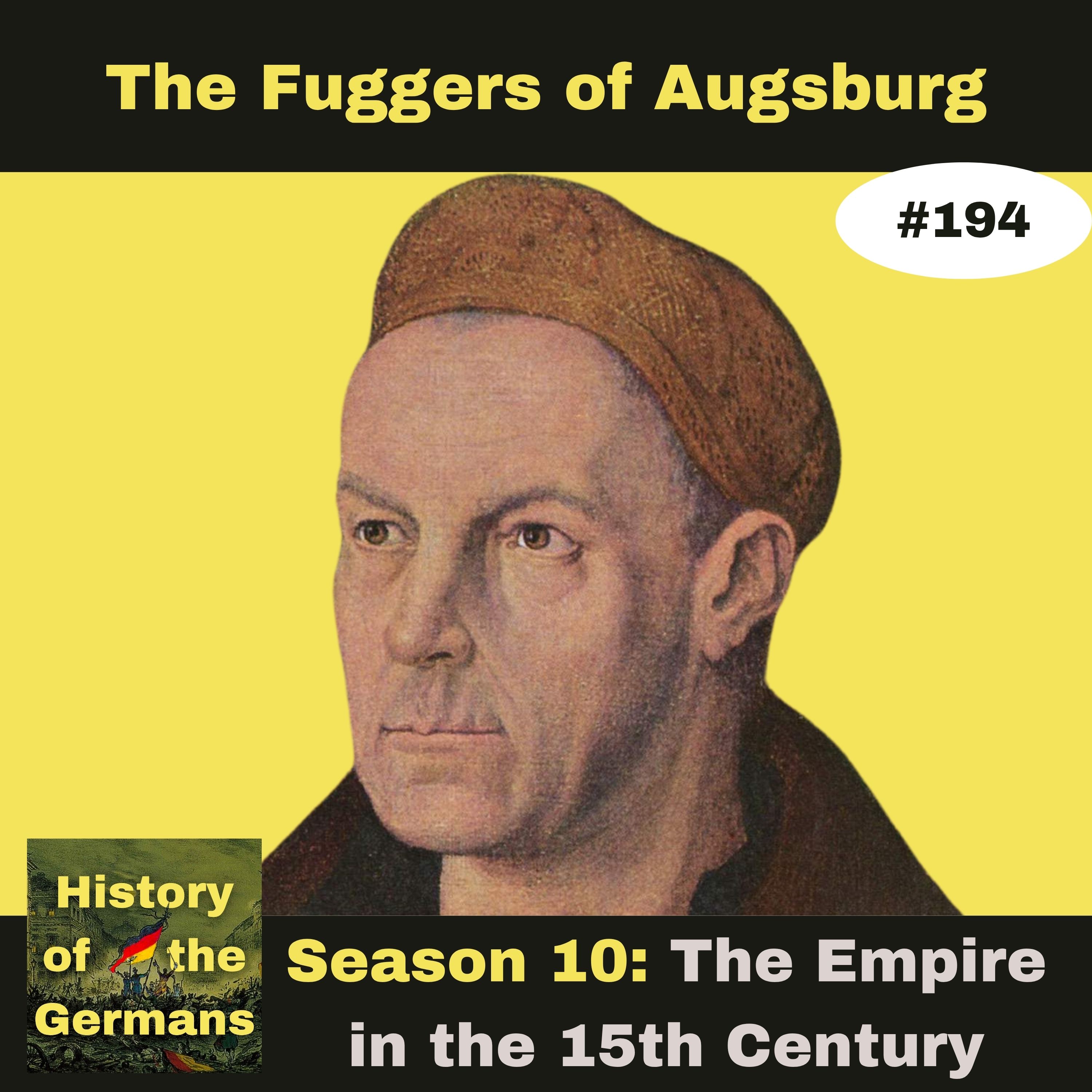
He is a man who needs no introduction, having made his first appearance 27 episodes ago in #194 The Fuggers of Augsburg. This prince as morally bankrupt as he was intellectually impoverished limped along on well and truly his last leg. He was now sixty years old and had run out of possessions he could sell off or mortgage. For forty years he had focused on creating an equal number of illegitimate children, frantically building luxurious castles and pleasure palaces and fighting pointless wars. The last of these was a totally avoidable clash with the Republic of Venice, which comprehensively ruined him even though he had actually won.

To fund his debauched pastimes, he had relied heavily on his friend, duke Albrecht IV of Bayern-Munich. Albrecht had bribed senior members of Sigismund’s entourage and gained an almost complete hold over the increasingly doddery count of Tirol. If you remember episode 197, duke Albrecht’s grand plan was to reconsolidate the territory his ancestor the emperor Ludwig the Bavarian had brought together, and that included the Tirol. And being an excellent steward of his own lands, he had the coin to bankroll whatever madcap idea Sigismund came up with.

As security for these loans, Sigismund mortgaged his lands, first the county of Burgau, a number of courts and then for the risible sum of 50,000 gulden, the whole of Further Austria. When finally all the peripheral lands were pledged away, Albrecht offered the breathtaking sum of 1 million gulden for the whole of Sigismund’s lands, with a clause requiring Sigismund’s heirs to pay off the whole sum in one go before they could take posession.

What all that boiled down to was a full takeover of the Habsburg territory outside Austria itself. If Albrecht had been successful, the Wittelsbachs would have become as powerful, or even more powerful than the Habsburgs. The Tirol was not only immensely rich due to the often mentioned silver mines and the Brenner pass, but it was also strategically crucial. The Tyrol provided the essential land connection between Astria in the east and the ancestral lands on the upper Rhine and Burgundy. If the Wittelsbach could drive a wedge between the two Habsburg territories, the power balance would tilt permanently in their favor. Munich, not Vienna would have become the imperial capital.

This process of gradual encroachment into the Tyrol and further Austria had begun in the 1470s. Albrecht was a patient and prudent player of the game. But still he made a bad mistake. In 1486, around the same time the freshly crowned king of the Romans, Maximilian was showing off the magnificence of the Low Countries to his father, Albrecht bailed out the bankrupt free city of Regensburg and incorporated it into his duchy. He may have thought this was the least offensive thing he had done to the Habsburgs, but Regensburg would become the sweet mustard his enemies will drown him in.

Talking about offending the emperor, Albrecht really knocked it out of the park in 1487. As a frequent visitor to Sigismund’s court in Innsbruck, he was introduced to Maximilian’s sister Kunigunde. Somehow the Bavarian accountant Albrecht burned up in passion for the smart and independent Kunigunde. When he asked her father for her hand in marriage, the emperor Friedrich III had initially been positive. Kunigunde was the Apple of his eye, but on the other hand an alliance with this ambitious and well regarded prince may come in handy one day.

That changed when Friedrich heard about the incorporation of Regensburg into Bavaria. Friedrich had a thing about the rights of the emperor, and removing a free and imperial city from his control was not on. He sent a letter to cousin Sigismund telling him to cancel all negotiations with Albrecht. Albrecht was undeterred and bribed Sigismund’s chancellors to forge this letter into one where Friedrich was gracefully consenting to the marriage. Kunigunde, already smitten by the Bavarian’s charm, was delighted by her father’s consent, and on January 13, 1487 uttered an enthusiastic “yes” in the court chapel of Innsbruck.

Now that was the end of the line. Friedrich III issued an imperial order to unwind all the various transactions with the Wittelsbachs, return the lands to the family fortune and asked Sigismund to dismiss his corrupt councilors. The estates of Tyrol very much agreed with Friedrich III and called a meeting in Hall in August 1487. The hapless Sigismund was confronted with a hostile crowd that accused him of causing unnecessary strife with the emperor, disrespecting his wife and tyranny. He was graciously permitted to accept a sort of temporary retirement, where he handed over the management of his lands to the estates, who in turn would pay his debts and release his property from the Wittelsbachs. All Sigismund asked for was a generous endowment for his misbegetting of bastards. After that was granted, though never paid, Sigismund the desolate count of Tyrol shuffled off the political stage. He abdicated formally in 1490 and Tyrol passed on to Maximilian who made Innsbruck his capital.

Sigismund died a few years later. His last wish was to bathe his hands one last time in buckets of coins to remind him of his nickname, der Münzreiche, he who is rich in coin. But by then he was so poor, he had to borrow the buckets from a local money man.

But that was not the end of this. All these pledged territories had already been handed over to the Bavarians, as was the custom with such credit arrangements. The two Wittelsbach dukes, Albrecht of Bavaria-Munich and his cousin, Georg of Bavaria-Landshut had no intention to hand back all the territorial gains they had made over the previous decades, and hence give up their political ambitions, not even the city of Regensburg.

If the Bavarian dukes had to be forced, the natural tool in Friedrich’s hand would have been the imperial ban followed by a request to the imperial diet to fund the military force needed to execute the ban. But the imperial diet was not a real option at this point. The coronation of Maximilian had kicked off the process of imperial reform for good, and any support from the imperial princes would have required wide reaching concessions from the emperor, something Friedrich III was not prepared to consider.

If they could not pursue it as an imperial action, what about funding their own army using the tons and tons of silver that came out of the mines of Schwaz?

Well, that wasn’t so easy. The way the mining business worked in the 15th century was as follows: The princes owned the silver in the ground as part of the regalia. But they usually lacked the money and the expertise to dig it up. So they granted a license to entrepreneurs who would do all the hard work. Under the terms of the licence the entrepreneur would be required to sell the silver at say 5 gulden when the market value was 10 to 12 gulden. The prince could theoretically sell the silver at market, but they rarely did. They were often so far in debt, they needed money right away, so bankers, like the Fuggers or Gossembrot would offer the prince 8 gulden in advance. This delta, between 5 and 8 gulden, or effectively 25% of the total value of the silver came to the prince, the rest, 45% went to the mining entrepreneur and 30% to the banker.

Sigismund managed to get himself so deep into debt, he pledged the bankers not just the right to buy the silver at 8 gulden, but even the 3 gulden he would normally take home.

Friedrich III and Maximilian had two options. They could cancel Sigismund’s agreements with the bankers, default on the old man’s loans and take the silver and sell it on the open market. That should theoretically bring hundreds of thousands of guldens to the princely purse.

But here is the rub. Who would buy the silver ore? The only people who owned smelters to extract the silver from the ore, were other bankers who had close commercial links across the industry. And they knew that if they took the silver ore, it was only a question of time before the Habsburgs would come to them for a loan and then some other banker would play the same trick on them. So they would politely decline. You do not think that is how that works? Well, just read up about Dan Gertler and his dealings in the Congo, and please use a sensible publication, not the bots.

Plus there was a whole rats’ tale of logistical issues, such as where to find the transport for the ore when all the carts are owned by the bankers, who also maintained the roads etc., etc.,,, And you still need the mining entrepreneurs who themselves had borrowed from the bankers and could be cut off from credit.

The biggest banker to Sigismund in 1487 was none other than Jakob Fugger. His consortium had lent 150,000 gulden, secured on silver from Schwaz. When they saw Sigismund’s fate going down, they opened up lines of communication with Maximilian. Maximilian understood that he was in a bind and acknowledged the claims of the Augsburg bankers. But it would still be a while before they started lending at scale to the man who would become their most famous client.

In other words, Maximilian and Friedrich III may now have princely control over two of the richest lands in Europe, the Low Countries and the Tyrol, but they still had no money and a war to fight. How?

The solution to this problem materialised in the form of the Schwäbischer Bund, the Swabian League. We have encountered these leagues and associations already several times before. There was the Rhenish league that tried to clean up the robber barons on the Rhine, theLeague of Constance fighting Charles the Bold and the most famous and most enduring one, which was of course the Hanse. The Hanse by the way never called itself the Hanseatic League, because as you may remember, under the Golden Bull the free cities of the empire were prohibited from forming such leagues. Nevertheless they appeared regularly throughout the 14th, 15, and 16th century as pressure from the territorial princes mounted.

Apart from cities clubbing together to fend off rapacious territorial lords, there were also the associations of imperial knights and counts. These members of the lower and middling aristocracy had the same problem with overbearing dukes and electors, who were bringing more and more of their class under their direct vassalage. The most famous of these associations of knights was the society of the Shield of St. George that had been around on and off since 1406.

Both city leagues and knightly associations were usually temporary alliances with modest, if any organisational structure.

This new one, the Swabian League that Friedrich III created in 1488, was quite different. Firstly, it was an imperial top down initiative, not a bottom-up one led by knights or cities. Then it brought together two normally not very aligned groups, the cities and the knights. And, it had actual institutions, the league council and the foremen of the league. The council was the main decision making body and comprised 18 to 21 elected councillors. Day to day management of the league was in the hands of the foremen, the Bundeshauptleute – German words always twice as long and thrice as precise. And finally there was a court of the league to adjudicate disputes between league members.

Another major innovation was that the councillors took decisions by majority and they were binding on all members. If you remember, the Hansetag, itself a very important institution, did not have either majority voting nor was it binding on the member cities, unless the council had instructed its representative explicitly to commit them to a particular course of action.

In the Swabian League, if the councillors decided to go to war, the league went to war. Moreover, the league had gone with the times deployed trained mercenary armies, rather than a motley assortment of diverse contingents sent by individual members. The cost of the professional army was borne by members in proportion to their perceived military and economic strength.

A nod to the old world was that the institutions were split in two and later into three. There was a bench for the 20 Swabian cities, who would send one foreman and 9 councillors and a bench for the 450plus  knights, who would again send one foreman and 9 councillors.

And the league had associated members, namely the Counts of Wuerttemberg, the margrave of Baden, the archbishops of Mainz and Trier, the margraves of Ansbach and the count of Tyrol, who was technically still Sigismund, but in reality first the estates and then the Habsburgs. These associated princes were – at least initially – not full members and hence excluded from the decision making process. They were later integrated, but formed just one of the three branches, carrying the same weight as either the cities or the knights. 

Which begs the question, why would any of the participants be willing to hand over their freedoms to such a rigid institutional structure. This again was a sign of the changing times. As we pointed out in episode 197, the success of the Bavarian dukes, first Ludwig of Bavaria-Landshut and then Albrecht IV of Bavaria-Munich lay in their ability to provide the basic services of the state, peace and justice. Keeping the roads free of brigands, punishing wrongdoers and building the occasional bridge or road did wonders to the willingness of subjects to pay taxes. And that is what their neighbours in the old stem duchy of Swabia noticed and they wanted a piece of it. In fact Albrecht of Bavaria -Munich was the one who set up the first, much more loosely structured league that maintained peace and justice across most of what is now southern Germany.

But by 1488 that league had broken down, in part because of Albrecht’s cousin Georg’s rudeness, but also because the ambition of the Wittelsbachs to become the new dominant power in the empire had become apparent. When Albrecht took over Regensburg, all the free cities in the region and the counts and imperial knights knew that they had only two choices, club together and retain at least part of your autonomy, or be swallowed up by the House of Wittelsbach. That is why they came.

The Swabian League would last up until 1534 and it was a participant in much of what we will discuss in the upcoming episodes.

When the Swabian league was formed in January 1488, all its members were ready and rearing to have a go at the Wittelsbachs. But the war against Bavaria had to be postponed since – as we know – at that exact point in time Maximilian was made a prisoner by the mob in Bruges and Friedrich III had to go north the free his son.

But by 1489 the two monarchs of the empire were both in Tyrol and got to work. The Swabian league mustered an army to regain the lands that Sigismund had passed on to the Wittelsbachs. His cousin Georg caved almost immediately and handed over what he had gained and paid a fine of 36,000 gulden. Albrecht was more persistent. He refused to hand over Regensburg, even tried to hold on to Further Austria, plus he insisted that his wife Kunigunde, the sister of Maximilian, had a claim on Sigismund’s inheritance.

The league members were keen on a fight, the emperor was insisting on the return of Regensburg, two of Albrecht’s younger brothers rebelled, and even an association of Bavarian knights declared a feud against their duke. The only one who did not want all-out war against his brother-in-law was Maximilian.

Maximilian was more interested in a peaceful resolution so that he could go after king Matthias of Hungary who was still sitting pretty in Vienna. The Bavarian drole de guerre persisted until 1492 when Albrecht under pressure from all sides and in view of a League army of 20,000 finally caved. He kept his duchy, Regensburg remained a free imperial city until 1803, and the Wittelsbach’s grand ambitions were smashed.

And lady fortune smiled once again on Maximilian and Friedrich III. Matthias Corvinus, had died on April 6, 1490. And what was even better, he had died without leaving a legitimate male heir. He had an illegitimate son, John, who he had hoped he could get the emperor Friedrich III to legitimise. But that never happened. John never took the Hungarian throne.

Meaning that when Matthias Hunyadi unexpectedly disappeared, the kingdom of Hungary found itself without a king. And without a king, even the worlds most expensive army is vulnerable. Maximilian realised the opportunity, convinced the estates of Tyrol to fund an army of Landsknechte and by the autumn his forces stood before Vienna. Resistance was only sporadic and he took the capital, then rushed after the retreating Hungarians into Styria, entered Hungary December 1490. He besieged and plundered the coronation city that I am afraid I cannot pronounce and moved on to Buda. But that is where the momentum stalled. As always, the money had run out and he could no longer pay his men. The winter had turned out to be extremely hard, supplies could not come down the frozen Danube and the local population enraged by the plundering hordes of mercenaries had grown hostile.

Maximilian withdrew to Austria to a hero’s welcome. Meanwhile the Hungarian magnates had chosen a new king, Wladislaw Jagiello, the man who was already king of Bohemia and whose father, Kasimir IV was king of Poland and Grand Duke of Lithuania. Within a century the descendants of Jogaila, the pagan ruler of Lithuania we met in the season on the Teutonic knights, had become a dynasty that ruled a vast landmass from the Black Sea to the Baltic.  

Wladislaw, the new king of Hungary and Bohemia was however not the most impressive scion of the family. He was famous for saying well, well to anything his council of senior lords suggested and the Hungarian nobles joke that he was their king, but they were his lord and master.

Wladislaw, or more precisely the Hungarian lords were willing to make peace. Maximilian acknowledged Wladislaw as king of Hungary, but retained the right to call himself king of Hungary. They signed a treaty of friendship and for the nth time, a Habsburg signed a compact of mutual inheritance rights. Should one of them , aka Wladislaw or Maximilian die without male offspring, the other’s descendant would inherit everything. We are nearly there, only one more contract to go before the Habsburgs can take the Bohemian and Hungarian crowns for real.

To sum it up, that was some major achievement. Maximilian had regained and consolidated all the Habsburg possessions in one hand for the first time in centuries and he has added the Low Countries.

All that is true, but still, the winter of 1490 saw our hero seething with anger. Whilst he had been fighting out there in Hungary, the king of France had humiliated him in front of all of Europe. It is these pesky Frenchmen again. You can understand why he really did not like them.

When Maximilian left the Low Countries in 1489, the war against the cities and against France was not over by any measure. The fighting would go on for another three years. The reason we lost track of that is simply that Maximilian had passed on responsibility for that war to Albrecht of Saxony, an imperial prince and war entrepreneur.

The Low countries were however not the only theatre of this war. When he was mustering his army to go into Hungary, he had pondered an attack on the Franche Come and on Burgundy as an alternative. This was part of his grand plan. You see, Albrecht of Bavaria was not the only one with a grand plan, Maximilian had one too, just grander and more ambitious than his brother-in-law in Munich. But, as the great philosopher Mike Tyson so astutely observed, “everyone has a plan, until the get punched in the face”.

Maximilian’s grand plan was to completely encircle the French king and then gradually squeeze him into submission. To do that he had been building alliances for more than a decade now. He had established close links to the Spanish monarchs, Ferdinand of Aragon and Isabella of Castile. His relationship with the Tudor king Henry VII of England was wobbly given his clear Yorkist sympathies, but for now the interest of the two kings were sufficiently aligned to work together. The third main player in this game was the duke of Brittanny. Britanny at this point was an independent duchy in the North Western corner of France, quite a lot larger than modern day region of Bretagne. Throughout the Hundred Year’s war, Brittany with its Atlantic ports in St. Malo, Brest, Lorient and Nantes had been an important bridgehead for the English and an on and off ally of Burgundy. Maxmilian had inherited this relationship and duke Francois II of Burgundy had been a major supporter in the war against Louis XI and Charles VIII.

In 1488, just when Maximilian was locked up in Bruges, duke Francois first lost a decisive battle against the French and then fell off a horse and died. He left behind a daughter, Anne of Britanny, 12 years old and now suddenly the most desirable heiress in Europe. 

And who was the man who desired her most, if not the master of dynastic marriages, the great heiress whisperer, Maximilian of Habsburg. He was not only after a chunky piece of real estate, he was after this specific piece of real estate, as it opened up the chance to fight France on three fronts.

Little Anne was quite excited about Maximilian’s interest, already seeing herself crowned empress by the pope in front of an admiring crowd in St. Peter. Had she listened to the History of the Germans Podcast, she might have thought about that differently.

Maximilian had one advantage over his many rivals, and specifically Charles VIII of France, he was free and single. Charles was – and I am sure you have forgotten about that, because so did I – but Charles was still, despite all the things that had happened in the meantime, engaged to Maximilian’s only daughter Margaret. Margaret had been dispatched, kidnapped, stolen, whatever you want to call it by the French after the peace of Arras in 1482. Margaret had come with an impressive dowry of cities and territories on the western edge of Burgundy. And she had grown up at the French court as the future queen and allegedly content to spend her life with the by no means attractive Charles VIII. Therefore the French party could not offer a crown to little Anne, only marriage to some cousin of the king.

Hence, when Maximilian sent his embassy to negotiate a potential betrothal, his men were well received. Discussions were as always protracted, but in the end little Anne and the imperial faction at her court made up their mind. She liked the crown, and they believed Maximilian’s promise that the army he was gathering with Tyrolian silver right now was going west to protect her and her lands against French incursions.

All was arranged, and Maximilian’s friend the handsome Polheim married little Anne by proxy. Once again a princess spent the night with a man who was not her husband with the lights on and a sword between them.

When Maximilian received the news that down in Brittany everything was ship shape and Bristol fashion, he concluded that he could now take his army to Vienna and leave little Anne for later.

But then, news travel in both directions. Little Anne, who happened to be very young, but not very thick, realised that she was not her suitor’s #1 priority. And Charles VIII realised that his #1 issue wasn’t the dowry of little Margaret, but the risk of an imperial Brittany armed to the teeth in his back.  

Charles mustered his forces and set out for Britanny. He knew that nobody would stop him. The Spaniards, Ferdinand and Isabella were busy conquering Grenada, the English did not trust Maximilian, and Maximilian’s army was fighting in Hungary a thousand miles away.

The French took one castle after another and by the autumn of 1491 they stood before Anne’s capital in Rennes.

Anne, abandoned by everybody and at risk of loosing her land, agreed to meet Charles VIII. The two of them had a long chat, at the end of which they agreed terms. A few days later they met again, this time in the chapel of the castle of Rennes where they announced their engagement. You can only imagine the expression on the face of the handsome Polheim, who had only weeks earlier had spent a night with the duchess and had been convinced that he had gotten his boss married. And that marriage should still be valid, since only a papal dispensation could dissolve such a union.

Dispensation or not, Anen of Britanny married king Charles VIII of France on December 6, 1491, her second king husband, but not her last.

Maximilian was apoplectic. He was humiliated, not only because Charles had married who he believed was already his wife, but also because the Frenchman had discarded his daughter Margaret, his fiancée for almost a decade. Maximilian’s hatred for the French deepened even further, if that was at all possible. He told everyone that “No man on earth has ever been disgraced as he had been at the hands of the French”. For the rest of his life he kept a little red book where he noted all the hideous crimes the Valois had committed against him.

Then Maximilian did what a mighty lord had to do in this situation. He once again declared war on France.  To do that, he once again needed an army. This time he tried to garner support by stirring up public opinion against the French. He had flyers printed shouting that the bride of the King of the Romans had been abducted – and that the honour of the empire was at stake. This attempt at propaganda did however not stick. When he asked the imperial princes for help, he received not just the usual, njet, but howls of laughter as they recounted the circumstances of his dishonour.

In the end he gathered mercenaries funded by loans backed by Tyrolian silver and at least conquered the Franche Comte. His forces did however not stretch to a conquest of the duchy of Burgundy, because once again, the money ran out. I guess you see the pattern now..

In 1493 the two sides finally came to agree a peace. Charles gave up the Franche Comte, returned Margaret and most of her dowry and recognised Philip the handsome as the heir of Burgundy. In return Maximilian acknowledged Charles and Anne’s marriage, even procured a papal dispensation.

The whole affair was so embarrassing that all documents relating to the marriage of Maximilian and Anne were destroyed. The only trace that prove it ever happened, was a receipt for 13 gold coins that the handsome Polheim had donated to the cathedral of Rennes on the occasion of the blessing of the union between Anne and Maximilian.

This war with France was finally over, the Habsburg lands were reunited in one hand. It is time for peace and reconstruction…maybe for others, not for Maximilian. For Maximilian war was not a way to reach a solution, war was the solution. So the next set of wars is just round the corner, but not now, next week.

And if you happen to have some silver that has gone up by a cool 150% in 2025, why not put some of it to good use – not hiring mercenaries – rather ensuring this show remains independent and advertising free. You know where to go and you know what to do…

32 destinations chosen entrely subjectively

Where To Go in Germany – Part 2 History of the Germans

Listen on Spotify

Listen on Apple Podcast

Listen on YouTube

Transcript

Hello and welcome to the second part of your Christmas bonus, my entirely subjective list of places to visit in Germany. Today we will cover the remaining Bundesländer, namely Nordrhein-Westfalen, Rheinland-Pfalz, Saarland, Sachsen, Sachsen-Anhalt, Schleswig-Holstein, Thüringen and two more places that I have chosen entirely because I can.

One of the legacies of the Holy roman empire is that Germany does not have just one place where everything happens,  where politicians, entrepreneurs, bankers, artists, and actors travel on the same underground trains and eat at the same restaurants. Berlin is the capital with its political class of members of the Bundestag, journalists and lobbyist and at the same time a major gathering place for artists, musicians and thespians of all stripes and home to many tech startups. But the bankers are in Frankfurt, the headquarters of the major companies are in Stuttgart, Munich, Düsseldorf and spread around everywhere. Several of the major publishing houses are in Hamburg, the private TV stations in Munich, but none of these places have a monopoly on any of these activities. There are banks headquartered in Munich and major corporates in Frankfurt, there is great theater in Düsseldorf, Dresden and Schwerin, there are world leading companies headquartered in tiny towns like Künzelsau.

And that cuts through to the major cultural sites. Though the quip that there were 365 states in the Holy Roman empire is vastly exaggerated,  there were once a hundred capital cities, from splendid Dresden to tiny Hohenzollern-Hechingen, each with its princely residence, cathedral, grand monastery and theater. The great artists either travelled from court to court, leaving behind their works here or there, or stayed in one of the free imperial cities, operating large workshops.

Therefore what you cannot do in Germany is to go to one city and see all the major treasures the country has “collected” over the centuries, as you can do in the Louvre or the British Museum and the National Gallery. In Germany you have to move around, see one thing at the time, always in the knowledge that its significant counterpart is a few hundred miles north, south, east or west of you. This is one of the legacies of the medieval empire that Germany has in common with Italy.

And hence we are going through each of the Bundesländer trying to pick out one absolute must-see and one place where you are likely to encounter fewer people. And as we have covered 9 Bundesländer up to Mecklenburg-Vorpommern already, the next location we will have to get to is Nordrhein-Westfalen, Germany’s most populous state.

Nordrhein-Westfalen

If we talk about must sees, Aachen is where every upstanding listener of the History of the Germans will go, and it is undoubtably the right thing to do. The imperial chapel, with its Roman columns brought across from Rome and Ravenna and Barbarossa’s magnificent chandelier provided suitable surroundings for the coronations since Otto the Great. And if you happen to go there, take a look at the treasures in the Dommuseum, worth every second of it. And do not forget to listen to the ghoulish opening of Charlemagne’s grave by Otto III in episode 14  .

Bust of Charlemagne in the Aachen Dommuseum

Cologne

A close second place you should not miss is Cologne. The city has been mentioned 500 times already in the show and there are likely another 500 incidences to come. Germany’s most venerable and for a long time largest city has been the stage for events from the Prologue episode to the siege of Neuss we discussed in episode 214.  As the seat of one of the seven Prince electors, a major pilgrimage destination and the main hub in the trade between the empire and England, Cologne often played a decisive role. Its history is so varied and significant, it warrants its own podcast, the History of Cologne by Willem Fromm.

Of the things to see in Cologne, the Cathedral and its shrine of the Three Wise Men is unavoidable. I would also recommend the Römisch-Germanische Museum, that displays items related to the long history of Roman presence in Germany and specifically in Cologne.  And do not miss the remains of Cologne’s history as a free imperial merchant city and senior member of the Hansetag League. The Overstolzen House, a 13th-century Romanesque house, and the Town Hall, with its 16th-century porch, the Gürzenich, or Banquet Hall, of the merchants of the city (1441–47), and the 16th-century Arsenal are all reconstructed on the outside, though the interior has sadly been lost to war damage.

These alone would justify a visit, but what makes it a must see are the 12 great Romanesque churches including Sankt Gereon, Sankt Severin, Sankt Ursula, Sankt Maria im Kapitol, Sankt Kunibert, Sankt Pantaleon, Sankt Aposteln, and Gross Sankt Martin. Few places in Europe can boast such a density of sacral architecture erected between the 4th and the 13th century.  

LEAD Technologies Inc. V1.01

Once you have done this marathon, head down to Früh’s, Sünner im Walfisch or Sion for a refreshing Kölsch and the unique atmosphere of a classic beer house. If you do that, you have to take the S-Bahn down to Cologne’s eternal rival, Düsseldorf and taste their Altbier in one of their traditional beer houses like the Füchschen, Schiffchen or Uerige.

Essen – Zeche Zollverein

18 million people spread over 34,000 km2 making Nordrhein-Westfalen one of Europe’s most densely populated areas, in particular the almost continuous urban landscape between Düsseldorf and Dortmund, otherwise known as the Ruhr.

View of Essen

I would love to say that the Ruhr is pretty, but that would be pushing it. There are pretty places though, like the Bredeny lake and its park with the villa of the Krupp family or the Schwebebahn in Wuppertal. Several of these cities are very old; Essen abbey boasts an Ottonian Westwerk and 10th century artworks and Dortmund had been a member of the Hanse and still retains some vestiges of that time, whilst Mercator established a cartography business in Duisburg.

If people travel here from afar, it is usually related to football, or soccer for our American friends, given the region hosts some of the most successful and most storied clubs.

But there is another way to get an understanding what made this state where almost one fifth of Germans live. And that is a visit to Zeche Zollverein, a coal mining industrial complex that counts amongst the largest of its kind in europe. It operated from 1847 to 1986 and has now been turned into a museum, or to be more precise, one of the many buildings on the site is now the Ruhr Museum providing an insight int how this region turned into one of the largest industrial agglomerations in the world.

Shaft 12 of Zeche Zollverein

But what impressed me more than the exhibits is the sheer scale and awesome beauty the structure. It comprises two large complexes, the mine with its Shaft 12, built in the Bauhaus style that is the basis of the claim that this is the most beautiful coal mine in the world. And then there is the nearby coking plant, a 600m long behemoth.  The canal that ran alongside once held water used to cool down the coke. Today it is used In winter as one of the coolest ice rings I can imagine.

Zeche Zollverein has a museum but is not a museum, it is a vibrant centre with 150 start-ups and corporations using the space, a range of cultural institutions, a branch of the university and shops. Since opening in the 1990s, Zeche Zollverein has become a weekend destinations for people from all around, including my cousin who took me there and left me speechless.

That is unfortunately all we can cover in Nordrhein-Westfalen, leaving such gems as Paderborn (see episode 19) and Münster for later exploration.

Rheinland-Pfalz

It is time to head down to Rheinland-Pfalz, the state created in 1946 from chunks of Prussia’s Rhine province, Rheinhessen and the Bavarian Palatinate. This is the land of the archbishops of Mainz and Trier, the Counts Palatine on the Rhine, the counts of Nassau and most significantly the various barons on their castles overlooking the Rhine river.

Which gets me to the must-see in Rheinland-Pfalz, and that is the Rhine valley, namely the bit between Mainz and Bonn. I know, it is on everybody’s bucket list for a visit to Germany, but so is Heidelberg and we covered that as well.

Marksburg with Rhine Valley

What is most fascinating is the gap between its preception and what it actually signifies in German history. Turner and Byron had made the rhine valley into one of the main destinations on the grand Tour and many a mylord travelled along citing  these stanzas from Childe Harold’s pilgrimage:

childe harold audio – Google Search 2:11:20

   The castled crag of Drachenfels

   Frowns o’er the wide and winding Rhine.

   Whose breast of waters broadly swells

   Between the banks which bear the vine,

   And hills all rich with blossomed trees,

   And fields which promise corn and wine,

   And scattered cities crowning these,

   Whose far white walls along them shine,

   Have strewed a scene, which I should see

   With double joy wert THOU with me!

The river nobly foams and flows,

   The charm of this enchanted ground,

   And all its thousand turns disclose

   Some fresher beauty varying round;

   The haughtiest breast its wish might bound

   Through life to dwell delighted here;

   Nor could on earth a spot be found

   To Nature and to me so dear,

   Could thy dear eyes in following mine

   Still sweeten more these banks of Rhine!

And as the boat floated between the Lorely and Katzenellenbogen the representatives of Thomas Cook sold the tourists steel engravings of Burg Katz, the Mäuseturm in Bingen or Stolzenfels castle which they would hang on their walls to dream of grim robber barons, helpless prelates and damsels in distress. All these images and dreams of the Romantic Rhine ended up in the rubbish bin when Germans and Brits faced each other across their trenches in World War I.

Bingen

But that romantic yearning for crumbling castles, picturesque towns and to quote Byron again: peasant girls, with deep blue eyes,  And hands which offer early flowers” was not an exclusively British obsession.

The Germans were at it too, Goethe, Hölderlin and Kleist started the literary tradition that peaked with Heinrich Heine and Clemens von Brentano, Schumann and Liszt composed piano pieces, symphonies and Lieder, Wagner’s ring of the Nibelungen takes place on the Rhine, before we get into the less salubrious world of the “Wacht am Rhein” and Carl Zuckmaier’s famous Wine, Women and Song. During the 19th century rich industrialists and the Orussian royal family turned the castle ruins into what a fairytale gothic castle was supposed to look like.

Burg Stolzenfels

The whole place is so drenched in narratives, myths and anecdotes, it is a dreamworld made into reality. A dreamworld that obfuscates its real significance. The Rhine had been the backbone of the European economy for centuries, the main transmission line that connected the Low Countries and Italy. Its castles were toll stations funding princely ambitions, may they have been territorial, political or religious all through German history. Its cities were centres of trade and innovation, its villages made the world’s favourite white wine etc., etc.

And it is gorgeous!. Take a trip down the river either on the train that follows the banks of the river, or on a ship or boat….

Trier

Going from one of the absolute top destinations in Germany we now go to one that is quite incomprehensibly overlooked, and that is Trier. Trier may not formally be Germany’s oldest city, but it is certainly the one that holds more ancient Roman buildings than any other in Germany, and could easily compete with better known places in France or Spain.

Aula Palatina Trier

Augusta Treverorum became one of the four capitals of the Roman empire in 293 AD and grew to between 75,000 and 100,000 inhabitants. It retains its famous city gate, the Porta Nigra from this period, the Aula Palatina, the basilica that once served as the throne room of emperor Constantine was preserved as a church, making it the largest extant hall from classical antiquity, it’s cathedral goes back to a church commissioned again by the emperor Constantine, and retains much of the old structure, with later additions in the 10th, 11th and 12th century. Trier obviously comes with the usual complement of amphitheatre, ruins of the impressive Roman bath, and a still fully functioning 2nd century bridge. The Rheinische Landesmuseum holds more exhibits from Roman times, including the famous Wine ship of Neumagen that explains a lot about trade on the Moselle and Rhine and Roman navigation and the largest treasure of Roman gold coins ever found.

Codex Egberti – The Healing of LAzarus

And if you have time, drop into the city library that holds the Codex Egberti, one of the great Ottonian illuminated manuscripts, a reminder that Trier was not just important in roman times but had been a crucial archbishopric throughout the Middle Ages and into the early modern period. Who could forget Baldwin of Luxemburg, brother of emperor Henry VII and eminence grise of the empire for most of the 14th century.

Coronation of Henry VII – in the codex of balduin of Luxemburg

That is of course only a small selections of the delights of Rheinland-Pfalz. You will almost certainly want to go to Speyer as well and marvel at its great cathedral we described already in episode 25 or spend some time in Mainz, home to the most senior of Prince Electors as well as of Johannes Gutenberg (episodes 186 to 188), or follow the river to Worms, original home of the Salian emperors and site of the Nibelungenlied.

Saarland

Fortunately our next destination is not far. The smallest of the territorial German states, the Saarland is where we go next. And I have to make a grave admission, I have never done more than drive through. I will of course remedy that, but what it means is that for now I cannot offer any personal recommendations.

Amongst the things I found that could entice me to go to the Saarland is first up the Saarschleife, a gigantic bend in the River Saar caused by the stream hitting a hard Quarzite rock. It looks cool.

Saarschleife

The other location would be the Volklinger Eisenwerke, the only fully intact steel works from the 19th and 20th century. There are visiting tours and a museum explaining how this enormous facility operated, as well as special exhibitions. So if you decide to skip the Zeche Zollverein in Essen, and you want to better understand Germany’s industrial past, this might be a suitable replacement.

Gebläsehalle der Völklinger Hütte

Sachsen

Our next Bundesland is almost due east from here – it is Saxony in all its splendour. And when we talk about Saxony as in the kingdom and now Bundesland of Saxony, as opposed to the stem duchy of Saxony,  we are talking about a state created by and for the House of Wettin. For much of the 17th and 18th century this principality outshone Prussia, its neighbour to the north. Augustus the Strong and then his son Augustus III were both electors of Saxony and kings of Poland. They maintained two capitals, Dresden and Warsaw where they made a credible attempt at competing with the Versailles of Louis XIV. This expenditure relegated the dynasty back to the second league, but left behind some of the grandest and most impressive baroque architecture on German soil.

Dresden by Canaellto

In other words, Dresden is a must-see. Several of the structures that had been heavily damaged, even wiped out by the Bombing of Dresden in February 1945 but much has now been reconstructed. In particular the Frauenkirche has become a symbol of reconciliation and rebirth. The whole process had already started under the GDR government with the reconstruction of the Semperoper  in the 1980s and continued with the almost complete rebuild of for example the Taschenberg Palais and the Residenzschloss. I worked in Dresden in 1991 and I had the chance to visit the building site of the Residenzschloss. Seeing the concrete walls of what is today the audience chamber of Augustus the Strong was one of the weirder experiences I ever had in sightseeing.

Großer Schlosshof mit Fresken (2021)

But whilst much of the city centre had suffered horribly, there are several absolute gems of the heyday of baroque Dresden that have survived largely unaltered. There is the Alte Gemäldegalerie that houses the collection of Italian renaissance art put together by the otherwise hapless Augustus III, and the Grüne Gewölbe, the treasury of the House of Wettin that had been made accessible as a museum in 1729 as a means to project its immense wealth.

Gruenes Gewoelbe

Going a bit further afield, you may want to see Meissen where the principality started and its castle where  Johann Friedrich Böttger established the famous Meissener Porzellanmanufactur, the first place where porcelain was produced in Europe. Porcelain was an obsession amongst aristocrats in the 17th and 18th century, but had gone into total overdrive amongst the German princes. Everyone had a porcelain collection, usually housed in small “Chinese” room full of mirrors and golden wall shelfs. In Dresden you had an entire palace to house the collection, the Japanese Palace in the Neustadt.

Dresden Zwinger

Today the collection is shown in the Zwinger, once part of the city’s defences but repurposed by Augustus the Strong as, a party palace, orangery, garden, just something very unique and strangely wonderful. A Japanese palace was of course not enough exoticism for the spendthrift Saxon rulers, so they had a Chinese palace too, in Pillnitz, just a few miles upriver.  Pillnitz is of course not just one small Chinese villa, but three separate buildings, one on the water, one on the hill and one in the middle. And there is Moritzburg, the fairytale castle in a lake full of hunting trophies..and, and, and.

Schloss Pillnitz

I am going to shut up now. And if you go to Dresden, just spare a few days for Leipzig too. Where Dresden was where the money was spent, Leipzig is where it was made. And today Leipzig is arguably the more vibrant of the two cities.

Bad Muskau

When it comes to overspending, the two Augustuses are hard to beat, but it can be done. The man who achieved that sheer impossible feat was Hermann, Fürst von Pückler-Muskau. He is today mostly remembered for Fürst Pückler ice cream, a mix of chocolate, vanilla and strawberry flavours he did not even invent himself but was just named in his honour by the Prussian court cook.

Hermann, Fürst von Pückler-Muskau

He was a famous dandy who kept a team of white stags to pull his carriage down Unter den Linden, but his true achievement was as a gardener. His two parks, one in Bad Muskau in Saxony and the other in Branitz in Brandenburg are absolute high points in European garden architecture. Laid out in an English style the park stretches 5.6 km2 across what is now the German-Polish border. As you would expect, this is an artificial landscape of lakes and hills dotted with various follies and pavilions.

In the Muskau Park

The sheer scale of the project pushed the man who was born as one of the richest nobleman in Germany deep into debt. In a desperate attempt to raise funds he and his wife divorced so that he could go to England and marry a wealthy heiress. That scheme turned out to be a touch too obvious and the British press made a mockery of the German prince’s attempts to woo an English rose. Pückler described events in hilarious letters to his now divorced but still much loved wife. She then published these letters to rustle up cash, which turned into a best seller. Like modern a day sailing youtuber, Pückler embarked on a new career as a travel writer. He journeyed across the Ottoman empire, even made it to Ethiopia and Sudan. One of the souvenirs he brought back from his trips was an11-year old Ethiopian enslaved girl that he installed in Bad Muskau where she promptly succumbed to the inclement climate, and probably just utter misery.

Money eventually ran out completely and Pückler had to sell his castle and gardens in Bad Muskau in 1845 and moved to Branitz where he could not stop himself and got gardening again. He died in 1871. Like his lifestyle, his religious convictions were at odds with the conservative world of 19th century Germany. Since cremation was not yet permitted, he went around the problem by having his heart dissolved in sulphuric acid, and ordered that his body should be embedded in caustic soda, caustic potash, and caustic lime. These granular remains were then buried underneath a pyramid in his garden.

His life cries out for its own episode.

Sachsen-Anhalt

Moving swiftly, or in fact not so very swiftly on, we come to Sachsen-Anhalt. This is the land of Otto the Great who is buried in Magdeburg cathedral and his father, Heinrich the Fowler whose grave is somewhere underneath the abbey church of Quedlinburg. Even Barbarossa squeezed himself in on the Kyffhauser, which is shared between Sachsen-Anhalt and Thüringen.

Naumburg

And the must-see place here is also linked to these early medieval days, it is the Cathedral of Naumburg, and more specifically the Stifterfiguren, the sculptures of the founders of the church. These include the legendarily alluring Uta von Ballingstedt, but also the other 11, each carved by an absolute master of the craft in the 13th century. If you are following me on social media you can find a post going through every single one of the 12 figures and their histories.

Naumburg an der Saale, Dom, Stifter Markgraf Ekkehard II. und Uta

The second destination in this state is Dessau. This is another of these tiny capitals, in this case the seat of the dukes of Sachsen-Anhalt-Dessau. Not much of the old city of Dessau is left, apart from a ducal palace. But halfway between Dessau and Wittenberg, famous for Luther’s theses, is the garden landscape of Dessau-Wörlitz, a set of interwoven palaces and parks that cover an impressive 142 km2

The reconstructed Bauhaus-Building

But that is not the only reason why I would suggest to go there, the real attraction is the Bauaus. You can visit the original building where the Bauhaus school moved to after it had been more or less expelled from Weimar in the 1920s. It is a fascinating structure that, like much of the other ideas of the Bauhaus had enormous influence on the way the world looks everywhere from Texas to Tokyo. The Bauhaus museum is by the way not in the actual Bauhaus buildings, but in the centre of Dessau.

Schleswig-Holstein

Time to take our last trip up north and have a look at Schleswig Holstein. As a sailor, this is my place, along with Mecklenburg-Vorpommern. It is just stunningly beautiful if you have a soft spot for hard winds and sandy beaches.

Lubeck Skyline

Culturally the must see place is of course Lübeck, the queen of the Hanse. We did a whole series on the Hanse and the role of Lübeck within it, we talked about the art and culture that in the main centred here – episode 127, so I am not sure what I can add in this episode. Maybe take a marzipan safari. Whilst Niederegger has become the leading brand for German Marzipan, there are four more manufacturers in Lübeck and true aficionados prefer either Mest or Martens or Carstens or Lubeca over the better known fare. Lots to discover…

As for the second location in Schleswig Holstein, there are of course the islands, namely Sylt which provide a uniquely German summer holiday experience and of course any kind of water sports in the Förde on the Baltic shore, including but not limited to sailing.

But I would like to break a lance for the city of Schleswig, the seat of the dukes of Holstein-Gottorp who occasionally ruled Denmark, Sweden and Russia, though not all at the same time. There is an impressive palace here with gardens and the like.

Gottorp palace

Beyond that there are three unique and compelling things here. The first are the remains of Hedeby or Haithabu, a Viking settlement that dominated the trade in the Baltic between the 8th and 11th century. You can see reconstructed Viking houses and a Viking museum explaining the significance of the place in international trade.

Danevirke

In the 7th century the Danes built a line of fortifications from Haithabu on the Baltic to the North Sea shore which remained the main Danish line of defence against invasions until the Schleswig-Holstein war of 1864. The great wall of China, begun around the same time, is admittedly more impressive, but lost its military function in the 17th century.

And then you have the cathedral of Schleswig, itself a lovely gothic church with an impressive carved main altar. The funky bit is in the cloister. Like so many churches and monasteries, Schleswig too was given a massive makeover in the 19th century. The creative renovation work here included the discovery and enhancement of a frieze underneath the massacre of the innocents. The frieze depicted various animals, including some quickly identified as turkeys.

Schleswig Turkey

This caused some confusion given the original decoration dated back to 1320. The only viable explanation was that the Vikings must have been to America before and had brought the motif of the turkey back from their journeys. That rapidly turned int0 a whole narrative of brave Nordic sailors spreading out to the American continent long before any Spaniard had ever held a compass. Under the Nazis the story that men from Schleswig had discovered America became canon. It wasn’t until 1948 that Kurt Wehlte used x-ray to prove that the turkeys were indeed a turkey placed there by the 19th century “restorers”.  

Thüringen

Congratulations, we have made it to the last Bundesland in alphabetical order, but by no means the least.

If you look on a map of the Holy roman empire from say after the peace of Westphalia, you see several large entities, Austrian and Spanish Habsburg, Bavaria, Brandenburg-Prussia, Saxony, Wurttemberg, Hessen, Brunswick etc. And then in between all these tiny places. And Thuringia is one of the regions where the chart says things like “various Saxon duchies” or “unmappable microterritories”.

Weimar

And here in Thuringia is the probably most famous of these duodez principalities, Sachsen-Weimar. This tiny principality whose political position was so insignificant, they did not have to contribute their own soldiers to the imperial Reichsmatrikel but simply paid an equivalent tax, managed to attract Johann Wolfgang von Goethe, Friedrich Schiller, Martin Wielandt and Gottfried Herder to its court. And they came there and lived there during the absolute height of their fame. There is no real equivalent, unless you were to say that Charles Dickens, George Elliot, Thomas Hardy and Jane Austen had decided to live together in the grounds of Belvoir Castle. Very pretty, but a bit off the beaten track.

Der Weimarer Musenhof (1860); Schiller liest in Tiefurt

Weimar retains much that reminds one of these days when the country’s greatest writer was also the prime minister of the tiny state and walked across the park to have tea with the duchess and her court of local baronesses.

Goethe’s Garden House

Weimar is of course also the place where the national assembly hunkered down to write the constitution of the republic in 1919, since Berlin was simply too dangerous.

Wartburg

Thuringia has many more of these smallish state capitals, including Gotha, home of Prince Albert and Meiningen, capital of the Duchy of Sachsen-Meiningen until 1918, complete with theatre and one of the oldest orchestras in the world. And of course Erfurt, beautifully restored to its late medieval glory. I could go on.

But the other place I would suggest you see in Thüringen would probably be on most people’s must see list anyway.  But again, I actually do make the rules, so I can break them if I want to.

Perched high above the town of Eisenach, Wartburg castle offers sweeping views over forested hills that immediately justify the journey. This is where Martin Luther found refuge and translated the New Testament into German—an act that shaped the language and transformed European religious life. Walking through his modest room gives you an intimate connection to ideas that changed the world.

Wartburg Castles

Beyond the Reformation, Wartburg is also a cradle of German identity. Medieval legends of competition between singers, the courtly life that disgusted Saint Elisabeth of Thuringia, and 19th-century nationalism all converge within its walls. The architecture itself is striking, blending Romanesque foundations with later restorations that reflect changing artistic ideals.

Equally compelling is the setting. Wartburg sits amid hiking trails and quiet woodland, allowing you to combine cultural discovery with nature. It is everything with everything on it.

Odd Ones Out

And that is where I could, or maybe should end it. But no. I promised you two more places that are purely subjectively my favourites amongst the must-sees and the not so well known.

Bamberg

And top of the pops, the place to be that others also go, at least for me is Bamberg. If you go and see one piece of art in Germany, make it the Bamberger Reiter. Yes, I know that the Nazi used him as an archetype of the Nordic race and national ideal. Which makes it even more ironic that he may or may not depict a Hungarian and was likely made by a French artist.

Bamberg Rider

Put all this away in a box and just look at it. The serenity of the figure, the elegance of the shapes, the mystery of its meaning and the unusual position of an equestrian statue inside a church, all makes this wonderfully bewildering and captivating.

And the Dom is full of other wonders, the marble sarcophagus of pope Clement II that appears more Roman than medieval, the stunning carvings of Tilman Riemenschneider on the grave of Henry II and Cunigunde and the modest box that holds the remains of Konrad III stuffed into a corner of the crypt by his ungrateful nephew Frederick Barbarossa. And more 13th century sculptures that take your breath away.

Henry II and Kunigunde

The city below too is stunning, one of the few that survived intact, including a town hall on a bridge across the river. There is an episcopal palace by Balthasar Neumann, not as breathtaking as the one in Würzburg, but still impressive. And in the Bamberg Museum you can see what may be the absolute pinnacle of Ottonian illuminated manuscripts, the Bamberg apocalypse.

Bamberg Apocalypse

And since you are in the area, nip across to Bayreuth, not necessarily for Richard Wagner, but to see the theatre, built for the wedding of a daughter of the Margrave in 1750 and still standing, almost unchanged in all its epic gold and red splendour. A unique survivor.

Weikersheim

And now for the very, very last place, Weikersheim. If we talk about tiny states with artistic and architectural ambitions far beyond its resources, Weikersheim takes the biscuit.

Schloss Weikersheim

The state its capital had once been, Hohenlohe-Weikersheim ended to far beyond the border of the princely park. But still, they built themselves a palace in the finest 16th century style. Its great knight’s hall sports a 40 metre long ceiling, decorated with hunting scenes by Balthasar Katzenberger, whose skill lay more in colouring in, than actual painting . On the walls count Wolfgang II ordered his hunting trophies to be displayed as part of plaster reliefs of the actual animals they belonged to. Once seen, you will never forget the  Weikersheim elephant.

Weikersheimer elephant

In the 18th century another count of Weikersheim remodelled the castle again. This time it was brought up to the latest fashions of aristocratic living, complete with a defile of rooms for him and her and a mirror cabinet to show off their collection of Chinese porcelains.

What makes a visit so spectacular is that literally nothing had been changed inside and  out since the line of Hohenlohe Weikersheim died out in 1760. The house became a secondary residence for another branch of the family and remained that until the family had to sell it to the state of Baden-Württemberg in 1967.  

One consequence of 200 years as a secondary residence was, that the place was never heated in winter. The furniture and artworks have become so used to the seasonal changes in temperature and relative humidity that heating the castle would now result in the destruction of the decorations. So when you visit in winter, you very much keep your coat on.

For me Weikersheim epitomises so much about Germany. The fragmentation into so many smaller entities has led on the one hand to political insignificance followed by overcompensation in the 19th and 20th century, but at the same time has massively enriched the country. A place the size of Weikersheim in France or Britain would not harbour quirky works of art and a history all of its own.

I hope me droning on about places, gardens, cathedrals and coal mines has given you an idea of how diverse Germany is and maybe you found something you feel you want to visit…and in case you cannot join me on this year’s History of the Germans Tour and glide down the Main and Rhine Rivers this summer, there may be another tour in 2027.

Thanks for listening and usual service will resume on January 8th when we find out how Maximilian of Habsburg fares as King of the Romans.

Come along!

Hello friends of the History of the Germans. Great news, the tour is on!

We have set up a website where you can sign up. I have put a link in the show notes, as well as on my website History of the Germans in the Travel, maps and Books section.  

Sign up here: History of the Germans Podcast Tour – BikePlanet

We will be travelling on the passenger ship Iris, a converted classic Rhine barge. Travelling by boat is – unsurprisingly – one of my favourite ways to see the world. We do not have to get in and out of hotels, we have breakfast and dinner in spectacular scenery and can see the sights as most travellers did before the invention of the motorcar. Note that Iris has capacity for only 25 passengers in double cabins, so speed is of the essence…. Should there be more demand than we can fulfil, we will give priority to patrons.

So what are we going to do? Subject to the usual caveats, we are planning to meet in Aschaffenburg near Frankfurt and then travel along the Main and Rhine rivers via Frankfurt, Mainz, Eltville, Braubach, Koblenz, Andernach, Remagen to Cologne with a trip up to Aachen.  The tour will end in Düsseldorf.

Aschaffenburg

En route we will pass some of the most famous of German castles that made the Rhine Valley the dreamscape of Romantic poets. Among them are Rheinfels, the great defensive stronghold; Marksburg, the only Rhine castle never to have been destroyed; and Stolzenfels. Koblenz, with its vast fortifications, and the Remagen Bridge stand as reminders of the dramatic events of the 19th and 20th centuries.

As we reach the Rhineland, we encounter Schloss Brühl, a masterpiece of Baroque and Rococo architecture, before spending time in one of Germany’s most storied—and for a long period its largest—cities: Cologne, with its magnificent cathedral and remarkable Romanesque churches. A day trip to Aachen, home to Charlemagne’s chapel and its extraordinary cathedral treasury, forms one of the highlights of the journey.

Much like the podcast, this tour explores not only politics and history but also art, culture, and, of course, wine and beer. Visits to the Städel Museum in Frankfurt, the Landesmuseum Rheinland-Pfalz in Mainz, and the Römisch-Germanisches Museum in Cologne provide additional perspectives, complemented by wine tastings in Eltville and visits to traditional beer gardens.

This is an action-packed programme, though you are always free to remain on board, take a leisurely walk, or enjoy a drink ashore. You may also choose to explore independently, perhaps by bicycle, as the journey unfolds.

If that is something that you may find exciting, go to History of the Germans Podcast Tour – BikePlanet where you find more detail on the trip, dates, pricing, terms and conditions etc.

I hope to see you on the boat.

32 destinations chosen entrely subjectively

Where To Go in Germany – Part 1 History of the Germans

Listen on Spotify

Listen on Apple Podcast

Listen on YouTube

Transcript

A very, very merry Christmas to you all.

As you are still awaiting your presents, mine has already arrived, which is the chance to make this show. Despite all my occasional moaning and groaning about how much work it is, I have never enjoyed anything as much this. Who could have imagined that digging through often dusty books and articles and trying to put together an interesting and compelling narrative together for a discerning audience was that much fun. And the reason I can do all this is you, the listeners and patrons of the History of the Germans Podcast. So thank you, thank you and thank you.

Now let’s get to your Christmas present. I had promised you 5 to 10 places I particularly love and that are not on the standard itinerary for a trip to Germany. But when I shortlisted the places I particularly like, I noticed a bit of a pattern. They were all within a limited range, basically near places I had lived or that have some link to my family. That is human, but not exactly helpful. Because if you want to go to Germany and for some inexplicable reason choose not to spend all your time in either Hamburg or the sunniest, most beautiful and culinarily attractive area that is Baden, then this episode would be profoundly useless to you.

I clearly needed some discipline. The plan is now to go through each Bundesland and point out two places, one that is a genuine must-see, and the other a place fewer people go and that is still interesting in its own right. That makes it 32 locations plus 2 bonus ones where I will fully indulge myself by dragging you into deepest Tauberfranken. And I know that still leaves room for enormous bias, in particular when it comes to the larger or richer Lands. But note, this is my Podcast and a choose when I want to.

Still it is a lot. And I can imagine that you may want to play sections on one or two places you really like to your friends of family as a way to convince them of the wisdom of going to Germany. So to make it easier to find, I will set up chapters for each Bundesland. If you listen on a podcast app like Spotify, you can go to the episode details, find the chapters and navigate to the bit you want to listen to. Alternatively, you can go to the episode webpage on my website at historyofthegermans.com, where you find the transcript again with headlines for each Bundesland. The order of progress is alphabetically, again hoping this helps you find things.

Baden Württemberg – Heidelberg and Freiburg

And so, without any further ado, let’s begin with the alphabetically and in any other aspect first Bundesland on the list, Baden Württemberg.

Heidelberg

And the must see place there, no ifs, no buts, is Heidelberg. As I had mentioned before, it is here where I went to school, went through the trials and tribulations of adolescence and am therefore completely unable to be objective. But then, this is objectively one of the 10 most beautiful cities in Germany, its settings, architecture, history is just stunning.

Sure, it is an absolute tourism hotspot. But most of them are day trippers who leave for Frankfurt airport before nightfall. In the evenings this is still a city for the locals and students and you can get a decent meal and lovely glass of the excellent Palatinate wine even on the central square and the street that leads down to the Alte Brücke. We did talk about Heidelberg, its castle and university in episode 189 and 190 already, so check those out before you go.

If you happen to stay a bit longer in the city, you may want to go up the Heiligenberg the hill opposite the town. You can follow the Philosophenweg, a 2km walk that provides stunning views of the city and holds reminders of the 19th century philosophers and writers who had made Heidelberg famous.

Blick vom Schlangenweg auf Altstadt und Schloss, Bild Juni 2023

If you climb further up, you come past the monasteries that once owned the surrounding lands before the counts Palatine arrived and built their capital here, and finally you get to see the Thingstaette. Opened by Joseph Goebbels in 1935 as the home to the Reichsfestsiele, the Nazi equivalent to the Salzburger Festspiele. It is an open air stage, allegedly inspired by Greek and Roman theatres. But that is where the comparison ends. The acoustics were terrible and complex amplification systems had to be installed so that the actors could be understood. The plays and events staged there were meant to induct the people into the National Socialist faith. It is much smaller than the Reichsparteitagsgelande in Nurnberg, but it still conveys some of that mishmash of Greco-Roman, medieval and Nordic elements that were used and abused to foster the Nazi ideology. Post war the place fell into disrepair and staged some of the coolest raves in the eighties and nineties…home to a very different German spirit.

Thingstaette Heidelberg

And since we are here, you could also take a short train ride to Schwetzingen. The palace there was one of the houses the counts palatine moved to once the Schloss in Heidelberg had been destroyed in the War of the Palatine Succession. Its park, rather than the palace itself is the main attraction, featuring the classic far reaching baroque axes you would expect but also a more natural garden in the English style with dozens of follies, including bathhouses, temples, pavilions and of course the famous Schwetzinger Mosque.

Aerial image of the Mosque in the Schwetzingen Palace gardens (view from the southeast)

It is here, that in 1668 the Count Palatine Carl Ludwig ordered his gardeners to plant white asparagus for the princely table. This king of vegetables was a delicacy only available to the very rich who could afford the complex process of growing the plants under mounts of sand.  It became more widely available when Max Basserman, a local entrepreneur established large scale agricultural production and found a way to keep them fresh in tins. White Asparagus is a German obsession, with various locations claiming to produce the highest quality, though of course Schwetzinger has to be the best. As I said, this is an entirely biased and subjective episode. So if you have never tried it and you are coming between Mid April and St. Johannis or June 24th, give it a go. Not everyone gets why it is so special, but once you have fallen for it, you will wait every year for Spargelzeit.

White asparagus

As for my second recommendation in Baden-Württemberg, I was torn simply because there is so much. We talked about Stuttgart and Tübingen in episode 190 and 192, Karlsruhe in 191, Ravensburg in episode 193  and of course Constance and its council in episodes 171 to 174. It then boiled down to the monastery in Maulbronn, one of the best preserved Cistercian abbeys in Europe and the city of Freiburg. And as this is an entirely subjective show, Freiburg it is.

Freiburg im breisgau

The city founded by the dukes of Zähringen in the 12th century (see episode 15) became the administrative center of the Habsburg ancestral lands, known as Further Austria. It has its university, which as you may have heard me mention, I attended, and which is still going strong.

Freiburg does not impress with oversized castles or dramatic location. Its charms are on a more human scale. Its main square, the Münsterplatz is pure delight. In its center rises its gothic Cathedral, that had been built as a parish church and hence has just one, not two towers. Nor is it the tallest steeple, but, according to Jacob Burckhart, the most beautiful spire in all of Christendom. It is so compelling that when the church of St. Lamberti in Munster, one of the city’s most venerable and largest, needed a new church tower, they built an almost 1:1 replica of the Freiburg Minster. It is also one of the few major gothic church towers in Germany that were completed during the Middle Ages.  Cologne, Ulm and Regensburg all sport 19th century spires.

The interior is of course impressive with its high Altar by Hans Baldung Grien and the gothic sculptures inside and out. But is again the human scale of everything that makes Freiburg so lovely. Sitting outside in one of the wine bars on the Münsterplatz, preferable the stalwart, Oberkirch and drinking a glass of the truly excellent Baden wine is hard to beat. We would go there as students, nursing a tiny glass and hoping one of these old duffer would turn out to be an alumni of the university who would happily foot the bill for the evening in exchange for reminiscing of his or her student days. And today, when I go, I am that old duffer and I pay for drinks and tell stories that only I find really interesting. It’s the circle of Life…

And do noy forget, you are in the epicenter of German fine dining. Baden cuisine can easily hold its own against the Alsatians on the opposite shore of the Rhine. The climate that provides more days of sunshine than anywhere else in Germany provides the produce needed to satisfy a demanding clientele. The city itself boosts 5 Michelin star restaurants and the surrounding area another 20 or so. If you go north from there to the small town of Baiersbronn, which can claim to be amongst the places in the world with the highest density of Michelin stars per head in the world, including  two three star restaurants. I personally do not care that much about going to 3 star restaurants. But I do believe their presence elevates standards across a whole region. And that results in restaurants that receive what I believe to be the much more desirable Michelin award, the Bip Gourmand. That is given to restaurants that offer excellent quality food at reasonable prices, which is right up my street. If I could pass on one tip that makes life better, it is to download the Michelin guide app and seek out restaurants with the Bip Gourmand. It has never failed me and brought me to truly exceptional places. I am not paid to advertise this, this is simply a tip  from me to you. And – you may have guessed – Freiburg and the Black Forest is chocker block full of Bip Gourmand restaurants.

Bayern – München and Regensburg

Enough about what Americans would call “my home state” and go across to Bavaria. You may know by now that my relationship with Bavaria is, to say it politely, ambivalent. But that may be nothing but envy of this blessed land.  Or, to be more historically accurate, Bavaria is at least two lands, Bavaria and Franconia, and arguably the Upper Palatinate and Upper Swabia are also under Bavarian occupation.

Munich

When it comes to the absolute must sees in Bavaria – Bavaria, the answer has to be, as much as it pains me – Munich. If like me your spiritual homeland in Hamburg, then Munich is just wrong in any conceivable way. The ostentation, the language, the fashion, the undisguised arrogance… up here in Hamburg we look down on people in a much more sophisticated manner.

That being said, Munich is stunningly beautiful. My favourite thing is to go for a run early in the morning through the Englischer Garten and finish off under the arcades of the Hofgarten giggling at the pomp and pathos with which the 19th century frescoes depicted the high points in the history of the House of Wittelsbach. The rest of the Residenz, one of Europe’s largest palace complex is definitely well worth visiting, in particular the treasury.

And once you are worn out of courtyards, state rooms, corridors and theaters, take a quick look around the corner at the Old Court, where my favorite Wittelsbach, Ludwig the Bavarian lived. Whilst he was really powerful, interesting and consequential, his palace is positively minuscule compared to those of his lesser descendants. Just saying…

The oldest residence of Wittelbacher to Munich city area (about mid 13 century). The tower visible in the picture and bay windows are late Gothic and date from around 1460th The Alter Hof is the protected cultural heritage of the Hague Convention.

I would not dare making a list of places to go in Munich, simply this is ultimately down to your interests and style, all possible variations thereof can be catered for. The Old Pinakothek hosts the art collection of the Bavarian rulers, who had been buying, inheriting and stealing stuff for centuries, the Lenbachhaus is home to masterpieces by the German expressionists and the Deutsches Museum is where you can hear all about Fortschritt durch Technik.

There is one art museum I would add to the list that few people go to, and that is the Villa Stuck. Franz von Stuck, whose house and atelier the villa was, was Germany’s most celebrated artist in the late 19th century. His art oscillated between Jugendstil, the German version of Art Nouveau and symbolism. These striking pictures often diving into mild eroticism and dark myths has gone quite comprehensively out of fashion. But that may not last forever. Fashion changes, even when it comes to older art. I can remember a world where hardly anyone had heard about Caravaggio. And these late 19th century artists, the Pre-Raphaelites, the Nazarener and Symbolists might be on the way up. So grab the chance to be able to say that you had been to Villa Stuck long before everybody else went.

Franz von Stuck: The Actress Tilla Durieux (1880-1971) as Circe. Ca. 1913. Oil on wood, 60 x 68 cm. Inv. 11370. Photo: Jörg P. Anders.

Ok where to go after Munich. Of course none of you would dare – or dare to admit –to visit that abomination in the foothills of the alps, that cardboard grandeur built by a pseudo absolutist who sold his country to fund his architectural fever dreams. There are 20,000 castles in Germany and you go for that one? Cinderella’s castle in Disneyworld is more authentic.

Ok, if it isn’t Neuschwanstein, then where. We have already covered a number of must-sees in Bavaria in separate episodes, Nürnberg in episode 153, Rothenburg ob der Tauber in episode 193Augsburg in Episode 194 and Landshut in episode 197.

Regensburg

Let me break a lance for Regensburg. When I said Heidelberg is one of and not the most beautiful city in Germany, the place I thought about was Regensburg. Like Heidelberg, it old town suffered only little damage in World War II, which is a rarity. What you will find very often in Germany is that the area around the great cathedral or town hall is made up of late 20th century structures, not all of which have aged well. The reason for that is not that Germans were keen to tear down the old and build the new in its stead, but that almost all cities had been bombed to the ground. Not the worst impact fascism had, but probably its most constant reminder.  

In Regensburg you can see what a grand late medieval city looked like. Its stone bridge, built in the middle of the 12th century had seen first Konrad III and then Barbarossa setting out for their respective crusades. Its cathedral is another masterpiece of Gothic art. And from 1594 onwards the estates of the Holy Roman Empire gathered here in the town hall of Regensburg, from 1663 in a permanent session.

Illustration from 19th century.

This is where imperial laws were passed and conflicts between the different sates resolved, probably more effectively than they are given credit for. And there is the palace of the Thurn and Taxis family, the imperial postmasters, who gave their name to my favorite means of transport.

But the reason Regensburg is special is not the individual attractions, but the coherence of the whole city. There are so many corners that have literally remained unchanged for 500 years allowing you to fully immerse yourself in the world of the medieval free cities. And if you take into account how much bigger and richer Nürnberg or Augsburg were at the time, you can get an idea of the scale and beauty of these late medieval trading hubs.

Another interesting aspect of Regensburg is that the city, despite remaining the seat of a catholic bishop and home to three imperial abbeys, was a major center of the protestant faith offering sanctuary from religious prosecution and spearheading missionary activities. The two communities lived side by side for centuries which  led to a duplication of institutions like schools, churches, hospitals and the like. There were several free imperial cities that operated on that basis, a sign that religious tolerance isn’t solely an invention of the 18th century and thrived even in Bavaria.

Since we go about these things in alphabetical order, our next stop is as far as you can get from Bavaria, not geographically, but culturally, and that is of course Berlin, the home of people Bavarians call ”Saupreiß”.

berlin

What is there to see in Berlin? Pointing things out in the capital is a real problem for me, or more precisely two interrelated problems.

The first issue is that my favorite places in Berlin have closed. one permanently, the other temporarily. The Pergamon Museum where you can go through the market gate of the roman city of Millet and then the Ishtar gate of Babylon before hitting the Altar of the Hellenistic city of Pergamon, well that museum is closed at least until 2027 and only scheduled to fully reopen in 2030.

My other favorite was the Tacheles, an artist community that squatted in a former department store and proudly displayed a Mig 21 Russian fighter jet in the courtyard and other not quite health and safety compliant works. That lasted for a surprisingly long time, but closed in 2012 and has now been turned into luxury apartments, one of which recently sold for a cool 10 million Euros. Another sign that the times when artists and tech firms came to Berlin for its cheap rents and amazing spaces are over.

But even without the Pergamon and the Tacheles, there is no shortage of world class art in Berlin. From Nefertiti to Bruce Naumann, everybody is in Berlin. Check out not just the Museums but also the private galleries that make Berlin the capital of contemporary art in Europe.

The other problem I have with Berlin is that things move so fast. In most German cities not just the main historic sites, but even the restaurants and bars barely change. The top nightclub in Munich is still the same it was in the 1980s. In Berlin though, things move far to fast for me to keep up.  

But I have a solution to this problem. Its name is Jonny Whitlam. He is a tour guide in Berlin and a fellow podcaster and on whose show, History Flakes, I have appeared before. Jonny really knows his stuff and is great fun to have around. I put a link to his website in the show notes.

Brandenburg

Surrounding Berlin is Brandenburg, and again the must see place here is without a doubt Potsdam, the true capital of Prussia. Yes Berlin was the official capital, but Potsdam is where Frederick II spent his evenings chatting with Voltaire and the intellectuals of the Berlin Academy and his mornings in very different exchanges with his strapping guardsmen.

Adolph Menzel – Flötenkonzert Friedrichs des Großen in Sanssouci

As you travel from Berlin to Potsdam you cross the Glieniker Bruecke, the place where the US and Soviets exchanged their spies. There you enter a landscape of interconnected lakes and royal and imperial palaces from the forbidding Neues Schloss built solely to prove that Prussia was not bankrupt after the 7-years war,  Sansouci, Friedrich II’s pleasure palace, Babelsberg a 19th century beauty and Cecilienhof, where  the Potsdam conference consigned Prussia to the scrap heap of history.

Having seen this, the most appropriate thing to do then would be to seek the very beginnings of the state of Brandenburg-Prussia. So head for the Spreewald, famous for its intricate network of natural canals, lush forests, and wetlands, often called Germany’s “bayou”. It is also home to the Sorbs, one  of the few remaining communities of Slavic peoples who once occupied the entirety of the lands between the Elbe and the Polish border. You can visit the Slavic castle of Raddusch, a replica of the circular fortresses that Albrecht the Bear found so hard to overcome, he had to resort to murder and complex back room dealing to get in, as we have learned in episode 106.

Slawenburg Raddusch

The other things you should do in the Spreewald is go on a boat trip through the canals, buy some of the exceptional pickled cucumbers, as regularly featured on my favourite Instagram account, DDR Mondbasis.

Bremen

Still stuck with the letter B, we are moving on to the smallest of the Bundesländer, Bremen. Small, but perfectly formed. The Rathausplatz with the ginormous statue of Roland, the Dom, the town hall and the Schütting is one of the greatest ensembles of Hanseatic architecture.

Do not be fooled by the peace and serenity of the location. Bremen’s history is a ruthless and bloody one, as we have seen in episode 126.

And underneath the Rathaus, in the Ratskeller you find one of the oldest wine cellars in Germany, which you would not expect so far north. All that goes back to a privilege from 1330, that reserved the right to sell wine for the city council. Like all monopolies, it did not initially strive for quality, so for centuries the citizens of Bremen could only choose between two kinds of wines, the common and the better. That may explain why Bremen turned into the home of world famous breweries like Becks and the main Coffee traders in the country. Still, things improved over time and now you will be offered the choice of 650 different German wines in the Ratskeller and you can gaze at the oldest still unopened wine barrel in the country, containing some I am sure delicious 1653 Rüdesheimer Riesling.

Bremen is, as I mentioned small and perfectly formed, which means everything is close by. So do not miss the Boettcherstrasse, just around the corner from the Rathaus. Built between 1922 and 1931 on the initiative of Ludwig Roselius, a coffee trader, it is a rare example of architectural expressionism, a structure that tries to replicate the ideas and aesthetics of the Blaue Reiter in a three dimensional medium.

The state of Bremen is actually two cities, Bremen and Bremerhaven. Now I cannot honestly recommend a visit to Bremerhaven, unless you want to see the place where some of your ancestors embarked on their journeys to New York, Rio de Janeiro or Buenos Aires.

Bremerhaven: Museum of Emigration

What makes Bremen really special – at least for me – are the people. They have that Hanseatic openness with a brilliant dry sense of humor and charm.

Hamburg

As much as I love Bremen, if I ever were to move back to Germany, I would move to Hamburg, no two ways about it. Germany’s second city fits me like a glove. It has the space and the sky, the doorways are made for people of stature, they drive nice but not ostentatious cars, their sensibly sized houses are decorated in the best possible, not the latest fashion and they sport that healthy glow that comes from summer holidays spent on bracing walks on the north sea beaches.

Hamburg Rathaus and city

The downside of all that style and restraint is that Hamburg cannot offer much in terms of splendid palaces, massive art collections or cathedrals with Puttos dripping from the ceiling. Tourists come and walk through the Speicherstadt, the world’s largest warehouse district, built along canals, entirely from brick between 1883 and 1927. At its end you find the Hafen City, one of Europe’s largest urban regeneration projects that culminates in the Elbphilharmony, a truly spectacular concert hall overlooking one of the five largest harbors in the world.

Wasserschloss in der Speicherstadt; aufgenommen von der Poggenmühlenbrücke; links: Holländischbrookfleetbrücke, rechts: Wandrahmsfleetbrücke

Much of the old city that once must have looked like Lübeck or Bremen vanished in a massive city fire in 1842 and then in the Hamburg Firestorm in July 1943. But what you see today has been built in the 19th century and then again in the late 20th, all – as one would imagine – in discreet elegance.

Hamburg Mellin Passage

The best way to enjoy the true beauty of the place is by taking an Alsterdampfer, a passenger boat that takes you round the two lakes in the center of the city. You get to see canals and bridges, of which Hamburg claims to have more than Venice, the graceful white washed villas where perfect children playing on the grass that leads down to the water’s edge. Get off at Alte Rabenstrasse and grab a seat at Bodo’s Bootssteg, a waterside bar, order an Alsterwasser, beer with lemonade, stare into the sun and feel happiness.

Hamburg: Bodo’s Bootsteg

Hessen – Kassel and Marburg

This is where I would love to end on, but the tyranny of the alphabet pushes us on. We have barely covered 6 of the 16 Bundesländer and the next one is Hessen.

If you come by plane, you will most likely arrive in Frankfurt, making this city an inevitability. But not a bad one at all. Frankfurt was one of the three “capitals” in inverted commas of the Holy Roman Empire. The Golden Bull determined that all emperors had to be elected in Frankfurt, a process that took place in a side chapel in the church of St. Bartholomew nowadays called the Kaiserdom. This goes back even further to the Franks of Merovingian and Carolingian times who elected their kings on the hallowed ground of their homeland, Franconia. The election was followed by a celebratory dinner in the Kaisersaal of the Römer, the houses that form the medieval town hall, whilst the people were given the greatest of delicacies, the sausage that became known as the Frankfurter.

Frankfurt Römer (city hall)

And in 1848 Frankfurt witnessed the very first freely elected German parliament holding its constituent session in the Paulskirche. This first stab at democracy did not succeed, but at least we tried.

The opening of the Frankfurt Parliament in Frankfurt’s Paulskirche in 1848. Coloured, contemporary engraving. View at the President’s table, over which the portrait Germania by Philipp Veit emerges.

There are some great museums in Frankfurt, but if you want to go a bit further afield, I recommend two cities, Marburg and Kassel.

Kassel – Wilhelmshohe

Let’s start with Kassel, once capital of the landgraves of Hessen-Kassel. Whilst their old palace had disappeared in 1811, the grandest of the monuments of these otherwise monumentally awful rulers draws all the views, the Bergpark Wilhelmshoehe. 2.5 square kilometers of baroque and English garden design on a hillside that is overlooked by a 40 metre tall pyramid on its summit, which in turn is crowned with an 8.5m tall golden statue of Hercules. Beneath it runs a water feature that comprises a Baroque water theatre, grottos, fountains, two hydraulic organs, and several waterfalls. Water tumbles down the 350m long great cascade into the of course great pond, from where the once tallest fountain in the world sprays water 50 metres into the sky. That is what selling your soldiers to the highest bidder gets you.

The best time to visit Kassel is during the Documenta, an art exhibition that takes place every 5 years, always creates all sorts of controversies with resignations and accusations as only the art world can produce. Visitors and artists give this otherwise rather sedate town a particular buzz, a counterpoint to the overwhelming impression the Bergpark gives you.

Documenta 14 in 2017

MArburg

At the other end of the spectrum is Marburg, like Kassel once a capital of the Landgraviate of Hessen. Some cities have a university, Marburg is a university. During term time ancient medieval streets have a much more youthful flair than the surroundings would suggest.

And it was also once the home of Saint Elisabeth of Hungary, wife of Landgrave Ludwig of Thuringia. Those of you who support the show can listen to a whole episode about Elisabeth of Thuringia, whose life story of persistent abuse by her confessor is amongst the saddest stories about medieval piety I can think of. The Teutonic knights built a magnificent church over her grave, the Elisbethenkirche, and in 1236 once the apse was constructed her body was translated there. Emperor Friedrich II served as one of her pallbearers, a sign of the recognition she enjoyed a mere 5 years after her death.

We covered her daughter’s fight for her son’s inheritance and the creation of the state of Hessen in episode 186. Another descendant of Saint Eisabeth, landgrave Philipp, in the spirit of the reformation had her remains dug up and sold them off to catholic princes.

Niedersachsen – Hildesheim and Rammelsberg/Goslar

The next Bundesland on the list is Niedersachsen, Lower Saxony, or as we would call it, Saxony. Now in most cases the capital of the state is often a must see destination or at least in the top 10. Niedersachsen is the exception. Hannover, apart from a claim to speak the cleanest form of Hochdeutsch is sadly not very exciting.

Hannover – New Town Hall

Hildesheim

What is exciting, at least for history geeks like us is Hildesheim, the see of my favourite ballsy bishop, Bernward of Hildesheim.  He was the tutor and later advisor of Otto III and rescued his lord when he rushed into an angry mob of Romans, brandishing the Holy Lance.

But beyond personal bravery he was also an enormously cultured man. From high nobility he advanced quickly through the ranks of the church but his true passion was mathematics, painting, architecture and the manufacturing of liturgical objects in silver and gold. And once placed on the bishops’ throne he embarked on a massive building program.

He left behind two masterpieces of Ottonian architecture, the cathedral of St. Mary and the church of St. Michael. St. Mary holds the greatest treasures, namely the St. Bernward doors, coast in Bronze around 1015 and completely unique in scale and quality of decoration.

St. Bernward Doors

And the column of St. Michael, where Bernward had Trajan’s column replicated in Bronze only that instead of Imperial armies, loot and prisoners of war, it depicts scenes of the old testament.

The Bernward Column in St. Michael’s (before 1810). 

St Michael’s cannot offer the same level of treasures, despite featuring a rare ceiling made from 1300 pieces of wood and again extremely rare. But since St, Mary was rebuilt after Bernward’s death, St, Michael is clearer expression of the bishop’s architectural ideas. As the Unesco World Heritage convention acknowledged, quote: St. Michael’s is one of the rare major constructions in Europe around the turn of the millennium which still conveys a unified impression of artistry, without having undergone any substantial mutilations or critical transformations in basic and detailed structures. The harmony of the interior structure of St Michael’s and its solid exterior is an exceptional achievement in architecture of the period. Of basilical layout with opposed apses, the church is characterised by its symmetrical design: the east and west choirs are each preceded by a transept which protrudes substantially from the side aisles; elegant circular turrets on the axis of the gable of both transept arms contrast with the silhouettes of the massive lantern towers located at the crossing. In the nave, the presence of square impost pillars alternating in an original rhythm with columns having cubic capitals creates a type of elevation which proved very successful in Ottonian and Romanesque art.” End quote

St. Michael’s Church

Rammelsberg/Goslar

So where did all the money come from that allowed bishop Bernward to create his grand churches. For that we may want to go to Rammelsberg in the Harz Mountains where you can visit the silver mine that once provided the material wealth that propelled Otto the Great and his successors to the top of the political pyramid in western europe. The miners and engineers that worked there in the 10th century passed their knowledge on to their sons who spread out across europe, bringing crucial skills to Saxony, Tyrol, Bohemia, Hungary, Sweden and, and, and; laying the foundation for the metal bashing industry that still forms the bedrock of the country’s economy.

Mine of rammelsberg

And whilst there, you go to the other side of town and visit the Kaiserpfalz in Goslar, home of Emperor Henry III and his intended permanent capital.

Mecklenburg-Vorpommern – Schwerin and Mecklenburgische Seenplatte

And now we get to the 9th Bundesland in the alphabet and last one for today, Mecklenburg Vorpommern. And here the capital is a must see, Schwerin.

Like Hamburg, there is a lake in the centre of town, but that is where the comparisons end. On an island sits a castle like no other. When the dukes of Mecklenburg commissioned a complete remodelling of their main residence in the middle of the 19th century, they pulled out all the stops. This is often called the Neuschwanstein of the North, but that can only be an insult. Neuschwanstein was a stage designs inspired by the operas of Richard Wagner, Schwerin was built on the walls of an actual castle that dates back to the 10th century and by some of the greatest historicist architects, Gottfried Semper, best known for the Semperoper in Dresden. The family that once reigned there is no less unusual.

As you enter, you pass underneath a giant statue of Niklot, the pagan Slavic leader of the Obodrites and opponent of Henry the Lion. We covered his life and story in episode 104 and the broader conflict between the Saxons and the Obodrites in episode 101. Niklot’s descendants once converted to Christianity, became the dukes of Mecklenburg who played a major role in Northern European history. And this was their home. Sure the 19th century embellished things and the decorations are ludicrously over the top, but that is also its charm.

Wismar, Stralsund und rügen

What else is in Mecklenburg-Vorpommern? There are the Hanseatic cities of Wismar, Stralsund and Rostock that had made their regular appearances in the episodes about the Hanse and are well worth visiting for their brick gothic architecture. Wismar is the best preserved, whilst Stralsund gives you access to Rugen and its fantastic sandy beaches. By the way, Anglo-Saxons have a false impression of the Baltic, expecting its water to be very cold, they even use the term Baltic to denote freezing. Nothing could be further from the truth. Given the see is shallow and does not pull in much icy Atlantic water, it warms up quickly in summer, making Rügen, Hiddensee, Usedom, Heiligendamm and so forth ideal places for summer holidays by the seaside, in particular when you have small children to cater for.

Rugen – Sellin Pier

And if you want a truly perfect holiday, charter a sailboat or bring your own. I did that two years ago and cannot wait to get back.

Mecklenburger Seenplatte

But there is one trip I have not done and that is still on my list, and that is sailing through the Mecklenburger Seenplatte, the system of interconnecting lakes between Berlin and the Baltic shore. There are allegedly over 1000 lakes and inland waters here, some quite busy, but also still many that are quieter. You can charter a sailboat or a motorboat from one of the dozens of charter companies and set off. The boats are tiny and not at all luxurious, but you can anchor in a secluded bay, go for a swim and sleep on deck looking at the stars. That would be my kind of thing.

Müritz See

So, we worked through 9 out of 16 Bundesländer, which means we are not yet finished. But I am. So, if you have been listening in bed whilst the kids are rustling about the living room in search of presents, get up and smell the Turkey.

As for me, I have already got my presents since we Germans do it on the evening of the 24th. All I have to do today is get up, pack the kids in the back of the car and drive to my lovely in-laws for Goose and even more presents. Though as I said, the greatest of them all has already arrived.

So, thank you all so much for listening and supporting the show. And have a very merry Christmas. I will be back with the second instalment next week.

Why there are no more City States

Ep.219: Maximilian I (1493-1519) – The Fall of Ghent History of the Germans

Listen on Spotify

Listen on Apple Podcast

Listen on YouTube

Transcript

Hello and welcome to the History of the Germans: Episode 219 – The Fall of Ghent, or why there no city states no more.

The words High and Late Middle Ages conjures up images of fog rising up over a field where knights in shining armor are trading blows with double handed swords, mighty bishops overseeing the construction of monumental cathedrals and peasants toiling on the land as serfs.

The reason we see it that way goes back to the chivalric literature that celebrated the aristocratic lifestyle where tournaments and poetry mattered more than the humdrum world of business.

But let’s just take a look back at the High Middle Ages, the time of Richard the Lionheart, Saint Louis and Frederick Barbarossa. Who controlled access to the great endeavor of the time, the conquest of the Holy Land? Who re-opened up the connections to the wider world, from Novgorod to India and China? Who were the most ferocious fighters who neither expected nor granted any quarter? Who had all the money?

These were the great cities of Italy, of Flanders, of Picardie and Provence and of the Holy Roman Empire. Verona under the Della Scala in the 14th century generated tax revenues twice as high as those of England, Venice capacity was sixty percent of what France could generate. And these cities fielded armies that, as we know, defeated the Holy Roman Emperors, even the most capable ones like Barbarossa and Frederick II time and time again. Their absolute dedication to fight to the end was evidenced by their extremely heavy and slow war carts, the Carroccios and by the bravery of the Flemish Militia at the Battle of the Golden Spurs. And the first European since Roman times to make to India and China wasn’t a Knight errant, but a Venetian merchant, nor were the vast lands on the Eastern side of the continent linked up by military force. The crusades, the grand project of the age was as much a venetian mercantile adventure as a religious pilgrimage, culminating in the sack of Constantinople in 1204.

I could go on, but the bottom line is that the medieval city states played a much larger military and economic role in the 1200, 1300 and 1400 than the 19th century novels of Sir Walter Scott and the plays of Friedrich de la Motte Fouquet had made us believe.

At their height there were 65 free and imperial cities, maybe the same number of Italian city states, and probably several hundreds of cities that enjoyed significant autonomy from their sovereign. Today, the UN recognises only two city states, Singapore and Monaco, as well as the Vatican City as an observer, so, amongst us girls, there is only one real city state left.

What happened? Where did all these city states go? And why?

That is what we are going to discuss today, when we look at the showdown between Maximilian of Habsburg, widower of the last duchess of Burgundy and father of Philip, the universally recognised heir of the Low Countries and the Flemish cities, and specifically its largest, the city of Ghent.

But before we start a quick correction. Last week I mistakenly said that Margaret of York was the mother of Marie of Burgundy. That is of course incorrect. Her mother was Isabella of Bourbon, the first wife of Charles the Bold.

And as punishment for my mistakes, I cannot allow myself to wax lyrically about the benefits of supporting the show on historyofthegermans.com/support, but am limited to expressing our gratitude for keeping the show advertising free to Andy K., Patrick R., Sprocket Tinkerwind, Mani R., Vasilisa, Ethan B., Casper H, and John S.

And with that, back to the show…

Last week, we left Maximilian pushed out of the guardianship and regency of the Low Countries. And worse, he saw his 2-year old daughter taken away to France to be brought up as a future French queen and his 4-year old son and heir Philip put under the tutelage of the Estates General. According to the chronicler Olivier de la Marche, Maximilian complained his life had turned into that of saint Eustace, whose son was taken by a wolf and his daughter by a lion.

Contemporaries as well as historians have regularly pointed out how vastly different the old emperor Friedrich III and his son were. Where Maximilian thrived in tournaments and war, Friedrich was always cautious and hardly ever appeared in person on the battlefield or in Tournament, Friedrich III was always secretive and closed, whilst Maximilian was open and engaged with anyone from barbers to barons, Friedrich’s court was a dour affair, in part as a function of the shortage of money, whilst Maximilian fully embraced the splendor of the Burgundian court and its never-ending sequence of tourneys, dances, musical recitals, solemn masses and grand entrees in stunning cities, the elaborate hunts in the rich forests etc., etc.

But they are still father and son. Both of them were interested in the latest developments in technology, in mining, minting, manufacture of guns and armor etc. They were curious about what they called the dark arts, from alchemy to necromancy, and had a habit of collecting precious stones. And when it came to personality, they both held the unshakeable belief in the destiny of the House of Austria and from that derived a persistence, even stubbornness that kept them going even when anyone else would have concluded that the chips are down and it was time to go home.

And it was this infinite resource and tenacity, that kept Maximilian from giving up after he had been forced to sign the treaty of Arras in spring 1483. This tenacity may be somewhat admirable from the distance of 500 plus years, but if you had been living in the Low Countries during these years, you would have preferred a more malleable duke.

The Estates General had intended for Maximilian to be ousted from his role as guardian and regent in all the lands of the dukes of Burgundy. But the estates themselves were not a balanced body. The number of delegates and their selection process had not been formalized, so that sometimes entire provinces were absent from the debates. And given the meetings were often held in Ghent or Bruges, the representatives of the cities of Flanders were usually over represented. And it was the cities of Flanders that were most adamant in their desire to get rid of Maximilian, whose wasteful wars and rapacious German administrators were destroying their lands, or so they said.

That view was not necessarily shared by everyone. Brabant and Hainault took a more favorable view of Maximilian, whose victory at Guinegate had protected these provinces from French occupation. Which is why Maximilian went straight to Mechelen, Antwerp and Brussels.

What happens next will be shocking to many fans of the Last Knight, the great chivalric hero. But we should not forget what he was fighting for. Not just for some piece of land he had hoped to rule thanks to an advantageous marriage, he was also fighting for the continued existence of his dynasty, whose survival in Austria was threatened by the king of Hungary, and even more importantly, he was fighting to one day see his children again, the boy and the girl who he had promised his dying wife to protect. With that much at stake, he did not take prisoners. The war in the Netherlands is turning even nastier.

His first act was to go to Liege where William de la Marck, the wild Boar of the Ardennes had not only unseated the prince bishop but had also split his head open with an axe. A battle fought outside the walls turned into a brutal massacre where Maximilian’s heavy artillery tore through the city militia. The terrified Liégeois threw the French out and let Maximilian in. The archduke, instead of punishing the murderous partman hired William into his army. William did get his just desert a few years later, not for his crimes but because he had betrayed Maximilian once too often.

Still raging with anger, Maximilian had all city councillors and noblemen in Brabant arrested who at some point had supported the French. They were tried and convicted and five of them were executed, including the mayor of Antwerp. This blood court led to a further hardening of position, not in Brabant, but across the border in Flanders. Led by Ghent, Bruges and Ypres, the estates established a regency council that comprised the city governments and several senior aristocrats, some of them members of the order of the Golden Fleece.

Though before Maximilian could turn his forces against his main opposition in Flanders, he had to deal with another problem, Utrecht. The prince bishopric of Utrecht, like Liege, had been an associate part of the Burgundian state and its bishop was chosen by the dukes. The current officeholder was David, an illegitimate son of Philip the Good, or as they called it at the time, a bastard of Burgundy. David’s position as bishop of Utrecht had been precarious, ever since his father had pushed his nomination against the opposition of the Hooks, and he had not helped things when he forced through a radical centralisation policy. When the death of Marie of Burgundy created a political opening, the Hooks in Utrecht captured their bishop and paraded him around in a cart filled with manure before putting him in jail.

That mistreatment of a member of the ducal family called out for revenge. Maximilian brought his heavy artillery before Utrecht and systematically pulverised the city walls. After 2 months the eminent citizens came out of the gates barefoot and with ropes around their necks, begging for forgiveness. The city was fined 40,000 gulden, ordered to dismiss all their troops, give up their privileges as an independent city and had to permit the construction of a fortress inside its walls.

Over the subsequent months he reestablished his hold over Guelders and Holland, took Arnheim and made peace with the duke of Cleves.

He now held the entirety of the North of the Low Countries and had his back free. It was time to turn on the rebellious cities of Flanders.

And another event strengthened Maximilian’s hand. King Louis XI, the wily adversary whose intrigues had sent Charles the Bold into his frozen death and whose spider’s web of allies and bribery agents had already brought 6 years of war and devastation to the Burgundian state, died on August 30th, 1483.

The cities of Flanders sent an embassy to Paris to congratulate the new king of France, the 13-year old Charles VIII and renewed the treaty of Arras. Maximilian had the envoys arrested for treason before they could return to Ghent.

Then he declared the regency council dissolved. His agents distributed pamphlets claiming the regency council, including the knights of the Golden Fleece who served on it, had harmed duke Philip, his son and their hereditary lord. The regency council responded, stating that they were loyal subjects of their true lord, archduke Philip, and that Maximilian had been fighting ruinous and useless wars and had allowed the remaining cash to be taken out of the country by his corrupt German advisers. Hence the only way to protect the Netherlanders from eternal subservience to the Germans was if Philip was educated as a Netherlander, here in the Low countries.

Before we get on with this story, it may be worth while to ask the question, what the deep underlying reason for their objection to Maximilian’s rule was. Sure the points they made about corruption and the independence of the Netherlands from foreign control were truly felt. But if we go one abstraction level up, and look into Maximilian’s broader political objectives, we see something that is much more traditionally Burgundian. The young Habsburg wasn’t introducing new and foreign policy instruments, what he was doing was continuing the policies of Philipp the Good  and Charles the Bold, who had tried to forge their diverse territories into one coherent and ideally contiguous state, a kingdom even. That would include one central appellate court in Mechelen, a central fiscal and administrative organization and a standing army.

All that sounds fairly modern, so why did the elites in the Flemish cities whose business network spanned the known world and who were more literate and better educated than most, why did they object? The reason we live – more or less happily – in centralized states today is because the state holds a monopoly on violence, protecting me from bandits and baddies, ideally from invasions too. The advantages of safe roads and borders should be evident to a Flemish merchant, but apparently it wasn’t. They were prepared to go all the way to thwart such centralization and modernity. Why?

One part is simply pride, pride in your city, pride in the long list of charters a place like Ghent had wrestled from reluctant princes that granted self determination and freedom. Freedom is always a great rallying cry, though it can mean very different things to different people.

Given my background and world view, I also believe there was a strong commercial motive her. And so it may be a good idea to go to the father of economic understanding, Adam Smith and one of his most famous quotes:

“In all countries where there is a tolerable security, every man of common understanding will endeavour to employ whatever stock he can command, in procuring either present enjoyment or future profit.[..] A man must be perfectly crazy, who, where there is a tolerable security, does not employ all the stock which he commands, [  ] in some one or other of those [..] ways. In those unfortunate countries, indeed, where men are continually afraid of the violence of their superiors, they frequently bury or conceal a great part of their stock, in order to have it always at hand to carry with them to some place of safety, in case of they being threatened with any of those disasters to which they consider themselves at all times exposed.” End quote. Source: Wealth-Nations).

Montesquieu makes this even more explicit:

 “Great enterprises in commerce are not found in monarchical, but republican governments….An opinion of greater certainty as to the possession of property in these [republican] states makes [merchants] undertake everything….Thinking themselves sure of what they have already acquired, they boldly expose it in order to acquire more…” end quote

And to bring in a modern instead of an 18th century source, here are Bradford de Long and Shleifer in their 1991 paper on Princes and Merchants: quote

“As measured by the pace of city growth in western europe between 1000 to 1800, absolutist monarchs stunted the growth of commerce and industry. A region ruled by an absolutist prince saw its urban population shrink by 100,000 people per century relative to a region without absolutist government. This might be explained by higher rates of taxation under revenue maximizing absolutist governments than under non-absolutist governments, which care more about general economic prosperity and less about state revenue.”

Bottom line, what the Gentenaars feared, beyond the impact on their personal freedoms and privileges, was the impact that a centralizing, authoritarian government could have on their business. The history of the Flemish cities is full of counts and duke whose political objectives were fundamentally at odds with the economic interests of the burghers, resulting in a never-ending string of uprisings and wars. This latest revolt against Maximilian was therefore nothing new or unusual.

If one was a betting man, the odds were very much in favor of the cities of Flanders. Ghent, Bruges and Ypres were the by far richest cities in Northern Europe. The networks of their merchants and the reputation of their cloth stretched across the whole of europe. They were home to the branches and counting houses of the bankers of Florence, the traders of Genoa, Venice, Barcelona and Lisbon, the merchants of the Hanseatic league and the wool-sellers of England and Wales.

And beyond the all important coin, they could rely on support from the French. Sure, young king Charles VIII was no match to his father, but his elder sister and the current regent of France, Anne de Beaujeu was. She became known as “Madame la Grande”, on account of her masterful management of France during the troubles following Louis XI’s death. Her father called her “the least foolish woman in France”, which is another black mark against an already thoroughly blackened reputation.

In any event, she was no pushover and French support for the Flemings, and in particular the Gentenaars, the inhabitants of Ghent and Bruggelingen, the citizens of Bruges was firm. I cannot believe I missed out on these most excellent terms over these last episodes. There is also Brugse Zotten, which I understand is very rude and will be reserved for next week’s episode.

There we go, the Gentenaars, Bruggelingen et. al. put together an army and recruit a suitable commander, Jacob of Romont, once a friend and lieutenant of Charles the Bold and – according to some – the true engineer of Maximilian’s victory at Guinegate.

As for Maximilian, his financial resources had never been great, but now, without the tax income  from Ghent and Bruges, his tresury in truly dire straits. His debts had already built up to one million florins. But then…

Maximilian had, as we just described, brought Brabant, Hainault, Holland, Seeland, Guelders, Liege and Utrecht under his control. These lands may not be as rich in coin as Flanders, but almost as populous.

And these places followed Maximilian not just out of fear. When the Estates General established the regency council and their guardianship over little Philipp, they had set up a rotational system whereby the young duke was to be passed around the different provinces of his realm, so as to get to know their institutions and customs. But that never happened. The Gentenaars never let little Philipp stray beyond the walls of their city out of the justified concern that Maximilian may capture/free him. But that left the other provinces suspecting a takeover by the Flemish.

And finally, inside Ghent and Bruges, there were different factions. Not everyone was sufficiently concerned about the long term impact on their economy to bear the near term pain of a prolonged war, the burning of the countryside and eventually a siege of the city.

The division also had a social component. In Ghent the pro- French, pro war party relied heavily on the lower classes, led by a sock maker, Jan van Coppenhole and two other men, called Rijm and Ondrede, which in Dutch could be translated as Rhyme and Unreason, whilst the “friends of Austria” tended to be the upper classes of cloth merchants and long distance traders.

Hostilities began with Gent and Bruges arming two fortresses that overlooked the entrance of the Scheldt River, interrupting commercial traffic into Antwerp, right around the time the annual great fair was supposed to take place. Maximilian responded by first destroying the fleet of Flanders’ privateers before taking the two fortresses and hanging all its defenders.

The next target was the small, but strategically important city of Dendermonde. Maximilian disguised his soldiers as monks and pilgrims, even persuaded an abbess to provide additional credibility, and sent them into Denderonde. They got to the gate, and whilst the city guards were debating whether to let the abbess in, the pretend monks jumped off their carts and ran the guards through and secured the gate. Maximilian rode into the city with a large detachment and Dendermonde submitted.

The Gentenaars and Bruggelingen responded with a massive attack on Brabant, including Brussels. That nearly broke Maximilian’s alliance, but through sheer strength of personality he stiffened the resolve of the Brusseleers and raised the militia of Hainault that drove the enemy back.

Now it was Maximilian’s turn. He took the city of Oudenaarde where his supporters opened the gate. Again, Maximilian rode onto the main square, asked the citizens to yield, or he would unleash his mercenaries.

These successes had swelled the ranks of his army, which now counted 20,000, mostly men of foot. And he had some extremely heavy artillery that had allowed him to break the walls of Liege, Utrecht ad so many other places.

That was the plus side, but on the other side of the equation, the French now officially entered the war. M. de Crevecoer, who had risen to Marshall of France despite his extremely poor management of the battle of Guinegate, slipped 4,500 top notch French troops into the city of Ghent, reinforcing the 16,000 solider under Romont.

Maximilian’s senior officers advised against an attack of Ghent. The enemy forces were too strong and the walls reinforced. Still Maximilian was determined to get the greatest city in his land under his control and get his son back.

His solution to overcome the strength of Ghent was to play on the two greatest human motivators, fear and greed. When the wind stood in the right direction, he ordered his soldiers to burn the suburbs, including the extremely expensive and crucial windmills. As the smoke was drifting into the city, the Gentenaars feared for their livelihoods and streamed out of the gates to extinguish the fires. Meanwhile Maximilian’s army had advanced towards Ghent under the cover of the smoke. Once they deemed to be close enough they spurred on their horses and rushed down towards the gates. Some militiamen tried to fend off the attackers, but most of them ran back towards the gate. Everything happened so fast, a number of Maximilian’s riders had overtaken the fleeing Gentenaars and had gone through. The guards on the gate had to make a painful decision, wait for everybody to get back inside, which meant letting Maximilian get through, or let the gate crush down and leave your fellow citizens outside to be captured or hanged. They decided to drop the gate.

Maximilian’s attack had not succeeded, but it had rattled the Gentenaars. He sent messages into the city asking whether he ever had demanded as much in taxation and hardship as their new city government was now exacting. And all that to withhold his son from him? Was that destruction of their lands worth, just to live without a prince?

His supporters in the city begged him to halt the plundering of the countryside for 15 days, enough time they said to change the minds of their fellow citizens.

Maximilian granted them this reprieve and took his army away from Ghent to tackle the other rebellious city, Bruges. This time he opted for an attack by sea. He went to Antwerp and requisitioned a 100 ships, loaded his soldiers on board and went for Sluis, the commercial harbour of the great trading city. He captured a number of ships and threatened to burn and bomb those moored up in the inner harbour. That was enough for the merchants of Bruges. They opened their gates and Maximilian entered under great jubilation. He did punish the leaders of the pro war party harshly, confiscated all French ships in the harbour but confirmed the great city’s rights and privileges.

When news of the fall of Bruges arrived in Ghent, the radicals led by Rijm, Odenrade and Coppenhole prepared for a last stand. They seized what remained of the ducal treasury and sent it down to the mint to hire replacements for the mercenaries that were leaving the city every day. That was the moment the guilds sided with the patricians and overthrew the government. They put them on trial, accusing them of having called in the French and broken the peace. Rijs and Odenrade were beheaded, but Coppenhole managed to escape.

The Gentenaars opened negotiations with Maximilian.  They accepted Maximilian as the guardian and regent for their lord, young Philipp, paid reparations of 360,000 Ecus and opened their gates. In return Maximilian promised not to take Philipp out of the Low Countries, grant a general amnesty and not bring more soldiers into Ghent than he had brought into Bruges.

When Maximilian arrived before Ghent, his son Philipp was awaiting him. The chronicler Jean Molinet described the scene as such: And when the son saw his father, he took off his hat, and as they approached each other, they did honours to one another; and when they came together, they embraced and kissed each other, whereupon the hearts of those who saw them were so filled with joy that they wept copious tears.” End quote.It had been more than 3 years since the two had seen each other. After Philip and Maximilian’s reunion, the young Count of Flanders was sent off to live under the guidance of his grandmother, Margaret of York, in her dowager town of Mechelen.

Maximilian entered the city of Ghent with 6,000 men. And this time, the victorious entry was not led by knights on horseback. Instead his army marched on foot, eight abreast, even his generals, most of them noblemen like the count of Nassau, the Lord of Montigny, the Lord of Palmes, and others had dismounted .

A whole string of battles, Crecy, Muhlberg, Morgarten, Sempach, Grandson, Murten, Nancy, Guinegate and so forth had proven the superiority of disciplined infantry over knightly forces.  This was the first time the new military order was recognised in a victory parade.

But there were some issues that made the people of Ghent nervous. Maximilian had brought 6,000 of his best soldiers, not 500 as he had promised in the peace treaty. And these men may be disciplined in the field, in a city, particularly in a defeated city, they were not. Here is what jean Molinet tells us happened next:

“The following Monday, the eleventh of July, at about noon, four Germans went to the prison [..] on the grain market to retrieve three or four Germans who had been imprisoned there by the townspeople for attempting to break into their lodgings. The four Germans immediately took the keys from the prison guard, whom they locked up in a room. They opened two doors and approached the prisoners, but were unable to do anything more, for the guard cried out so loudly for help that many people from in front of and behind the prison immediately came to see what was happening, so that the Germans did not dare to leave. The people who had gathered in front of the prison, informed of the situation,[…] went to the town hall, where the court was assembled, and demanded justice […].

At  this time, the duke found himself at the town hall, greatly astonished by this gathering and their unusual behaviour, asked the Flemings to go back to their homes; which they refused to do, saying that they were not asking anything of the duke, but wanted punishment for the said Germans. The duke agreed, but that was no longer enough for them; for by around six o’clock in the evening, they brought their banners to the old market, which they closed off with carts and set up their serpentines, bombards, culverins, falconets and other instruments of war.

Seeing this, the duke, wishing to know their intentions, sent the bishop of Cambray to them, who informed them that the duke was very displeased with them and sought to pacify them with gentle and kind words, but they took no heed of his remonstraions. At about ten o’clock at night, they left the Old Market, in battle formation, with all their weapons, and marched towards the ducal palace, reaching the bridge near the Augustinians, the Place Sainte-Vierge and the bridge where heads are cut off. When the duke learned of their departure, he gathered the Germans and his other men at Ten Walle, his fortress, and commanded each of them to carry the banner of St. Andrew’s Cross in front and behind them; and it was decided to attack the said Gantenaars and put everything to fire and sword;

But Monseigneur Philippe of Ravenstain and several good burghers of Ghent fell to their knees before the duke. He relented, and with the duke’s consent, the lord of Ravenstein and the count of Chimay went to appease the aforementioned Flemings. But they were rebuffed and lost many of their hats, coats, slippers and other clothing, which greatly displeased the duke; and worse still, the people of Ghent rang the great Roland, that is to say, the bell of alarm;

Maximilian then sent a small number of Germans and Angles to skirmish with them. They did good work on all sides; and drove people and animals into the river; and some Flemings were killed. {…]; the Gantenaars retreated to the old market. The duke then offered forgiveness, on condition that certain persons be taken from both sides to satisfy them for the injustices they had suffered; so they withdrew their banners to their homes at about six o’clock in the morning on Tuesday.

That same day, the Duke, accompanied by his nobles and a well-ordered group of Germans, came to the town hall at about nine o’clock, where, after much lengthy discussion, he demanded the imprisonment of the leaders who had instigated or were the cause of this armed uprising and mutiny. Five or six men were arrested that same day and taken prisoner.

The duke hastily brought back his men-at-arms who were in the town and castle of L’Escluse,; he also called his garrisons from Ath, Enghien, Tenremonde and Audenarde; and around noon, Monseigneur Philippe de Ravestain, accompanied by four hundred Englishmen, took up positions in the crossbowmen’s fortress located in front of Thostel in the town, where they spent the night in arms, the Germans moved into another quarter near the old market to subdue the said Gentenaars;

The Duke of Austria {…] had the people of Ghent themselves rebuild the five bridges that they had broken during the war, near his fortress in Ten Walle, so that he could leave as he wished.

The people of Ghent had built on their fish market a staircase eighteen to twenty feet high, on which stood four lions, one bearing the arms of the king (of France), another those of Duke Philip, the third those of the county of Flanders, and the fourth those of the city of Ghent. The duke had the king’s arms removed in broad daylight and replaced with his own. The duke had the artillery of Monseigneur des Querdes, as well as that of Ghent, taken to his fortress; and the people of Ghent returned to him his tapestry, his cross, his library and other jewels amounting to a great treasure; and they offered to pay him one hundred and twenty-seven thousand gold escudos within a year.

The mutineers who started this dispute were tortured to the number of forty. On Saturday, seven Gantenaars were executed, two of whom had paid twelve hundred pounds of gros. End quote.

Maximilian had achieved what no other Burgundian duke had been able to do. He had subdued the rebellious city of Ghent by military force. Not even Philipp the Good had achieved that.

Which gets us back to the initial question, why there are so few city states left.

In previous centuries Ghent and most other medieval cities have been able to withstand the power of territorial princes. The Hanseatic League had defeated the king of Denmark, the Lombard league of Italian cities pushed out the emperors Frederick Barbarossa and Frederick II, countless German cities shook off the overlordship of their bishops, dukes and counts during the 13th and 14th century.

From the middle of the 15th century, that process went into reverse. Many members of the Hanseatic League came under the control of local princes, some venerable places like Mainz faced financial collapse and had to seek shelter with a territorial ruler, the Italian cities were taken over first by local tyrants in the form of the Signoria and then by the great territorial states of Milan, Venice, Florence, the Papal States, Ferrara, Mantua and a few more.

The still prevailing theory argues that this was the result of changes in methods and scale of warfare. The use of artillery and infantry required early modern armies to be trained to coordinate across the different arms, something that required either a standing army or the use of mercenaries. Either of these were exponentially more expensive than warfare had been in previous centuries. Only larger state entities were able to deploy violence on this scale, making city states obsolete.

If we look at the events of Maximilian’s campaign to regain control of the Low Countries between 1483 and 1486, I am not sure it supports this theory. Maximilian’s resources were limited compared to the combined force of Ghent and France. His success was built more on cunning, personality and the internal divisions amongst his opponents than brute force of his army.

There is a countertheory that says that the formation of modern, territorial states was actually a phenomena on the European periphery, in France, Prussia, Austria-Hungary and Russia, whilst in the areas that formed and still forms the economic heartland of europe, the famous Blue Banana that is made up of Northern Italy, Western Germany, the Low Countries and England had remained somewhat fragmented exactly because the cities had the resources to fend off the pressure of larger territorial entities, which again allowed them to benefit from the absence of absolutist rule.   

This question, whether the scale and structure of the military forced consolidation or whether there were other drivers in play will be a constant companion in the episodes to come.

Either way, for Ghent this affair had long term dire consequences. The 8 years of constant warfare, the destruction of the land and the uprisings unsettled many of the richest merchants and entrepreneurs. Antwerp, not far away in Brabant seemed a much more stable centre of operations, away from the French border. And after all that had happened, Maximilian was now intent to promote his duchy of Brabant over the unreliable Gentenaars and Bruggelingen. A slow exodus to Antwerp and Brussels began. That exodus will accelerate even further, when the Flemish cities attempt for one last time to get rid of Maximilian three years later.

But in-between Maximilian will return to Holy Roman Empire where things have gone seriously wrong. The same day Maximilian entered Ghent in triumph, Matthias Hunyadi, the king of Hungary did the same in Vienna. His father, the emperor Friedrich III had become homeless, the ancestral lands were lost. The Wittelsbachs were stretching their mitts out to gain Tyrol from the feckless Siegmund and the Turks, the Imperial Reform, everything was stalling. The victor of Flanders, the ruler of the Burgundian Netherlands was needed back home.

How he fares there is what we will discuss, well not next week, since next week is when I will drop you some travel advice, but the week after that. And then there is Yuletide, which, in the German tradition, takes place at midnight on the 24th of December, exactly as it says in St. Luke, not on the 25th as these godless Anglo-Saxons believe. And with that caveat, Merry Christmas to you all.

The Gathering at trier in 1473

Ep. 213: Friedrich III (1440-1493) – Duping the Duke of Burgundy History of the Germans

Listen on Spotify

Listen on Apple Podcast

Listen on YouTube

Transcript

Introduction

Hello and welcome to the History of the Germans: Episode 213 – Duping a Grand Duke or the Awakening of Friedrich III, which is also episode 11 of season 11: The Fall and Rise of the House of Habsburg.

How long can an emperor not be an emperor? The official record stands at 25 years, that is how long Friedrich III had stayed out of the core areas of the Holy Roman Empire. That meant 25 ears of Imperial Diets without the presence of an Emperor, 25 years of stasis on the challenges of the time, the reform of the empire and the defense against the Ottoman expansion.

But sometime in the late 1460s the apathic emperor Friedrich III, dubbed the Imperial Arch Sleepyhead awakes and does what he had never done before – something. And that something turned into a lot of things, some related to imperial reform, but the most significant something for European history was a marriage, well, an engagement for now, followed by a flight down the river Mosel away from the intended father of the bride.

Yes, it is that famous marriage, just not in the way you may have thought it happened.

Christmas Present

But before we start I wanted to ask you what you want for Christmas. There are so many of you who contribute to the show either financially or by telling their friends and family about the History of the Germans. I had originally thought I would provide a regular flow of bonus episodes for you, but this was ultimately not feasible. As we moved out of the early and high middle ages into the Late Middle Ages and Early Modern Period, the sheer volume of information and the quite frankly bewildering complexity of the period has made demands on my time that left no room for bonus episodes. But you surely deserve more. So I am going to produce a Christmas special, and if you are a patron or one time donor to the show, you can choose what this Christmas special is going to be. Here are the options based on proposals I have received over time:

  • A classic Q&A episode where I will try to answer all your questions,
  • A travel itinerary through Germany where I give you 5 to 10 places I think you should see and that are not on the classic route, or
  • A maximum five minute recording of me butchering German Christmas songs.

I will send you an email in the next few days from my email address historyofthegermans@gmail.com with a poll. Just click on what you prefer and I will deliver, but please do not make me sing….

And if you want to participate in the poll but have not yet signed up as a patron, you can do so at historyofthegermans.com/support as Ulrik M., Nathalie W. , Christopher T., Noel F. and Stepan C. have already done

And with that, back to the show.

What could Have Been…

We are in the 1460s and it is make or break time for the emperor Friedrich III. The head of the house of Habsburg was a case of terrible miscasting. For all we know, he would have been much happier as a simple imperial prince living in his castle in Wiener Neustadt and tending to his garden and his beloved wife Eleanor. If that had been his fate, he might have ended up as Friedrich the Fruitful, last mentioned in an 1878 biography by a renowned medievalist at the university of Graz, appreciated for his tasteful late gothic funeral monument, but otherwise completely forgotten.

Tomb of emperor Friederich III

But that was not his destiny. Instead the electors, believing he was the foretold last Emperor who would finally bring peace and justice to the land, if not ring in a 1000 years of bliss, had elevated him to king of the Romans.

They were sorely disappointed. Friedrich was apathic, always looking for compromise and happy to step back his ambitions. He had kept away from the issues of the empire, not even shown himself there for 25 long years. This long period of inertia had gained him the nickname the Imperial Arch Sleepyhead.

A.E.I.O.U.

But he was also an intelligent and a genuinely serious person. We do not know whether he realized his shortcomings, but he believed profoundly in the sanctity of the office he had taken on. Even though he had neither the resources nor the charisma to enforce the imperial rights, he never abandoned them. He was, if anything, a staggeringly stubborn man. The kind of doggedly tenacious person who would let his family be bombed to smithereens in the Hofburg rather than giving up his rights to the duchy of Austria.

Even before he had been elected he had devised his personal motto, the letter A.E.I.O.U. Like his ancestor Rudolf the Founder who had devised his own secret script, Friedrich was into astrology, puzzles and mysticism. So he never declared officially what this was supposed to mean, leaving everybody guessing.

A.E.I.O.U. in Friedrichs “Handregistratur”,

When he first mentions it in his notebook in 1437, it might have meant “Amor electis, iniustis ordinor ultor”, which means something like “friend of the chosen and avenger to the unjust”. But then it could also mean, “Alle ere is ob uns” = all honour is for us or Aquila electa iusta omnia vincit = the chosen and just eagle conqueres all.

Friedrich not only saw the empire as eternal and superior to all other princes, he also firmly believed that the House of Austria was exceptional. He had fully bought into the Privilegium Maius, the great forgery of his ancestor, including the fake letters by Caesar and Nero granting Austria preeminent status in the Roman empire.

He took as gospel the “Austrian Chronicle of the 95 Rulers” that had emerged around the same time as the Privilegium Maius. We talked about that in episode 204. This was the story of the rulers of Austria going back to the year 1,500 BC. Here we are reliably informed that this glorious land, once founded by Hercules’ son Norix, had been ruled first by Jewish patriarchs, then Roman emperors and Babenberger dukes, before its great mission was taken up by the Habsburgs.

Friedrich had the coats of arms of these 95 imaginary predecessors immortalised in stone in the courtyard of his castle at Wiener Neustadt. He confirmed the validity of the fake Privilegium Maius in his function as emperor.

Wappenwand der Wiener Neustädter Burg (Theresianische Militärakademie)

And somehow in his head and then in his propaganda, these two strains merged into a narrative whereby Austria was the natural inheritor of the imperial title and predestined to unite Europe. That is when the most common interpretation of AEIOU took hold: “Austriae est imperare orbi universo” or in German: “Alles Erdreich ist Österreich untertan”, both of which mean All the world is subject to Austria.

It is from here onwards that the members of the house of Habsburgs, even when they were ruling far flung lands in Spain or Naples or Flanders, referred to themselves as members of the Casa di Austria, the House of Austria, the dynasty that was predestined to rule over the whole world.

But in 1470, this idea of an all powerful Austria could not be further from reality.

the threat from Matthias Hunyadi

As we heard last week, Friedrich’s neighbour to the south, Matthias Hunyadi, the king of Hungary was reorganizing his kingdom along the lines of a modern Renaissance state, complete with humanists, libraries and a standing army. A standing army strong enough to hold back the mighty Ottoman empire and hence infinitely more powerful than any levy Friedrich could muster in Austria.

And the man who had so often come to Friedrich’s rescue, Georg of Podiebrad, had himself come under a lot of pressure. His past as a leader of the Utraquists had finally caught up with him. Pope Paul II had revoked the Compacta that had readmitted the Utraquists into the Catholic Church and in 1466 excommunicated and deposed the king. Matthias Hunyadi found it in his heart that he, as the shield of Christendom, had to pick up the burden of stealing Georg of Podiebrad’s crown.

As it turned out, Matthias wasn’t as good a general as he was an organizer and book collector. So, despite his extraordinarily well trained and well equipped army, his progress against Georg was slow. But as far as Friedrich was concerned, Podiebrad could no longer be relied upon to come and take the conkers out of the fire as the Germans would say. And the big question was what Matthias would do once he was finished with Bohemia.

Strengthening of the Wittelsbach opposition

Next up the alliance of imperial princes who had already tried to replace Friedrich twice, had become even more powerful. They had won the Mainzer Stiftsfehde and the Princes War. Friedrich’s allies, the margraves of Baden, the duke of Wurttemberg and Albrecht Achilles of Brandenburg were licking their wounds. And then the Wittelsbachs had added another Prince Elector to their list. In 1463 the canons of Cologne had elected the brother of Friedrich the Victorious as their new archbishop and Prince Elector. They might have lost Georg of Podiebrad as a candidate for the title of king of the Romans following the latter’s excommunication, but they were now talking to the richer and more powerful Matthias Hunyadi who was contemplating a bid for the imperial throne, not a man with modest ambitions was he.

But that was still not all. The empire had not only to deal with a resurgent Hungary looking north, but also with a duchy of Burgundy that was disentangling itself from France and was looking to expand eastwards.

Teh expansion of Burgundy into the Empire

The duchy of Burgundy as an independent state had come about initially because king John the Good of France who wasn’t very good as a king, had given the French Burgundy to his beloved youngest son Philipp.

Burgundy is one of those confusing places and political entities. The name goes back to a Germanic kingdom created in the 5th century. It was absorbed into the Merovingian kingdom and broke up into several parts in the 10th century.

There is the duchy of Burgundy, roughly equivalent to the French region of Burgundy around Dijon and Beaune. Then the free county of Burgundy around Besancon, known as the Franche Comte. The kingdom of Upper Burgundy, roughly today’s French Speaking Switzerland with its centers in Geneva and Lausanne and finally lower Burgundy covering the Rhone river from Lyon to Arles and the French Alps. This Burgundy that we are talking about today has its nucleus in the duchy of Burgundy, nothing to do with these other Burgundies.

Burgundy By Marco Zanoli (Sidonius) Own work, CC BY-SA 4.0, https://commons.wikimedia.org/w/index.php?curid=5943793

After Philipp, called Philipp the Bold had received the duchy of Burgundy from his father, he married the heiress of the immensely rich county of Flanders, who also brought Brabant and Limburg into the family. There was one duke in the middle called John the Fearless, but it was under the third duke, Philipp the Good who ruled from 1419 to 1467, that the Burgundians expanded aggressively into the empire.

We did already discuss the acquisition of Hainault, Holland and Seeland in episodes 198 and 199. But Philipp the Good wasn’t done with that. Throughout his reign he added Luxemburg, Namur and Liege, making him truly the Grand Duke in the West.

Burgundy under Philipp the Good

The Burgundian rulers were immensely wealthy because they owned the great Flemish trading and cloth-making towns of Bruges, Ghent, Antwerp, Brussels, Ypres, and, and, and…. For a long time the Burgundians had been focused on French politics where they were the deciding force in the Hundred Years’ War. I was Burgundian support for the English that forced the French into the treaty of Troyes that brought the soin of Henry V to the French Throne.

But when Henry V died and England was careering towards the War of the Roses, the Burgundians were in a bit of a pickle. Though they were originally French princes, the French did not like them very much anymore – something about burning a virgin in Rouen. So as much for self-preservation as for self-aggrandization, the grand Dukes of the West needed a new title and a new positioning. And that title and that positioning was in or in conjunction with the empire.

The son of Philipp the Good, Charles who we call the Bold, but which the French call Le Temeraire, the Reckless, built a huge standing army and ordered tapestries that depicted Gundobad, the fifth century king of the Burgundians, and he would often talk about the lands of the emperor Lothar that covered a broad stretch of territory from the North Sea to the Mediterranean.

Charles “Le Temeraire”

All things that made many people inside the empire nervous, including the emperor Friedrich III, who as we have just heard, already had a long list of things to be nervous about.  

The Awakening of friedrich III

He was actually so nervous he did something he had not done before, which was – to do something. As I said, he wasn’t stupid or a total pushover, just slow, deliberate and keen on the quit life. But a quiet life was no longer on the card, If he wanted to get out of this situation, and most importantly for him, preserve the honor of the House of Austria as well as the Imperial crown, he needed to find new allies and approaches.

Friedrich III

The first thing he did was to go to Rome and reconfirm his close relationship with the papacy now that his friend and former chancellor pope Pius II was dead. What he got from this meeting with pope Paul II apart from promises of support and friendship was the approval of separate bishoprics for Vienna, Wiener Neustadt, Ljubljana and I think one more, important steps that allowed him to deepen and consolidate his power at home.

Mino da Fiesole – Paulus Venetus PP. II

A renewed Approach

But that was no longer enough. The powers arrayed against him had grown far beyond the once important powerbase of his family.

So, in 1470 Friedrich III completely reverses his policy stance. It is as if he had listened to a poem by Janos Pannonius, the great Hungarian Humanist who wrote:

Rome was once saved by Fabius’ delaying

But your delays, Friedrich have brought it to breaking.

You’re always consulting and never quite doing.

Couldn’t you act for once and stop all that chewing

You harken to Saturn, the most frozen of stars;

Far better if emperors were guided by Mars

After 25 years of not setting foot into the empire, of calling diets and assemblies he did not attend and eternal dithering and debating and delaying, Friedrich III took off his imperial arch sleepy head.

The solution to his problems lay in the empire. If he could harness the power of the imperial princes in the defense of his homelands, then he may be able to face off against Matthias Hunyadi. And how can he get that done – by finally delivering on Imperial reform.

The Landfrieden of 1467

In 1467 he issued another common peace, this time including an outright ban on feuding. Anyone pursuing a feud without authorization was guilty, not just of a breach of an imperial order, but was guilty of lèse-majesté.

That was significant in two ways. First, the concept of lèse-majesté is part of Roman Law, the famous laws of the Justinian which granted the emperor in essence absolute power over legislation and execution. These powers have been circulating and have been claimed by the emperors since Barbarossa. We discussed them extensively in episode 55. That was 3 and a half years ago in podcast time and 300 years in actual historical time.

Corpus Iuris Civilis – Dionísio Godofredo – 1583

In the meantime, Roman law had permeated so much of European, specifically continental European jurisprudence. What appealed was that Roman law was structured and comprehensive. Justinian had made sure that this great opus had an inherent logic where each element connected with the other in the creation of one coherent legal philosophy, the exact opposite of the Germanic laws built on tradition and precedent.

It was Roman Law that was taught at the universities across Europe making sure that lawyers from different legal traditions and speaking different languages could still understand each other, negotiate agreements and argue cases before each other’s courts.

And it was immensely popular with kings and princes as it cut through the messy set of ancient rights and privileges, the estates and other representative bodies that pointed to tradition and long practice to hem in the ruler.

Whether it was the Renaissance states of Italy, the grand kingdoms of France and Hungary or the German territorial princes, everyone was busy implementing Roman Law principles.

Friedrich III jumped on the bandwagon when he added the lèse-majesté to the arsenal of the fight against feuds. And he did implement these rules, at least to the extent he was able to. When his mercenary captain, Andreas Baumkirchner declared a feud against the emperor over unpaid bills, Friedrich lured him to Wiener Neustadt, and had him and two of his colleagues executed – for lèse-majesté. He had learned to walk and chew gum at the same time.

Areest of Andreas Baumkircher (19th cnetury)

The Chancery under Adolf of Nassau

In 1470 he had a visit from Adolf of Nassau, the archbishop of Mainz. We have met him in episode 191 and 186 already. Not a nice guy, but Friedrich is no longer mister Nice Guy either. He needed to get stuff done and Adolf was a guy who could get stuff done. Adolf took charge of the imperial chancery and the Kammergericht, the redesigned professional court system that Friedrich had established in 1442, but that had fallen into disuse.

Adolf II von Nassau, Archbishop of Mainz

The Imperial Diet of 1471

And Friedrich showed himself again in the Empire. In 1471 he called the princes of Christendom to Regensburg for a grand assembly to discuss what to do about the Ottomans. Admittedly that was a bit late, a touch self-serving as Ottoman raiders had been penetrating into Styria and yielded the usual zero result, but at least Friedrich was breaking the ice, no longer Saturn, the most frozen of stars.

And Mars was on its way.

Build-up to The Burgundian Engagement

But before he got there, he took a detour to see Mars’ lover, Venus. Not for himself obviously. Since his wife Eleanor had died in 1467, he had not shown any interest in other women, either out of his natural inertia or in an attempt to create another holy imperial couple like Henry II and Kunigunde.

No, Venus was reserved for his one and only son, Maximilian. Last time he had appeared on the scene was in 1463 when he was a four year-old hiding in the cellars of the Hofburg. But by now, i.e., the year 1473, he had grown up to be a strapping lad of 14, ready to take on his duties as son and potential successor to the Holy Roman Emperor.

And his father had an idea, or more precisely his former chancellor Aeneas Piccolomini had  had that idea a long time ago. An idea so cunning, it would change the history of Europe quite fundamentally.

And that idea was for Friedrich to take a leaf out of the book of his ancestor Rudolf I and finally properly leverage his imperial title, not by calling in vacant fiefs, that he would do later, but by offering crowns in exchange of marriage. And the person he was offering the crown to was Charles “Le Temeraire”, the Reckless, the Grand Duke in the West, duke of Burgundy, Luxemburg, Limburg, Geldern, count of Flanders and Namur, advocate of the prince bishoprics of Liege and Utrecht, etc., etc. pp. And in exchange Charles would offer the hand of Mary, his only daughter and only child, in marriage to Maximilian of Austria.

What an amazing deal! Charles gets what he always wanted and the House of Habsburg brings home the richest heiress in Europe. But before you go, ah hurrah we are finally getting into how the Habsburg had married their way to the top, let’s hear what actually happened.

Such a seminal transaction could not be done over the phone or by messenger, the two principal actors – no not Maximilian and Mary – but Friedrich and Charles needed to meet. And that meeting took place in the autumn of 1473 in the city of Trier.

Friedrich had come there with an entourage of Imperial Princes, including several Prince Electors, a total of about 2,000 men.

The Splendour of Charles the Bold

Charles “Le Temeraire” arrived with his own standing army of 15,000 and a full display of the wealth and power of the Grand Dukes of the West.

Kaiser Friedrich III. und Herzog Karl von Burgund – Treffen in Trier 1473. Hier wurde erstmals über eine Heirat mit Maria von Burgund gesprochen. Holzschnitt aus dem “Weiß Kunig”

Charles had reached the pinnacle of his career. He had clapped his adversary, king Louis XI of France in irons, had brutally suppressed an uprising in his city of Liege, allowing his troops to plunder and burn the place so that the Austrian ambassador wrote back to his master that Liege was covered in a blanket of red snow, only the stumps of the church towers sticking out. After that the proud cities of Flanders, even the mighty and unruly Ghent submitted to the will of the duke. That was followed up with the annexation of the Duchy of Geldern and an agreement with the duke of Lorraine that turned that duchy into a protectorate of the Burgundians. With these acquisitions Charles had finally connected the family’s original possession, the duchy of Burgundy with their main power base, the low countries in one contiguous territory. And he was extending his tentacles further south by acquiring the Habsburg lands in Alsace from Friedrich’s dissolute cousin Sigismund of Tyrol.

When Charles rode into Trier at the head of the army that had burned Liege, had taken Geldern an intimidated the duke of Lorraine, he insisted on showing the other side of Burgundian power, the splendor of his court. He arrived wearing a cloak bedecked with 1,400 pearls and 23 rubies over his golden armor. He wore a hat, not yet his most famous golden hat, but still an ostentatious garment featuring a stork feather decorated all over with precious stones.

Charles the Bold in mourning attire after the death of Philip the Good. Illumination from a manuscript of Chastellain’s Chronicle of the Dukes of Burgundy

Charles had brought what looked to many his entire store of household goods, clothes in gold and ermine for himself and his entourage, the finest tapestries from the unsurpassed workshops in Arras, Tournai and Brussels, plates and cups made from gold and silver, the most dazzling armour from Milan, ,anuscripts lavishly decorated by the Limburg brothers and travel alters by Jan van Eyck and Rogier van der Weyden and, and, and whatever bling there was, Charles had it, and lots of it, and he was flaunting it.

The Devonshire Tapestry, Arras 1420/30
Fall of Tangier, from the Pastrana series of tapestries, Tournai 1472-1480
Mon seul désir (La Dame à la licorne) – Musée de Cluny Paris

The contrast to the austere and in comparison, penniless emperor was stark. And what made the whole thing even more awkward was that Friedrich as king and emperor ranked far above a mere duke, even one who had more land, more soldiers and a lot more money than he had.

Reliquiar Karls I. des Kühnen – Gérard Loyet (1467–1471)

The negotiations at Trier

The first few days were taken up with questions of etiquette, before negotiations could begin for real.

Charles and Emperor Frederick III at a banquet in Trier by Diebold Schilling the Elder

Charles opening bid was that he would like to be elected king of the Romans and thereby become Friedrich’s successor as emperor. He would then sponsor the election of Friedrich’s son Maximilian who would also become his heir by marrying the delightful Mary of Burgundy.

Mary of Burgundy, portrait by the circle of Master of the Legend of Saint Madeleine (Maître de la Légende de sainte Madeleine), Château de Gaasbeek, c. 1530–40.

Friedrich very much liked that very last bit of the offer, but the other elements not so much. Friedrich was not at all willing to allow a King of the Romans to be elected during his lifetime who would then lead the imperial reform movement and sideline him. And that reluctance even extended to his own son, let alone the powerful duke of Burgundy.

Fortunately for Friedrich he could hide behind the reluctance of the Prince Electors to endorse Charles’ candidature. Friedrich still had a majority in the college of electors, having strong links to the archbishops of Mainz and Trier, the duke of Saxony and the Margrave of Brandenburg.  But these links were not strong enough to convince them that they should elect someone with a standing army of 20,000, reckless ambition and a reputation for utmost brutality. Plus they had not enjoyed being upstaged by Burgundian glitz and glamour every single day of the 1 and a half month the gathering lasted.

The Burgundian army under Charles the Bold storms the Swiss garrison at Grandson in February 1476

A crown and an Engagement

Friedrich proposed an alternative option. What he could arrange was an elevation of the duke of Burgundy to king of Burgundy. That was an ancient title the empire had acquired (episode 24) but it had been a long time since anyone had been crowned king of Burgundy, I think the last one  was Karl IV. But the title had never formally disappeared.  

I could not find out what exactly the constitutional construct for Charles’ intended royal title had been. Was it a title like the king of Bohemia that gave a degree of independence but retained the bonds of vassalage to the empire, or was it meant to be an elevation to an independent royal title as it had been bestowed on Poland and Hungary in the 11th century.

Even if this was a bit vague, Charles was keen. The royal title he was sure would help him to turn his various territories with their respective institutions and traditions into a more coherent political entity. And he really liked to wear a crown instead of just a ducal hat. So he had his goldsmiths produce such a crown and a sceptre, an orb and all the other accoutrements, all in the finest and latest Burgundian fashion.

Coronet of Margearet of York, Wife of Charles the Bold, made around 1468

He summoned the bishop of Metz to preside over the ceremony.

But before that went ahead, the last business end needed to be tied up. The engagement of Maximilian and Mary of Burgundy. As it happened, only Maximilian was present at Trier. Mary had stayed behind in Flanders depriving the Emperor from inspecting the merchandise, which irritated him no end. Charles seemed to have brought his entire household, just not its most important member. But even though she was sight unseen, still the engagement went ahead.

Mary and Maximilian love brooch dating to 1476. Engagement brooch given to Mary of Burgundy by Maximilian I of Austria

With all the agreements signed and completed, Charles spent his days devising ever more elaborate parades, rituals and costumes to display his soon to be elevated status. Whilst Friedrich had very different thoughts. Well, we do not know what his thoughts were and historians have debated them back and forth for a long time.

The flight of emperor friedrch III

What we do know is that in the middle of the night, the day before the intended coronation, Friedrich with his small entourage boarded a ship and slipped out of Trier. When Charles heard about it, he sent his trusted lieutenant and governor of upper Alsace, Peter von Hagenbach to intercept the emperor. Hagenbach and his men rode as fast as they could along the Mosel river. When their horses got tired, they swapped them for a rowing boat and they rowed as hard as they could. Finally, they caught up with the emperor. Here is historian Bart van Loo’s description what happened next: quote

Konrad von Grunenberg’s ship (1486)

Hagenbach who was fluent in French and German could address Friedrich III in his own language and asked whether his majesty wouldn’t wait a bit for the Burgundian duke.  Hagenbach said that Charles felt wretched because the emperor had risen so early. If it pleased Friedrich to exercise patience, the duke would be able to say farewell in a dignified manner. Even in delicate circumstances, courtesy remained an important consideration.

Friedrich agreed on condition that it would not take too long. When half an hour had passed and the vessels were still bobbing in the stream, a frown appeared on the emperor’s face. Hagenbach declared he would fetch his master. He could not be far away. Friedrich nodded. The Governor of Upper Alsace then jumped in his boat, but he was barely out of sight before the sovereign of the Holy Roman Empire gave the order to continue the journey. By the time Hagenbach reached the duke, the bird had flown.” End quote.

What followed was an epic tantrum. Charles the bold had already been famous for his outbursts, but what his courtiers observed on this day, November 25th, 1473 went beyond what anyone had seen before. Charles locked himself into his room and smashed all his furniture’s like a 15th century Keith Moon. This day that he had hoped would be one of glory and triumph, had become one of fury and shame. The duke of Burgundy had been played in the most outrageous fashion. His daughter, the greatest prize in the European marriage market had been given away for nothing. Breaking the engagement wasn’t an option because it would make his embarrassment even more obvious than it already was, and there was also no other means to acquire a royal title. The rage that he felt about this would send him on an ever more reckless path to achieve his dream of reviving the early medieval Burgundian kingdom or even the empire of Lothair.  

Outlook

And this path will lead him to a small town between Cologne and Dusseldorf, the city of Neuss and into one of the longest and most celebrated sieges of the Late Middle Ages, though celebrated more vigorously in the German Lands than in the dominions of the Burgundian dukes.

Siege of Neuss by Charles the Bold in 1475, by Adriaen Van den Houte

But this story and how that elevated both the sense of unity amongst the subjects of the empire and their emperor is what we will look at next week.

I hope you will come along again.

And if you feel the weight of a golden hat compressing your neck or you got tired of your thousands of pearls sewn into your ermine coat, you could augment your splendour by donating your fellow listeners a few more weeks of advertising free listening to the History of the Germans. You know where to go and you know what to do.

How Germany became the centre of the most advanced industry of its day

In 1550 Spanish court records show that the Augsburg armorer Kolman Helmschmied was paid an advance of 2,000 ducats for a full armour for king Philipp II. The final price for this piece was 3,000 ducats. At the same time Raphael could charge at max 170 ducats for an altarpiece. Even the Renaissances’ best paid artist, Michelangelo received just 3,000 gold florins for the painting of the ceiling of the Sistine chapel. Armour, along with tapestries, were the most valuable artworks of the 15th and 16th century.

That was just one set of armour made for the most powerful monarch of the time. But what about the thousands of soldiers he commanded, did they have armour? Oh yes they did. Not quite as sophisticated and certainly not as decorated, but they did. And where did these thousands of helmets and breast and back plates come from? From the same places where their prince’s fancy metalwork came from, from Nürnberg and Augsburg. Their swords came from Passau and Solingen and their firearms from Suhl.

How come these mostly southern Germn cities became the armories of Europe whose output clad the armies that fought the never-ending wars of the 15th, 16th and 17th century? How did they supersede Milan, the centre of weapons production in the preceding century in terms of quality, scale and availability, and create a tradition of metalworking and entrepreneurship that lasts until today?

That is what we will look at in this episode.

Listen on Spotify

Listen on Apple Podcast

Listen on YouTube

Transcript

Hello and welcome to the History of the Germans: Episode 202 – Arms and Armour which is also episode 17 of Season 10 “the Empire in the 15Th Century”.

In 1550 Spanish court records show that the Augsburg armorer Kolman Helmschmied was paid an advance of 2,000 ducats for a full armour for king Philipp II. The final price for this piece was 3,000 ducats. At the same time Raphael could charge at max 170 ducats for an altarpiece. Even the Renaissances’ best paid artist, Michelangelo received just 3,000 gold florins for the painting of the ceiling of the Sistine chapel. Armour, along with tapestries, were the most valuable artworks of the 15th and 16th century.

That was just one set of armour made for the most powerful monarch of the time. But what about the thousands of soldiers he commanded, did they have armour? Oh yes they did. Not quite as sophisticated and certainly not as decorated, but they did. And where did these thousands of helmets and breast and back plates come from? From the same places where their prince’s fancy metalwork came from, from Nürnberg and Augsburg. Their swords came from Passau and Solingen and their firearms from Suhl.

How come these mostly southern Germn cities became the armories of Europe whose output clad the armies that fought the never-ending wars of the 15th, 16th and 17th century? How did they supersede Milan, the centre of weapons production in the preceding century in terms of quality, scale and availability, and create a tradition of metalworking and entrepreneurship that lasts until today?

That is what we will look at in this episode.

But before we start the usual thanks to our great patrons whose unwavering commitment keeps this show advertising free. And you too could bask in the soft glow of the appreciation of your fellow listeners by signing up on historyofthegermans.com/support. This week we send our warm regards to Pete H., David S., Annette F, Luis, Louis, Daniel, Stephen G. and Christian G., , , who have already done so.ardy, whose upcoming book you can find in the book recommendations, and Eamon M., whose generous help at historyofthegermans.com/support keeps the enjoyment coming.

And with that back to the show

I am approaching this episode with no small amount of trepidation. I know that several of you have a strong interest in arms, armor and fighting technique. And some are taking their passion so far as to learn and apply these techniques in real life as y kids would say. In other words, there are some serious experts here who will catch me out mercilessly when I am getting things wrong.

I on the other hand cannot really distinguish between a rapier and a broadsword. My interest in the topic of arms and armor is purely from a history and economic history perspective. So. if you are looking for a deep dive into the different types of armor and weapons, how exactly they are used, you will be disappointed. I did look for a podcast that I could direct you to if that is what you were seeking, but am afraid I could not find it. There is however a whole world of YouTube videos out there that do a brilliant job at explaining things.

What I can do though is give you an idea how the economics of this business worked and why this amazing industry cluster in southern Germany came to be.

That being said, I will start with a very brief rundown of the development of arms and armor in europe before we go into the question why Nurnberg, Augsburg, Passau and later Suhl and Solingen became the dominant manufacturing hubs for land-based arms and armor.

Armor is as old as human combat. To win a fight you first have to survive it. Hence every time a new weapon was developed, it was immediately followed by the invention of a way to deflect it. And every deflective tool was immediately followed by the development of a new offensive weapon, which created a new tactic to diffuse it and so forth and so forth. Knightly amour as we find it in every half decent museum had its predecessors in ancient Greek helmets, the ornate breastplates of roman emperors and the scale armour of the Persian cataphract.

What interests us here is the armour and arms in europe since the Middle Ages, which followed the same pattern. Every new form of arms and armour is a reaction to a new threat posed by an enemy with a superior technology.

When this podcast started in 919, that threat were first and foremost the Magyars, horse archers who could attack swiftly and release their composite bows on their enemies. And the response of in particular Henry the Fowler, king of East Francia was armored knight on horseback.
This armour consisted mainly of chainmail, rather than plate. This was helpful against Magyar arrows and even more against swords. Swords at the time were too brittle to be used for stabbing. Instead, early medieval warriors were slashing at their enemies, a move chainmail could deflect.

Chainmail never went away and was used for centuries thereafter. However, as external enemies had been defeated and the Europeans moved on to fight each other, military tactics changed.

The preferred weapon alongside the sword was the spear or lance. Up until the 12th century European warriors used their spears in the same way as we see Native Americans using them in Westerns, i.e, overhand or by thrusting them forward.

The first shift in fighting technique was implemented by the Normans. These guys were, to use a technical term, nutters. So far, armored cavalry had used horses as transport to get close to the enemy where they would be lobbing their spears or slashing their swords before returning back to the line to get a new spear. The Normans came up with the idea to use the horse as a weapon. So, instead of turning around after the spear had been launched, they simply kept going at full tilt into the midst of the enemy forces.

I might have told this story before, but a few years ago I went to see the Palio in Siena. And before the actual race, the carabinieri stage a full-on cavalry attack with swords drawn around the course. I do not think I have ever seen anything more terrifying. Anna Komnene, the daughter of the Byzantine emperor Alexios Komnenos said about these nutters in 1148: “A mounted Frank is unstoppable – he could smash through the walls of Babylon”. End quote.

And that was before they employed the couched lance, aka the kind of fighting with lances we know from medieval tournaments. That came in the very late 12th and early 13th century. Fighting with a couched lance means that the lance is held under the Achsel and retained by various kinds of contraptions. The impact of a couched lance on an opponent is roughly factor four of the impact of a lance thrusted or thrown.

This shift in tactics drove a vast number of changes. The focus is now not just on get close to the enemy and then apply whatever weapon one has at hand, but it is all about the speed and the force of the clash between opponents. Getting this right is tricky, seriously tricky. It requires years and years of training. Which is why they invented tournaments at exactly this time. It is to hone their skills in a comparatively safe environment.

When attacking, the knight will aim his lance at three potential targets, the head, which is extremely hard to hit, but would have a catastrophic impact on the adversary. The shield or body, which is a bigger target, but is a lot less likely to do catastrophic damage, or the horse, which leaves the enemy unharmed but would result in an immediate removal of combat capacity.

Chainmail provides very limited protection in this kind of warfare. As we go through the 12th into the 13th and 14th century, new forms of protection emerge. The head is the first to get covered in more sophisticated helmets of varying construction. Breastplates are developed that are supposed to deflect the impact of the lance and finally the horses are getting covered in iron.

The efficacy of a couched lance can be improved if the butt is attached to some form of rest. That rest could be integrated into the breastplate, allowing the rider to use more of his body to deliver the impact. Hence, we find all sorts of attachments to the breastplate that holds the lance.

Couched lance combat has a couple of drawbacks. It is quite inaccurate and a knight who has missed his target will find himself in the midst of the enemy forces, or worse, is unhorsed and needs to continue fighting on foot.

By the 15th century that has become seriously dangerous, but in line with improvements to armor, sword technology had also advanced. They are now often made of steel, which is harder and less brittle than iron. Swordsmen can now not only cut, but they can also thrust without having to fear their sword will break in two. Which is another nail in the coffin of armour purely made of chainmail.

Gradually plate armour covers more and more of the body. Legs and the back are getting covered and by the mid to late 15th century we arrive at the kind of armour we can see displayed in all their grandeur in the Metropolitan Museum, the Kunsthistorische Museum in Vienna, the Royal Armouries or one of my favourites, the Wallace Collection.

Even though infantry becomes more important on the battlefield during the Hundred years’ War and firearms show their enormous power in the Hussite Wars, plate armour is still produced and used in vast quantities for almost 300 years thereafter. Because it was still effective.

For one, the absolute top end quality plate armour could sustain the impact of a musketshot, but more importantly, firearms remained one shot weapons well into the 19th century. Hence a phalanx on armoured riders could still run down a line of arkebusiers busy reloading their weapons. Therefore, military tactics developed that combined firearms with pikemen and heavy as well as light cavalry well into the 17th century.

The other important factor is that armour is not just a military tool, but also fashion. I took part in the Wallace Collection’s summer school about arms and armour this year and the curator Keith Dowen and the armourer David Edge compared renaissance armour to modern day cars. A spectacular armour, like the one OttHeinrich of the Palatinate or emperor Maximilian would wear, was like driving a customised Ferrari or McLaren. These were status symbols that combined performance at the outer edge of what was technically possible with beauty and bling. These were, along with tapestries, the by far most expensive luxury goods in any princely household.

This is an audio show, so it is simply impossible to describe some of the most astounding pieces made in the 15th and 16th century, but I can completely see why some people put Helmschmied, Lochner, Negroli, Wilhelm von Worms and Konrad Seusenhofer on par with some of the great renaissance painters. And that is at least what their contemporaries believed. As I mentioned, in 1550 Colman Helmschmied  charged the Spanish court 3,000 dukats for a full armour, whilst Raphael at the absolute height of his fame commanded 177 dukats for an altarpiece. In other words, you could get 15 Raphaels for one Helmschmied.  

There would be lots and lots more to be said about the functionality and decoration of armour in the 15th and 16th century, but this is not what we are here for. The question we want to answer is why the most magnificent machines or war and masterpieces of art were produced in Nurnberg, Augsburg and Innsbruck and at the same time, why these, together with Passau and later Suhl and Solingen, became the Arsenal of Europe, the place you went to when you needed to equip 5,000 cavalry in a hurry.

Each of their stories is slightly different, and since we have done Augsburg recently, let’s focus on Nurnberg first.

To make armour, in particular to produce it at scale and at the desired level of quality, there are a couple of basic things that are needed.

Water is crucial. To hammer a sheet of metal into shape was extremely labour intensive. Armourers used water mills to drive hammers to first grind the metal ore and then to flatten the steel. Watermills also drove polishing wheels used to smooth and polish armour and to sharpen swords. But crucially, to produce high quality is steel is all about heating the metal to the right temperature. Watermills drove bellows that pushed a consistent level of oxygen into the forge, keeping the temperature steady, In the case of Nurnberg, the Pregnitz was diverted across multiple mill canals that powered water mills throughout the city, not only for armourers but for all sorts of other trades as well.

The next thing an armourer needs is charcoal for the forge, and again it has to be charcoal of consistent quality to keep the temperature steady. . Nurnberg was famously surrounded by poor soil, one of the reasons Barbarossa had granted them free imperial status in the first place. And that soil was therefore still covered in forests, ideal for producing the valuable charcoal.

Then they need iron ore. Thanks to the rapid expansion of all sorts of mining activities during the 14th and 15th century, there were multiple sources of iron ore or iron ingots accessible to Nurnberg artisans. But one mountain held and still holds Europe’s largest deposit of the most valuable iron ore, an iron ore that was already marginally carbonized called Siderite or FECO3 to give it its scientific name. That mountain is the Erzberg in Styria, the ore mountain. Do not get that confused with the Erzgebirge, the Ore Montains on the border between Saxony and Bohemia. This is the Erzberg in Styria. Styria was under Habsburg control and once the Habsburgs became emperors, the empire’s foremost cities, like Nurnberg, Augsburg and Passau had ready access to this valuable ore. And mining was and is a capital intensive business. Where could capital to run an open cast iron ore mine come from – correct, the bankers of Augsburg and Nurnberg, who happened to also be the guys who bankrolled the armourers.

Transport infrastructure was crucial. There is no point making vast quantities of helmets, breast plates and gauntlets and then not being able to deliver them to the customer who is readying for war. When Nurnberg was founded, it was not at the crossroads of any major roads. But by the 15th century, the city had bent Europes flow of goods to its will. New routes have been established that all went through Nurnberg. The Via Imperii that comes down from Stettin on the Baltic then through Leipzig goes all the way to Rome via Venice intersects here with the Via Regia that links Krakow with Paris. Other routes link Nurnberg to other key nodes like Prague, Augsburg, Vienna and Regensburg. By 1500 the city on the Pregnitz sits like a spider in the middle of central Europe’s trade routes. On top of that, Nurnberg merchants held trading privileges with 70 cities across the empire and beyond, making their wares materially cheaper than their competition.

To speak business strategy for a moment, another factor that leads to the development of industry clusters are demand conditions. In an ideal scenario, there is already some major local demand for the product that gets the industry to enough scale to compete internationally. This why a lot of the latest tech is developed in larger domestic markets like the US and China, rather than say, Belgium.

I guess you know where we are going with this. These last 15 episodes have introduced you to a veritable plethora of local conflicts, the Mainzer Stiftstfehde, the seemingly never-ending Bavarian wars of succession, the fight for the Low countries and these are only the ones I selected for being the more juicy and meaningful ones. The Holy Roman Empire in the 15th century was a never-ending rigmarole of armed conflicts between princes, princes and cities, cities and emperors and any other combination thereof, plus there were the larger wars, the ones against the Hussites and ever more importantly those against the Ottomans.

So, domestic demand was not a problem armourers needed to worry about unduly.

Nurnberg’s lead in arms and armour manufacturing kicked off with a rather mundane-sounding invention, mechanised wire drawing. The very first wire-drawing mills in europe opened in the city in 1368. Long, uniform metal wire is produced by pulling metal rods through successively smaller dies. As you can imagine, this was brutally hard to do by hand. Using waterpower to deliver a consistent amount of pull made the process infinitely faster, cheaper and delivered a much higher quality product.

The wire drawing process was one of Nurnberg’s most closely guarded secret. Master wiredrawers had to be Nurnberg citizens, they weren’t allowed to leave the city or take apprentices from abroad. The secrecy around this process was materially tighter than it was on the armourers themselves.

Having access to large quantities of cheap, uniform wire gave Nurnberg an initial leg up in the armourers’ business, since chain mail consists, yes of wire. The Nurnberg chainmail became famous for its strength and durability, it gained its own brand name, the Nürnberg Ringpanzer. Yes, I know you have been waiting for me to say the word Panzer on the podcast for ages, and here it is.

Wire drawers were not the only metalworkers in Nurnberg. One of the city’s main exports were on the one hand rather mundane things like knives, scissors, spoons, basins and funnels, but on the other side there was also a long tradition of producing high-end mechanical works. Regiomontanus, who we met last week, alongside his theoretical mathematics and astrology tables, also produced precision instruments for astrology and navigation. And he was by no means the only one. Nurnberg became famous for the compass or is it compasses they produced. Reading glasses were another speciality. And then, further up the artisanal food chain were the various kinds of gold and silversmiths.

But what of the armourers themselves. How did they become – together with those in Augsburg and later Innsbruck and Greenwich – the foremost producers in Europe.

I think three factors were crucial here, competition, specialisation and co-ordination.

Master armourers in Nurnberg were only allowed to employ two assistants and one apprentice. That prevented the establishment of large, dominant producers. These small producers were in constant competition with each other for lucrative orders. Other than in most cities, large orders did not have to be passed through the guild who would distribute them equally amongst the different masters, but would be given to merchants. The merchants would choose who to subcontract to, based on their reputation for quality, reliability, speed and price.

This competitive pressure spurred the armourers on to constantly strive for improvement. One of the key criteria for the quality of armour and swords was the balance between hardness and flexibility. Steel could be hardened by quenching, aka first heating it up to a high temperature and then rapidly cooling it in cold water followed by tempering, a second round of heating but followed by a very slow cooling process. The trick was to find the right balance between initial temperature and length of the quenching and tempering that hardened the steel but not letting it become brittle. Getting this right involved a whole lot of experimentation and required to improve temperature control of the forge. The latter depended on the quality of the charcoal and the consistency of the air blown into the fire. The German armourers kept tinkering and tinkering with this process until they got it right. Their main competition, the armourers of Milan had chosen to protect flexibility by quenching their steel in less conductive liquid, like oils. That prevented brittleness but failed to achieve the hardness desired.

Alan Williams from the university of Reading did analyse two pieces of late medieval and early modern armour made from similar steel for its metallurgical properties. He concluded that the Italian armour from 1570 scored 183 on the Vickers hardness scale, whilst the German piece scored 514 on the same scale. In other words, by the 16th century, German armourers were producing armour 3 times harder than the North Italians who had dominated the market in the early 15th century.

The other thing that made armour great were the mechanics of it. A full armour was supposed to weigh no ore than 25kg to ensure the knight could get up and continue to fight once unhorsed. So, the harder the steel got, the thinner and lighter it could be, which in turn meant more and more of the body could be protected without exceeding the weight limit. And these parts of the body that could now be covered, the legs and arms are full of these complicated connecting bits we call joints. And to be able to fight, the joints need to remain able to move. The German armourers developed sliding rivets and ingenious articulations that let a knight move freely inside what was essentially a metal exoskeleton. Again, master armourers constantly competed with each other to produce ever more elaborate versions of these complex mechanics.

Apart from competition, the other reason German armourers got so good was specialisation. To become a master armourer, the apprentice had to produce his masterpiece, i.e., a piece of armour that showcased his skills and that was of such quality it passed muster with his fellow armourers or the authorities. And depending what kind of piece it was, a helmet, gauntlet, sword or breastplate, this became the only product the newly minted master armourer would be licensed to produce. Those who made helmets were not allowed to branch out into breastplates and vice versa. So the new master would make say helmets on Monday, Tuesday, Wednesday, Thursday and Friday, He would make helmets In January, February, March, April May, June, July, August September, October, November and December, Helmets this year, next year, the year thereafter and from then on to the day they either died or got bored and left. Dead or bored, he would get better and better and better at it. This is what business people call the economics of experience. And economics of experience are so much more powerful than the better-known economics of scale. Any, even the smallest improvement in the way helmets are made apply to all subsequent helmets until the next round of improvements appears, which again brings the process up again further, and so on and so on.

Radical specialisation was something happened across all kinds of trades in Nurnberg. Nurnberg registered 114 individual artisan guilds. They for instance differentiated between makers of “rough” wire, makers of fine wire and makers of silver-plated wire.

Which gets us to the third reason artisans from Nurnberg and Augsburg churned out such astonishing product, co-operation.  A full suit of armour consists of dozens of components, helmets, plates, mail, gauntlets, swords and so forth. Each of these were made by different master artisans. And when it came to the top end luxury armour, the kind of stuff emperor Maximilian paid almost as much for as pope Leo X paid Michelangelo to paint the Sistine chapel ceiling, a whole lot more trades got involved. There were the silver and goldsmiths doing the decorations. When we see armour today, it is mostly polished into a bright shining silvery colour. And quite a lot of armour was indeed polished to that colour, requiring a polisher to do that work. But some, maybe even most armour, was colourful. One process was called blueing, where the metal was burnished until it achieved a peacock blue colour. The Wallace collection holds a piece of armour they believe was originally blue with contrasting shining silver-coloured elements. Other may have been straight up painted. What exactly they painted on this armour is largely lost because the Victorians decided that all and every knight was one in shining armour – no space for fancy-coloured fighters.

The great artists of the time, Albrecht Durer and Hans Burgckmaier too got involved. They designed armour for their clients and painted them wearing it afterwards. 

So, who co-ordinated all these trades. It seems that for the top, top end armour the superstars of the industry, the Helmschmieds, Lochners and Seusenhofer most likely had control of the project and chose their suppliers and decorators.

When it came to the commissioning of vast quantities of what is called munitions armour, i.e., armour designed to be worn by simple soldiers on campaign, the coordinators were usually the great merchants. This again was one of the unique advantages of places like Augsburg and Nurnberg. The great mercantile  houses, the Fuggers, Welsers, Imhofs and Tuchers had the contacts to the imperial and princely courts to secure orders of such magnitude. And not only that, they would also offer to provide financing to the prince and emperor. And on the other side of the bargain they would also provide finance for master armourers to build up stock after having financed their suppliers as well.

Holding stock was extremely capital intensive. But it could come off spectacularly. Having 500 helmets in stock when the duke of God knows where is finding himself in a bit of a pickle, commanded a massive premium over helmets that arrive when the duke’s capital is already burning. Which is why having five hundred helmets available for pick-up wasn’t something unusual in Nurnberg in the 16th century.

And these helmets were not just available, they were also of predictable quality. Nurnberg was somewhat unique amongst the free imperial cities in as much as the patricians had broken the power of the guilds. After a failed uprising, the council had taken over much of the guild’s role, including the supervision of quality standards and the branding. Wares that met the standard set by the city council, i.e, the merchants who bought and sold the merchandise,  were branded with the letter N.

Quality control is what saved the German makers of arms and armour from the fate of the much more famous makers of Damascus steel. True Damascus Steel was undoubtably superior to the European product. Still the Mughal emperors on the 17th century preferred European blades from Solingen. Why? Damascus steel is hard to get right. Abd it did not come from Damascus or any other specific place, but from all kinds of places all over the East. There was no central authority that controlled the quality of the end product. So lots and lots of producers were manufacturing what they called Damascus Steel, some of it was of stounding quality, but much of it was not. And nobody could tell which was which. The brand deteriorated.

At the same time the town of Solingen developed its own steel making process and kept such tight control over the quality, that the name Solingen until today stands for top quality knifes, worldwide.

This combination of skill, branding and finance is what made in particular Nurnberg the go-to place for massive orders. The only place to that could match it in terms of mass output were the Habsburg armouries emperor Maximilian established in Innsbruck. He had brought several famous armourers from Augsburg and Nurnberg to Innsbruck. What these artisans did there was on the one hand create spectacular luxury armours for the emperors, but the other, more important function was to arm the imperial armies. And free from the shackles of the guild regulations in Augsburg and Nurnberg, huge workshops could be set up that exploited the resulting economics of scale.

Whilst Nurnberg focused more on volume production, Augsburg took an almost unassailable lead in making the world’s finest luxury armour. Augsburg had already established itself as the home of Europe’s foremost silver and goldsmiths. These guys now brought their skills into the world or armour. Go into any museum of armour and look at the star piece in their collection, it will almost inevitably come from Augsburg.

Ok, that is not 100% right. The museum will likely also hold a astounding looking Italian armour from Milan or Brescia, from masters like the Negrolis or the Messaglias. These are wonderous contraptions covered in elaborate decorations mimicking mythical animals or modelled on ancient Greek or Roman styles. They sparkle in the sun and look fantastic when the emperor enters a city on triumph. What they are pretty useless at, is protecting the wearer against even the most feeble blow from a sword.

Which gets us to the last reason why the centre of armour production shifted from Milan to Southern Germany. And the answer is the third most powerful force on the known universe after compounding and human stupidity, pot luck. Arms manufacturing needs war, but it is important that it is the right amount of war. And Northern Italy in the late fifteenth century got the wrong amount of war. The so-called Italian wars that pitted France against the Habsburgs, the Italian states against each other and the papacy pitching in at various points, these Italian wars were a disaster for Italy.

Machiavelli in the last chapter of the prince appeals to Lorenzo de Medici quote “Italy, left almost lifeless, waits for someone to heal her wounds, to put an end to the sackings of Lombardy, the extortions and plunderings of the Kingdom [of Naples] and of Tuscany, and to cleanse the sores that have festered for so long.”. Whilst Leonardo, Raphael and Michelangelo created the greatest artworks the world had ever seen, the Italian cities they worked were regularly sacked and their industries smashed. And one of these industries that could not keep up in these conditions was the Milanese armourers.

The success of the German armourers did not just produce their own industry cluster. The metalworking industries in general were all cousins. A city known for armor often produced other metal goods: cutlery, tools, machinery, clocks, scientific instruments, you name it. In 1621, of the 3,700 master craftsmen in Nuremberg, about 600 worked in ironwares. The techniques used for one product often fertilized another. The skill to draw fine wire (for mail armor or for strings and cables) helped in making mechanical clock springs. The ability to cast cannon and mix alloys informed bell-making (Nuremberg and Augsburg both cast huge church bells). And the presence of gunsmiths and metal engravers in the same city led to some cross-pollination – for instance, the beautiful engraving and etching seen on luxury firearms and armor was often done by artists who also worked on printing plates and fine art. It’s not a stretch to note that the city that printed the Nuremberg Chronicle and built the first pocket watches (the famous “Nuremberg eggs” by Peter Henlein) was the same city exporting the best mail shirts and muskets. The cultural flowering of Nuremberg in that era – the “centre of the German Renaissance” – was enabled by its prosperous crafts economy of which arms-making was just one pillar.

Nothing lasts forever though. The downfall of the great southern German cities did not come with the gradual decline of the use of armour. That was compensated by their equal prowess in the production of firearms, both handguns and cannon and all kinds of sophisticated instruments.

What broke them was the wrong amount of war, aka the 30 years war. Nurnberg stayed neutral  and was protected by powerful fortifications, but their markets had been wiped out by the end. Moreover, their customers, the emperors and princes began introducing standing armies using standard equipment. State-owned arsenals were able to deliver these cheaper and more efficiently than the fragmented master armourers. Nurnberg and Augsburg declined and it took until the industrial revolution before they gradually came back to life.

Nevertheless, some elements of the early success of German industry in Nurnberg and Augsburg survive to this day. The Mittelstand, the backbone of the German economy consists of comparatively small, family-owned businesses that have risen to global leadership in their field through fierce competition, extreme specialisation, co-ordination and quality control.  

And this seems to me a good point to end our journey across the empire in the 15th century. There are many more topics we could have explored, the dukes of Brunswick and those of Pomerania, the involvement of Brandenburg in the wars between Poland and the Teutonic Knights, the silversmiths of Augsburg, the sword makers of Cologne and Passau. But 15 episodes in, it is time to move on. The next season will pick up when we last had a closer look at the Habsburgs, i.e., when Rudolf the Stifter invented the title of archduke. And take the story all the way to Charles V. I hope you will join us again when that kicks off in a few weeks’ time. In the meantime I will drop episodes from other podcasts I admire into the feed. Give them a chance. They are really good in their own way.

And do not forget, you can support the show by going to historyofthegermans.com/support and make a contribution. I have not much to offer, other than my heartfelt and for the most generous, eternal gratitude which should make you feel even more generous.

See you soon!