The Burgundian War, 1477-1483

Ep. 218 – Hedgehogs and Herons, The War that Made the Habsburgs History of the Germans

Listen on Spotify

Listen on Apple Podcast

Listen on YouTube

Transcript

Hello and welcome to the History of the Germans: Episode 218 – Hedgehogs and Herons, The Burgundian War

By 1477 the rules of war that had been enshrined in the laws of chivalry are gone. The contest between the French and the Habsburgs over the inheritance of the Grand Dukes of the West gives us a foretaste of the things to come.

This war isn’t just fought between the opposing armies lining up for the decisive battle, but include wholesale starving out of the population, funding local uprisings and using propaganda and bribery to incite rebellions on the enemy’s homefront.

No one in 15th century Northern Europe is better at this new game than the industrious spider, king Louis XI of France. But a plucky 18-year old Austrian duke who had arrived in Ghent with not much more than the clothes on his back, abundant energy and a budding military genius gave him a run for his huge amounts of money, until tragedy struck.

Lots of deception, drama and devastation today….

But before we start, let me tell you again about this History of the Germans trip that may or may not happen. The idea is to travel on a barge on the Rhine river from Aschaffenburg to Cologne, or maybe beyond. The boat looks lovely and we could see Frankfurt, Mainz, the castles of the Middle Rhine, Bonn, Cologne and of course, Aachen. Some of you have told me they would be interested, but at this point not enough for me to go ahead with it. So, if that is something you would be interested in and you are free for a week end of June/early July let me know at historyofthegermans@gmail.com. It would help me a lot to decide whether or not I want to go ahead with it.

And with that, back to the show

Last week ended on the wedding night of Maximilian of Habsburg and Marie of Burgundy, one of the rare occasions where dynastic marriages created a brilliant match. The two of them really got on. Maximilian was writing letters to his friends back home in Styria, waxing lyrically about how gorgeous his new wife was and how much fun the two had together. Marie in turn spoiled her husband with clothes, armor, tournaments, mummeries, and above all hunts, for fox, stag, boar and even bear.

Maximilian was, one can be sure, delighted, but above all, he was relieved. Because this marriage was built on false premises. Marie, her mother the duchess of York and all of Burgundy believed that Maximilian was going to bring with him a great imperial army that would beat back the attacks by the industrious spider, king Louis XI of France.

Distributionof the lands of Charles the Bold after 1477 (purple forFfrench acquisitions)

When he showed up empty handed, things could have turned sour very quickly. This was a time where violence, even against princes and mighty dukes was a common way to express dissatisfaction with someone’s behavior, level of support or simply, existence. Duke John the Fearless of Burgundy had been murdered on orders of the dauphin of France in plain sight. That was revenge for the murder of the duke of Orleans, the uncle of that same dauphin, later king Charles VII. Across the channel in England, Humphrey duke of Gloucester, George duke of Clarence and the princes in the tower disappeared in the Tower under mysterious circumstances. In Italy Giuliano de Medici and Galeazzo Maria Sforza were in the way and then got out of the way in broad daylight. And these were just the successful and obvious attempts on princely lives. Poison was an ubiquitous tool to re-arrange the line of succession or the college of cardinals, and a suitable means to remove a groom whose assets came up short.

When Maximilian rode up to Burgundy, he took his life into his own hands and hoped for the best. And somehow things had worked out really well, at least so far. The notoriously rebellious city of Ghent had received him with grand fanfare, chronicler described his appearance as that of an angel having descended from heaven and some even held up banners saying: “Whatever you tell us to do, we will do it”. Spoiler alert, that banner will not be used ever again.

But still, things had been much better than anyone could have hoped. The day after the marriage celebrations had concluded, the citizens of Ghent swore him allegiance as the new duke, and even more importantly raised 500,000 Ecu for the defence of the realm.

And Maximilian got to work immediately. He sent two of his senior generals out to relieve the cities of St. Omer and Valenciennes, halting king Louis’ advance in Artois and Picardie. As early as September 1477, merely a month after the wedding, king Louis signed a truce and handed back several small towns as well as the imperial city of Cambrai.

The reason for Louis’ hesitancy to continue the war was a letter from the emperor Friedrich III demanding the return of all imperial fiefs accompanied by the threat of imperial war. Louis was a cautious man who avoided major military conflict wherever he could and tried to achieve his objectives through what could benignly be called diplomatic means, though many of his cultural attaches were dual use operators.

Equally, the estates of the low countries were basing their contribution to the war effort on the idea that at least in time, the empire, or at least the Habsburgs would weigh in on the fighting.

Hence during the winter of 1477, Maximilian found himself in some sort of precarious limbo. On the one hand, his father’s letter and the decisive moves on St. Omer and Valenciennes had reduce the military conflict to a trickle of border skirmishes. On the other hand, if he could not mobilise the empire and/or his family to send military aid by the spring, his complete lack of resources would become apparent to everyone. King Louis would redouble its efforts and the estates may well withhold further support for the war.

Maximilian wrote to his father that though he was now a mighty lord and owned many lands and cities, all this could be gone in 10 to 14 days. If he, his father does not send him support soon, they would likely never meet again. He and Marie had already pawned their jewels for 100,000 gulden, even the famous golden coat that Charles the Bold had worn when he entered Trier in 1473, gone. There will not be peace here unless the emperor comes and sends this king of France back beyond Paris. There is no bigger and more cowardly villain in the whole world, wrote Maximilan. He never gives battle, but keeps his troops on the border to wear us out financially.

All this begging was however to no avail. The King of Hungary, Matthias Hunyadii had formally declared war on Friedrich III and invaded Styria; meanwhile the Turks continued to raid the emperors homeland, as they had been doing for years now; a peasant revolt had kicked off in inner Austria and feuds over the archbishopric of Salzburg and the bishopric of Passau were raging. Friedrich was indeed in no position to send help.

The empire in 1477

His cousin, Sigismund of Tyrol, owner of the richest silver mines in Europe, was equally reluctant to help. He had arguably benefitted most from the demise of Charles the Bold, having first received the purchase price for the Habsburg lands in Alsace from the duke, and then regained those thanks to the league of Constance. But instead of passing on these funds, Siegmund sent Maximilian a bill for 150,000 gulden of reparations for the damages caused by the wars of Charles the Bold. Sigismund’s reluctance was in part caused by the annual subsidy of 50,000 gulden he received from Louis XI. But there was also something else. Sigismund was in the process of selling the Tyrol and further Austria to the House of Wittelsbach, specially Albrecht IV of Bayern-Munchen. We covered these shenanigans in episode 197. The Wittelsbachs, who had managed their lands much, much better than the hapless Sigismund were rich enough to buy him out, and if they had succeeded, the Bavarian-Tyrolian complex would have outearned the remaining Habsburg lands by factor 2 or even 3. Had Maximilian then failed in Burgundy, the Wittelsbachs would have ended up on the imperial throne and Munich, not Vienna would have become the capital, most likely of all of the German speaking lands.

Bottom line, powerful forces prevented the house of Habsburg to come to the aid of their sole remaining male heir. And as for the other princes in the empire, they looked at the conflict, which at this point concentrated on Flanders, Artois and Picardy, aka on French fiefs, and regarded it as a private matter of the house of Habsburg. There was no national awakening here, as had appeared when Charles the Bold besieged Neuss.

There was however one person, Maximilian could rely on to rally power to his side, and that was his mother in law, Margaret of York. The sister of king Edward IV was dragging her brother kicking and screaming into first a commercial and over the years into a military alliance with Burgundy. This return of the Anglo-Burgundian alliance, which included a promise to Edward IV of a coronation in Reims naturally terrified king Louis XI of France, which further entrenched the conflict.

Margaret of York, Annaymous painter

With Edward IV, or indeed even before that alliance was firmed up, came duke Francois of Brittany. Brittany was at this point still independent from France.

And last but not least Margaret and Maximilian established diplomatic ties with a new major power that had emerged in the south, Spain. Ferdinand of Aragon and Isabella of Castile had married in 1469 and thereby unified Spain – to the degree that Spain is unified. With Castille a traditional ally of France and Aragon a rival, the political leanings of a unified Spain could go either way. Thanks to Maximilian and Margaret’s diplomacy Spain swung behind the empire and against the kingdom of France.

Some historians date the beginnings of the European political landscape that lasted until the Diplomatic Revolution of 1756 to these events in 1477. For centuries European politics were dominated by an alliance of Spain, the Habsburgs, the Empire and England pushing against the richest, most populous and most expansionist country in Europe at the time, France. And in a way this lasted into the 20th century, when France was the “Erbfeind”, the hereditary enemy of the Germans.

The conflict between Habsburg and France at its height

As always in history, the protagonists themselves are at best vaguely aware that their actions may result in fundamental changes to the balance of power on their continent. Maximilian’s concerns were not about some major geopolitical shifts, he was just trying to make it through, and have some fun in the process.

He was only 19 years old, freshly married to the woman of his dreams who had made him not just happy, but also rich beyond his wildest dreams. As Marie introduced him to the treasures of Burgundy, to the 20 cities in her lands that were bigger than Vienna, the grand festivities of their entrees into Brussels, Antwerp, Liege, and of course Bruges. There were the magnificent castles and palaces in the cities, all infinitely larger and more ornate than Wiener Neustadt, 2 dozen moated country seats, so many venerable monasteries, that just one of his counties, Hainault had 20 of them larger than anything in Austria.

Then the court life, the dresses and robes made form silk and the famous Flemish cloth, the precious ornaments worn by both women and men. The rooms decorated with tapestries from Arras, Tournay and Brussels and the jewel-like images of van Eyck, Memling and all the other so disparagingly called primitives. Libraries full of the most accomplished miniatures and armories that took his breath away.

The Ghnt Altarpiece by Hubert & Jan van Eyck, 1425-1432

Art and music were a shared passion for Maximilian and Marie, alongside the hunting, the tournament and the mummeries. And so the winter of 1477/78 was filled with dread about the increasingly precarious situation of the low countries but at the same time resonated with the laughter and thrill of an endless sequence of tournaments, dances and hunts.

Dance after a Tournament, from the Freydal

What is truly impressive is Maximilian’s energy. Despite the constant reveling and the exigencies of young love, he worked his way through the rather dull accounts of the Burgundian state. And he came to the almost inevitable conclusion that Charles the Bold, or to give him the proper translation of his moniker, Charles the Reckless, had indeed been reckless. He may as well have left a note saying “I am afraid, there is no money left, best of luck”.

Charles the Bold had already pushed up taxes to near breaking point leaving very little what the treasury would today call “headroom”. As for the gold and silver treasures that in Trier had impressed the Habsburgs to the point of irritation, all of those, even the silver table service, had already been sent to the mint.

And there were two other headwinds Maximilian faced as went up to the Estates, asking for fresh funds. One was that by now everybody realized that no help would come from the empire, that Maximilian had brought with him no more than the clothes on his back. And the second was that Louis’ agents spread the rumor that all these taxes would end up in the pockets of Germans who were taking the cash out of the country. This unfounded story became so persistent, it hampered Maximilian’s efforts for the entirety of his reign.

The war that began again in the spring of 1478 had to be fought in four separate theatres. One was the official war, which was fought in the Artois and Picardie between the armies of Louis XI and the Burgundian forces. The second theatre was in Holland, where Louis’ money had rekindled the eternal conflict between Cods and Hooks we had hears about in episodes 198 and 199. These factions, like the Guelfs and Ghibellines in Italy no longer reflected any economic or political differences but were built on hatred passed on from one generation to the other, which made them so persistent.

Charles Rochussen – Jacoba of Bavaria, entering the conquered Gorcum, encounters the corpse of Willem van Arkel

Theatre three was the duchy of Guelders. Charles the Bold had occupied Guelders using a conflict within the ducal family. Now that Charles was gone but several of the Guelders claimants were still around or had heirs and successors, the province rose up. What did not help at all was that Guelders was rammed full of strong castles and surrounded by rivers and marshland, leaving it a thorn in Maximilian’s side for decades to come.

There are other conflicts that flare up from time to time, like for instance in Liege and Utrecht, the true fourth theatre of war was public opinion. I keep mentioning it and will continue talking about the fact that the printing press was rapidly changing the world. News and pamphlets, printed in one of the 1,000 printing presses that had sprung up in the five decades after Gutenberg, spread facts and opinions further and faster then ever before. And that was even more the case in the densely populated and broadly literate society of the cities of the low countries, of Ghent, Bruges, Antwerp, Brussels, Ypres, Lille, Amsterdam, Nijmegen, the Hague, Delft, den Bosch and the dozens and dozens I have not mentioned.

And as so often with new technologies the systems and safeguards that ensured the accuracy of the information and the honesty of the opinions were not yet in place, leaving ample room for propaganda, lies and deception. Louis XI was a man of the early modern period and he wasn’t shy of using these new tools, alongside the more traditional methods of bribery and incitement.

That being said, Maximilian had some serious shortcomings in the eyes of his new subjects. He was a foreigner, no doubt, and he brought in some of his and his father’s trusted allies, friends and advisers. And these allies, friends and advisers took over some important and lucrative jobs, fueling fear of a German takeover. Further the presence of three theaters of war, each separated by a distance of several days ride meant Maximilian was constantly moving from one place to the next. And once there, he was under enormous time pressure to resolve conflicts quickly. One way to accelerate things is extreme brutality. Maximilian’s tactics did include execution of his opponents after surrender, the burning of the suburbs as cover for his attacks and the cutting down of fields as a means to starve out the defenders.

But the biggest drawback to his popularity was financial. The hope of the Habsburg marriage was that the cost of defending the Burgundian state would be shared. But that was not going to happen. The entire cost of the he effort had to be borne by the low countries and in particular the big cities. That meant even higher taxes than before and if there is one thing people do not like is higher taxes, combined with no improvement in services.

As we follow the Burgundian war, what we will see is the interconnection between these elements, the increased brutality and destruction feeding more unrest, which in turn requires more taxation, which in turn feeds more unrest and so forth and so forth. If there was a way to get out of this vicious circle it would be a decisive battle that forces the King of France to make real peace. And as we know a powerful state on its eastern border was an existential threat to the kingdom of France, meaning peace with the king of France required a truly decisive battle.

In 1478, that battle did not take place. Maximilian was constantly pacing from the French border to Holland and then to Guelders and back again. That left little room to gather a large force and challenge the French king, a French king who was not keen on the vagaries of an open battle in the first place.

Louis’ idea was to pursue a war of attrition, keeping up the pressure that required Maximilian to keep his hugely expensive army in the field, which meant he had to keep taxes up or even increase them, making him ever more unpopular. So in June 1478, Louis once again offered a truce to last one year, which Maximilian accepted. These truces never brought peace, just reduced the cost for Louis who switched to local raids, whilst Maximilian needed to maintain the full scale border defenses.

On the positive side, In June 1478 Marie gave birth to a boy, a major blow to French ambitions. Louis’ agents had spread the rumor that the child was actually a girl. Margaret of York was so concerned about these lies, she took little Philip – which was his name by the way – to the market square and showed his naked body to the people, who broke out in wild cheers.

The next year, 1479 wasn’t off to a good start. As Louis had intended, Maximilian had to go to the Estates General again and ask for more money. Meanwhile Louis’ policy of destroying the countryside by burning or cutting down fields had led to a shortage of grain in the cities. Attempts to import grain from the Baltic and elsewhere were thwarted by a fleet of French privateers. French merchants were also boycotting the fairs in Antwerp and Bruges. Economic depression and famine was engulfing the richest region in Northern Europe. Needless to say that there was still no help coming, not from Friedrich III who was caught up in wars with the Turks, not from Siegmund of Tyrol bribed by France and Wittelsbach, nor from a Holy Roman Empire that did not care.

Hostilities began as soon as the truce ran out in June 1479. Louis attacked Dole and then Douai. Maximilian, who had been occupied with the ongoing uprising in Guelders returned to his southern border, bringing along his army of 20,000, arguably the best force he had been able to gather so far. These were in part mercenaries, some Swiss, some English longbowmen, but also local men, the city guards, the countryside miitia and the knights of Burgundy, including the members of the order of the Golden Fleece, the Burgundian equivalent of the order of the garter.

They enveloped the city of Thérouanne, which forced Louis to finally accept an open battle. The French cavalry outnumbered the Burgundian horse 2 to 1, and a defeat appeared likely, so Maximilian and his generals decided to send the expensive heavy artillery away, and try their luck with just the light guns and Chutzpah.

On August 7th 1479, a boiling hot day, the two armies came together near the village of Guinegate. Maximilian had placed his infantry, made up of pikemen, arquebusiers and longbowmen in the centre, whilst his two small cavalry detachments were covering his flanks. As the French appeared, Maximilian rose on his horse and addressed his troops, talked about the just cause of the house of Burgundy, the cruel destruction the French had inflicted on their lands, then he dismounted, kissed the earth that may receive his body today and said a prayer. All his men took his example end knelt down in the burning heat, and prayed for victory. When they rose, they shouted Long live Austria and Burgundy, the Lion of Flanders and of course, St. George. Much invigorated by this display of righteousness of their young leader, they waited.

The French kicked off proceedings by running a massive cavalry charge against the Burgundian riders on the left flank. As we heard, the French mounted forces outnumbered the Burgundians 2 to one, maybe even more in terms of heavy cavalry. The charge was a great success, Maximilian’s left flank broke and turned tail. As they rode off into the sunset, the French knights followed them, keen on the rich ransom the great Burgundian lords could surely provide. Even the overall commander of the French forces, Philippe de Crevecoer was dragged along by the excitement and temporarily left the battlefield.

Meanwhile Maximilian’s centre remained under pressure from French artillery and light cavalry forces. The situation was extremely dire. If the main part of the heavy French cavalry returned, they could outflank the remainder of the Burgundian forces and  annihilate them. Maximilians advisers suggested to call it a day and run to save his life. The chroniclers do not mention it, but Maximilian may well remember the last time a member of the House of Habsburg was in a similar situation, Leopold III at the battle of Sempach. And like his ancestor, Maximilian refused to leave the men who were prepared to fight and die for his cause. He stayed with them, up on his horse, below his banner, drawing the enemy fire, ready to die, just as Leopold III had done. He asked his noblemen to dismount and fight with the infantry. They were now all equals and would be victorious together or go down together.

Die Schlacht von Therouanne/Guinegate 1479 (Die Ehrenpforte Kaiser Maximilians I., Separatausgabe der Historiendarstellungen, C 2.4). Albrecht Dürer (Werkstatt) Wolf Traut (Künstler_in)

He ordered the carts up from the camp and formed a Wagenburg studded with pikes, which stalled any French attack, may it be by riders of firearms. This giant hedgehog slowly moved forward, engaging the enemy centre, the longbowmen and harquebusiers constantly shooting at the French soldiers. Maximilian was fighting in the front line without regard for his personal safety, an example that encouraged his men. Where have you ever seen a noble lord staying with his foot soldiers after his knights have fled. Encouraged by the progress of their comrades, the Burgundian cavalry regrouped and re-entered the fray.

The battle lasted from Midday to sunset around 08:00, at which point the French withdrew to the city of Hesdin. The French cavalry weighed down by loot passed the battlefield on their return from that fateful chase, but did not even engage.

Maximilian erected his tent on the battlefield, and as per a tradition that went back to Alexande the Great, celebrating his first great victory by spending the night in total control of the field.

The victory of Guinegate was Maximilian’s first major success and though he had some experienced generals around him, displayed many of the traits he would show throughout his career. He was bold, even when outnumbered, able to quickly find creative and clever solutions to challenges and he had this almost magical impact on his troops. His personality, the “leutseiligkeit”, the ability to charm everyone, from peasant to prince, combined with his personal courage to the point of risking his life, inspired the men who followed him through thick and thin.

In the aftermath of his success, his popularity reached a temporary highpoint, in particular in Brabant and Hainault. There were processions and te-Deums all across the Burgundian lands, and given this is the new world of the printing press, he had tales and songs published that spread the news of his great victory, the eternal humiliation of the French.   

But despite all the great proclamations and personal bravery, the reality was not quite as rosy. Louis’ army was damaged, but not at all defeated. And Maximilian himself had suffered severe losses. There was no chasing the French all the way to Paris. Instead, Maximilian had to go back to Ghent and once more, ask the Estates General for money. Meanwhile Louis’ forces kept up the pressure on the border, his agents were inciting rebellions in Holland and Guelders and were now stirring things up in the city of Ghent itself.

The brutality of warfare increased, if that was at all possible. When Maximilian took the fortress of Malannoy, he had the French commanders hanged. The French responded by executing fifty Burgundian captives. One of the issues was that the French had no scruples destroying the countryside and starving the Burgundians, whilst Maximilian was reluctant to do the same on territory he hoped would one day return to the Burgundian state.

1479 ended without much progress for either side. The sound of weapons was muffled by the snowfall of the extraordinarily cold winter of 1479/1480. Another reminder that behind all these political events the so-called Little Ice Age was progressing unabated to its climax that gave us Breughel’s delightful pictures of ice skating peasants but also severe food shortages and wide spread deprivation.

The political situation became even more tense when Maximilian introduced a beer tax in the spring of 1480 that resulted in a string of rebellions, even in regions so far loyal. These uprisings and the reluctance of the estates to properly fund the defense of the realm convinced Maximilian and the political party that formed around him, that he had to resume the centralization policy of Charles the Bold. He appointed a new chancellor and took sole charge of matters of war and foreign policy.

As one can imagine, this went down like a ton of bricks in the brick built cities of Ghent and Bruges. The estates demanded that Maximilan and Marie rein in their spending for all the tournaments and mummeries. They responded by celebrating the baptism of their daughter Margaret with all the pomp and circumstances the Burgundian court was still able to muster.

In some ways 1480 and 1481 brought some improvements. The French advance slowed down as they reformed their army. The battle of Guinegate as well as the long string of victories of the Swiss and Hussites prove the usefulness of infantry forces. The French, always reliant on the prowess of their knights faced up to the changing times. Swiss mercenaries became the mainstay of the French army. This restructuring gave Maximilian some breathing space and then, in February 1481, king Louis XI suffered a stroke from which he never fully recovered.

The other theatres of war, in Holland and Guelders did not calm down. Again and again did the young duke take his forces North to separate the cods and hooks in Holland or to bring down another one of the seemingly innumerable fortresses in Guelders. The spiral of brutality tightened further, be it mass execution of Hooks or the sacking of Venlo. But progress was made.

Moreover, the alliance with England too was coming along nicely. Margaret of York had travelled to England was working hard on her brother, and getting through despite heavy bribery by the French. The alliance with Brittany was signed and Marie and Maximilian called their third child Francois in honor of their new  associate. Though this boy died shortly afterwards.

Meanwhile Louis XI’s health kept deteriorating, his end being imminent. His son, the future Charles VIII was still only 12 years old, meaning France would be too preoccupied with regency and infighting to pester the Burgundians.

Wake of Louis XI. Miniature from the Memoirs of Philippe de Commynes.

Hence, in the spring of 1482 the ducal couple could look forward to at least several years of peace and rebuilding of their shattered lands.

 The partying resumed and in March the duchess rode out to a Reiherbeize, a peculiar form of animal cruelty whereby falcons were released to attack and kill herons. Herons were deemed a delicacy and often served at medieval feasts. As she was following her falcon and spurred her horse to jump a ditch, the saddle girth broke and she was thrown off her horse. She landed on a tree trunk and suffered serious damage to her inner organs. It is also likely that she was pregnant. Marie of Burgundy suffered horribly over the following fortnight, before she died on March 27th, 1482, aged just 26.

Mary of Burgundy chased by Death, from the Book of Hours of Mary and Maximilian in Berlin.

On her last day she called the knights of the Golden Fleece to her chamber, explained that she has made her two surviving children, Philip and Magarethe the heirs to all her lands, and Maximilian their guardian. She asked the knights to honor this arrangement and swear fealty to her husband. She said goodbye to Maximilian, Philipp and Margarethe, asked for forgiveness for all the injustices she had committed, receive the last rites, and died.

Maximilian was devastated. He really loved his wife, and for the rest of his life he would treasure her, commission artworks in her memory let her appear in his literary works as the virtuous lady he, as the Last Knight, served for ever. A whole iconography emerged that depicted Mary of Burgundy as the Virgin, a style that found its apotheosis in Albrecht Durer’s Death of the Virgin showing Mary’s last moments.

Albrecht Dürer – Feast of Rose Garlands with Mary of Burgundy as the Virgin

Despite the empty coffers of the Burgundian state, he staged one of the grandest funerals in Burgundian and that means European late medieval history. 15,000 people from all ranks of society came to pay their respects and accompany her coffin to the Church of Our Lady in Bruges. 2,000 priests and monks wearing black and holding candles, a 1,000 noblemen in mourning clothes, 16 counts and bannermen acted as pallbearers,  followed by the heralds of the Burgundian lands carrying her coats of arms, civil servants and army officers and then  Maximilian and the children. Behind them 500 noble ladies, 3,000 wives of the eminent burghers and then the people.

There is a tale that in 1507 Maximilian asked the abbot Johannes Trithemius, a real person with a reputation as a magician and necromancer, to conjure up his first wife, Mary of Burgundy. Trithemius succeeded and Maximilian even recognized a birthmark on her that only he knew about. But the experience shook him so hard, he forbade the abbot to ever to do it again. This story became the source for the story of Dr. Faustus who in both Marlow and Goethe is asked to conjure up Helen of Troy for the emperor’s enjoyment, but desires her himself.

But that only happened in 1507, right now, in 1482, there are much more pressing matters.

King Louis of France, by all accounts on his very last leg, literally jumped up with joy from his deathbed, as the chronicler Philippe de Commines reports. Even though there was still a formal truce in place, he sets his armies in march to throw out the duke of Austria as he had called Maximilian all along. At the same time his agents and supporters in Flanders and Brabant were working overtime.

On April 28th, Marie was barely dead a month, the Estates general came together in Ghent and demanded a share in the guardianship of the ducal children and immediate peace with France. The merchants, artisans and common people  may have continued the fight on behalf of the daughter of Charles the Bold, but not on behalf of Maximilian.

And there had also been a material change in the economics that made a peace with France desirable. In the early stages of the Hundred years war, the great cities of Flanders and Brabant had sided with England against France, since they depended heavily on wool from Wales and Lincolnshire to produce their luxury cloth. But since the 1350s, the English had shifted from exporting wool to manufacturing their own cloth. And their cloth now competed with the Flemish product. Therefore the textile merchants of Ghent, Ypres and Brussels cared more about their end markets in France than their dwindling English supply chain.

Munro, John H. (2003b). “Medieval Woollens: The Western European Woollen Industries and their Struggles for International Markets, c. 1000–1500”. In Jenkins, David (ed.). The Cambridge History of Western Textiles. Vol. 1. Cambridge University Press. pp. 228–324.

Almost overnight the will to resist the French evaporated. The cities that Maximilian had designated as border defenses opened their gates to the French without a shot being fired. In May the estates told Maximilian that peace negotiations are unavoidable and that they sought a marriage between the dauphin Charles and his 2-year old daughter Margarethe.

Maximilian objected, but he could not do anything. The estates refused him money to continue the war, his father was now under serious pressure back home in Austria and would have to leave Vienna the year after. The Imperial diet had once again refused to help the Habsburg in their private venture in Burgundy. And his new ally, king Edward IV of England was dying.

Louis then opened another frontier and unleashed William de la Marche, the boar of the Ardennen, on the long suffering city of Liege. This legendarily brutal nobleman, who some called a partman, not quite human, took over the city and by his own hands killed its bishop, Louis of Bourbon a longstanding ally of the Burgundian dukes. As the dead prelate was floating down the Maas, his murderer convinced the cathedral chapter to make his son the new bishop, whilst at the same time French soldiers occupied the key fortresses in the bishopric.

Euegene Delacroix: the Murder of the bishop of Liege

The treaty the estates negotiated with king Louis set forth that the dowry of little Margaret should include the duchy and county of Burgundy, the Artois, Macon, Auxerre, Charolais, Noyers, Salins, Berry and Boulogne, lands that should fall to her husband, the future king Charles VIII, should she die without children. And to make sure Margarete would become a good French princess, she was to leave for Paris immediately.

The County of Flanders was recognized as a fief of France and its highest court, the Parlement in Paris was given jurisdiction over the county. In other words, the richest part of it all, Flanders became a separate entity.

As for 4-year old Philipp, the heir to the now much diminished state of Burgundy, he should remain under the sole guardianship of the Estates General in Ghent.

As for Maximilian, the estates suggested he returned back to Austria to help his father. They, the estates argued, had no need for his military and administrative skills, since peace was now reigning across the lands.

When Maximilian, under much duress signed the treaty in March 1483, Mary of Burgundy’s accident had happened barely a year ago. All he had fought for, the freedom of Burgundy, his family was gone. The town squares and village greens of France were erupting in celebrations, whilst in the streets of Ghent and Bruges people asked openly, what the Austrian was still doing here. Meanwhile Matthias Hunyady’s cannon were breaking the walls of Vienna. A lesser man would have concluded that god had decided the days of the House of Habsburg are over.

But neither father nor son were prone to such thoughts. They were descendants of the 95 lords of Austria that go back to Greek and Jewish Antiquity and they knew that one day A.E.I.O.U. But that day is not today, maybe it will be next week. Listen in and find out.

Last thing, you may know this, but just in case it has slipped your mind, you can support the show by going to historyofthegermans.com/support and sign up for membership or make a one-time contribution.

The Burgundian Wedding, 1477

Ep. 217 – When Mary Met Maxi, the Burgundian Wedding History of the Germans

Listen on Spotify

Listen on Apple Podcast

Listen on YouTube

Transcript

Hello and welcome to the History of the Germans: Episode 217 – The Lucky Marriage of Maximilian and Marie

How often have you heard this phrase “Let others wage war; you, happy Austria, marry”. It goes back to a whole string of marriages, first Maximilian of Habsburg married the heiress of the duchy of Burgundy, then his son married the heiress of Spain and finally his grandson married the heiress of Hungary and Bohemia. And bish bash bosh, an empire is created in the horizontal.

That is nice and neat but not at all true. Sure the marriages happened, but not in the way at least I have been told. There was a lot more drama and a lot more agency than you think. For a whole six months Maximilian, the Last Knight in his shining armour, left Marie of Burgundy to fend off invasions, revolutions and conspiracies on her own. She was imprisoned, her ministers were hanged and she was told marriage to a 7-year old hunchback was her only way out. How she managed through that and found herself in the very first truly passionate marriage we have heard about in the History of the Germans Podcast, well, that is what we are talking about today.

But before we start a quick question. I have been given an opportunity to organize a History of the Germans trip down the Main and Rhine at the end of June, beginning of July. Is this something any of you would be interested? If so, let me know. That would help me enormously in making a decision.

And as always, I want to thank our patrons, who have signed up on Historyofthegermans.com/support and whose generosity keeps this show going and going advertising free; they are: Stepan P., Michael McG, Tom T., Lorie C., David L. and Heidi K.

And with that, back to the show.

Last week we ended on the 21st of May, 1477 when Maximilian, archduke of Austria, son of emperor Friedrich III, who had just tuned 18, his head full of tales of chivalric romance, of Lancelot and Percival, Tristan and Roland donned his silver breastplate  and rode out of Vienna to rescue a damsel in distress, who by pure coincidence also happened to be the richest heiress in Europe.

Lukas Cranach: Maximilian as St. George

Every story of valiant knights and virtuous ladies needs a monster, a dragon or some villain who throws obstacles in the way of the great hero that he needs to overcome to prove himself worthy of her love. When Maximilian had his journey to Burgundian power turned into a rhymed novel, these villains were three and their names were Fürwittig, Unfalo and Neidelhart.

Out here in the real world, the villain was only one, King Louis XI of France, and he acted not out of low cunning, but for completely understandable political motives. Nor did he die by the executioner’s hand, as  Fürwittig, Unfalo and Neidelhart did in Maximilian’s tale.But in one way the Theuerdank is true to events, the creativity that Louis showed in his schemes to thwart Maximilian was more than a match for his three-headed fictional avatar.

But I am getting ahead of the story.

Maximilian sets out from Vienna on May 21st, as I said, but Charles the Bold had died on January 5th, that was more than four months earlier. And it would be the beginning of August before he entered the de facto capital of the Burgundian state in Ghent. What happened in the meantime?

Well, quite a lot actually.

News of the battle of Nancy spread quickly across Europe. But initially the news were contradictory. Participants of the battle had seen Charles ride off on his great charger El Moro, and nobody had seen him fall. It took a few days before his body was identified. And even then, it was impossible to believe that the Great Duke of Burgundy, whose image, if it could have been reproduced by modern means, would have graced the bedrooms of teenage boys and girls from Aragon to Albion, that the chivalric hero of the age, was actually dead.

The death of Charles the Bold

King Louis XI of France was probably the first of the key protagonists to receive the news. He had established a courier service for government post in 1464, and that service had brought him the news about the battle of Nancy within just 3 days, his riders having covered a distance of 450km.

Therefore just 3 days after the reckless duke had bitten the snow, Louis XI set his plan in motion.

Louis had been expecting the defeat of Charles in his wars with the Swiss for a while now. It was his money and his diplomacy that had encouraged the creation of the League of Constance, the defection of Rene of Lorraine, and paid for the Swiss mercenaries at Nancy. After Grandson and Murten it was clear that Charles was badly mauled, his resources much diminished and hence a window of opportunity had been opening up. Therefore, even before Charles final battle had begun, Louis had already mustered an army in Champagne and Picardy, ready to march into the duchy of Burgundy and into Franche Comte when the time came. And now the time had come.

Officially Louis marched into Burgundy just to keep it safe for his beloved cousin who was so sadly missing. And when the next courier arrived and told him Charles had actually died, the king of France, giddy with excitement, went on to stage two. It was always clear that upon the demise of the last Burgundian duke, his heir would be his daughter Marie. And Marie, Louis declared could not inherit the duchy of Burgundy, which – as per Salian law, could only be passed down in the male line. The fief was vacant and the king of France’s army came to take what was rightfully his. What Louis argued as a reason to occupy Franche Comte, which was still an imperial, not a royal fief, well, whatever. He had guns and men and that should be enough for now.

Louis XI has received a lot of bad press, in particular in the German and English speaking world.  Sir Walter Scott summarized him as follows: “That sovereign was of a character so purely selfish—so guiltless of entertaining any purpose unconnected with his ambition, covetousness, and desire of selfish enjoyment—that he almost seems an incarnation of the devil himself, permitted to do his utmost to corrupt our ideas of honour in its very source. Nor is it to be forgotten that Louis possessed to a great extent that caustic wit which can turn into ridicule all that a man does for any other person’s advantage but his own, and was, therefore, peculiarly qualified to play the part of a cold hearted and sneering fiend.” Machiavelli had only one criticism of Louis XI, that he replaced his national infantry with the Swiss mercenaries he regarded as unreliable.

Jacob t=de Litemont: Portrait Louis XI of France

A true villain then.

Before we jump on the bandwagon and regard Louis XI as President Snow trying to break up the star-crossed lovers, we should take a step back and look at Louis and his Kingdom of France in the broader political context of the 15th century.

Louis XI was born in 1423, at a time when his father, the dauphin Charles had been disinherited by his own mother and his crown been promised to an English king.  Anglo-Burgundian armies occupied Paris and were inflicting defeat after defeat on the man they called “the king of Bourges” after the rather modest capital of his shrinking territory. When Louis was six, he met Joan of Ark and it was only her divine intervention that made the gradual recovery of the royal house of Valois and the kingdom of France possible. What remained in the personal and institutional memory of the French Kingdom was the notion that the English can be pushed out of the country even if they win all the battles as long as they are alone. An alliance between England and Burgundy however, that could take down the Royal family, even the kingdom itself. And what are the chances God would once again send a 13-year old peasant girl to save the day. Therefore no king of France could sleep soundly as long as there was a  powerful state on their eastern border. When Louis XI attacked Burgundy hours after receiving news of his distant cousin’s defeat, it was not just greed for territory and wealth, but an act of preventive self-defense.

And the sneakiness, the double dealing, the paying of agents and hidden allies – well it wasn’t cricket, but then, he was fighting for the survival of his dynasty that had nearly been wiped out 50 years earlier.

O.K. the state of the Grand Dukes of the West had to go, but how could that be done?

Well the first step was to take over the southern part, the duchy of Burgundy and the Franche Comte, which happened within just days. But these were the economically and militarily less significant parts and also disconnected from the main territory. So how to get hold of the rest?

There were a couple of cities in what is today the regions of Picardie, Pas de Calais and Ardennes that had been part of the lands of Charles the Bold, but, like the duchy of Burgundy, were to revert to the crown in case of the absence of a male heir. And so Louis dispatches several of his lords to negotiate with the citizens about a handover, and as always provided them with bags of cash to facilitate the process.

But at some point it was clear that he would run into some form of resistance. The question is, what to do then.

Option one was to simply use brute force and invade Flanders, Brabant, Hainault, Luxemburg and afterwards Holland, Seeland and Guelders.

Option 2 was to compel the heiress, Marie of Burgundy to break the engagement with Maximilian and marry her to his son, the future king Charles VIII.

Both options had their difficulties. Marie was 20 and Charles VIII only 7 years old and rumored to be extremely ugly. Louis acknowledged that problem and would have offered Marie the alternative of marrying a French prince of more suitable age and appearance.

Portrait of King Charles VIII of France (1470–1498)

But even that would not have resolved the other issue, that Marie was engaged to the son of the emperor Friedrich III and that most of her lands were imperial territory. The insult to the empire that would result from the broken engagement and the French expansion deep into the imperial lands could once again galvanize the princes as it had happened during the Siege of Neuss.

So, not as easy a run as some suggested. But definitely an easier run than the brute force approach. Taking all the Burgundian lands from a defenseless princess and without legal justification, that was going to raise even more eyebrows, let alone armies.

Decisions had to be made quickly, since any time now the pesky Habsburg prince could show up in Flanders with a massive imperial army and the game would be up. So Louis did all of it, all at the same time.

He opened negotiation with Marie and her mother, Margaret of York about a potential marriage to his son. At the same time his armies began encircling cities who had not immediately succumbed to French money, flattery or legal arguments.

As for the cities beyond the reach of his guns, he instructed his envoys to bribe city councils, and where that failed, incite revolt. One of these envoys was Olivier le Daim, count of Meulan, a particularly colorful character. Born to humble parents in a village near Ghent, he had  sought his fortune in Paris, where he became a barber. By some unclear mechanism, he got into royal service as the valet and then barber of the king. That was quite a responsible job, since the barber was the only man who was allowed to approach the king with an open knife. It was also well paid given the propensity of the age to hire assassins. He makes an appearance in Vicor Hugo’s Hunchback of Notre Dame: quote This barber of the king had three names. At court he was politely called Olivier le Daim (the Deer); among the people Olivier the Devil. His real name was Olivier le Mauvais, aka Olivier the bad.

Skimming the main sources about Olivier the Bad I am not sure that he really was that bad. He was extraordinarily loyal to his king, which is not a surprise given his elevation from barber to baron, but I have not seen an allegation that he was doing the king’s dirty work, the poisoning and murdering, so common in the Renaissance. Which suggests his real crime was rising too high, and when Louis died, Olivier was immediately hanged by the nobility for insolence, ending in the same mass grave as Esmeralda.

Anyway. Olivier was given the most important job, which was to go to Ghent and either convince Marie to marry little Charles VIII of France or, should that fail, stir up things in this legendarily rebellious city. As you can imagine Marie did not yield to the charms or arguments of the royal barber, which is why he concentrated on plan B.

Ok, we have Louis XI bribing and fighting his way into the Grand Duchy of the West, but what was the heir to the Burgundian lands up to?

The anonymous chronicle of Flanders said quote: “And his daughter Marie was left, young and without experience, burdened with so heavy an inheritance that no man would have dared bear it.” This is one of those quotations that is both entirely accurate and utterly misleading. Inexperienced is often equated to naïve, amateurish and hence in dire need of a someone who takes decisions on her behalf. But it could also simply mean that so far she had been kept away from the affairs of state and hence had not experienced what it meant to rule. But she might be a fast learner.

Marie of Burgundy

I will leave the judgement to you, whilst I will first talk about why Burgundy in 1477 was a “heavy inheritance” and then tell you how she handled it.

The state of Burgundy had not emerged organically as a product of cultural affinity, but was purely a product of the ambitions of a cadet branch of the French royal family. Its lands straddled the border between the kingdom of France and the Holy Roman Empire. Parts of it, namely the duchy of Burgundy itself, the Artois and most of Flanders were fiefs of the king of France, whilst Brabant, Hainault, Holland, Seeland, Friesland, Limburg, Liege, Utrecht, Guelders, the Franche Comte and Luxemburg were imperial fiefs. Some regions spoke French, other various dialects of low German. There were the great textile manufacturing cities like Ghent, Ypres, Arras, Tournai and the trading hubs of Bruges, Antwerp and Amsterdam, but also large sways of food producing countryside. Some regions were used to tight control by the duke, such as Hainault, others had almost complete independence, like Friesland, in some regions there were long standing feuds like the cods and hooks in Holland, others acted in unison. If you have even just a cursory understanding of Belgian politics, you get the picture.

The grand dukes had been working for a long period trying to forge these diverse components into one coherent and contiguous state, like France and England and Portugal etc. Under Charles the Bold this long held dream was about to become reality. Charles policy had three main components, one was to establish a land bridge between the duchy of Burgundy in the south and the Low countries in the North, that is why Lorraine became one of his key obsessions. The second element was the crown of a kingdom of Burgundy. Like Karl IV had done with the St. Wenceslaus crown in Bohemia, Charles believed by creating a crown as a symbol of his state, he could tie his nobles, cities, even peasants to an idea, a political concept, something that transcended the personal loyalty to him as their duke. And part three of the strategy was to centralise power in his territory. He sidelined the courts on the level of his various duchies and counties and either linked them to or replaced them by a high court in the town of Mechelen. He did the same with the fiscal administration and strengthened central government function, headed by his chancellor.

Session of the Parliament of Mechelen presided over by Charles the Bold. 17th century drawing after a 15th-century original

None of these policies were popular with the proud cities or the estates of his duchies and counties. They pushed back against the ever increasing tax burden that Charles imposed to fund his wars of expansion. They balked at the expense of the court, the splendour of which shifted from a source of pride for the locals to a symbol of extortion. But what they really objected to was the suppression of all their individual rights and privileges, the freedoms they had accumulated over centuries.

These objections had fuelled endless revolts, including those in Dinant and Liege. Charles response had been to burn both cities to the ground and kill its citizens by the hundreds and thousands. At which point Charles needed to build up an ever larger army to both fight abroad and suppress his opponents at home. Which increased the tax burden even more, which in turn accelerated the centralisation policy, which in turn fuelled the anger and resentment against the regime. Which led to more repression, more expense for military forces and so forth and so forth.

When Marie confirmed her father’s death almost a month after the battle of Nancy, all this anger and hatred broke through to the surface. Preachers called the demise of the duke, Gods punishment for his excessive tyranny and it is surprising that the mob did not celebrate it by lighting bonfires and partying through the night.

Almost immediately after the announcement that Charles was definitely dead, the Estates General, aka the assembly of all the powerful people in the Low Countries came together. They did recognise Marie as the legitimate heir to all the lands of her father. But, the centralised state of Charles the Bold was to be dismantled, the court in Mechelen abolished, fiscal authority returned to the estates in the individual duchies and counties, all ancient rights and privileges of the cities to be confirmed and their right of resistance should the ducal government exceed their prerogatives recognised. Marie’s role had become that of a symbol of the state with limited power. But, the good news was, that a least the state continued to exist.

The city of Ghent, the largest agglomeration in the Low Countries, probably even the largest city north of the Alps, became the epicentre of political unrest. The fall of the duke and the broad re-arrangement of responsibilities and powers encouraged the middle classes, the artisans and their guilds to demand more influence in city politics, and in particular protection against the emerging protoindustrial manufacturers of cloth. Young men were now roaming the streets and pulling former Burgundian officials out of their houses and beat them up, sometimes strung them up on lampposts. Well not lampposts since they did not exist, so whatever posts they may find.

View of Ghent, 1534

Faced with this chaos, Marie gave in to the demands of the Estates General and granted the Grand Privilege which reset the political situation to a fictitious time before the centralisation efforts of the Burgundian dukes. If she had thought this had resolved issues, she was sorely mistaken. Wherever she travelled in the following weeks, she was made to sign similar decrees, handing over her rights as duchess or countess to the estates.

Marie grants the Great Privlege

On the positive side, apart from a general recognition of Marie as heir, was that the estates raised troops to defend the borders of Marie’s patrimony. This slowed Louis down, but did not stop him. Cities and fortresses negotiated with the king of France and often times swapped sides as support from Ghent was arriving much slower than the bags of gold from Paris.

Hanging over all of this was now the question who should join Marie and her lands in Holy Matrimony. Louis, as we have already heard, had put forward his son, the hunchbacked dauphin Charles. There were also some other chancers around, one being the duke of Cleves who offered his lands as a neat way to round up the Burgundian territory, then another von Cleves who had no land, but was apparently quite handsome and a childhood friend of Marie’s. Marie’s mother briefly suggested her brother, the duke of Clarence, he who later ended up drowned in a barrel of malmsey wine. And then there was Maximilian.

Marie and her suitors

But it was not entirely Marie’s decision. Now that the Great Privilege had been signed, the Estates General demanded their say in the negotiations. So there were two delegations negotiating with Louis XI, one comprising Marie’s chancellor, Willem Huguonet and one of her courtiers, Guy d’Humbercourt as well as  another delegation made up of the representatives of Ghent and the estates. When the city delegation came to Louis, he saw them as rabble, the typical rebellious folk from Ghent. He was not really interested in doing a deal with them.  Instead he used the opportunity to blow up Flanders for good. He showed the city delegates a letter from Marie’s hand that said in no uncertain terms, that she would only accept terms negotiated by her chancellor and 3 other named individuals. Any arrangements made with the city were of no import to her. As it happened, that was pretty much the opposite of what she had told the Estates General.

News of that, what the people of Ghent variously called deception, betrayal and treason, set the streets alight. Huguonet, Hambercourt and the two others named in Marie’s letter were dragged to the main square, tried for treason and convicted. Marie immediately pardoned them to save their lives, but the pardon was disregarded. All four were hanged on April 3, 1477.

Execution of William Hugonet, miniature from 1477 by the Master of Mary of Burgundy

Now the whole of the Burgundian state blew up. Whoever had shown sympathies for Charles’ policies in the past was deposed and sometimes tried and hanged. In Holland the ancient civil war between Hooks and Cods resumed. The artisans and sometimes the mob took control of several towns.

Marie became a prisoner in her palace in Ghent. Her mother and closest adviser was sent away. Communication with the outside world became difficult. Marie’s lady in waiting smuggled one letter out to her betrothed, young Maximilian in Vienna, that he should come as quickly as possible, since otherwise quote: “I would have to do things that I would never voluntarily want to do” end quote.

Young Maximilian meanwhile was stuck back in Vienna. As we heard last week, the king of Hungary and his tremendous and tremendously expensive standing army was preparing to attack Austria. Hunyadi may have received some generous support from Louis XI, though this may not even have been necessary. The Raven King wanted Austria for his grand central European empire.

One can imagine Maximilian being torn between his loyalty to help his father defending their homeland against a hugely threatening, powerful invader, whilst at the same time his fiancée, daughter of his childhood hero was in dire straits, held prisoner by ruffians and attacked by a slippery, scheming French king. It was not an easy decision.

He sent a delegation headed by his protonotary, Dr. Georg Hessler to Ghent to discuss the detail of the marriage contract. Hessler had been closely involved in the negotiations since Neuss and was familiar with all the details. He was by the way another commoner playing a crucial role in these events, just like Olivier the Bad, the French royal barber and Willem Hugueonot, the executed Burgundian chancellor. This is a period of history where society is much more permeable than it had been even just a 100 years earlier and equally more permeable than it would be 200 years later. All these men could rise to incredibly powerful positions on merit alone. This did of course not happen on the back of territorial princes diving deep into predecessors of Adam Smith or John Stuart Mills. The reason they promoted these often highly educated and incredibly bright men, was because they were unencumbered by connections to the leading aristocratic families and they were fiercely loyal, two things the nobles never were.

Hence Dr. Georg Hessler led Maximilians embassy to Burgundy. But though ambitious commoners drive events, the external veneer still had to be embellished by great nobles. So with him came the archbishop of Trier, the bishop of Metz, the Count Palatine Ludwig of Veldenz and 300 riders, their armour polished so as to blind the Ghenters with their reflection.

Instead of leaving these men waiting, as would have been quite common, Marie welcomed them warmly on the doorstep. Once indoors, the bishop of Metz begins the formal proceeding announcing Maximilian’s intention to marry the gracious lady of Burgundy.  He handed over a letter with a diamond inside as a sign of how serious the Habsburg takes this suit. That would normally kick off a procedure that went on for weeks of hard negotiation over the details of apanage, the dowry, the morning gift, the rights of the groom, yada, yada, yada.

This time, the venerable bishop had barely finished his little speech praising Maximilian’s great qualities as husband, warrior and prince, when Marie interrupted him and went – o.k., let’s do it. Like right here and right now. Everyone looked round confused. No, no, her father had said Max was a sound guy and since he told me to marry him, I will marry him. Can we get on with it now?

And indeed, the next evening Marie of Burgundy and Maximilian of Habsburg were married by proxy. Ludwig Count Palatine stood in for Maximilian and in an attempt to make this as permanent as possible, the couple shared a bed for the night, though obviously separated by an unsheathed sword, and presumably a sentry guarding the lady’s honour.

Meanwhile Hessler wrote back to his master saying, get here asap. Do not think about the cost, this is going to be so worth it. The Low Countries alone could throw up 1.2 million guilders per year. For comparison, the imperial title produced just 20,000 and Austria maybe 200,000. And of course with all the bedding of duchesses business, the honour of Austria and the archducal family was now at stake. Come, come, make haste.

The Austrian delegates were doubly keen on the swift arrival of their lord, since the febrile situation in the low countries could easily turn against them and they could join Mrss. Hugueonot et.al. whose bodies were still swinging on the gallows.

Because something quite unexpected had happened. The arrival of the imperial delegation had created a sudden shift in the public opinion. 3 months of exposure to French aggression had caused doubts amongst the citizens of Ghent and the Estates General as to whether the king of France would be an upgrade to Charles the Bold and would respect their ancient freedoms. A quick scan of what was going on in France itself revealed that Louis XI was no less keen on centralisation than the Burgundian dukes, just did not burn down his own cities that often. And the chaos in the streets, the rebellious artisans and renewed fighting made the leading merchants and landowners distinctly uncomfortable. Then news spread that Louis had brought in 4,000 men with sickles and scythes to cut down the harvest, in an attempt to starve out Ghent, Ypres and Bruges. Rumours of hangings and broken promises inside French occupied cities did the rest. Seeing the 300 armoured riders coming in through the city gates reminded them that French Blue wasn’t the only colour.

As the wedding was announced, the people began shouting Kaiser, Kaiser and Maximilian, Maximilian. The garrisons of St. Omer, Aire, Conde and Valenciennes took heart and  stood up to the French tide. The remnants of Charles’ army trickled back from Lorraine and replenished the garrisons. The state of Burgundy was back.

Their hope now rested on Maximilian, and even more so, his father Friedrich III, to bring in the mighty armies of the Empire. They had seen this army before, when it had appeared before Neuss. Its knights, hardened in dozens of feuds, the infantry with their pikes that had fought in the Mainzer Stiftsfehde, the Princes war, the Soester Stiftsfehde, and innumerable now forgotten wars. And let’s not forget that what is now Switzerland was still part of the empire, and these men of Grandson, Murten and Nancy, as the Burgundians had so painfully learned, were invincible.

Swiss praying before the battle of Grandson

All eyes turned south, where any minute now the young prince would appear and throw out the French and bring peace, a peace where the ancient freedoms are preserved, just as they are in the rest of the Holy roman Empire.

Maximilian, hearing of the 1.2 million gulden, the support from the local populace and the physical attribute of his betrothed, set off in May. But it took him 3 months before he entered the great city of Ghent.

What has he been doing in the meantime? Well, the problem was that Maximilian understood full well what Marie and the Burgundians expected him to bring as a morning gift, aka a massive army of German supersoldiers. And he also knew that his father, under attack from Matthias Hunyadi, could not give him a massive army of German supersoldiers, in fact he could not spare a single man. All Friedrich could do was to call in favours, officially bestow the imperial fiefs on Marie and wish his son and soon to be daughter in law the best of luck.

Maximilian now travelled from one court to the next begging for men and money to defend the western border of the empire against the machinations of the French. But success eluded him. Louis had been busy bribing German princes not just to refuse help, but to stake their own claims. The king of Bohemia demanded Luxemburg, the Wittelsbachs Holland, Seeland and Hainault and  even cousin Sigismund of Tyrol, Maximilians closest surviving relative said no, whilst counting the 50,000 gulden Louis XI had given him and which he would undoubtably waste on more girls and guns.

Maximilian arrived in Ghent at the beginning of August 1477 with just 1,200 horse, many of those bought with Burgundian money. But many mighty princes and archbishops accompanied him and he himself was the business. Atop his palfrey, clad in white over his silver and gold armour, 18 years old, not really handsome, but physically strong, with a determined face, he appeared, as one chronicler said, like an angel descending from heaven. And Ghent did return the favour. The streets were covered in flowers, triumphal arches had been erected, the burghers hung their hugely valuable tapestries from their balconies and everywhere people shouted You are our duke and prince, defend us or, most unusual for the rebellious Ghent, one banner read, “Whatever you tell us to do, we will do it”.

Maximilian’s entry into Ghent

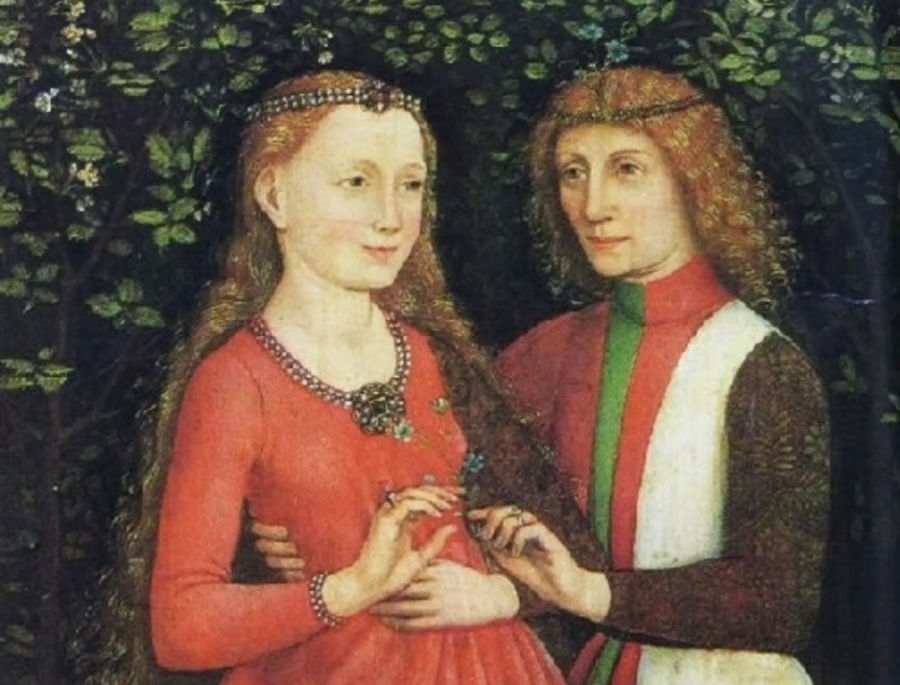
Straight from the procession, Maximilian headed to Ten Walle, the ducal palace. Having passed through a line of torches he for the very first time encountered his bride. The reception now followed Burgundian court protocol with long speeches, praising each other’s lineage and fecundity. And then we move into something our boy from Styria may not have expected. His intended mother in law told him that Marie had hidden a carnation close to her heart, the symbol of pure love and good luck. To which he may have responded, oh, yeah, cool. But then his mother-in-law insisted that he should go and get it. Question mark, question mark? Maximilian had, had girlfriends before, but he was not used to opening lady’s corsets in public. But that is exactly what the archbishop of Trier now suggested he did….There is a Netherlandish picture of Maximilian in the Kunsthistorische Museum that shows him as a young man, holding a carnation , and frankly, looking utterly bewildered.

Maximilian with Carnation

They got married the next day in a, by Burgundian standards, modest ceremony. The ongoing war, impending famine and the mourning period for Charles the Bold prevented a full display of the splendour of the greatest of the late medieval courts.

But that was not necessary, because these two, Maximilian and Marie hit it off like we have never seen before in a princely wedding. Maximilian wrote back to his friend, Prüschenk, and forgive me if I do this in German, but it just works that much better, quote: Ich hab ein schöns, froms tugendhafftigs Weib,….und dank Gott. Sie ist ..von leib klein, viel kleiner als die Rosina und schneweiss; ein pruns Haar, ein kleins Nasl, ein kleins heuptel und antlitz, praun undt grabe Augen gemischt, schön und lauter; dann das unter heutel an augen ist herdann gesenkt, gleich als sie geschlaffen hiet, doch es ist nit wohl zumerckhen. Der Mund ist etwas hoch doch rein und rot. Sonst vieler schöner Jungfrauen alls ich all miein tag einer gesehen hab, und frölich“ end quote.

Maximilian and Marie

I would like to translate that, but I can’t. Let’s just say that he describes all her little minor imperfections and then says that she is the most beautiful woman he has ever seen. And for all his life he will profess his love to her. She appears in all his pseudoautobiographies as the lady he aspires to be worthy of, he has her depicted as the virgin in his altarpieces, in portraits, forever young, forever beautiful.

Marie at prayer

But there was none of that detached admiration thing that runs through chivalric literature. She was smart, decisive, and in these first months after her father’s death had shown enormous resilience, so he trusted her judgement. They worked together, and they played together. Both of them were mad about hunting, tournaments, music and dancing. She would ride along chasing boar, stag, fox and cheer him on when he was jousting with an opponent, danced with him at the mummeries he so loved. They were made for each other, and within barely a year she gave birth to a son, Philipp, named after her grandfather and the founder of the Burgundian dynasty.

Marie of Burgundy on horseback

So, all was great. Tu Felix Austria, Nube. All of Burgundy is now gone to the Habsburgs, the road to an empire where the sun never sets is wide open.

Well, don’t we forget something here? Ah, the army that Maximilian was supposed to bring. Where is that? Well, nowhere to be seen. All he had brought were 1,200 men against Louis XI’s army of 20,000 well trained and well equipped forces. And Louis was not going to give up on Burgundy. He could not. As long as Burgundy exists, every French king is in mortal danger. The war will go on, and next week we will see whether Maximilian can do more than woo an heiress. I hope you will join us again.

And those of you who feel for poor Maximilian who had to bow his head in shame, admitting to his beloved wife that unfortunately, he does not have the money and the power that she had expected, remember, you can put him back in the saddle at least here on this podcast. You know where to go and you know what to do.

A Childhood between the Middle Ages and the Renaissance

Ep. 216 – The Youth of Emperor Maximilian I History of the Germans

Listen on Spotify

Listen on Apple Podcast

Listen on YouTube

Transcript

Hello and welcome to the History of the Germans: Episode 216: The Youth of Emperor Maximilian I, which is also episode 14 of Season 11: The Fall and Rise of the House of Habsburg.

What is it like to grow up the son of the emperor? For most of the rulers of the Holy Roman Empire we have covered so far, no idea. There are scarce reports about the way the princes grew up, safe for tales like the emperor Ludwig the Bavarian being kidnapped by his pet monkey. But now, as the Late Middle Ages make way for the Renaissance, we can see the boy who would be king at play, being fed by his nursemaid and pretending to be a knight at a tournament.

Maximilian as a baby eaing

And even better, this emperor is Maximilian, the last Knight, one of the most iconic rulers of his time. Come along as we descend into the delights and terrors of his epic childhood, complete with mythmaking in drawings and woodcuts.

But before we start a few things. Part 2 of the Barbarossa series I did with the history of Venice and the History of Italy is out and well worth listening to. I have uploaded the full three episodes both on the Patreon feed and on the website membership site for you to listen to advertising free. And as always, if you want to keep the show as is go to historyofthegermans.com/support and become a patron as Ralf M., Wei-Chun L., Stephen M., Frank McC. Edward H., Herr Muskie, Christopher G. and Jonathan G. have already done.

And with that, back to the show.

So far in this podcast we have not talked much about the childhood of the key protagonists. The only case I can remember is that of Karl IV and his relationship with his father, John, the blind king of Bohemia. And most of what we know about his childhood and his relationship with his father came from reading between the lines of his autobiography and the fact that he did consistently 180 degree the opposite of his father.

With Maximilian, things are very different. We hear about his fear as a little boy during the siege of Vienna, him getting stuffed with sweets by his mum and his early memories. There is even a woodcut showing him just playing for fun.

And as we are talking about childhood in the late Middle Ages, it may be worthwhile looking into this question whether premodern people loved their children as much as we do, or at least intend to do.

This debate goes back to a French historian, Philippe Aries, who published “l’enfant et la vie familiale sous l’ancien regime” in 1960, better known by its English title “Centuries of Childhood“. Aries looked at the depiction of children in art before 1500, where they often appear in adult dress and act as miniature adults. The same he thought was the case in literature, where childhood is very rarely a topic, and where it is mentioned, children are disposable, effectively lesser adults. And indeed if you look at the donors on medieval altarpieces, their children tend to wear the same clothes as the adults, just smaller. Even the Christ Child is often shown detached from the virgin with a much older face. It wasn’t before the early renaissance in Italy that Jesus is shown as a human baby clinging to his mother.

From this he concluded, that childhood is a recent idea and that parenting in the Middle Ages was largely detached. Nuclear family bonds of love did not exist in the era, and children died too often to allow parents to get too emotionally attached to them. They weren’t treated as delicate and would spend a lot of time outside family structures, sometimes fostered out as domestic servants or to be brought up by nursemaids.

This book caused a huge amount of controversy and created a whole cottage industry of medieval scholars rebutting the thesis.

I am in no position to make any meaningful contribution to this debate. However, from a purely anthropological and biological perspective a society where parents fail to build true emotional bonds with their children would find it hard to function. And as for children wearing adult clothes in portraits, two things spring to mind. One, do even the adults wear these clothes every day? Of course not. They have themselves painted in their Sunday best. And so are their children. The fact that my kids’ school photos show them wearing jacket and ties, or demure skirt and blouse, sadly does not mean that they called me sir and  made sure they were seen but not heard. 

And when it comes to the lack of records about childhood in literature, we have to remember that paper only began spreading around europe in 14th century. The first German paper mill opened in Nurnberg in 1390 and in England it took until 1490 for paper to be produced there. Vellum, as we heard in the Gutenberg episode, was extraordinarily expensive. Hence what adults wrote down were the things adults found most important, theology, history, politics, science and chivalric romance. And most of these adults who wrote things down were clerics who lived in religious houses without children.

So, concluding from the absence of reports about childhood games that medieval parents did not love their children is the same as saying, the lack of articles in the Financial times covering the subject of kids playing in the mud, proves that bankers are bad fathers, well they may be, but it is not the journalists fault.

On the balance of probability, I would say that medieval mums and dads loved and cared about their children as much as we do, and that the terrible child mortality left them with a lot more grief to deal with than we have to do.

But there is one thing that I agree with Aries about, which is that the way children and childhood are depicted and recorded changed in the 15th century. And quite profoundly. The childhood of the future emperor Maximilian I lies exactly in this transition period, which is why we have a record of it, a record that may help us understand the man and political actor he became.

He was born on Maundy Thursday of the year 1459, in the east tower of the castle of Wiener Neustadt. When he was in his late thirties he asked the humanist and writer Joseph Grünpeck to effectively ghostwrite his autobiography, the History of Friedrich III and Maximilian. And in this, let’s say mildly embellished account, the newborn Maximilian, when washed in his tiny bathtub, for a very brief moment stood up, which is not quite as impressive as Hercules strangling snakes as a newborn, but still a clear sign of great power and glory ahead.

Maximilian in the Bathtub: AT-OeStA/HHStA HS B 9 Joseph Grünbeck: Historia Friderici et Maximiliani, 16. Jh. (Einzelstück (Aktenstück, Bild, Karte, Urkunde))

And so he needed to receive a grand and powerful name. Constantinople had fallen just 6 years earlier and though Friedrich III famously did nothing about it, he – as emperor – was now officially responsible for getting it back. Hence Constantine would be a most suitable name for his eldest son and heir. Several of his siblings would end up with Byzantine names like Helena, John and Christoph. Another option was George, after St. George, the hero of Christian chivalry and patron of the knightly order Friedrich III founded a few years later. But the emperor went for the name of a local Austrian Saint, Maximilian of Lorch, a missionary who was decapitated when he refused to abandon Christianity. As far as saints go, he is about as local and as obscure as you can get. Still he had appeared to Friedrich III in a dream and had saved him in one of his very few battles. And that is why we now have so many Maxes. My grandfather was a Max, and it is a top 50 first name in Germany and even in the UK. Chances are, you have a Max in the family. And now you know where the name comes from, a dream of the Imperial Arch Sleepy Hat.

Maximilian vom Pongau, Statue in der Kirche St. Anna in Sulzbach-Rosenberg.

Even if young Max did not stand up at birth, physical strength and dexterity was a key theme in his childhood and later life. His father, despite being tall and broad shouldered had always been a bit flabby. Not his son. Maximilian came much more after his grandfather, and even more his grandmother. Ernst the Iron had been a legendary warrior, a master in the handling of all weaponry and given his moniker, was never out of his armour. And his wife, Maximilan’s grandmother the legendary Cymburgis of Mazovia, the alluring daughter of a polish duke and famously strong, able to bend horseshoes and push nails into walls with her bare hands.

But long before he could show any physical prowess himself, the future emperor was thoroughly traumatised as Friedrich III’s reign hit its low point. The weeks in the Hofburg in 1463, hiding from the cannonballs down in the cellars left him with a constant fear of being overpowered, a need to be stronger and more aggressive, fending off attacks as hard as he could. He never openly dismissed his father, but master Grünpeck had to marshal all his remarkable faculties to make Friedrich III look powerful and admirable. He declared the old emperor had become all powerful thanks to his cunning and conniving, playing the disloyal princes one against the other, so he could punish his enemies without a single stroke of the sword.

Attack on the castele of Vienna 1463 (grunpeck) AT-OeStA/HHStA HS B 9 Joseph Grünbeck: Historia Friderici et Maximiliani, 16. Jh. (Einzelstück (Aktenstück, Bild, Karte, Urkunde))

Maximilian writes that his father had again and again allowed traitors who had spread malicious rumours and insults get away with no more than a mild dressing down, saying that the tongues are meant to be free, and should not be constrained by the law. What he called the patience of the emperor compelled his mother, the formidable Eleanore of Portugal to say to her husband, quote: “you are not worth covering your shame with a loincloth as long as you do not punish crimes with all severity, by not doing so you are just opening the floodgates to mischief”. Maximilian writes that this was said in jest, but hey, if I was from the most illustrious family of Portuguese kings and navigators, and my husband got me shot at by some plebs and eat porridge for weeks, I would not be joking about sending him out into the cold without underpants…

And deep down it seems that is what Maximilian thought as well. It is quite evident that Maximilian’s attachment to his mother had been much closer than that to his father. Eleanor was much livelier, sometimes volatile and more exciting than his sedate, considerate father.

eleanor and Maximilian from Weisskunig

As was common for noble families, Maximilian was almost immediately handed over to nursemaids and nannies to be brought up. It was a Habsburg tradition that the small children ate and played with the children of the servants. We even have a small drawing of little Maximilian, complete with archducal hat, being fed alongside the other children in the household of Wiener Neustadt. These relationships seem to have remained beyond childhood and shaped him.

Maximilian turned out to be one of these people who could talk to anyone, be it a bishop,  a banker, a baker or a beggar. Sure, he was a Habsburg and he believed his family was predestined to rule the world. He adopted A.E.I.O.U, his father’s weird motto that became Alles Erdreich ist Oesterreich Untertan, he knew for a fact that there had been 95 lords of Austria going back to Noah and that Caesar and Nero had elevated the archduchy to the most venerable province of the roman empire. But at the same time, he was never haughty or condescending. The word that was most often used to describe him was “leutselig”, which is usually translated as affable or amiable, but has an additional component of really enjoying the company of others of die Leut, the people. And that is always and for everyone a hugely valuable thing, but given Maximilian almost always lacked hard power, these soft skills was what built the Habsburg-Burgundian empire.

Maximilian talking to everyone (from weisskunig)

Once he had come out of the nursery he turned into a wild child, exploring the castle of Wiener Neustadt, its stables, armouries, walls and ditches, large forests and the gardens his father so fastidiously catered for. Coming along on these quests were now the sons of the local nobility, many of whom became friends for life. There was even a Turkish prince, Omar Kalixt, allegedly a half-brother of Mehmet the conqueror amongst his circle. But this is not the court of Louis XIV with levees and courtiers shuffling backwards out of the room. In his daily life, Friedrich III was a modest man, and so was the little court he gave to his son. There was simple food, hearty games and true friendship.

Maximilian and his mates hunting (Grunpeck)

Still a shadow hung over this image of an idyllic, or as my son would say, wholesome  childhood. Maximilian barely spoke until he was six years old and even later was closed off with his parents and teachers. Most historians ascribe this to the way his was schooled.

We are now in the early modern period, and an illiterate prince had become inconceivable. As Friedrich III said, an uneducated monarch is nothing but a crowned ass. Children were hence introduced to the key elements of the medieval education, the trivium and then the quadrivium, i.e., first logic, grammar and rhetoric and then arithmetic, geometry, music and astronomy.

The first three were the stumbling block, since what these highfalutin terms, logic, grammar and rhetoric meant was learning Latin and that meant learning the Donatus, that Latin textbook that was amongst the first things Gutenberg ever printed. His mother had approached an eminent humanist to teach her son, using the book on education of the old family friend, Aenea Silvio Piccolomini. But Friedrich did not trust anyone with his son, except for his loyal Styrians. The first of his teachers was o.k., but the second was much harsher. Corporal punishment was common on so many levels, including in schooling. And -with his father’s permission – his praeceptor Peter Engelbrecht beat little Maximilian hard whenever his Latin vocab or grammar fell behind the standards that he expected. Once when lightning struck the castle and Maximilian laughed at his teacher’s startled expression, he was slapped for that as well. The net effect was that he never learned really good Latin, though he became fluent in Slovenian, French, Flemish, English, even Spanish not through books but by talking to lords, ladies, labourers and Landsknechts. And he kept a grudge for his old schoolmaster for the rest of his life.

Maximilian in school (grunpeck)

To escape the horrors of the schoolroom, he fled to his mother’s chambers where he was fed sweets and presumably got the warmth and love his father did not convey to him as easily. In fact the parents had a massive row over Eleanor’s habit of giving the kids candy. The emperor accused her of stuffing them to death. And of their five children, three died. When Maximilian’s sister Kunigunde got sick, Friedrich personally cared for her, limiting her to his modest and presumably healthier diet.

One can only imagine little Maximilian’s pain at his mother’s death when he was just 8 years old. Eleanor barely made it to 30 and succumbed to some sort of stomach ailment, possibly cancer, which suggests Maxmilian witnessed her slow and agonising death. He venerated his mother for the rest of his life. Depictions of her in his commissions made her resemble a saint, even the virgin, rather than a real life person. 

Eleanor of Portugal by Hans Burgkmair

As he grew older, he escaped the clutches of Peter Engelbrecht and experienced a more enjoyable form of learning. He had an unknown instructor who taught him drawing and  calligraphy. That was far more up his street, and as we will find out, Maximilian became an extremely knowledgeable patron of the graphic arts, and even more astute at utilising imagery for his political aims.

His next set of teachers helped him develop an interest in the subjects of the higher learning, in particular history and politics. It is often said that he never developed much aptitude with numbers, leaving him prey to the economic genius of Jakob Fugger. I have read varied opinions about that and so we should leave this subject until we get to it.

One of the reasons there is debate about what he did or did not learn has to do with the way Maximilian managed his image. As we will see, propaganda and PR were crucial in the way he operated politically. And part of that propaganda were various accounts he commissioned of his early life. We already talked about Grunpeck’s History of Friedrich III and Maximilian, which is a highly flattering but otherwise traditional chronicle. Maximilian also commissioned a rhymed poem called the Theuerdank, a sort of chivalric romance where a young prince has to master various challenges, defeat evil opponents and resist temptations to be worthy to marry the rich princess in the west, where obviously Theuerdank is Maximilian and the princess is Mary of Burgundy. Towards the end of his life he commissioned another book, another way for him to create a mythology about himself.

This book is called the Weisskunig, which is witty play with words, as it means both the White king, as well as the Wise king. But that is pretty much the only witty thing about it. In 251 woodcuts the reader is introduced to a fictitious Maximilian who is a mix of Jesus, Aristotle, Archimedes, Hercules, Thomas Aquinus, Michelangelo, Mozart and even Nicholas Flamel. This mega Maximilian is a total genius, disputes with the wise men in a brace of languages, helps painters to find their style, builders to improve the sturdiness of their houses, teaches armourers how to harden the steel, plays music better than the greatest musicians – in short, a totally insufferable know-it-all. This book covers Maximilian’s life well into the Italian wars, or as he described them, the war against the King of Fish, aka the doge of Venice.  In a way he was lucky this self magnification set in scene through the much more magnificent woodcuts of Hans Burgkmaier was only published long after his death. All this material makes it harder, rather than simpler, to figure out how he actually grew up, and what he learned.

But even if he did not excel in intellectual pursuits as much as he later in life pretended to have done, it is obvious is that Maximilian was a man who loved, and I mean, really loved physical activity, adventure, and blowing things up. From early on, he and his group of friends spent most of their time riding horses, hunting with dogs and falcons, training for the dozens of different forms people could hurt each other in tournaments, even getting to grips with handguns and cannon. One time Maximilian had horded enough gunpowder that he could have blown up the bombard and himself, but luckily someone found out and stopped him. Aged six he got his first set of armour that he wore with pride around the courtyards of Wiener Neustadt.

Maximilian playing with guns

As he grew into a teenager, the intellectual education receded more and more into the background and Maximilian focused more and more on practical topics, and that meant for a prince, even in the late 15th century, warfare, both individual fighting skills as well as military strategy, tactics and technology.

This he approached with the mindset of an encyclopaedia, a comprehensive compendium of all the available information about a subject. For example he commissioned the Freydal, another one of these pseudo autobiographies which on the one hand recounts the story of a knight and son of a mighty prince, trying to win the heart of three beautiful ladies. But it is also an exhaustive tableau of two things, tournament techniques and mummery. There are 256 miniature pictures, depicting sixty-four tournaments, which involve all conceivable forms of simulated combat, on horseback and on foot, and a variety of evening entertainments, usually masked balls or wild dances featuring all kinds of costumes and dance moves. There is even one where the men wear women’s clothing – just to prove that there is nothing new under the sun.

Freydal Mummery Folio 207

But at age 14, if you could have looked into his head, what you would have found above all, were the chivalric romances, the tales of Percival and Lancelot, of Tristan and Siegfried. He was a boy who loved sports, who loved armour, weapons and above all, adventure. In what world would he not have seen himself as the 15th century version of the superhero, the chivalric knight out on his quest to slay dragons and gain the heart of the lady of his dreams.

All this sounds very late medieval. All this talk of chivalry, fighting techniques and damsels in distress may get one to believe Maximilian was as conservative and backward looking as his father. But there is also another side to him. He was fascinated by technology, not just military technology. From his earliest days he visited the workshops of armourers, gunsmiths, printers, painters, any kind of metalworkers, he learned about mining, smelting, minting of coins, architecture, metallurgy of any kind. He is excited about geology in particular precious stones.  He shared his father’s interest in what he called the black arts, Alchemy, Astrology, Mysticism, even Necromancy. Though the claims in the Weiss Kunig are hugely exaggerated, there remains the fact that he had more understanding of modern topics, like manufacturing and economics than many of his contemporaries.

That same dichotomy is observable when it comes to religion, his mother had imbued him with a deep personal piety, whilst his father taught him to use the organisation of the church as part of his revenue base. So, Maximilian became a man who could passionately dream of going on crusade or at least do a pilgrimage to Jerusalem as his father and grandfather had done, whilst at the same time diverting the funds collected for the recovery of Constantinople to pay his personal debts.

In 1471 and 1473 Maximilian is for the first time introduced to the wider world of the empire. He travelled with his father from Styria to the imperial diets at Augsburg. There he saw the grand princes of the empire competing in spectacular tournaments. To get an idea what that may have looked like, check out the unbelievable exuberance of the armour, dresses and fancy headgear in the Triumph of Maximilian by Hans Burgkmair and his son. At the same time, the city itself impressed young Maximilian. Augsburg was one of the centres of art and industry in the German lands, a kind of late medieval silicon valley, New York and Hollywood rolled into one, the place where some of the greatest armorers have their workshops, some of the best painters and sculptors produced mindboggling beauty, merchants were trading wares from Venice, Novgorod, Lisbon and London, and bankers were setting up their stalls, ready to compete with the Lombards. Augsburg would become Maximilian’s favourite city, the place he would spend more time in than anywhere else, safe for his capital in Innsbruck. The king of France would later call him “the mayor of Augsburg”.

Jorg breu Augsburg in Spring

And then, in 1473, he met the embodiment of this last gasp of chivalric culture, Charles the Bold the grand Duke of the West.  If the imperial princes in Augsburg had been impressive already, this guy was next level. The clothes, the armour, the pearls, the precious stones, the tapestries all and everything 10, 15, 20 times bigger, more beautiful, more sophisticated than the modest household in Wiener Neustadt. Sure his father had something he called the hundred thousand gulden coat and an impressive collection of gemstones, but really, could that compete with the grandeur of Burgundy. And Charles had fought in dozens of battles, in the midst of the action, taking daring decisions his advisors had told him not to. What a contrast to his hesitant, slow and miserly father. Maximilian was like an Austrian cart racer meeting Lando Norris or James Hunt for those of an older generation. Of course Maximilian thought Charles the Bold was the business.

Battle of Charles the Bold – Weisskunig

Charles invited him to one-on-one meetings, they talked about war and weapons and armies. Charles gave him a beautifully decorated copy of his military manual, a copy that still exists. And Maximilian was to marry the daughter of his hero. It does not get any better than that, or could it?

Maximilian would never again sit down with Charles of Burgundy. He would later write that he had met him and Mary of Burgundy before Neuss in 1475, but that meeting never took place. During that war Maximilian was kept under the protection of the bishop of Augsburg, a long way from the front line.

Maximilian and Marie at Neuss – the Meeting that never happened

Meanwhile, as Charles fortunes darkened, the need to settle the marriage contract between Maximilian and Marie of Burgundy became ever more pressing. Charles had few friends left, having disappointed king Edward IV of England and alienated his neighbours. A positive relationship with Friedrich III and the empire was his way to balance out King Louis XI of France. He could no longer insist on a crown for his land of Burgundy as a precondition for the betrothal, and so in 1476 he set a date for the ceremony. We know why he did not make it to the event, but as far as the lawyers were concerned, the Habsburg-Burgundian merger was ready and good to go.

News of the disastrous battles of Grandson, Murten and finally Nancy reached Austria throughout 1476 and 1477. One would expect that Maximilian had set off for Gent as soon as he had heard of Charles’ demise, but he could not.

News of Charles death arrive in Vienna

Friedrich III and Maximilian were back home in Austria. Matthias Hunyadi, the king of Hungary and leader of a standing army even larger than that of Charles of Burgundy, was attacking their homeland.

Matthias, the bulwark of Christendom against the oncoming Turkish flood had actually made peace with the Sultan and was seeking land and wealth in the West. His first target had been Bohemia where Georg of Podiebrad reigned over a fragile alliance of moderate Hussites and Catholics. The continued existence of the Utraquists, whose theological difference to the orthodox Catholicism had narrowed down to the right to take the eucharist in the form of both bread and wine, kept irritating Rome. Pope Paul II excommunicated Georg of Podiebrad in 1468 and tasked Matthias Hunyadi, king of Hungary, to remove the heretic and force Bohemia back into the bosom of mother church. But the shiny army of the Raven King struggled to knock down the Hussite Wagenburgs. He had taken over half the country, Moravia and Silesia, the parts that had traditionally been catholic, and had himself crowned king of Bohemia. But he could not make his way to Prague. Even the death of Georg of Podiebrad in 1471 did not change the situation. The Bohemian barons called in the brother of the king of Poland and the war kept going.

Throughout the 1470s, Friedrich III got sucked into this war. It was obvious that Matthias had his eye on Austria. Whenever the war in Bohemia ended, Matthias forces would go for Vienna. So far Matthias had not attacked, but he had let Turkish raiding parties cross his lands to pillage Austria. But since 1474 he was piling on the pressure, gradually opening hostilities. Matthias formally declared war on Austria in June 1477, a war that would last until 1490.

These issues in Bohemia and Hungary were the reason Friedrich III and Maxmilian were off the scene in the west after the siege of Neuss.

Which also meant that when Charles the bold had his head split open in the snowstorm outside Nancy, Maximilian was hundreds of miles away from his intended bride. And that was bad, because she really, really needed him.

Charles the Bold’s rule of his lands was built on the still smouldering ruins of the cities of Dinant and Liege. The grand centralisation he had forced through, the estates and court at Mechelen was accepted only out of fear. And when Charles the Bold was no more, there was no more fear and no longer did the cities or the territories recognise the central power. King Louis XI of France whose elaborate plan to wipe out this dangerous enemy had come to fruition in ways far beyond his wildest dreams, was moving on the young heiress, Marie of Burgundy. The situation was extremely precarious, Ghent was in open revolt, Marie’s chief minister was beheaded before her very eyes. New suitors were circling the ducal place, including the famously ugly dauphin of France, the future Chares VIII. Maximilian’s bride was in clear and imminent danger. Her knight in shining armour had to saddle his horse and ride out to rescue her, his own lands, the Raven King, his ailing father all be damned.

This is when it can get no better. The knight’s quest is on. Maximilian, slim but strong, clad in the finest armour, trained in warfare to within an inch of his life heads out for his grand adventure, to gain his kingdom.

Which is where we leave him. Next week the two lovers will finally meet and the war to preserve her and her inheritance will kick off, whilst back home in Austria the armoured knights, disciplined infantry and mighty cannon of the Raven King push for Vienna. I hope you are going to join us again.

And if you find yourself touched by this story and wish for you and your fellow listeners to enjoy the first encounter of the great lovers of the 15th century without me having to make deeply inappropriate references to mattresses, you know where to go and you know what to do.

The defeats of Charles of Burgundy at Grandson, Murten and Nancy

Ep. 215 – The Bold in the Cold, the end of Charles of Burgundy. History of the Germans

Listen on Spotify

Listen on Apple Podcast

Listen on YouTube

Transcript

Hello and welcome to the History of the Germans: Episode 215 – The Bold in the Cold, the end of Charles of Burgundy.

Introduction

The rise of the Habsburgs to world domination pivots on one crucial moment, the marriage of Maximilian of Habsburg to Mary of Burgundy, the daughter of Charles the Bold, last of the Grand Dukes of the West.

Maximilian I and Mary of Burgundy, stained glass, Basilica of the Holy Blood in Bruges, between 1480 and 1490

The usual story is that young Maximilian one day walked down the aisle of some splendid cathedral and was handed the richest principality in Europe on an jewel-encrusted golden platter by the father of the bride. All he then had to do was lie down and think of the Habsburg-Burgundian empire.

That is not quite what happened. When Maximilian arrived in Ghent in August 1477, his father-in-law lay dead in a ditch in Lorraine and large sways of ducal authority and income had gone. Within less than 3 years, 1474 to 1477 Charles the Bold had frittered away the mythical wealth of the Burgundian dukes. And not just that.

These years between 1474 and 1477 helped turn the medieval empire into the Holy Roman Empire of the German Nation. So please allow me to do this episode, even though very, very few of the protagonists or parties to the conflicts are Germans in the modern sense.  

Collaboration with History of venice and History of Italy

If however you prefer to listen to more Germanic content, I have something quite juicy for you. At midnight yesterday the History of Venice podcast has released a unique three way collaboration where they talk to Mike Corradi from A History of Italy and yours truly about Frederick Barbarossa’s grand plan to take over Northern Italy between 1152 and 1177. I had so much fun doing that and I hope you enjoy listening to it.

Christmas Special

As long as you come back. In particular you have to come back for the Christmas Special. It is now time to reveal outcome of your vote. Drumroll…. You have voted with absolutely overwhelming, just over 75% majority  to …..make me sing….no, no,no. I am so grateful you have saved me from this humiliation. No, the winner is…recommendations for 5 to 10 places I think you should see and that are not on the usual travel itinerary.

Thanks so much to all of you who have participated. It was brilliant to see that there is now a real community of fans of the history of the Germans podcast out there. And I hope I can come up with something interesting…release date will be Thursday, 25th of December – it is the Christmas special after all.

And with that, back to the show.

recap

Last week we ended with the lifting of the Siege of Neuss. Charles the Bold, duke of Burgundy, the richest prince in Europe and master of one of the first modern armies had failed to break a small town on the Rhine. For 10 month the finest artillery pieces the world had ever seen pounded the walls of Neuss. And with every week the city held out, the aura of the Burgundian war machine diminished.

The emergence of Mass Media and Public Opinion

And as news of the heroic defense spread rapidly across the empire, the mood changed. When I first published last week’s episode I said that there were no pamphlets telling the story of the siege of Neuss, but I found myself mistaken very quickly. Printers in Strasburg and Cologne published rhymed chronicles of the Burgundian wars in 1476 and 1477, which makes it almost certain, that printed narratives had been circulating whilst the fighting was still going on. And we find letters describing the events of 1474 and 1475 in the archives of dozens of cities, taken along by traders going up and down the Rhine and then copied across the extensive networks of the Hanseatic League, the Augsburg bankers, the Ravensburger Handelsgesellschaft, discussed at the Frankfurt and Leipzig fairs and passed along by messengers in the pay of the territorial princes. From Luebeck to Graz, from Berne to Riga, people heard about the epic struggle in the West.

fettisheim, Konrad: Geschichte Peter Hagenbachs : Reimchronik der Burgunderkriege , 1477

These wars of the second half of the 15th century were the first conflicts that were covered by an early version of mass media. And like mass media throughout the rest of history, news changed minds and attitudes even of people far away from the events.

For most of the period we have covered in this podcast, the empire had been a matter for the aristocratic elites. It was all about the emperors, the prince electors, sometimes about the imperial princes. If people outside that demographic had any influence, they had usually been churchmen whose theological ideas had seeped into the world of politics or who had risen to become bishops, cardinals, even popes. What we have not seen before were educated laymen having a role in politics beyond the confines of their cities or courts. We already mentioned Martin Mair, the prime minister of Bavaria-Landshut and major political opponent of the emperor Friedrich III. He did of course stand out, but men of his background and education permeated the political and economic structure of the territorial principalities leading to the emergence of something akin to public opinion

This public opinion is what both motivated Friedrich III to take a lead in the resistance as well as made it possible for him to gather an army to face off against Charles the Bold. His role in the events around the siege of Neuss is often played down. It just does not fit with the idea that Friedrich III was the Imperial Arch Sleepy Hat who hid in his castle in Styria, never showing up when he was needed.

The Holy Roman Empire “of the German Nation”

This time Friedrich III was everywhere, calling imperial diets, attending informal meetings with the local dukes and counts, stiffening the resolve of the townsfolk and the estates by spending Christmas 1473 and 1474 in Cologne, and leading the imperial army to Neuss in 1475.

In March 1475 he wrote the following letter quote: “Honourable and well-beloved faithful people, we have (after our great period of instability, now some time ago) betaken ourselves hither to the See of Cologne in person, together with our and the Empire’s electors, princes, counts, those of the cities and other faithful people; and, for the deliverance and preservation of the Holy Empire and German nation, with the assistance of Almighty God, we intend to offer mighty resistance against the duke of Burgundy in his improper, arbitrary undertaking that he has carried out in the See of Cologne, which is an electorate and a notable member of the Holy Empire, to the truncation, severance and injury of the Holy Empire and German nation, against the prohibition issued against him by our Holy Father the pope and by us. And to that end we have conquered – with great effort, expense and labour – certain towns and fortifications along the Rhine in which the same duke of Burgundy’s people have been, and we are now in daily military preparations to meet the same duke of Burgundy in the field and to defy and defeat him with armed force, through God’s help.” End quote.

Thanks again to professor Duncan Hardy for this translation, which is from his very recently published book Law, Society and Political Culture in Late Medieval and Reformation Germany.

Nuremberg chronicles – Kingdoms of the Holy Roman Empire of the German Nation

That does not sound very sleepy to me. And notice the mention of the German Nation. This was not your usual plea to medieval vassals to fulfill their sworn obligations. This talks about the defense of the empire against the improper undertakings of the duke of Burgundy and the injury inflicted on the Nation. Friedrich III may appear gothic and medieval in his buildings and outward appearance, but in his acts after 1463, he is much more modern than he has been given credit for.

The Engagement is Still On!

And he remains an astonishing negotiator. Because, whilst he is rallying the reluctant nation into a war against Charles of Burgundy, he is also still keen on the marriage between his son Maximilian and Charles’ only child, Marie. One would assume that given the outright war between the two men and the extremely volatile character of Charles the Bold, that this engagement would now wash down the Rhine River.

But it did not. Charles did not give up his hope to gain a crown and hence could not or did not want to bin the engagement. There is also the remote chance that having met Maximilian in Trier, he had grown fond of the young man. His state as powerful as it was, was also brittle. The great trading cities insisted on their independence and the territories had not yet fused into one coherent structure. Hence his daughter would need a competent husband by her side if she were to hold on to the Burgundian empire.

Or maybe he did not think at all about Friedrich and Maximilian and all that. He reconfirmed the engagement just to reduce the long list of headache inducing problems that had been piling up whilst he had been held up in Neuss.

No Campaign against King Louis XI of France

Charles had calculated that the campaign into Cologne would last no more than a few weeks. That was the amount of time it had taken him to incorporate the duchy of Guelders and to get the duke Rene II of Lorraine to submit to him. If everything had gone to plan, he would have incorporated Cologne in the autumn of 1474, and then gone on to his next big project, putting the English king Edward IV on the throne of France. Charles real enemy wasn’t the emperor or anyone else on his eastern border, the man he really wanted to crush was Louis XI, the king of France. It was time for Anglo-Burgundian Alliance to once more ride into Paris.

But the heroic Hessians inside little Neuss prevented a new Agincourt. When Charles arrived in Calais months later than planned, he did not bring his army. He wished Edward the best of luck in his war with France, told him he was going through Lorraine and that they should sit down for a coffee in Paris some time. The dejected Edward and Louis of France made peace a few weeks later.

The reason that Charles could not team up with Edward was only partially the physical damage his army had suffered. The even bigger impact was the hit to his authority. Charles’ regime had been built on fear. He had burned Dinant and Liege not only out of spite, but as a signal that he would brutally crush every opponent, that he would not give mercy. And this fear is what kept the cities of Ghent, Bruges and all the others in line, it is what made the duke of Guelders and Lorraine drop to their knees when he showed up. And that fear was based on the superiority of his army. What Neuss had shown was that his army was not invincible, and without an invincible army there was no fear and without fear Charles was just a man with a ridiculous golden hat.

Burgundy in Trouble

The clearest indication that his state was in trouble was the League of Constance. You may remember from last week that the cities of Strasburg, Colmar, Basel and Selestat had teamed up with the Swiss Confederacy to throw out Peter von Hagenbach, Charles brutal governor of Lower Alsace. They had brought in the ever cash strapped Sigismund of Tyrol, which added the Habsburg lands around Freiburg in Breisgau to the League.

And then, when the siege of Neuss was going badly, duke Rene II of Lorraine joined the League. We have met Rene II already. He was the patron of Martin Waldseemueller and Matthias Ringmann whose famous map gave the American continents their name (episode 201). But that happened in 1507 at the very end of Rene II’s life. We are in the year 1474 and Rene II was young and reckless. He had become a vassal of Charles out of fear, but now that Charles’ terrifying army was falling apart before Neuss and king Louis of France was easing his concerns with cash, he did not want to be no vassal no more.

René II. von Lothringen, Darstellung in der Handschrift von Pierre de Blarru: Nancéide, Musée Lorraine

Rene II threw down a blood splattered gauntlet at Charles the Bold, or more precisely sent an envoy to do exactly that on his behalf. Instead of getting enraged as the poor envoy expected, Charles smiled and said, “your words bring me great joy”. A reaction that got his courtiers wondering whether God had clouded the common sense of their great lord.

Battle of Héricourt

Because at the same time his campaign to avenge the death of Peter von Hagenbach in Alsace had gone badly wrong. The big cities of Alsace, and even the villages, had strengthened their walls and  those who could, had hired mercenaries. And worse, the league of Constance mustered an army that chased the Burgundians away. And then they pursued them before the castle of Héricourt in the Franche Comte. In the ensuing battle Charles’ army lost 3,000 men and handed the castle over to Sigismund of Tyrol. Another nail in the coffin of Charles reputation as a great warrior.

Zeitgenössische Darstellung der Schlacht in der Burgunderchronik. Rechts das fliehende burgundische Heer.

Lorriane in Burgundian hands!

If Charles wanted to keep his empire after Neuss and Héricourt, he needed a win, urgently. So he led his army into Lorraine, took one town after the next within just weeks rode into the capital, Nancy. Duke Rene II fled to France.  

Charles was now lord of Lorraine which means he had established a connection between his possessions in the Low Countries and the duchy of Burgundy. You could now travel from the North Sea to the gates of Lyon without ever leaving the lands of the Duke of Burgundy. The grand dream of the dynasty, the resurrection of the empire of Lothair was within reach.

He was back on top. Burgundy was again the invincible, unstoppable power in the West. Neuss must have been an inexplicable aberration. In fact he now knew why it went wrong. The citizens of Bruges were responsible for the knock he had received. It was Bruges who had failed to provide the sappers and engineers he needed to break the walls. He demanded that they make up for this failure and support his upcoming campaigns with redoubled vigor, blood and treasure, or else.

Bruges chose “or else”. They did not send troops or cash or sappers or anyone. Charles may believe he was again invincible, but the cool calculating merchants of Europe’s most important trading hub could do the maths. Neuss was a tenth of the size of Bruges and held out for 10 months, so how long could Bruges hold out for?

The Grand Duke of the West may not have known or may not have cared what some petty bourgeois in Bruges thought. He was hungry for more conquests and more war to show the world that he was back in full.

The way to Grandson

And an opportunity to fight presented itself in the nearby duchy of Savoy. This duchy occupied what is today Piedmont, Nice and the Aosta Valley, but also the region around Geneva and Chambery, stretching as far north as Bourg-en-Bresse. Charles had an interest in Savoy as the next step down towards the Mediterranean and as a route for Italian mercenaries to come up and resupply his forces. Savoy, like Alsace, Franche Comte and the Swiss Confederacy was part of the Holy Roman empire. However, the dukes of Savoy had close links into France, the reigning duchess was the sister of Louis XI. Nevertheless the duchess had lined up with Charles the Bold, rather than her brother, because she feared incursions on her eastern border, by the cities of Berne and Fribourg.

To call them the Swiss at this point is not yet accurate. The Swiss confederacy was a permanent defensive alliance formed to push back the Habsburgs and as we now see, the Burgundians. But if a member wanted to expand, the others would not necessarily come along for the ride. So when Berne took over the county of Vaud, around lake Neuchatel, that was the business of the city of Berne. That happened in April 1475. The Bernois and their allies, the Fribourgeois took the Vaud and its main castle, Grandson, just when the siege of Neuss was winding down.

It took until early 1476 before Charles could react to this attack on his ally, the duchy of Savoy and to his supply route. He celebrated Christmas in Nancy and by January his grand army set out for the Vaud.

The first defensive structure they came across was the castle of Grandson at the bottom of Lake Neuchatel.  Charles’ great army with its 400 cannon took a couple of days to force the garrison of 412 men to surrender. Charles had them slaughtered to the very last soldier. The executioners hung them on the branches of the nearby trees until there was no more space. They drowned the others in the lake. This was against all military standards of the time. It was understood that any army would have to at least make some sort of stand in the beginning, but if they gave up quickly, they would normally be allowed to go home unharmed. Not this time.

Charles did not regard the militia of the city of Bern as combatants. They were commoners, fighting with pikes and shields and halberds, not chivalric knights on horseback. They could not demand the courtesies that existed between members of the nobility. In the eyes of Charles the Bold, their mere existence was an insult to the social order. Hence they could be killed with impunity, like the citizens of Liege and Dinant, and if he had got there, the inhabitants of Neuss.

The BAttle of Grandson

From Grandson he headed towards Berne, about 60 km north.  His grand army, replenished to a total of 20,000 after the siege of Neuss, journeyed along the shore of Lake Neuchatel. They moved slowly, dragging along their cannon, their fine tents, inns, cabarets and camp followers.

The delay at Grandson had allowed Bern and Fribourg to call on their allies in the league of Constance to come to their aid. And they did show up. They had to travel fast, which meant they had to travel light. They had few cannon, many were wearing light or no armor  and the cavalry from duke Sigismund of Tyrol had not yet arrived in its full force. What they had though were their pikes, their halberds and their shields, their familiarity with the mountainous landscape, their trust in their friends and neighbors standing next to them in the line of battle and the knowledge that Charles would cut them down to the very last if he defeated them.

Swiss praying before the battle of Grandson

Neither side knew where the other was. They were all groping around in the dark. On March 2nd, 1476, a Swiss advance guard spotted the Burgundian troops marching right below them. Without a second thought they attacked, ferociously. But this was not like Morgarten where the Habsburg forces were moving along a narrow path along the shore.

The Burgundians were able to form their battle lines as did the League. The core of the league forces were the Swiss pike squares which they called “Gewalthaufen” literally “horde of violence”. These squares comprised pikemen, holding out up to five meter long lances and protected by enormous shields. If the line of pikemen held, any oncoming cavalry charge would literally be skewered by the pikes. And once their momentum had stalled, the fighters behind the pikes would come out with swords and halberds cutting down the now immobilized riders.

It did work often, but not always. Cannonballs may mow down the shields and pikemen or the momentum of the cavalry charge could break the lines.

At Grandson Charles began with several cavalry charges, but the pikemen held firm. His artillery could not reach them, they were simply too far away. So Charles decided to lure them closer to his 400 cannon, operated by the greatest team of gunners money could buy.

To bring the Swiss pikemen closer, he needed to feign a retreat. That is never easy because the undisciplined armies of the Middle Ages might mistake the withdrawal of the front line as either a sign of cowardice and run them down or as a signal to turn around and run for their lives. But Charles had trained his forces for years, these were professional soldiers, led by experienced generals who understood tactics. So Charles took the gamble and gave the order to gradually fall back.

What he had not known was that the army they saw in front of them was only half of the League forces. The other half was still travelling on the ridge above, trying to catch up with their comrades. And it was exactly at the point the Burgundians were re-organizing their battle lines, that the reinforcements arrived on the scene. They saw a battle in progress and blew their horns. These horns, made from, as the name indicates, the horn of cattle, are amongst the oldest wind instruments in history and their sound had accompanied the attacks by Celtic, Germanic and  Viking armies for centuries. They sound a bit like this:  

Harsthorn (Uri)

Imagine you are a Burgundian soldier and your officer has told you that they were to tactically withdraw a few hundred meters. Sure, no problem, we have trained this a hundred times, so we are slowly moving backwards. But then you hear this sound <horns> above to your left and then a whole new army of pikemen comes out of the woodwork. Do you still believe this is a tactical retreat to lure the enemy before your cannon? No, of course not. What you now think is that the generals have concluded they are outnumbered and the battle is lost. And that they leave the schmucks in the front line to cover their flight. Well, not with me you say. And so say the Guiseppes, Jans, Johns and Johanns who made up the Burgundian army. Three florins a month is not enough to die for. So you turn round and run, so do your friends, the other squads, platoons, companies suddenly, the whole battalion is running. You run past the gun emplacements, past the tented camp, all the way until you can run no more.

Soon the great army of the duke of Burgundy is in full flight. Charles is trying to hold them back. He shouts, he hits at them with the flat side of his sword, but to no avail, he is dragged along by the masses running down the shore of Lac Neuchatel, past Grandson, back into Savoy.

Darstellung der Schlacht bei Grandson in der Luzerner Chronik des Diebold Schilling, 1513

Meanwhile the Swiss look at the whole shebang with utter disbelief that turned into amusement and then jubilation. The grandest, most feared army of the whole of Europe was running before them. And the two sides had barely exchanged more than a few blows.

Burgunderbeute – The largest Loot ever

They followed them down the valley and on to the lake, but hey had only a small cavalry force, so they could not catch up with the fleeing Burgundians on their horses.  And even if they could have, they would not have gone any further. Because they had stumbled across the wagon train of Charles of Burgundy.

For reasons best known only to himself, Charles had taken everything he owned along on this campaign, and Charles did own literally everything. The splendor of the court of the Valois dukes of Burgundy was legendary for a reason. What these sons of peasants and burghers saw before them was simply beyond their comprehension. The silver and gold reliquaries encrusted with precious stones, the dinnerware likewise splendid and the gold coins were easily recognized as valuable. As was the grandest item of them all, Charles solid golden ducal hat that featured more rubies and diamonds, ancient roman intaglios than any crown, his personal seal, again made with a kilo of pure gold were easily identified. But then there were the tents, decked out with the grandest tapestries, the vestments embroidered by the finest craftsmen and women of the Burgundian empire, the illuminated manuscripts that still dazzle the onlooker. Many of the soldiers had never seen such items and struggle to understand what they were. One farmer’s boy found Charles famous diamond, one of the largest in Europe at the time. He dropped it and it was run over by a cart. He dug it up again and sold it for a few florins to a priest. Its value was 20,000 florins, enough to buy a small county.

Pillage of the Burgundian camp after the Battle of Grandson, illustration by Diebold Schilling the Elder (1483)

The loot at the battle of Grandson entered the history books as the biggest booty ever caught in battle. Not much is left in Bern and elsewhere. Most of it has been broken up and sold in parts or simply destroyed in the frenzied aftermath, not surprising given the barrels of the finest Burgundy wine that was also quickly found, as were the ladies that had been following the army. The famous Golden Hat was sold and disappeared. Only a drawing of it remains.

The aftermath of Grandson

From a purely military perspective, Grandson wasn’t anywhere near as catastrophic a defeat as it was often depicted. Charles army had lost maybe a 1,000 men compared to 500 casualties amongst the Swiss. But the psychological blow was hard to take. Charles the Bold, like everyone else in his class, safe for the Habsburg dukes, dismissed the fighters from the Alpine valleys and the mid-sized trading cities of Bern, Basel, Zurich and Lucerne as peasants, inferior opponents that could be run down by a squadron of knights, even if outnumbered four to one. But once more a grand aristocrat who had grown up in a world of chivalric pride had to face the fact that the days of the superiority of the armed rider were over. Even though Charles was much more modern in his military thinking then the French lords at Poitiers and Agincourt, he could not understand how these lowlifes could defeat his wonderful and wonderfully expensive army.

Charles took the defeat very hard. There is a portrait made of him around this time that shows him as a dejected man, with the beginnings of a double chin, a five o’clock shadow, his eyes staring vacantly into the middle distance. That is a far cry from the beautiful young man in his best known portrait from 1461. After Grandson he experienced something like a mental breakdown, began drinking heavily and periods of melancholic withdrawal are alternate with  frenzied activity.

Charles the Bold in 1474

The loss of his personal possessions, the symbols of his wealth and position must have also been hard to bear. And even harder to bear in light of his deteriorating finances. Whilst even after Grandson, everyone in europe believed the grand Duke of the West to be the richest prince who ever lived, the reality was dire. His main source of income, the taxes from the great trading hubs of the Low Countries had dried up. Not that the cities did not have the money, but they were no longer afraid of him. They saw Neuss holding out for 10 months and now Berne beating the hell out of their duke. When Charles’ envoys came to Bruges and Ghent asking for more money, more guns and more men, they returned empty handed.

He still had credit with the banks and so he could replace the 400 cannon he lost at Grandson, but these were no longer the best and greatest guns in the western world. These were the pieces that had been held back, had been given to the lesser garrisons. Though he had not lost too many men, his army was marching for coin, not for glory. And coin was scarce, in the nights may wet home. In his  impotent fury Charles called the useless, claimed that they had been in the pay of king Louis of France anyway and so good riddance. The forces he hired to replace them were rarely of the same quality, nor did he have enough time to train them.

Then he fell ill with stomach cramps, suffering badly and the treatments weakened him to the point that his entourage feared for his life. But he recovered. And he wanted to have another go at these pesky mountain people.

Murten

The city he needed to take if he wanted to get to Berne was Murten. What followed was the second battle of Murten, the first one we covered in episode 24. And whilst the first one was fought in the depth of winter and the emperor Konrad II had to give up when the horses and men were literally frozen hard on to the ground, this second battle was fought in the summer, in June 1476, but that did not mean the weather was on the side of the attacker.

Hostilities began with the siege of the city of Murten. The Burgundian army began as per usual with the bombardment of the city walls. What answered them were their own cannon, the ones they had lost at Grandson and that had been brought to Murten. The 2,000 defenders of Murten were clear they would never surrender, they did not want to hang off trees like their comrades at Grandson. Which meant Charles was stuck before the town of Murten.

Die Belagerung von Murten durch Karl den Kühnen 1476. Amtliche Luzerner Chronik, 1513

That left enough time for the people of Bern to once again call on their allies. These were the members of the old confederation, Zurich, Zug, Lucerne and the cantons of Schwyz, Uri and Nidwalden, but also the members of the league of Constance, Strasburg, Colmar, Selestat and Rottweil sent soldiers, as did the Habsburg lands on the Rhine and duke Rene of Lorraine. These latter mattered since they brought in the cavalry that had been lacking at Grandson.

As the allies moved towards Murten, the weather began to turn. Charles had prepared every inch of the battlefield. He had sent scouts out who told him who was coming, when and where. His guns were in place, his cavalry had donned their armor, the crossbowmen and harquebusiers were in position, they were ready. But the enemy did not show. Instead what came was rain, endless, miserable rain. As darkness fell, Charles allowed his soldiers to return to their tents.

By the next morning it was still raining, if not worse than before. Charles believed it impossible the League would attack in this weather and to keep the morale up, he only ordered a few companies to man the battle positions. When a troop of 1,300 Swiss scouts appeared, they were spotted but not pursued.

Die Schlacht bei Murten, Darstellung im Zürcher Schilling 1480/84

At 12.00 the Swiss and their allies set up for battle. When Charles was told that was happening, he refused to believe it. It took no fewer than four reminders before he finally put on his armor and called for the muster.  Meanwhile the sun had come out and the battle began. The 2,000 Burgundians who we remanning and defending the gun emplacements fought ferociously against an overwhelming force. When Charles’ main army had finally gotten out of their tents, the Swiss pikesquares, the Gewalthaufen, had overrun the gun emplacement and 15,000 men armed with halberds were storming into the Burgundian camp. At the same time the garrison of Murten came out and attacked what was now their rear. The Lothringian and Austrian cavalry meanwhile ran down the flank of the Burgundian army. Charles, who had barely been able to put on his armor when the camp had already fallen, could only gather his remaining men and flee.

Eugène Burnand
La fuite de Charles le Téméraire, 1894-1895

This time the casualties in the Burgundian army ran into the thousands. The loot was much less than what had been found in Grandson. A few years later a charnel house was erected for the bones of the fallen Burgundian soldiers. An inscription was added that began with the words: Helvetians, stop, here lies the army that laid waste to Liege and shook the throne of France…

nancy and the end

Meanwhile duke Rene II of Lorraine had thrown the Burgundians out of Nancy and many other cities of his duchy. Charles went to Dijon, in Burgundy where his family’s rise to power had begun. He gathered another army, the third one in less than three years, to take back Nancy, to rebuild his land bridge between North and South, to then complete his empire from the North Sea to the Mediterranean.

He pretty much had lost the plot. His enemy. Louis of France declared him mad, his courtiers worried when he was talking gibberish or laughing maniacally, saying his empire had enough resources to sustain many more blows like Grandson and Murten.

Where does the money come from? From our old friend Tommaso Portinari, the representative of the Medici bank in Bruges, he of the Portinari triptych. His knowledge of art clearly surpassed his risk management skills. This loan was the straw that broke the camel’s back, that compelled Lorenzo the magnificent to close the Medici bank, leaving the reign of the financial system to Jakob Fugger of Augsburg.

Hans Memling‘s c.1470 Portrait of Tommaso Portinari and Portrait of Maria Portinari

Fortified with Florentine money, Charles gathered 10,000 men and marched on Nancy. It was now October and the weather was turning. This time the city of Nancy was not prepared to yield. They knew what would happen to them if they did. Charles reputation for harsh retaliation and unconstrained terror had gone round europe and had stiffened the resolve of the cities he besieged. The weeks dragged on, winter was coming. Still Nancy held out.

Meanwhile duke Rene II was trying to put together a relief force. His allies, the Swiss turned him down, it was too late and too cold to go. But apparently an appropriate amount of gold and silver could warm their hands sufficiently, so that they were prepared to head out into the icy chill. Meanwhile Charles had been cut off from supplies by the bishop of Metz and one of his captains had switched sides.

Diebold Schilling, Battle of Nancy, 1477

The Swiss mercenaries, a force of almost 20,000 arrived on January 5, 1477, barely visible through the raging snow storm. The battle itself did not take long. Charles had again set up his cannon with utmost care, pointing to where the enemy had to come from. But it didn’t. The Swiss had gone around his camp in the cover of the woods and their sound muffled by the frozen flurry. When they attacked, the cannon pointed into the void, his soldiers, disoriented fled. Charles, once more, mounted his great horse El Moro looking for an escape. The last his men saw of him was the duke slashing randomly with his sword to fight his way out.

He was found the next day, his armor and weapons stripped off by scavengers, his head split open by a battle axe and frozen into a puddle of icy water. And with him ended the line of the great dukes of Burgundy.

Death of Charles the Bold before Nancy, by Charles Houry (1862)

What did it all matter?

Wow, that was a great story, but what does it have to do with the History of the Germans?

A whole lot.

Though today Lorraine, Alsace and Switzerland are not part of Germany, in 1477 they were without question part of the Holy Roman Empire, a Holy Roman empire that was gaining the add-on “of the German Nation”. And when Charles talked about what we now call the Swiss, he saw them as a type of Germans. The resolve to stand up against Charles that had first appeared at Neuss was the same sentiment that motivated the fighters at Grandson, Murten and Nancy.

But even more importantly, these successes confirmed to the rest of the empire that if they stood united, they could repel any foe, even one as rich and as powerful as the duke of Burgundy. And that if they don’t, some other rapacious king or grand duke will be successful where Charles had failed. It is this sentiment that gave the call for imperial reform the urgency that was needed to get it over the line.

And then, this is obviously a crucial moment in the history of Switzerland. Having defeated the greatest, most modern and most expensive army in Europe established them as the #1 mercenary service provider of the time. And it made them de facto unassailable, leaving them the choice whether they wanted to be part of this reformed Holy Roman Empire or not.

And last but by no means least, the death of Charles the Bold left behind an as yet unmarried heiress, an heiress that is engaged, but as we know, engagements can be broken. How Maximilian and Mary find each other, fend off the external and internal challenges her father had left her and with it fundamentally reset the political chess board in Europe is what will occupy us for the next few episodes. I hope you will join us again.

And, if you find yourself in possession of some loot picked up in the baggage train of an enemy and you are unsure what to do with it, you can always stiffen the morale of your fellow listeners by keeping the show advertising free buy sharing some of it. You know where to go and you know what to do…