
The late 14th and early 15th century was a period of upheaval, the certainties of the Middle Ages, that the pope ruled the world and that knights were invincible were crumbling away, the long period of economic growth, of eastward expansion and conversion of the pagans made way for war, plague and famine. The church was split in half and the Ottomans were coming.
This was an age that called forth larger-than-life characters: Joan of Arc, fierce and holy; Henry Bolingbroke, seizing a throne; Jadwiga and Jogaila, uniting kingdoms; the audacious Gian Galeazzo Visconti and fiery Cola di Rienzo; the ever-scheming John the Fearless and Jacob van Artevelde; the tragic Ines de Castro and the unflinching Jan Žižka.
Into this glittering and turbulent lineup steps a man whose reputation has not exactly been polished by time. Despised in his kingdoms of Hungary and Bohemia and even Constance, the city that owes him so much, decided to remember him as a fat naked crowned guy with skinny arms and legs, worn-out face, forked beard and disproportionate genitalia balancing on the hand of a nine-meter-tall sex worker. No, I am not making this up.

The late 14th and early 15th century was a period of upheaval, the certainties of the Middle Ages, that the pope ruled the world and that knights were invincible were crumbling away, the long period of economic growth, of eastward expansion and conversion of the pagans made way for war, plague and famine. The church was split in half and the Ottomans were coming.
This was an age that called forth larger-than-life characters: Joan of Arc, fierce and holy; Henry Bolingbroke, seizing a throne; Jadwiga and Jogaila, uniting kingdoms; the audacious Gian Galeazzo Visconti and fiery Cola di Rienzo; the ever-scheming John the Fearless and Jacob van Artevelde; the tragic Ines de Castro and the unflinching Jan Žižka.
Into this glittering and turbulent lineup steps a man whose reputation has not exactly been polished by time. Despised in his kingdoms of Hungary and Bohemia and even Constance, the city that owes him so much, decided to remember him as a fat naked crowned guy with skinny arms and legs, worn-out face, forked beard and disproportionate genitalia balancing on the hand of a nine-meter-tall sex worker. No, I am not making this up.A narrative history of the German people from the Middle Ages to Reunification in 1991. Episodes are 25-35 min long and drop on Thursday mornings.
“A great many things keep happening, some good, some bad”. Gregory of Tours (539-594)
HotGPod is now entering its 9th season. So far we have covered:
Ottonian Emperors (# 1- 21)
– Henry the Fowler (#1)
– Otto I (#2-8)
– Otto II (#9-11)
– Otto II (#11-14)
– Henry II (#15-17)
– Germany in 1000 (#18-21)
Salian Emperors(#22-42)
– Konrad II (#22- 25)
– Henry III (#26-29)
– Henry IV/Canossa (#30-39)
– Henry V (#40-42)
– Concordat of Worms (#42)
Early Hohenstaufen (#43-69)
– Lothar III (#43-46)
– Konrad III (#47-49)
– Frederick Barbarossa (#50-69)
Late Hohenstaufen (#70-94)
– Henry VI (#70-72)
– Philipp of Swabia (#73-74)
– Otto IV (#74-75)
– Frederick II (#75-90)
– Epilogue (#91-94)
Eastern Expansion (#95-108)
The Hanseatic League (#109-127)
The Teutonic Knights (#128-137)
The Interregnum and the early Habsburgs (#138 ff
– Rudolf von Habsburg (#139-141)
– Adolf von Nassau (#142)
– Albrecht von Habsburg (#143)
– Heinrich VII (#144-148)
– Ludwig the Bavarian (#149-153)
– Karl IV (#154-163)
The Reformation before the Reformation
– Wenceslaus the Lazy (#165)
– The Western Schism (#166/167)
– The Ottomans (#168)
– Sigismund (#169-#184
The Empire in the 15th Century
– Mainz & Hessen #186
– Printing #187-#188
– Universities #190
– Wittelsbachs #189, #196-#199
– Baden, Wuerrtemberg, Augsburg, Fugger (#191-195)
– Maps & Arms (#201-#202)
The Fall and Rise of the House of Habsburg
– Early habsburgs (#203-#207)
– Albrecht II (#208)
-Freidrich III (#209-
This is the last episode of this season and it is time to say goodbye to Karl IV, Ludwig the Bavarian, Henry VII, Albrecht of Habsburg, Adolf von Nassau and Rudolf of Habsburg. These have been some eventful 138 years.
When Karl IV died in 1378 he left behind an impressive list of achievements but also a number of failures. And he left behind a son, Wenceslaus he had invested with so much hope and so many crowns, it not only broke the bank but even chunks of the political edifice he had so patiently built.
How and why is what we will discuss in this episode.
The music for the show is Flute Sonata in E-flat major, H.545 by Carl Phillip Emmanuel Bach (or some claim it as BWV 1031 Johann Sebastian Bach) performed and arranged by Michel Rondeau under Common Creative Licence 3.0.
As always:
Homepage with maps, photos, transcripts and blog: www.historyofthegermans.com
If you wish to support the show go to: Support • History of the Germans Podcast
Facebook: @HOTGPod
Threads: @history_of_the_germans_podcast
Bluesky: @hotgpod.bsky.social
Instagram: history_of_the_germans
Twitter: @germanshistory
To make it easier for you to share the podcast, I have created separate playlists for some of the seasons that are set up as individual podcasts. they have the exact same episodes as in the History of the Germans, but they may be a helpful device for those who want to concentrate on only one season.
So far I have:
Salian Emperors and Investiture Controversy
Fredrick Barbarossa and Early Hohenstaufen

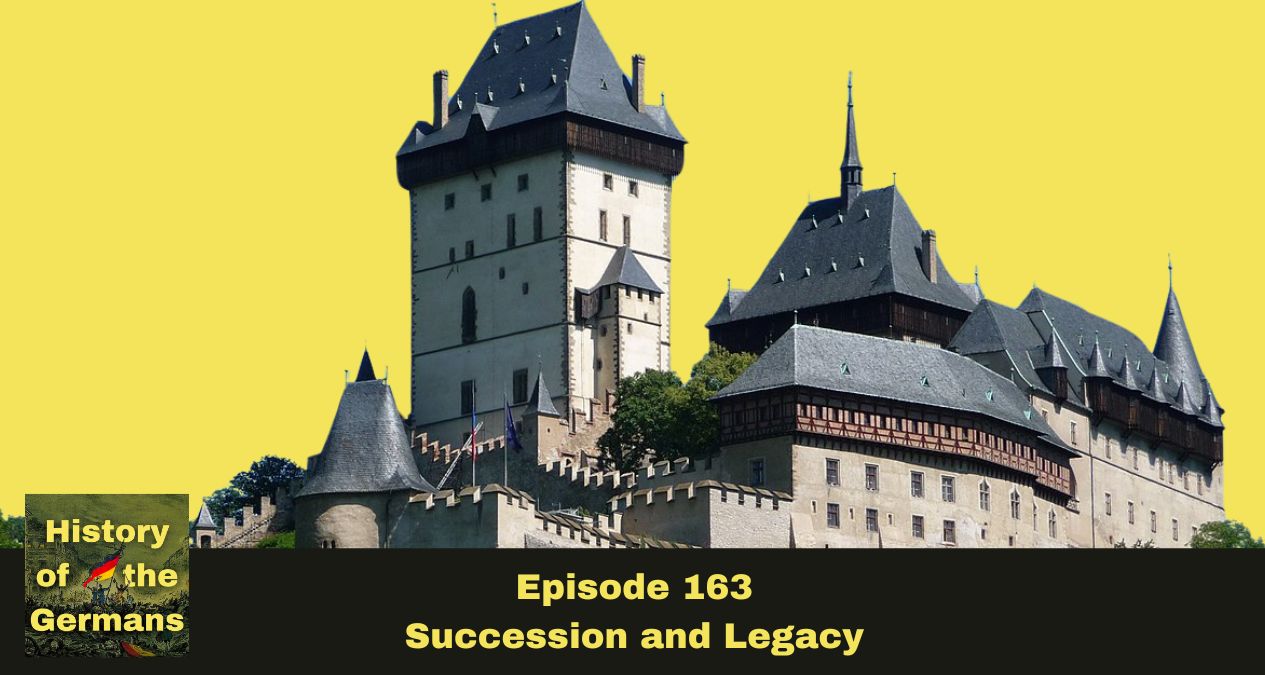
Episode 163 – Succession and Legacy
This is the last episode of this season and it is time to say goodbye to Karl IV, Ludwig the Bavarian, Henry VII, Albrecht of Habsburg, Adolf von Nassau and Rudolf of Habsburg. These have been some eventful 138 years.
When Karl IV died in 1378 he left behind an impressive list of achievements but also a number of failures. And he left behind a son, Wenceslaus he had invested with so much hope and so many crowns, it not only broke the bank but even chunks of the political edifice he had so patiently built.
For Episode Website and Transcripts, click here
Episode 169 – Sigismund, not yet Emperor
The late 14th and early 15th century was a period of upheaval, the certainties of the Middle Ages, that the pope ruled the world and that knights were invincible were crumbling away, the long period of economic growth, of eastward expansion and conversion of the pagans made way for war, plague and famine. The church was split in half and the Ottomans were coming.
This was an age that called forth larger-than-life characters: Joan of Arc, fierce and holy; Henry Bolingbroke, seizing a throne; Jadwiga and Jogaila, uniting kingdoms; the audacious Gian Galeazzo Visconti and fiery Cola di Rienzo; the ever-scheming John the Fearless and Jacob van Artevelde; the tragic Ines de Castro and the unflinching Jan Žižka.
Into this glittering and turbulent lineup steps a man whose reputation has not exactly been polished by time. Despised in his kingdoms of Hungary and Bohemia and even Constance, the city that owes him so much, decided to remember him as a fat naked crowned guy with skinny arms and legs, worn-out face, forked beard and disproportionate genitalia balancing on the hand of a nine-meter-tall sex worker. No, I am not making this up.
For episode webpage and transcript, click here
Episode 168 – From Osman to Nicopolis: The Rise of the Ottoman Empire
This week we delve into the transformative period of the Ottomans from Osman to the Battle of Nicopolis. It highlights how Osman, the son of an Anatolian warlord, laid the foundations for what would become one of the world’s greatest empires, despite starting as just one of many Turkic beys in a tumultuous landscape. The narrative explores the cultural and military strategies that enabled the Ottomans to expand, emphasizing their approach of gradual assimilation and religious tolerance as they conquered predominantly Christian lands.
For episode webpage and transcript, click here
Episode 171 – The Council of Constance Part 1 – Cleaning House
The Council of Constance marked a pivotal moment in the history of the Catholic Church and the history of Europe in general.
One issue on the agenda was the ongoing schism that the council of Pisa had failed to resolve. Another the reform of the increasingly corrupt clergy all the way up to the pope himself. And then there were a number of individual questions this gathering of thousands had to address.
Whilst all these were crucial questions, the way the council constituted itself foreshadowed a fundamental change in the way European saw themselves.
This part 1 deals with the establishment of the council and the removal of the popes, most importantly the pope who had convened the council on the first place, John XXIII and his counterpart, the emperor Sigismund.
For episode webpage and transcript, click here
Episode 172 – A World Event – The Council of Constance Part 2
The Council of Constance, which took place from November 1414 to April 1418, became a monumental event in history, not just for its pivotal decisions like the election of Pope Martin V and the execution of Jan Hus, but for the dynamic and often chaotic atmosphere it fostered among its diverse attendees.
Over the course of three and a half years, the city transformed into a melting pot of intellectual exchange, as leading minds from across Europe converged to debate pressing issues of the time, including the rights of indigenous groups and the justification of tyrannicide.
For episode webpage and transcript, click here
Episode 173 – The End of the Schism – The Council of Constance Part 3
We have talked about church reform for almost four years, the council of Constance talked about church reform for about the same amount of time and Luther will talk and write about church reform until he did no longer believe that the church could be reformed.
But what is church reform. Or more specifically, what did the delegates in Constance mean when they debated church reform, why did they fail to implement much even though they held off electing a pope and the voting system was set up to favour of the national churches and against central papal authority.
All this we will discuss in this episode plus we will hear some angelic voices that made even the most hardnosed church politician kneel in prayer.
For episode webpage and transcript, click here
Episode 174 – The Trial of Jan Hus
“They will roast a goose now, but after one hundred years they will hear a swan sing, and him they will have to endure.” These were allegedly the last words of a certain Jan Hus whose surname meant goose and who was burned at the stake on July 6, 1415.
Almost exactly one hundred years later a spiritually tormented monk, frightened by a vengeful God who sought to damn him, was assigned to teach the book of Romans at the new university of Wittenberg. And 2 years later this monk by the name of Martin Luther did (or probably did not) nail his 95 theses on the door of the Castle Church of that same town. As far as prophecies go, this must be one of the most accurate, assuming it was indeed true. But it wasn’t just the foretelling of the next reformer that makes the trial of Jan Hus such a fascinating account. So much is foreshadowed in this tale, it is almost uncanny. The railing against indulgences, the wealth of the clergy, the pope, a promise of safe conduct, a trial, villains and archvillains, accusations upon accusations, defiance in the face of certain death and then the big difference to the diet of Worms, actual death.