
For more than a hundred years the Holy Roman Empire was a mess of constant infighting between and within the great princely families. But by the 1360s the consistent policies and elaborate diplomacy of emperor Karl IV had produced a degree of stability not seen by anyone alive.
With the home front calm, the emperor can again assume a role on the European stage, setting in train seminal events that will reverberate across the centuries…

xxA narrative history of the German people from the Middle Ages to Reunification in 1991. Episodes are 25-35 min long and drop on Thursday mornings.
“A great many things keep happening, some good, some bad”. Gregory of Tours (539-594)
HotGPod is now entering its 9th season. So far we have covered:
Ottonian Emperors (# 1- 21)
– Henry the Fowler (#1)
– Otto I (#2-8)
– Otto II (#9-11)
– Otto II (#11-14)
– Henry II (#15-17)
– Germany in 1000 (#18-21)
Salian Emperors(#22-42)
– Konrad II (#22- 25)
– Henry III (#26-29)
– Henry IV/Canossa (#30-39)
– Henry V (#40-42)
– Concordat of Worms (#42)
Early Hohenstaufen (#43-69)
– Lothar III (#43-46)
– Konrad III (#47-49)
– Frederick Barbarossa (#50-69)
Late Hohenstaufen (#70-94)
– Henry VI (#70-72)
– Philipp of Swabia (#73-74)
– Otto IV (#74-75)
– Frederick II (#75-90)
– Epilogue (#91-94)
Eastern Expansion (#95-108)
The Hanseatic League (#109-127)
The Teutonic Knights (#128-137)
The Interregnum and the early Habsburgs (#138 ff
– Rudolf von Habsburg (#139-141)
– Adolf von Nassau (#142)
– Albrecht von Habsburg (#143)
– Heinrich VII (#144-148)
– Ludwig the Bavarian (#149-153)
– Karl IV (#154-163)
The Reformation before the Reformation
– Wenceslaus the Lazy (#165)
– The Western Schism (#166/167)
– The Ottomans (#168)
– Sigismund (#169-#184
The Empire in the 15th Century
– Mainz & Hessen #186
– Printing #187-#188
– Universities #190
– Wittelsbachs #189, #196-#199
– Baden, Wuerrtemberg, Augsburg, Fugger (#191-195)
– Maps & Arms (#201-#202)
The Fall and Rise of the House of Habsburg
– Early habsburgs (#203-#207)
– Albrecht II (#208)
-Freidrich III (#209-
The noble and gallant King of Bohemia, also known as John of Luxemburg because he was the son of the Emperor Henry of Luxemburg, was told by his people that the battle had begun. Although he was in full armour and equipped for combat, he could see nothing because he was blind. He asked his knights what the situation was and they described the rout of the Genoese and the confusion which followed King Philip’s order to kill them. Ha,’ replied the King of Bohemia. ‘That is a signal for us.’ […] ‘My lords, you are my men, my friends and my companions-in-arms. Today I have a special request to make of you. Take me far enough forward for me to strike a blow with my sword.
Because they cherished his honor and their own prowess, his knights consented. [..] In order to acquit themselves well and not lose the King in the press, they tied all their horses together by the bridles, set their king in front so that he might fulfil his wish, and rode towards the enemy.
There also was Lord Charles of Bohemia, who bore the title and arms of King of Germany, and who brought his men in good order to the battlefield. But when he saw that things were going badly for his side, he turned and left. I do not know which way he went.
Not so the good King his father, for he came so close to the enemy that he was able to use his sword several times and fought most bravely, as did the knights with him. They advanced so far forward that they all remained on the field, not one escaping alive. They were found the next day lying round their leader, with their horses still fastened together. “
Anyone with even a passing interest in late medieval history will remember this scene from Froissart’s description of the Battle of Crecy on August 26th, 1346. The Blind King of Bohemia, the epitome of chivalric culture riding into the midst of a battle striking at an enemy he cannot see, relying on his comrades to guide him.
This deed made such an impression on the Edward, the Prince of Wales, known as the Black Prince that he honored his foe by adding the Bohemian ostrich feathers and the dead king’s motto “Ich Dien”, to his own coat of arms. So to this day the Blind King’s heraldic symbols and German motto features on Prince William’s coat of arms, the Welsh Rugby Union Badge, some older 2p coins and various regiments in Britain, Australia, Canada and even Sri Lanka.
But this death, call it heroic or foolish, was only the end of an astounding life. John Of Bohemia, very much against his own intentions, played a crucial role in the establishment of the key counterweight to French hegemony in Europe. No, not England, but a power centered on Prague, Vienna, Buda and Pest.
Let’s dive into this story…
The music for the show is Flute Sonata in E-flat major, H.545 by Carl Phillip Emmanuel Bach (or some claim it as BWV 1031 Johann Sebastian Bach) performed and arranged by Michel Rondeau under Common Creative Licence 3.0.
As always:
Homepage with maps, photos, transcripts and blog: www.historyofthegermans.com
If you wish to support the show go to: Support • History of the Germans Podcast
Facebook: @HOTGPod
Threads: @history_of_the_germans_podcast
Bluesky: @hotgpod.bsky.social
Instagram: history_of_the_germans
Twitter: @germanshistory
To make it easier for you to share the podcast, I have created separate playlists for some of the seasons that are set up as individual podcasts. they have the exact same episodes as in the History of the Germans, but they may be a helpful device for those who want to concentrate on only one season.
So far I have:
Salian Emperors and Investiture Controversy
Fredrick Barbarossa and Early Hohenstaufen

Episode 154 – The Blind King John of Bohemia
John of Bohemia wasn’t the last knight, but he was a figure of a world that was slowly fading away. A world where armored men on horseback were invincible and hence had to be tamed by a complex set of rules they called the chivalric code. For someone like John the dos and don’ts of the aristocratic society he lived in ranked pari passu with the demands of power politics. Fighting for the Teutonic Knights out of a crusading vow or for the king of France out of an obligation as a vassal was of equal importance, if not of higher importance than taking up arms against Ludwig the Bavarian to protect the Tyrol.
What made him stand out in the eyes of his peers as one of the greatest of chivalric heroes was not just the courage to ride unseeing into the midst of a battle but also that he fought not for his own lands or material possessions, but to honour an oath he had given to another king.
But this death, call it heroic or foolish, was only the end of an astounding life. John Of Bohemia, very much against his own intentions, played a crucial role in the establishment of the key counterweight to French hegemony in Europe. No, not England, but a power centred on Prague, Vienna, Buda and Pest.
For Episode Website and Transcripts, click here
Episode 155: The Youth of the Emperor Karl IV
You have heard me complaining regularly over the last 154 episodes that what we report as political ambitions or strategic plans of the kings and emperors was pure conjecture derived from their actions and public statement. But we could never know what they were really thinking because none of them kept a diary, or if they did they did not survive to today. The subject of today’s episode however did write an autobiography, which is believed to have been written by the emperor himself, at least in large parts. So, for the first time we hear an emperor telling his own story….
For Episode Website and Transcripts, click here
Episode 156 – What price for a crown
The year is 1346 and we have, yes, another succession crisis. Without checking through my 1500 pages of transcripts, I have counted a total of 14 contested imperial elections in the 427 years we have covered so far. Henry the Fowler, Herny II, Henry IV, Henry V, Lothar III, Konrad III, Philip of Swabia, Otto IV, Frederick II, Konrad IV, Richard of Cornwall, Adolf of Nassau, Albrecht of Habsburg and Ludwig the Bavarians all had to contend with anti-kings or severe opposition to their ascension to the throne.
I guess you are bored with these and so were the citizens of the empire. But here is the good news. From Karl IV’s reign onwards these succession crises will become fewer and fewer. Why? One reason is of course the Golden Bull we will discuss in a few episodes time. But there is another one, which had to do with the way Karl IV overcome the opposition. He claimed it was divine providence, but modern historians point to a much more temporal force that tied the imperial title to the heirs of the house of Luxemburg…
For Episode Website and Transcripts, click here
Episode 157 – Black Death and other Calamities
In around 1320 near the lake Issy-Kul in Kyrgysistan the rats started dying. Shortly after the inhabitants became affected with terrible diseases. Some started coughing up blood and all who did, died within 3 days. Others developed swellings of the lymph nodes, particularly in the groins and armpits. Roughly half of them died within five days. A small number saw their feet and fingertips turn black. All of those died.
Everyone who could still leave sought refuge in towns and villages that had not been affected. The disease travelled with them. By 1330 Chinese chroniclers recorded a plague affecting the Mongol hordes. In 1346 a Mongol army besieging the Genoese trading city of Caffa on Crimea succumbed to the disease. In their final push to cow the defenders they catapulted the diseased corpses of their comrades into the city. The siege lifted grain transports from Caffa to Italy resumed. The disease reached Messina in Sicily in 1347. In 1348 it had enveloped most of Italy. 1349 it crossed the alps, by 1350 people died in their thousands in Northern Germany and Scandinavia. It took until 1353 before this wave of the plague petered out, leaving between 20 and 60% of the population of Europe dead. The disease returned in 1361-1363, 1369-71, 1374-75, 1390 and 1400. After that intervals became longer but the plague never went away completely and still today a couple of 100 people die worldwide of Plague every year.
For Episode Website and Transcripts, click here
Episode 158 – Prague – The New Rome?
The creation of Prague’s New Town was the Middle Ages most ambitious infrastructure projects, creating a third city near the ancient castles of the kings of Bohemia, making the combined city larger in surface area than Cologne, only surpassed by Constantinople and the eternal city. A new Rome was to rise on the shores of the Vitava River, a place adorned with churches and monasteries evoking the holiest places of Christianity and squares on such a monumental scale that reminds one more of the 19th century than the 14th. Prague still today attracts “people to it which no one can count”
This is what we will talk about today. Not just what he built, but why and how….
For Episode Website and Transcripts, click here
Episode 159 – The rise to Imperial Power
This season has now gone on for 22 episodes. We started with the interregnum of largely absent rulers and after a brief renaissance under Rudolf von Habsburg the empire became a sort of oligarchy where 3 families, the Luxemburgs, the Wittelsbachs and the Habsburgs took turns on the throne. Succession usually involved some form of armed conflict between the contenders and a struggle with the pope over who had precedence. Whoever emerged victorious then used the ever-dwindling imperial powers to enrich his family at the expense of the others.
When in 1349 Karl/Karel/Charles IV emerged triumphant from the latest of these conflicts, chances were that the same game would start anew, civil war between the three families, excommunication and murder. But it did not. Why it did not is what we will talk about in this episode…
For Episode Website and Transcripts, click here
Episode 160 – The Golden Bull of 1356
One of the most important constitutional documents of the Holy Roman Empire was the Golden Bull of 1356. But what did it actually say, and even more important, what did it not say and how does it fit into the context of the history of the Holy Roman Empire. That is what we are going to discuss in this episode.
For Episode Website and Transcripts, click here
Episode 161 – A Luxemburg Empire
All is well in the empire. The Golden Bull had been debated, agreed, sealed and then celebrated at the great diet in Metz you just heard about. The first time in decades that all the Prince Electors had come together and performed the ancient duties of their offices. Even the Dauphin of France had come to do homage to Karl IV for the lands he held inside the empire.
But did all the princes join in the joy? No, not really. There are always some who felt left out and they will try to upturn the new order. How they tried to do that and why these efforts laid the foundations for the future Habsburg empire is what we will discuss today…
For Episode Website and Transcripts, click here
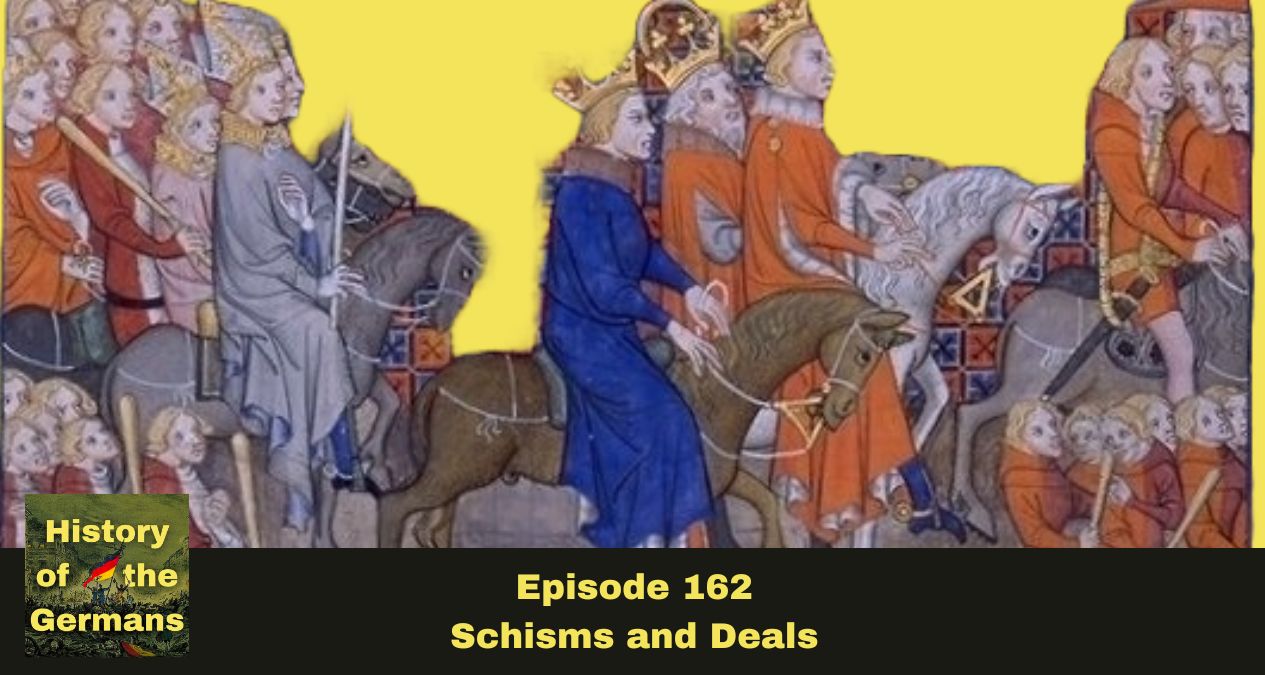
Episode 162 – Schisms and Deals
For more than a hundred years the Holy Roman Empire was a mess of constant infighting between and within the great princely families. But by the 1360s the consistent policies and elaborate diplomacy of emperor Karl IV had produced a degree of stability not seen by anyone alive.
With the home front calm, the emperor can again assume a role on the European stage, setting in train seminal events that will reverberate across the centuries…
For Episode Website and Transcripts, click here
Episode 163 – Succession and Legacy
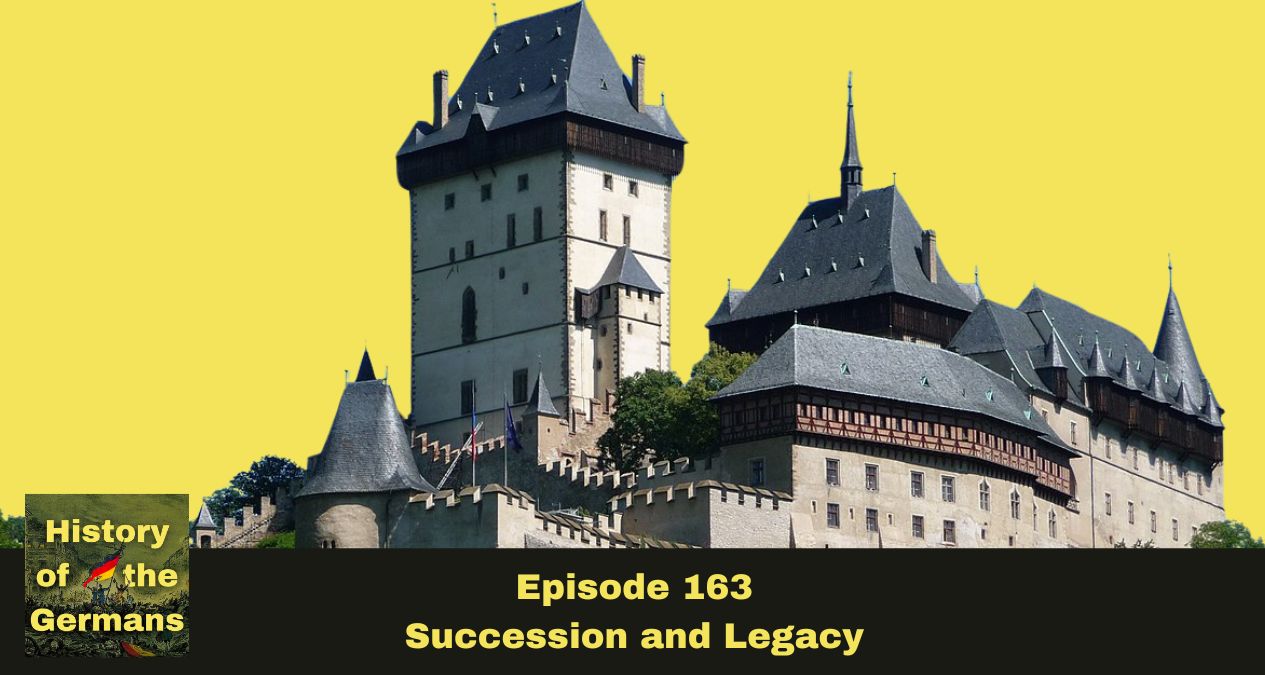
This is the last episode of this season and it is time to say goodbye to Karl IV, Ludwig the Bavarian, Henry VII, Albrecht of Habsburg, Adolf von Nassau and Rudolf of Habsburg. These have been some eventful 138 years.
When Karl IV died in 1378 he left behind an impressive list of achievements but also a number of failures. And he left behind a son, Wenceslaus he had invested with so much hope and so many crowns, it not only broke the bank but even chunks of the political edifice he had so patiently built.
For Episode Website and Transcripts, click here
Charles IV. A Portrait of a Medieval Ruler – Interview with Václav Žůrek
The Emperor and King Charles IV (1316-1378) represents today an untouchable monument in Czech history, carved into the marble of admiration and clichés. Although a new and thorough study of his reign is yet to be written, it is nevertheless useful to introduce Charles IV from a new perspective. In many regards, historical research has already brought new findings, and thus we are now able to shed new light on both his life and his reign