
Podcast

xxA narrative history of the German people from the Middle Ages to Reunification in 1991. Episodes are 25-35 min long and drop on Thursday mornings.
“A great many things keep happening, some good, some bad”. Gregory of Tours (539-594)
HotGPod is now entering its 9th season. So far we have covered:
Ottonian Emperors (# 1- 21)
– Henry the Fowler (#1)
– Otto I (#2-8)
– Otto II (#9-11)
– Otto II (#11-14)
– Henry II (#15-17)
– Germany in 1000 (#18-21)
Salian Emperors(#22-42)
– Konrad II (#22- 25)
– Henry III (#26-29)
– Henry IV/Canossa (#30-39)
– Henry V (#40-42)
– Concordat of Worms (#42)
Early Hohenstaufen (#43-69)
– Lothar III (#43-46)
– Konrad III (#47-49)
– Frederick Barbarossa (#50-69)
Late Hohenstaufen (#70-94)
– Henry VI (#70-72)
– Philipp of Swabia (#73-74)
– Otto IV (#74-75)
– Frederick II (#75-90)
– Epilogue (#91-94)
Eastern Expansion (#95-108)
The Hanseatic League (#109-127)
The Teutonic Knights (#128-137)
The Interregnum and the early Habsburgs (#138 ff
– Rudolf von Habsburg (#139-141)
– Adolf von Nassau (#142)
– Albrecht von Habsburg (#143)
– Heinrich VII (#144-148)
– Ludwig the Bavarian (#149-153)
– Karl IV (#154-163)
The Reformation before the Reformation
– Wenceslaus the Lazy (#165)
– The Western Schism (#166/167)
– The Ottomans (#168)
– Sigismund (#169-#184
The Empire in the 15th Century
– Mainz & Hessen #186
– Printing #187-#188
– Universities #190
– Wittelsbachs #189, #196-#199
– Baden, Wuerrtemberg, Augsburg, Fugger (#191-195)
– Maps & Arms (#201-#202)
The Fall and Rise of the House of Habsburg
– Early habsburgs (#203-#207)
– Albrecht II (#208)
-Freidrich III (#209-
On 31st of October 1517 a hitherto unknown professor at the smallish university of Wittenberg published 95 theses. And by doing so, he unleashed a sequence of events that would fundamentally change the face of Europe and still defines communities and nations.
The interesting question about the 95 theses is not why Luther rote them, but why they had any impact at all. Martin Luther stands at the end of a mile long queue of learned and sometimes less learned men who railed against the decadence of the church, called for a return to the actual text of the bible and demanded that the clergy lives like the apostles. But somehow the message on that fateful day in 1517 gained traction across the Christian world in a way no previous attempt had.
Why? That is a question I believe will be the guiding line through the coming seasons. Something about the social, political, cultural, religious and economic landscape of early modern Germany must have provided the cinder on which protestant ideas could catch fire.
You will now ask, why is Dirk talking about the Reformation. The last season ended on the 14th century, a good 150 years before “the day that changed western Christianity”. Aren’t we supposed to go through this chronologically.
Oh yes we are. But as we are moving forward at our accustomed pace we will hit the Hussite revolt that started in 1415. This religious uprising has so many common threads with Luther’s reformation, it may be seen as a dress rehearsal for the actual Reformation. Luther himself declared in 1519 “Ich bin ein Hussite” I am a Hussite.
Spoiler alert, the Hussite revolt did not lead to the fraction of the catholic church, but that makes it even more interesting. What were the circumstances that led the people of Bohemia and many other parts of the empire to take up arms to defend their convictions, how come they were successful and by what means could a reconciliation be achieved? Knowing that will help us understand why a 150 years later such a settlement failed to materialize, dividing Europe into Protestants and Catholics and spurning some of the bloodiest civil wars in history.
To explore the causes and impact of this reformation before the reformation we will take a look at the decline of the house of Luxemburg, the emergence of the Ottoman empire, the creation of Burgundy as a political entity separate from France, the defeat of the Teutonic Knights and the great western schism with its resolution at the Council of Constance where amongst other things Jan Hus was convicted and burned at the stake. We will dive into Jan Hus’ and his predecessor’s thoughts and convictions as well as the military innovations of Jan Zizka and probably a lot more things I have not yet thought about.
The music for the show is Flute Sonata in E-flat major, H.545 by Carl Phillip Emmanuel Bach (or some claim it as BWV 1031 Johann Sebastian Bach) performed and arranged by Michel Rondeau under Common Creative Licence 3.0.
As always:
Homepage with maps, photos, transcripts and blog: www.historyofthegermans.com
If you wish to support the show go to: Support • History of the Germans Podcast
Facebook: @HOTGPod
Threads: @history_of_the_germans_podcast
Bluesky: @hotgpod.bsky.social
Instagram: history_of_the_germans
Twitter: @germanshistory
To make it easier for you to share the podcast, I have created separate playlists for some of the seasons that are set up as individual podcasts. they have the exact same episodes as in the History of the Germans, but they may be a helpful device for those who want to concentrate on only one season.
So far I have:
Salian Emperors and Investiture Controversy
Fredrick Barbarossa and Early Hohenstaufen

Overview
Before there was the Reformation there was already a Reformation, in Bohemia, at the time a prominent part of the Holy Roman Empire.
There are not only so many parallels between the Hussite Revolt and the actual Reformation that Martin Luther called out “I am a Hussite”, the events leading up to it like the Council of Constance and the battle of Nicopol as well as the consequences of the subsequent war shaped German history.
Epsiodes
Season Opener (Episode 164)
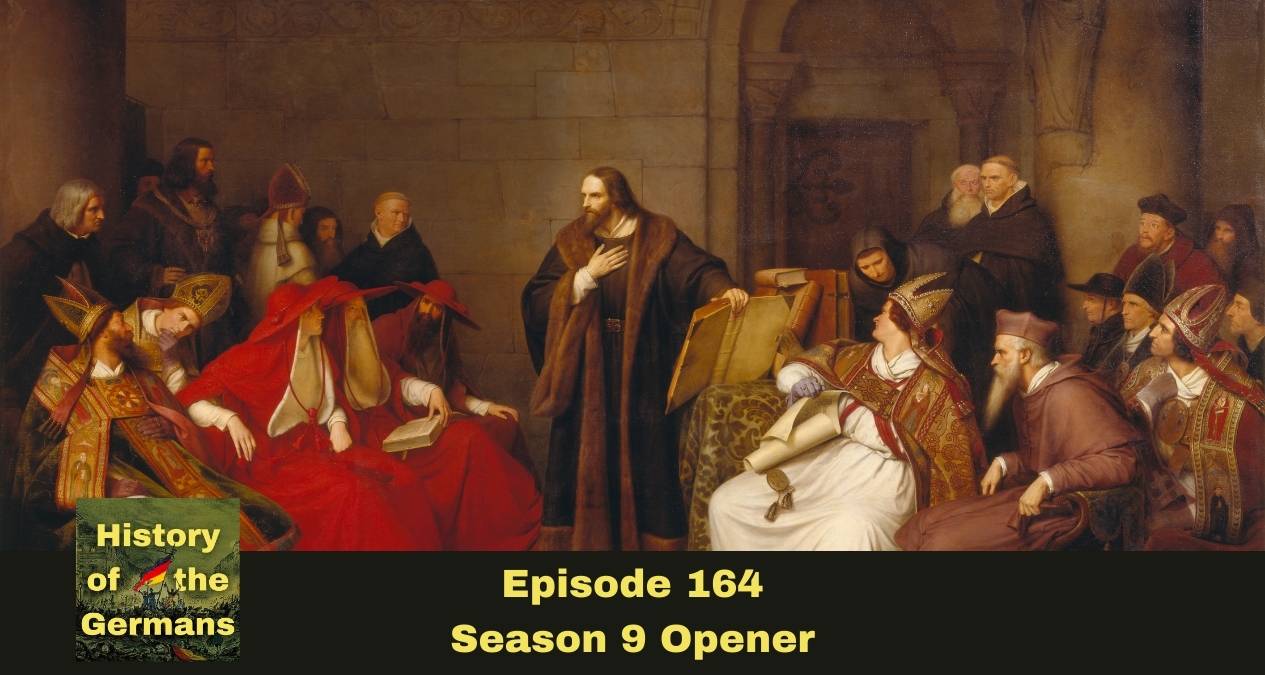
Our starting point for this season is November 1378, most precisely the 29th of November, the day the emperor, king of the Romans, king of Italy and king of Burgundy, Karl/Charles/Karel IV breathed his last.
Why that date? Because we are at a point of transition from the Middle Ages to the early Modern period and Karl IV and his Golden Bull were in many aspects the end point of some key historical trends that had dominated the Middle Ages. But what does transition from Middle Ages to Early Modern actually mean? In what way is this new epoch different from what went on before? The answer is, in almost every possible aspect, economic, social, political and cultural.
For episode webpage and transcript, click here
Episode 165 – Wenceslaus the Lazy
The Prince Electors of Cologne, Mainz, Trier and the Palatinate decided on August 20th 1400 that King Wenceslaus IV, son of the great emperor Karl IV, king of Bohemia and duke of Luxemburg was to be deposed for his “evil deeds and afflictions [that are] are so clearly manifest and well known throughout the land that they can neither be justified nor concealed” How could an imperial dynasty fall so fast and so hard?
For episode webpage and transcript, click here
Episodes 166 & 167 – The Great Western Schism (Parts 1&2)
In 1378 21 cardinals elected pope Urban VI and only six months later the self-same cardinals elected another pope, Clement VII. urban VI stayed in Rome, Clement VII returned to Avignon and the Great Western Schism was born. What caused it? How did effort to resolve the crisis end up adding a third pope? What did it mean for the church, the monarchies of europe and the common people?
For episode webpage and transcript, click here
Episode 168 – From Osman to Nicopolis: The Rise of the Ottoman Empire
This week we delve into the transformative period of the Ottomans from Osman to the Battle of Nicopolis. It highlights how Osman, the son of an Anatolian warlord, laid the foundations for what would become one of the world’s greatest empires, despite starting as just one of many Turkic beys in a tumultuous landscape. The narrative explores the cultural and military strategies that enabled the Ottomans to expand, emphasizing their approach of gradual assimilation and religious tolerance as they conquered predominantly Christian lands.
For episode webpage and transcript, click here
Episode 169 – Sigismund, not yet Emperor
The late 14th century was an age that called forth larger-than-life characters: Joan of Arc, fierce and holy; Henry Bolingbroke, seizing a throne; Jadwiga and Jogaila, uniting kingdoms; the audacious Gian Galeazzo Visconti and fiery Cola di Rienzo; the ever-scheming John the Fearless and Jacob van Artevelde; the tragic Ines de Castro and the unflinching Jan Žižka.
Into this glittering and turbulent line up steps a man whose reputation has not exactly been polished by time. Despised in his kingdoms of Hungary and Bohemia and even Constance, the city that owes him so much, decided to remember him as a fat naked crowned guy with skinny arms and legs, worn-out face, forked beard and disproportionate genitalia balancing on the hand of a nine-meter-tall sex worker. No, I am not making this up.
For episode webpage and transcript, click here
Episode 170 – Jan Hus, Reformer and Rebel?
Jan Hus emerges as a pivotal figure in the early Reformation, representing the clash between the burgeoning calls for reform and the entrenched power of the Catholic Church. Born around 1372 in what is now the Czech Republic, Hus began his journey as a humble student at the University of Prague, eventually becoming a prominent preacher at the Bethlehem Chapel. His growing influence was fueled by his criticisms of clerical corruption, particularly the practice of simony and the Church’s exploitation through indulgences. As tensions escalated between the Czech reformers and the German-speaking clergy, Hus found himself increasingly at odds with both the Church and the monarchy, leading to his eventual excommunication. The episode delves into how Hus’s teachings and the socio-political climate of Bohemia set the stage for a rebellion that would reverberate through the subsequent centuries, culminating in his fateful summons to the Council of Constance.
For episode webpage and transcript, click here
Episode 171 – The Council of Constance Part 1 – Cleaning House
This part 1 deals with the establishment of the council and the removal of the popes, most importantly the pope who had convened the council on the first place, John XXIII and his counterpart, the emperor Sigismund.
For episode webpage and transcript, click here
Episode 172 – A World Event – The Council of Constance Part 2
Over the course of the three and a half years the Council of Constance lasted, the city transformed into a melting pot of intellectual exchange, as leading minds from across Europe converged to debate pressing issues of the time, including the rights of indigenous groups and the justification of tyrannicide.
For episode webpage and transcript, click here
Episode 173 – The End of the Schism – The Council of Constance Part 3
Electing a new pope is not difficult, choosing a pope who will end a 40-year long schism, now that is a lot more difficult. In particular now that the council had enjoyed 2 years of freedom from papal oversight. What did they do with this time? what did they achieve, if anything?
For episode webpage and transcript, click here
Episode 174 – The Trial of Jan Hus
“They will roast a goose now, but after one hundred years they will hear a swan sing, and him they will have to endure.” These were allegedly the last words of a certain Jan Hus whose surname meant goose and who was burned at the stake on July 6, 1415.
Was he guilty of heresy? Does it matter? Who is responsible for his death?
For episode webpage and transcript, click here
Episode 175 – Death and Defenestration
The burning of Jan Hus and the ban on Utraquist communion brings the Bohemian’s blood to boil – and at the end of this episode 13 royal councillors fall out of the windows of the city council of Prague’s New Town
For episode webpage and transcript, click here
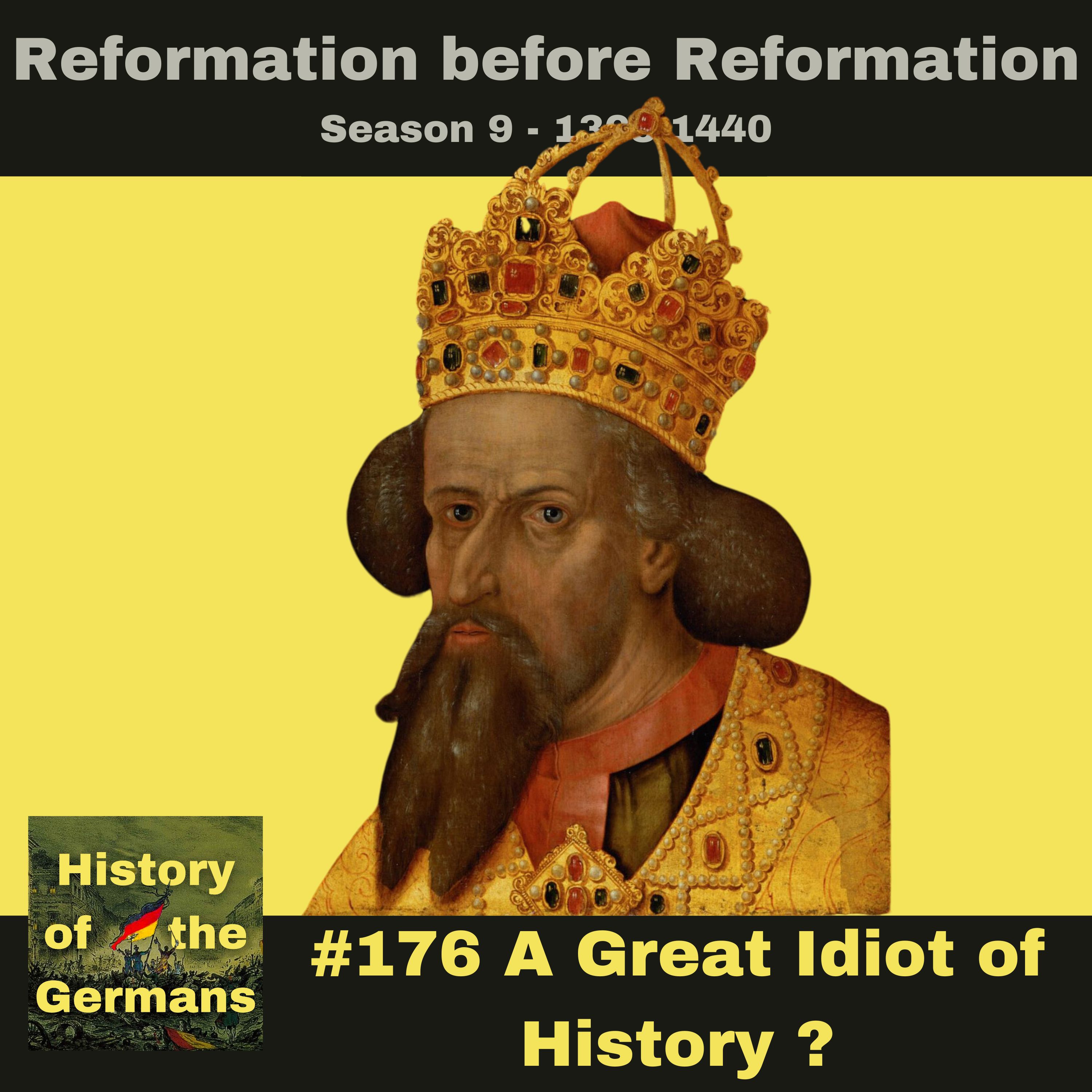
Episode 176 – A Great Idiot of History?
You have heard about the “Great Man” view of History, but have you heard about the “Great Idiot” theory? To turn a revolt into a revolution you need more than just a trigger event like the storm of the Bastille or a the Boston Tea Party, you also need a great idiot at the levers of power who responds so badly to the event, an escalation become inevitable.
For the Hussite Revolution this “great idiot” may be Sigismund the king of Hungary, King of the Romans and heir to the Bohemian crown – but was he really?
For episode webpage and transcript, click here
Episode 177 – The Day after the End of Days
When the victory over the royalists at the battle of the lesser Side of Prague turned into defeat, the radical wing of the Hussites asked why? The only possible answer that explained all that pain and suffering was that the Second Coming must be imminent. Everyone should take shelter in five cities and wait for the Apocalypse scheduled for February 14th, 1420…leaving the question, what to do on February 15th…
For episode webpage and transcript, click here
Episode 178 – No Hill to Die On
Few places hold such an important place within the Czech national narrative as Tabor and Vitkov. One is the place where the persecuted radical Hussites fled and established their own religious community, experimenting with entirely new concepts of society. The other is the key strategic point during the siege of Prague in 1420. Possession of this ridge to the North of Prague became the make or break for the Hussite revolution.
For episode webpage and transcript, click here
Episode 179 – Meanwhile in the Empire
Whilst Sigismund goes from defeat to defeat in Bohemia, the German Lands are falling apart. Though there was no major war, there is constant feuding between the princes, princes and knights, knights and cities and even peasants are feuding. These feuds yield as much destruction as the great wars of the time. And the ottomans are coming, the Hussites are threatening to blow up the existing order and the French are only decades away from a major resurgence.
The empire needs reform, with or without the emperor.
For episode webpage and transcript, click here
Episode 181 – Nude Dissenters and Blind Inventors
The Hussite Movement becomes ever more radical, culminating in the Adamites who lived like a Hippie commune, dancing naked in the woods. Meanwhile emperor Sigismund leads a huge army into Bohemia and lays a trap for Jan Zizka. The only way out of this trap leads to a major breakthrough in military technology
For episode webpage and transcript, click here
Episode 181 – Zizka’s Drum
We look at the military genius of Jan Zizka, his last victories in the Hussite Wars at Kutna Hora and Némecky Brod , and the internal conflicts that divided the Hussites. And in teh end we look at the greatest of legends about the blind general.
For episode webpage and transcript, click here
Episode 182 – The Return of the King
The war between Hussites and the Catholic Church had been raging for 15 long and painful years. The ideological gap seemed unbridgeable – until the aging king Sigismund sees an opportunity…
For episode webpage and transcript, click here
Episode 183 – The Aftermath of a Revolution
What changes did 20 years of opposition to the established church and 15 years of war bring to Bohemia? How did Jan Hus, Jan Želivský, Wenceslas Koranda and Petr Chelčický influence Luther, Calvin, Zwingli, Müntzer and von Hutten? How did Zizka’s reform impact the Swiss mercenaries and the German Landsknechte?
For episode webpage and transcript, click here
Episode 184 – A German Messalina? Barbara of Celje
Barbara, was a German Messalina, a woman of insatiable lust; so nefarious / that she had no god / nor angel nor devil / nor heaven nor hell/that she believed in.
When her handmaidens fasted and prayed / she scolded them / that they tortured their bodies / to worship a fictitious god.
Instead she admonished them / in her good Sardanapalian way / that they should in every way enjoy the pleasures of this life / because after this there is no other to be hoped for.
This godless harlot / sought paradise on this foul earth in doglike lust / although she was already close to 60 years of age.” End quote.
Or maybe not…