How the cnetre of european banking Moved from Florence to Swabia.

Jakob Fugger had been dubbed the Richest Man Who Ever Lived, but there are many more contenders, my favorite being an African, Mansa Musa, the ninth mansa of the Mali empire whose generous gifts during a visit to Mecca in 1324 triggered a currency crisis.

That is something Jakob Fugger would never have done. He never was a flamboyant banker who impressed his contemporaries with lavish displays of wealth. He was actually fairly dull. If anyone in the firm of Fugger was flamboyant, it was the chief accountant.

So if Jakob is a bit of a pale shadow, the story of what happened in the world of European Finance between 1480 and 1520 is anything but boring. Within just 40 years the heart of the banking industry moved from Florence and Venice where it had held sway since it was invented and moved north, into a medium sized Swabian city, Augsburg. That is as if JP Morgan, Goldman Sachs and Morgan Stanley closed their doors and in their stead some local players from Scandinavia or Mexico took over the financing of the Global economy.  

I am not kidding, something like that really happened back in the late 15th century.

Listen on Spotify

Listen on Apple Podcast

Listen on YouTube

Transcript

Hello and welcome to the History of the Germans: Episode 194 – The Fuggers of Augsburg, which is also episode 10 of Season 10 “The Empire in the 15th Century”

Jakob Fugger had been dubbed the Richest Man Who Ever Lived, but there are many more contenders, my favorite being an African, Mansa Musa, the ninth mansa of the Mali empire whose generous gifts during a visit to Mecca in 1324 triggered a currency crisis.

That is something Jakob Fugger would never have done. He never was a flamboyant banker who impressed his contemporaries with lavish displays of wealth. He was actually fairly dull. If anyone in the firm of Fugger was flamboyant, it was the chief accountant.

So if Jakob is a bit of a pale shadow, the story of what happened in the world of European Finance between 1480 and 1520 is anything but boring. Within just 40 years the heart of the banking industry moved from Florence and Venice where it had held sway since it was invented and moved north, into a medium sized Swabian city, Augsburg. That is as if JP Morgan, Goldman Sachs and Morgan Stanley closed their doors and in their stead some local players from Scandinavia or Mexico took over the financing of the Global economy.  

I am not kidding, something like that really happened back in the late 15th century.

Before we start I would like to thank s a, James L., Arlene A., John F., Nicolay, JayM, Nick R., and Leendert v.d.P. who have signed up on historyofthegermans.com/support and whose generous contributions keep this sow on the road and advertising free. Thanks to all of you.

And with that, back to the show.

Last week we talked about the Grosse Ravensburger Handelsgesellschaft, the largest trading company north of the Alps before the emergence of the Fugger and Welser of Augsburg. This company had its heyday in the 1450s, but by the end of the century it was in decline and it closed down in 1530.

The Grosse Ravensburger Handelsgesellschaft explicitly refrained from doing banking business. That was down to their rather stringent interpretation of the ban on taking interest that was laid down in the old testament. The words of Leviticus 25:36-37 must have stuck in their minds, where it says: quote “Do not take interest or any profit from them, but fear your God, so that your countryman may continue to live among you.”

This attitude towards banking activity was deeply engrained in most of Europe and seems to have been particularly deeply entrenched in the Holy Roman Empire. During a time when bankers from Florence, Venice and Rome were commissioning the masterpieces of the early renaissance, there were no bankers east of the Rhine river. Attempts by Italians to establish in Lübeck had long failed.

But all this is about to change dramatically. By 1500 the great Italian banking houses, the Pazzi, Pitti and above all, the Medici had closed their doors.  In their stead bankers from the Free city of Augsburg, the Fugger, Welser, Hochstaetter and many more had taken control of European banking, building up fortunes beyond imagining, the kind of money that buys crowns and entire countries.

How it was possible that these provincial cloth merchants from a place for which the Florentines didn’t even have maps or trade manuals could unseat the likes of Lorenzo the Magnificent is a complex story. Some of it is about banking, much is about mining and politics, but mostly, it is about accounting. Oh, I can feel your urge to press stop now and search for something more exciting, but trust me, this is going to be very exciting.

Banking in the 15th century

Before we get to Jakob Fugger and his colleagues and competitors, we need to dig a little deeper into banking practices in the 15th century.

A basic banking business model works roughly as follows.

The bank collects deposits from customers. The customers receive interest from the bank, usually at modest rate. The bank can then go and take these deposits and lends the money out to companies or individuals. From them they do receive interest that is higher than the interest they pay on deposits. It is this difference between the interest income from the loans and interest cost they have to pay the depositors that banks make money. Modern banks do a lot of other things too, but this is still the core of a banking business.

If you go back to Leviticus, it is pretty obvious that all these lending activities that form the core of the banking business model are disallowed. The old testament god was seemingly no economist. If he had been he would have known that banking is essential to make an economy grow as it channels idle funds from savers to be used by energetic entrepreneurs.

The way the medieval bankers and some friendly theologians got around the problem was through the instrument of the bill of exchange. We did encounter this already in episode 120 Money, Money, Money where we took a deep dive into banking in the Hanseatic League.

A bill of exchange is in the first place a way to transfer money between two far away places without having to carry bags of gold or silver, but it is also a loan.

Say you are a trader in Florence and you have shipped spices to a business partner in London who is expected to pay you £100 for these spices. You can go to your banker in Florence and say, what will you give me here and now if I instruct my partner in London to pay your branch in London £100. The answer depends on the exchange rate between Florins and British pounds, which is say 5:1. That means our Florentine trader gets 500 florins from his banker, cash in hand. The banker gets a handwritten note from the trader instructing his business partner to pay the banker’s London branch £100 sterling. And since the journey to London is long, the payment date is set for in 3 months. This note is then despatched to London, and on the day set out in the instruction the banker’s branch manager goes to the business partner and presents this document, called a bill of exchange. And assuming the business partner honours the order, the branch manager receives £100.

That sounds like a nice move by the banker. He hands over 500 florins today and gets his money back in a different currency in a land far, far away and as far as we can see for no monetary benefit. But hang on a minute. What is the exchange rate for pounds into florins in London at that point in time? Aha, it is 5.35:1, turning £100 into 535 florins. So if the branch manager sends the money back using the same process in reverse, the banker finds himself having made a profit of 35 ducats in six months, that is a neat 14% return. Nice. But how can the banker be sure that he would make that profit. The answer is, he cannot. There is a risk that the exchange rate in London at that point has moved to 4.9:1 and he would even have made a loss for all his troubles.

And that is why the theologians say, such a transaction does not involve a guaranteed profit aka interest. The banker’s profit is down to taking the exchange rate risk and is hence legal, even though what had actually happened is that our trader has just received a loan of 500 ducats. And here is the rub, the banker never took much of a risk that the exchange rate would move hard against him. Raymond de Roover, the historian who literally wrote the book on the Medici bank and hence 15th century banking had analysed the exchange rates between the various banking centres in Europe, namely the Italian cities and London, Bruges, Lyon, Geneva and Barcelona and concluded that the spread between the exchange rates in Florence and London was always  wide enough to ensure that losses were extremely rare. Returns could vary dramatically from 3% to 26%, but over time this levelled out to above 10%.

The rise and decline of the Medici Bank, 1397-1494 : De Roover, Raymond Adrien, 1904- : Free Download, Borrow, and Streaming : Internet Archive

This is how Florentine bankers could do commercial lending without ending up in the seventh circle of hell where the usurers lie with their purses around their necks in the burning hot sand of a desert, swatting away the heat and the flies, their parched tongues sticking out like that of on oxen.

This kind of lending structure was not only attractive in terms of revenues, it also carried moderate risk, at least by the standards of its time. A bill of exchange usually had some sort of commercial transaction underpinning it. In all likelihood the business partner in London had received some merchandise from his Florentine counterpart that was behind his willingness to pay out the £100. And hence it was likely that he had the funds from selling the merchandise, and even if not, the bill of exchange could be protested in court. This was an extremely rapid court procedure which led to immediate seizure of property, giving the bank access to the merchandise in question or other collateral.

As time went by, these bills of exchange developed further ever more complex variants, some of which involved fictitious transactions and so-called dry bills of exchange which looked increasingly like straightforward loans.

Being straightforward loans, they not only attracted the ire of the church, they were also riskier. If there wasn’t a commercial transaction behind it, what collateral could the bank access in case either the payor, i.e. the London businessman or the drawer, i.e., the Florentine spice trader failed to pay.

And that gets us to the highest risk lending in the late Middle Ages, the lending to sovereigns, the princes, kings, and emperors.

This sounds counterintuitive to modern ears. We live in a world where lending to the sovereign, i.e, buying government bonds is the lowest risk form of lending. The 10 year government bond rate in most developed word countries is even called the risk-free rate.

The reason for that is three-fold. For one, modern states have the ability to tax their citizens in order to pay back any debt. Modern states have fiat currencies, meaning they can print dollars, Pounds, Euros to their heart’s content to pay back their creditors and finally markets have confidence that the governments will use net new debt predominantly to fight imminent crises or fund investment in future growth. I will not go into a discussion of whether these assumptions are still true, I leave this to experts like Kenneth Rogoff and Adam Tooze to elaborate on.

But what I can say is that none of these applied to the kings of England, the dukes of Milan or the dukes of Burgundy, who happened to be the main borrowers from the Florentines.

They were all constrained in their ability to raise taxes, in England due to Parliament and elsewhere due to the political power of the cities and nobles. Money was precious metal which is hard to print, and whilst states could and did devalue their currencies often, that was usually accompanied by a loss of confidence. And finally, most of the borrowed funds went into inconclusive warfare or the splendour of their courts.

One infamous incident was when King Edward III of England looked at the 900,000 gold florins he had borrowed from the banking houses of the Bardi and Peruzzi and just simply said ‘Nah, I am not gonna pay that back – followed by – and what are you gonna do about that pal? Going bust is what they did, triggering a depression in the Florentine economy that lasted a decade and opened the way for the Medici.

One last point I had not quite realised before was the way medieval bankers funded themselves. Some of the money they lent out came from their own capital, but not that much. They did take deposits and they did promise a fixed interest to the depositors. That would be outright usury in the definition of Leviticus. But it went on all throughout this time. Why?

For one, nobody was supposed to know. These depositors were usually very rich individuals whose deposit agreements weren’t made public. Secondly, most of them were churchmen. The Rome branch of the Medici focused on two businesses, transferring money for the papacy and collecting deposits from the cardinals. And finally, when push comes to shove and a bank was going down, the depositors were happy to get at least their principal back. So when anyone asked whether they were receiving any interest for their deposits, they simply said, no sir, never. I truster messer Medici to invest it in his good works.

The Decline of the Italian banks

And this gets us straight to the Medici, the unimaginably rich bankers who filled Florence with some of the greatest artworks ever conceived and who married their daughters into the French royal family – twice.

But did you know that during the heyday of the family, the time of Lorenzo the Magnificent, the Medici bank was already at best limping along and that by 1494, two years after his death, it closed its doors forever.

Under Lorenzo’s grandfather, Cosimo the Elder, the Medici bank was a financial colossus that bestrode the European markets, dominating the financial centers of Florence, Venice, Rome, Geneva, Lyons, Bruges and London aka all of them. What happened?

Some of it were external events outside of the family’s control.

In 1463 war broke out between Venice and the Ottoman empire which cut off trading with Asia and saw many Venetian trading posts going up in flames. Their merchants perished, galleys sank to the bottom of the sea and wares were detained. The Venetian bankers who had financed said trading posts, merchants, galleys and wares tottered, but the crisis sucked in banks across the whole Italian peninsula, including several storied Florentine houses. The Medici had limited direct exposures, but the defaults reduced the availability of deposits and caused a severe recession in Florence. As de facto rulers of the city the Medici had to divert funds to sponsor public works for the unemployed.

Another setback was the decline in the availability of English wool. The Florentine economy was only partly banking. It was mainly built on making the most desirable textiles, specifically brocades, velvet and damask as well as high quality woolen cloth. For the latter they needed English wool. But that was hard to get since the war of the Roses devastated the country and a deliberate policy had been introduced to produce cloth in England, rather than just export the raw materials. Production of cloth dropped throughout the second half of the 15th century.

The next severe blow came in 1478 in the form of the Pazzi conspiracy. This had been a plot to unseat the Medici sponsored by pope Sixtus IV, he of the Sistine chapel. There is no time to describe this in full here, but check out episode 146 of the History of Italy Podcast to hear an amazing story. What matters here is that though the Medici prevailed and the conspirators were either killed or exiled, the result was that the bank lost the papacy as a client. Given the Roman branch had at times accounted for more than half of the profits of the bank, that was a serious blow.

On top of these matters outside of management’s control came some internal issues.

The Medici bank was a  holding company of its many branches. Each branch was run by a partner who held a material stake in the business of the branch and enjoyed significant autonomy. When Cosimo the Elder was still in charge, he kept a close eye on the goings on in the different markets. His grandson, Lorenzo the Magnificent had no interest in banking at all. He was a gifted politician and diplomat, but digging through account books that wasn’t his style.

And when the cat is asleep, the mice dance on the tables. The branch managers in Bruges and Milan were particular culprits. They had lent vast amounts to the Sforza dukes of Milan, the duke of Burgundy and Edward IV of England. All of these funds prove impossible to collect upon. The Yorkist Edward IV and Richard III were wiped out in the War of the Roses and the new Lancastrian king, Henry VII saw no reason to honor their debts. Charles the Bold of Burgundy had an unfortunate encounter with a halberd in 1477 putting an end to his repayments.

The fundamental difficulty with all these exposures was that there was no real collateral the Medici could access in case of default. These were sovereign authoritarian states and the courts would not dare seizing the property of their ruler to pay some Italian moneybag.

And whilst the branch managers were clearly out of their depths, there was also an inevitability to these outcomes. Once a bank had lent to a powerful prince, any future decision became a political one. Refusing to increase the exposure upon demand could be seen as a hostile move and could lead to refusal to repay the existing loans. So bankers ended up throwing good money after bad, until there was nothing left.

And finally, Lorenzo’s focus on politics meant that he used the bank’s resources for political aims, not as a way to generate profits.

When the Italian wars begin in 1494 with the invasion by the French king Charles  VIII, the whole of the Italian peninsula is thrown into turmoil. The Florentines expelled the Medici and read the last rites over the already shrunken Medici Bank. The Medici did return to Florence as grand dukes, but their bank was gone for good. There were other famous Italian banking families, the Chigi, Borromini and Strozzi to name just three. But none of them created a pan-European dominant network like the Medici.

The disappearance of the Medici bank and the other Italian houses left a vacuum. And into this  vacuum stepped a handful of families from southern Germany who took a very different approach.

Augsburg in the late 15th century

So why Augsburg? Hard to say, because there was nothing super special about the place – at least in the 1460s and 70s.

Augsburg is one of the oldest cities in Germany, having been founded by the Romans, and a regional center since at least the days of Trajan. It had been the site of the battle on the Lechfeld in 955 (episode 6 if you want to go all the way back) and had remained an important city throughout. Augsburg differed from the other Swabian Free Imperial cities in as much as it was the seat of a bishop. So it took until 1316 before the status of Augsburg as a free and imperial city was confirmed by Ludwig the Bavarian.

In 1450, Augsburg was one of the larger cities, but still smaller than Nürnberg or Ulm. It was a trading center that benefitted from easy access to the Brenner Pass and from there to Venice. But it had not yet become dominated by the great merchant houses. Augsburg main business was the production of Fustian, that same material that had made the Ravensburger rich.  For at least the first half of the century much of Augsburg’s Fustian was exported by the Ravensburgers rather than the Augsburg merchants. Socially the city was divided between the patricians, the old families and the guilds, which included the guild of merchants. Politics were volatile, uprisings of the exploited weavers frequent. In the 1460s the city made some disastrous political decisions which ended in a siege that they withstood. However, the lands surrounding the city were devastated and Fustian production declined.  A charismatic populist turned himself into an autocratic master of the city and was beheaded in 1478.

79c

Compared to Ulm which was the recognized leader of the various city leagues of the 14th and 15th century and Nürnberg with its prestige as the home of the imperial regalia and its flourishing trade in metals, Augsburg was a bit of an also-ran.

The Höchstetter

But someone must have put something into the water, because by around 1480 Augsburg gets on a roll. And this is not just one family, but several who got involved and then gradually took over the world of finance.

The Höchstetter were one of the most prominent families in town. They had originally been ministeriales in the service of the Hohenstaufen. In the early 15th century they show up as traders in Flemish and other foreign cloth. This, rather than the Fustian, remained the core business for the family for a very long time. They were amongst the first Augsburg families to set up shop in Antwerp. The head of the family Ambrosius Höchstetter had his training in Bruges and must have realized that Antwerp was about to overtake the once dominant Bruges and became the most important trading hub in Northern europe.

Höchstetter Haus in Augsburg

Other Augsburg families followed in their wake which gave the southern German firms a head start over the Italians and the Hansards who had insisted on staying in Bruges long beyond its prime.

Antwerp

Antwerp gave the Höchstetter the opportunity to build out relationships with Portugal. This great seafaring nation had realized that they were better off transporting the spices, silks and other luxuries from Asia to Flanders from where it could be easily distributed across European markets, rather than forcing traders to make their way down to Lisbon. Still the Höchstetter saw a point in having a branch a factory as they would call it in Lisbon itself where they got involved in the funding of the great expeditions.

Though pioneers in the Antwerp and Iberian markets, the Höchstetter only became seriously rich in the slipstream of the most famous of the Augsburg merchants and bankers, the Fugger.

Fugger origins

The Fugger were resolutely not patricians. Their ancestor, Hans Fugger had come from the village of Graben a few miles from the gates of the city. When he arrived in 1367 he was already a man of sufficient wealth to be listed as a tax payer. The entry in the tax register has kept puerile historians giggling for century, as the scribe spelled Fugger as F u c k e r.

And as bad as this joke is, I am afraid it is the only one this family has ever made. This is a dour bunch if ever there was one. Nose to the grindstone and go. I guess becoming the richest man who ever lived requires some sort of effort.

Interestingly, in the first century of the Fuggers in Augsburg, it was the women who really pushed the family forward. We know this because Augsburg held the most detailed and complete tax records of any German city. Every three years the wealth of every citizen was assessed and the tax level set for the subsequent period.

So when Hans Fugger arrived, he was assessed as having 22 florins, not bad for a country bumpkin, but nothing compared to the 1,806 florins he amassed in the 30 years he had lived in the city. When he died in 1408, his wealth stood at 2,020 florins. His widow, Elisabeth took this and over the following 25 years more than doubled it to 4,980 florins, at which the Fuggers had risen to position 27 of the Augsburg taxpayer hierarchy. Her sons, Jakob and Anton kept going and in 1448 are assessed as having a joint fortune of 10,800 florins, making them the top five taxpayer.

The Fugger of the Roe

Then the brothers fell out and they split up their businesses. The family of Andreas became the Fuggers of the Roe named after the roe deer on their coat of arms. Their business really went gangbusters under the leadership of Andreas’s son Lukas. Lukas wealth jumped from 2,588 florins in 1472 to 17,200 florins in 1492. Lukas ran a classic trading house together with his brothers. One brother was dispatched to Milan, another to Venice and a third was working the axis Nürnberg to Frankfurt an der Oder, and his son-in-law was based again in Antwerp. Their business was in textiles, spices and silks, wares they imported from Italy and Flanders to be distributed into the empire.

In 1480 the Fugger of the Roe got involved in finance. The step from merchant to banker was not a wide one. Merchants handled bills of exchange all the time and were familiar with the exchange rates and spreads as much as the bankers they dealt with. And the network of branches they had across Europe allowed them to transfer not just their own money, but also to send other people’s funds. As Raymond de Roover said, if you scratch the surface of a merchant, you find a banker and if you scratch the surface of a banker, you find a merchant.

One of these loans, 9,600 florins given to the city of Leuven in the Low Countries became his undoing. The city had given security in the form of tax revenues, but when it came to paying, they did an Edward III. They said ‘Nah, I am not gonna pay that back – followed by – and what are you gonna do about that pal?

What Lukas did was sue them before the council of Brabant and even before the imperial court. He won all the cases, he even got the city put under the imperial ban. Still they did not pay and by that time the firm of the Fuggers of the Roe was already bankrupt. And bankruptcy at this time meant that there was no way members of the family could get back into the standing of merchants. Lukas’ descendants ended up working as goldsmiths and artisans or as employees in their more successful cousins’ firm.

The Fuggers of the Lilly

Talking about the cousins, the family of the Fugger of the Lilly, they continued the tradition of the competent widows. Jakob the elder, the uncle of Lukas died fairly young, leaving behind a brace of sons and a widow, Barbara Bäsinger. She took over in 1462 with 6,600 florins and built it up in a much steadier, less spectacular way to 15,971 florins.

But in 1492 she was not the only Fugger in the book of taxable individuals. There were her three sons, Ulrich with 16,691 florins, Georg with 13,971 florins and Jakob with 11,971 florins. Put together, the family had plus minus 58’000 florins and had become the richest in Augsburg.

Ulrich Fugger

Initially their business encompassed the full gambit of the late 15th century, meaning a lot of textiles, woolen cloth, silk, a bit of Fustian but also spices and other luxuries imported from Venice. They didn’t do anything fundamentally different.

They did dabble in financial business too, lending sums of a few thousand to bishops or managing the money transfer from German dioceses to Rome.

The business was run by the three brothers, Ulrich, Georg and Jakob as a joint enterprise. They had signed a formal agreement of association that spelt out the relative participations and obligations of each of them. Ulrich and Georg are often dismissed as less significant than their youngest and more famous brother Jakob, but they were obviously gifted entrepreneurs who had propelled their firm to the top of a thriving city.

Georg Fugger

Jakob Fugger, the one everybody called the Rich had started his career in Venice where the firm of Fugger had acquired a chamber at the Fondaco dei Tedeschi, the house of the German merchants in Venice. There he learned the tricks of the trade, in particular about double entry bookkeeping that was spreading at the time. Venice was one of Italy’s great banking centres which must have allowed Jakob Fugger to gain an understanding of this business that, as we have heard, did not yet exist in the German lands.

Jakob Fugger

Things changed for the house of Fugger in 1485 when they began a commercial relationship with Sigismund of the Tyrol. Sigismund was a member of the House of Habsburg and a remarkably silly man. His motto was laudanda est voluntas”, which is best translated as “at least I tried”. What he tried was to burn through as much money as could possibly be burned through by a single man. His court entertainments, mistresses and number of illegitimate children were legend. Then war, as we know, is much more expensive than debauchery. Sigismund excelled in this as well, fighting his neighbors and even started a war with the Republic of Venice, a state infinitely larger and infinitely more powerful than him. His debts were piling up and piling up.

He sounds like a nightmare customer. What could possibly make the dour and penny-pinching Fuggers wanting to lend to him. Did they not know about the Bardi, the Peruzzi and the Medici bank’s problems lending to princes. And for heaven’s sake, their cousins, the Fugger of the Roe had just been bankrupted by a sovereign loan.

How can you lend to someone like that? The answer was silver. Tons and tons of silver that were dug up in the mines near Schwaz, a few miles from Innsbruck. By the late 15th century Schwaz had become the largest silver mine in europe. Given silver was money, it is a sign of Sigismund’s utter incompetence that he ended up in serious financial calamity. His courtiers and an Augsburg patrician, Georg Gossembrot were stripping poor Sigismund bare.

Getting involved here was a high risk undertaking. Sigismund was obviously volatile and his rapacious councilors will seek any opportunity to screw the Fuggers.

So they travelled with double belt and braces. They started with a loan of 3,000 florins, a minor sum for Sigismund who was in debt to the tune of 60,000 florins to the Baumgartner family of Kempten and a similar amount to several others. As security the Fuggers received a share in the output of a mine in Schwaz. The way this worked was that the mining operator had to sell their output at a fixed price to Sigismund as lord of the Tyrol. This fixed price was well below the market price one could achieve in Venice, Frankfurt or Antwerp. So what Jakob Fugger received from Sigismund as security was the right to purchase a certain amount of silver from the Schwaz mine at that discounted price.

And that was surprisingly solid collateral. Sure, Sigismund could set aside this right and tell the miners in Schwaz to sell him the silver rather than the Fuggers. But to do that, he would need ready cash, and ready cash is what Sigismund never had. And he could not raise ready cash from others because nobody would lend it to him if he was screwing his bankers.

That was one line of defense. The second one was to lend to the mining operators. Mining was and is a hugely capital intensive business. Drilling shafts and building the machinery to send people down and bring the ore up, the smelters and so forth were extremely expensive. As the Fuggers provided funding for these activities, they made the operators dependent on them. That way the operators would have an incentive to hand over the silver to the Fuggers rather than Sigismund should problems arise.

And thirdly, they established strong relationships with the Tyrolian estates who did control the county ever since the days of Margarethe Maultasch (episode 152).

And then there were the interest rates. A customer like Sigismund would be considered un-bankable  today, forcing him to go to a loan shark. The difference between a bank and a loan shark isn’t a moral one but an economic one. The bank prices on the expectation the principal will be paid back at some point, whilst the loan shark knows his customer will never be able to pay back the principal. A loan shark cares solely about the interest. If the interest covers capital within the next few months or a year, then everything beyond is pure profit even if there is never any repayment of the loan. Sigismund was someone who would never be able to repay the loan. Hence the Fuggers charged him like a loan shark.

And that is where it gets really clever. The loans to Sigismund never mention any interest, only the amount of silver to be collected in Schwaz and the fixed price. Sigismund was far too grand to want to find out what the market price for silver in Venice or Antwerp was. Hence he had no idea by how much the Fuggers and his other bankers were taking him to the cleaners for.

Nor do we, at least not exactly. The accounts detailing the profit and Loss of these trades did not survive and obviously silver prices fluctuate. But given Sigismund’s lack of creditworthiness and the usual rates of 10-15% in commercial lending, we are looking at 30, maybe 40%. So if the Fuggers can collect for 2 and a bit years, all subsequent silver deliveries are pure profit.

As their collateral strengthened, lending ever larger sums became possible. They had started with 3000 florins in 1485, in 1487 they advanced 14,500 florins, six months later a further 8,000 florins and in 1488 we move into an entirely different dimension. The Fuggers lent Sigismund 150,000 florins for his war against Vencie. In 1490, Sigismund’s debt to the House of Fugger stood at 268,00 florins. That is an astronomical sum, 6x the family’s wealth and nearly 13x the company’s capital.

So where did the funds come from? The Fuggers were taking deposits at a fixed interest. At this point the depositors are mostly members of the commercial elite of Augsburg related to the Fuggers, the Meutlin, Imhof, Rem, Rehberger etc. Arguably the fact that the other Augsburg families had been successful too, had become a key factor in the ability of the Fuggers to make loans on that scale.

Sigismund’s reign of Tyrol did not survive the utterly predictable defeat in his war with Venice. At this point things could have gone seriously pear shaped for the Fugger. The dukes of Bavaria were in a pole position to take over, in particular since Sigismund had no legitimate children. Since the Fuggers had no commercial ties to the Bavarians, they faced a tough time holding on to their rights to purchase the silver. But they were lucky and Sigismund abdicated in favor of his cousin Maximilian, the son of emperor Friedrich III and himself future emperor and grandmaster of the game of dynastic marriages.

Maximilian was a genius diplomat and a competent military commander, but his financial resources were similar to Sigismunds. He now owned the largest silver mines in europe, but he had no ready cash so he still needed the Fuggers in order to monetise them. The relationship between the Fuggers and the Habsburg became near symbiotic. The Augsburg bankers would lend ever larger sums to Maximilian and later his grandson Charles V, and in return would gain more and more mining rights and other privileges across the ever expanding Habsburg empire.

Whilst Tyrolian silver was starting the family off in the world of mining, this was not even close to the most important business they ran. The other metal they got their eyes on was copper. They acquired some rights in Tyrolian copper mines before they came in contact with a mining engineer called Hans Thurzo. Thurzo had acquired mining rights in a place called Neusohl in modern day Slovakia but needed funds to start digging, to build a smelter etc. In 1494 Thurzo and Fugger agreed to form a joint company to exploit the mine for a period of 16 years.

As we have heard in episode 153 on the city of Nürnberg, there were huge amounts of money to be made in copper through something called the Saiger process. This was a process by which the silver contained in the copper ore could be separated out, tripling or even quadrupling the value of the ore. Thurzo had learned the secrets of the Saiger process that Nürnberg merchants had protected for almost a century. And he intended to apply it in his new mine. By smelting the ore on site, rather than back in Nürnberg, production costs were much lower. Unsurprisingly the mine in Neusohl became instantly hyper profitable.

Sorting copper ore, Neusohl, Hungary (Banska Bystrica, Slovakia). From De Re Metallica, by Georgius Agricola, 1557. Illustration for Der Mensch und die Erde by Hans Kraemer (Deutsches Verlagshaus Bong, 1906-1913).

Only a year after opening, the Thurzo-Fugger company bought another mine, in Carinthia, and named it the Fuggerei and then a third one in Thuringia, at Hohenkirchen and another near Neusohl again. In Mark Haeberlin’s brilliant book about the Fuggers he gives lots of numbers of how many hundredeweights of copper they had dug up and smeltered, but I will not bore you with those. Let’s just give you an idea of how important this became. The total investment in Hungarian mining had risen to over a million Hungarian florins by 1502. The silver extracted from the copper made the Fuggers 2 million Hungarian florins. About 40% of Europe’s copper came out of the Thurzo-Fugger mines producing probably another 2 million florins in profit.

When Jakob Fugger bought the imperial crown for Charles V against competition from Francois Premier of France and King Henry VIII of England, the total bribes paid came to 851,918 florins, most of which was financed by the House of Fugger.  

The Fugger covered almost the entire value chain. Not only did they control the production of copper and silver in their own mines and to a large degree in the Tyrolian mines as well, they also managed the distribution. They built roads to transport the copper and silver, either to Venice or via Leipzig to Lübeck where it was put on ships and brought to Antwerp.

There are other businesses, including the often quoted business with the papacy. That was a small part of their activities compared to the massive mining operation. But they did transfer money between the German dioceses and Rome and funded the upfront payments newly elected bishops had to pay to St. Peter. One of these was the fees the archbishop of Mainz had to pay and that he hoped to recover through the sale of indulgences. Here the Fuggers again helped out handling the cash transfers, getting them involved in the business that so enraged Martin Luther.

But again, that was only a side hustle for them. The big bucks were in the mining business.

We have now gone on for almost 40 minutes and have not really talked about Jakob Fugger and his contribution to the firm’s success. That is odd, since he is probably one of the most recognizable figures of late 15th early 16th century Germany. But he is also a rather boring individual. He was one of these people who were obsessed with generating profits to the exclusion of anything else. Sure he did his fair share of patronage of the arts and he built himself an impressive townhouse. But he was no Cosimo the Elder who spent 600,000 florins on embellishing Florence, on Bruneleschi’s cupola of the Duomo or Donatello’s David whilst making himself the de-facto ruler of his city. Jakob Fugger did not aspire to rule Augsburg. His abiding legacy apart from awe-inspiring wealth is the Fuggerei, the oldest social housing project in Europe which is still going strong today.

What he was good at was making money. Biographers tended to argue that his huge loan to Sigismund was his great innovative move that elevated him to the pantheon of great CEOs. But that is hard to sustain. For one, he did not do that alone, but together with his brothers, nor was he the first to go all out on a particular prince. Nor was the particular system of collateralization entirely new. Where he differed was in the scale of his operations.

His true genius, if he had one, lay in the management of his sprawling empire. Remember, one of the reasons the Medici Bank failed was that branch managers in London, Bruges and Milan had made reckless loans. That never happened under Jakob Fugger or his successors. The accounts of the firm of Fugger were maintained by Matthaeus Schwarz, one of the great practitioners of double-entry bookkeeping. And accounting was really hard in this financial system that did not use outright interest but these weird exchange-rate differential based ways to compensate for capital and the silver price based payments in Tyrol. Estimating the profitability of silver production in Neuholz is made complicated when the end product is shipped across europe, mixed with silver from different locations..etc., etc…

Fugger also sent trusted lieutenants out to audit his branches, he rarely let a branch manager stay in one place for too long, but swapped them around the network, so they found it harder to cook the books. Basically he ran his shop like a modern business.

And as always with great geniuses, a big chunk of their success was down to being in the right place at the right time.

The first piece of luck was that the mines of Schwaz were still on an upward trajectory. The volumes produced kept going up and up. Had they dried up earlier, the House of Fugger would likely have gone down with them.

Then there was the luck of Sigismund’s lands being taken over by Maximilian who turned out to be such a massive winner for his dynasty and the Fuggers. When we talk about the Habsburgs next season, you will see in what deep dudu they had been in the 1480s. Their capital in Vienna was occupied by their enemies and the idea they could rise to becoming a European superpower was utterly preposterous.

The next unbelievable struck of luck was the discovery of the route to India. As it happened, the Indians, Chinese, Japanese and Koreans had zero interest in any of the boorish products of europe. The only way the Portuguese could pay them for the spices and silks they wanted, was with silver, a metal that was exceedingly rare in Asia. And guess who had all the silver in the world, the Fuggers. And where did they operate from – Antwerp. So the Portuguese went to Antwerp. Copper was another metal that was in demand in Asia, which again the Fuggers owned a huge amount of.

But where copper really came into its own was in military hardware. The barrels of cannons and pistols were made of bronze, which in turn is an alloy made from copper, tin and other elements like zinc, aluminum or silicon.

War was everywhere in the late 15th and early 16th century and it was fought with guns. And for guns you needed copper and for copper you needed Jakob Fugger. Fugger founded a consortium with the remaining other major copper producers that created a European monopoly. Being the sole provider of copper was not only great for price gauging, it also further tied down the firm’s largest debtor the house of Habsburg. If you did not pay the Fuggers, you did not get copper and no copper meant no guns and that meant no war.

This system was so watertight it survived Jakob Fugger by more than a century. His nephew and successor, Anton Fugger became arguably even richer than Jakob. His descendent continued the firm, though it did split at some point. The Fuggers are still around today as a princely family with great castles in Bavaria.

As it happened we did not get to talk about the other great Augsburg family, the Welser and their forays to Venezuela. Nor did we talk about Matthaeus Schwarz, history’s most flamboyant accountant who had a book of portraits of himself in his various outfits produced by an Augsburg artist.

That will have to be woven into next week’s episode when we are looking into what they did with all the money. We know Jakob Fugger didn’t do much exciting stuff, but his contemporaries were very much into art and culture, the southern German renaissance of Schongauer, Burgkmaier, Grunewald, Holbein and of course Dürer. I hope you will join us again.

Rothenburg ob der Tauber and the Ravensburger Grosse Handelsgesellschaft

Amongst the few perks the head of the General State Archives of Baden enjoyed were the occasional inspections of libraries across the country. It allowed for journeys away from the office and occasionally came with the invitation to dinner at the splendid castle or monastery.

And in 1911 few could rival with the honor of being invited to Schloss Salem, the home of Prinz Max von Baden, heir to the Grand Duchy. It is likely that Dr. Karl Obser – who held the post as head of the archives in that year – did enjoy his time in this stunning baroque abbot’s palace not far from lake Constance. But he was there not just for pleasure but also for work.

Though Salem had once been one of Southern Germany’s greatest Cistercian monasteries and had hence held a vast library and archives dating back to the 12th century, most of that material had long been shipped up to Karlsruhe. Therefore, expectations to find something exciting were modest.

But Dr. Obser was clearly a thorough archivist and left no shelf untouched or bookcase unopened. In an attic room with a broken window, he came across a drawer that must have been left open a long time ago as it had become home to a family, most likely to generations of families, of sparrows. Still Dr. Obser saw a few sheets of paper underneath the nest and investigated.

What he discovered were 1,825 sheets of paper holding the accounts of the Great Ravensburg Trading Company from 1450 to 1526. He had stumbled upon the most significant documentation of late medieval trading in the Free Imperial cities ever found.

The Great Ravensburg Trading Company was the largest single firm in Germany before the houses of Fugger and Welser reached their peak in the 16th century. Its accounts are a unique window into the way long distance merchants operated in this period, what wares they traded and what they thought was acceptable and what was unacceptable behavior.

This as well as the story of Heinrich Toppler, the dominant politician of Rothenburg ob der Tauber is what we are going to look into in this episode.

Listen on Spotify

Listen on Apple Podcast

Listen on YouTube

Transcript

Hello and welcome to the History of the Germans: Episode 193: The Trade and Tribulations of the Free Imperial Cities, which is also episode 9 of Season 10: The Empire in the 15th century.

Amongst the few perks the head of the General State Archives of Baden enjoyed were the occasional inspections of libraries across the country. It allowed for journeys away from the office and occasionally came with the invitation to dinner at the splendid castle or monastery.

And in 1911 few could rival with the honor of being invited to Schloss Salem, the home of Prinz Max von Baden, heir to the Grand Duchy. It is likely that Dr. Karl Obser – who held the post as head of the archives in that year – did enjoy his time in this stunning baroque abbot’s palace not far from lake Constance. But he was there not just for pleasure but also for work.

Though Salem had once been one of Southern Germany’s greatest Cistercian monasteries and had hence held a vast library and archives dating back to the 12th century, most of that material had long been shipped up to Karlsruhe. Therefore, expectations to find something exciting were modest.

But Dr. Obser was clearly a thorough archivist and left no shelf untouched or bookcase unopened. In an attic room with a broken window, he came across a drawer that must have been left open a long time ago as it had become home to a family, most likely to generations of families, of sparrows. Still Dr. Obser saw a few sheets of paper underneath the nest and investigated.

What he discovered were 1,825 sheets of paper holding the accounts of the Great Ravensburg Trading Company from 1450 to 1526. He had stumbled upon the most significant documentation of late medieval trading in the Free Imperial cities ever found.

The Great Ravensburg Trading Company was the largest single firm in Germany before the houses of Fugger and Welser reached their peak in the 16th century. Its accounts are a unique window into the way long distance merchants operated in this period, what wares they traded and what they thought was acceptable and what was unacceptable behavior.

This as well as the story of Heinrich Toppler, the dominant politician of Rothenburg ob der Tauber is what we are going to look into in this episode.

But before we start – ah, no, today I cannot be bothered. You already know how and why to help the show on historyofthegermans.com/support. So all I want to do is celebrate those amongst you who have already taken the plunge, namely: Edgars Z, Georg W.(D), Ben G., Paul M., Oblomov, Wade S., Tracy M. and from the other side of the galaxy, Lord Vader.

Ravensburg, and you are very much forgiven if you cannot place it on the map, is today a town of 50,000 in the far southeastern corner of Baden-Württemberg between Friedrichshafen, home of the Zeppelins, and the city of Ulm and its majestic church tower. If you have heard of it, it may be because of Ravensburger, the publisher of puzzles and boardgames, but you would not have associated it with any great mercantile or commercial activity.

Nevertheless, in the 15th century it housed the headquarters of a company that held a near monopoly in the trade between Spain and the empire and in certain wares, namely linen and a special cloth variously called barchent, bombast or fustian.

Before we get into Ravensburger and the Grosse Handelsgesellschaft, we need to put the whole region into the context of the free imperial cities of the 15th century.

Most people associate the idea of free imperial cities with Hamburg, Bremen, Lübeck, maybe Cologne, Frankfurt and Nürnberg. These were indeed free cities, but they are geographical outliers. There were hardly any north of the Main River. Few of the Hanse cities were free and imperial cities, in part because they weren’t in the empire, like Danzig, Riga or Reval, or because they were never given immediacy, like Stralsund, Wismar and Rostock.

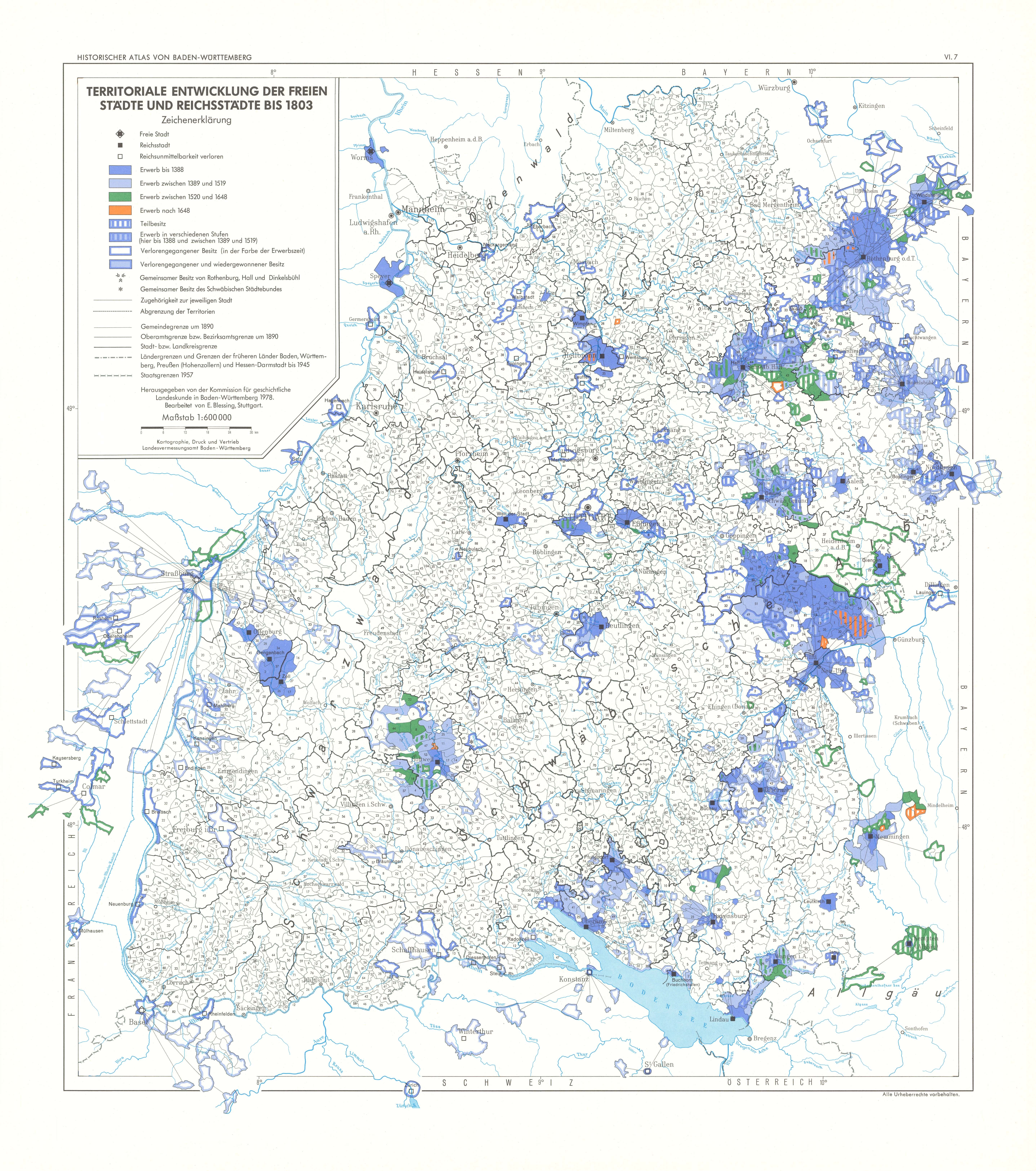
In actual fact the highest concentration of free imperial cities was in a corridor from Nürnberg to Lindau and then from Rottweil to Heilbronn. These include places that epitomize the idea of the German medieval towns, like Rothernburg ob der Tauber, Dinkelsbühl, Nördlingen, Schwäbisch Hall, Schwäbisch Gmünd, Memmingen, Kaufbeuren, Kempten, Lindau and Ravensburg. The largest amongst them were Nürnberg, Augsburg and Ulm, with Regensburg being the easternmost outpost and Strasbourg and Offenburg the ones furthest West.

HABW_06_07.jpg (5750×6500)

Which begs the question, why are they all concentrated in this area?

That goes back, again, to the Hohenstaufen. Many of these places, like for instance Rothernburg ob der Tauber, Nürnberg, Dinkelsbühl, Schwäbisch Hall and Schwäbisch Gmund were founded by the early Hohenstaufen as a line of defence for their duchy of Swabia against the House of Welf. If you want to catch up on that conflict, go back to episodes 45 following, the reign of Konrad III.

Besitz der Staufer bis 1250 – Detailseite – LEO-BW

When the Welf lost their possessions in Swabia and Bavaria, the military significance of these places for the imperial dynasty diminished. Still these foundations enjoyed sponsorship by the Hohenstaufen, turning into the economic heartland of their territory. For instance Schwäbisch Hall became one of the biggest financial contributors thanks to the salt brine that poured out of the local sources. This saline solution had a concentration of 4 to 8%, making it the largest and most effective source of salt in the region. The city also specialised in minting the Heller, one of the smallest coins, worth half a Pfennig. A German expression to say that someone had paid his dues in full, is “Auf Heller und Pfennig” = all down to the smallest fraction.

Schwäbisch Hall in winter

Politically these cities were tossed into an interesting situation when the Hohenstaufen fell between 1250 and 1268. They had been founded or controlled by the imperial family, either in their function as emperors or in their function as duke of Swabia. With the duchy of Swabia having disappeared, they had only one feudal overlord left, the emperor. Which made them de facto free imperial cities, though the formal recognition happened sometime between the reigns of Rudolf von Habsburg and Ludwig the Bavarian.

Another inheritance from the Hohenstaufen period were the elites, the patricians. They were in the main descendants of the ministeriales, the serf knights that made up the garrisons of the castles. Their ranks were occasionally refreshed by new arrivals either poor people climbing the ladder or by patricians from other cities moving across. These patricians socialised in their own drinking halls and religious confraternities. Membership in those often granted access to the city council and facilitated shared commercial endeavours. Over time many patricians abandoned mercantile activity and lived the life of minor nobility, including the castles, the jousting and the ostentatious clothing.

Below them ranked the artisans. They ranged from very wealthy, specialised trades which served high class customers like gold and silversmiths, spice and wine merchants, sword makers and miners at the top and the weavers usually at the bottom. The more common crafts in the middle like smiths, tanners, butchers, dyers, tailors, bakers, carpenters, clothmakers, retailer and saddlers, they often formed guilds to promote their interests. In some places, the patricians prevented them from organising themselves, because guilds tended to demand involvement in city politics, which often ended up in bloody conflicts.

Being a free imperial city is nice, because it means you are effectively free to do what you want, without having to deal with a territorial prince. But it is also a dangerous position to be in, because the institution that is supposed to protect you and that you pay some taxes to, the empire, is often unable to provide defence against rapacious dukes and bishops.

I guess that many of you will at some point visit Rothenburg ob der Tauber, and if you have not put it on your list, you should. It is the mother of all cute half-timbered cities in Germany, its Plönlein house making twice daily appearances on social media and its city wall still forming the outer perimeter of the place.

But in the 14th and 15th century, Rothenburg was anything but cute, nor were their elites or neighbours.

The dominant figure in the city’s history was Heinrich Toppler. If you drive up to Rothenburg, you may come past the Topplerschlösschen, arguably the first summer house built by a commoner since the days of ancient Rome.

Toppler had been mayor of Rothenburg between 1373 and 1407, though not continuously since the constitution of the city limited terms to one year and prohibited contiguous terms, like the consuls in ancient Rome.

It is not quite clear how Toppler became immensely rich. He was born to a relatively new family, his grandfather had come into town from the countryside and made some money trading in cattle and pork, enough to buy a house in the best neighbourhood. Heinrich’s father was admitted to the city council and Heinrich himself joined him there with his brother and brother-in-law sometime in the 1370s.

In 1380 he married Barbara Wernitzer, the sole child of the then richest man in town. He clearly invested this money wisely. His fortune increased from 2,000 gulden in 1370 to 31,000 gulden in 1407. But what exactly he did is a bit unclear. The debt register of the city of Rothenburg mentions only small debts owed to him. That suggests for one, that he wasn’t a banker and secondly, that his mercantile activity too was limited. Otherwise, he would have owed or owned a lot more trading debt.

He seemingly focused on real estate, of which he accumulated vast quantities, sometimes out of bankruptcies at very moderate prices. All this took place during a time when the city of Rothenburg was expanding its territorial footprint dramatically. Not through military conquest but usually by acquisition. Local nobles who had fallen on hard times sold lands and rights to the city to pay back loans or other debts. To what extent the astute patricians outsmarted the local nobles in their financial dealings in order to acquire their lands is up to speculation. But what is not up to speculation is that by 1480 the city had built a 62 km long border defence around their 350 square km territory. This defence consisted of three walls and two ditches; the walls being constructed mainly of impenetrable hedges. There were nine towers where travellers could enter the protected lands of Rothenburg after having paid their dues and had their wares inspected.

Given Toppler was mayor during the time and the engine behind the territorial expansion, it is not unfair to assume that he picked some of the juiciest pieces for himself. Though we would today regard such behaviour as illegal, it was not part of the accusations levelled at him later in life, and they put all sorts of things to him.

Toppler was not only the main administrator of Rothenburg in this period, he was also its main military commander and diplomat. And this time, the 14th and 15th century, was turbulent for most of these cities. The local princes were on the rise, trying to gobble up smaller cities, like the counts of Wurttemberg did as we heard in last week’s episode. At the same time the nobles, former vassals and ministeriales of the Hohenstaufen were reeling from the aftereffects of the Black Death that had undermined their financial viability. Some turned to banditry, some became mercenaries and others joined knightly associations. These associations, like the St. Jörgenschild, became regional powers.

To deal with these threats, Toppler negotiated the participation of Rothenburg in the Schwäbische Städtebund, the league of Swabian cities. City leagues had been explicitly prohibited by the Golden Bull but nevertheless formed at regular intervals as cities pulled together to push back the princes and the knightly associations.

Toppler established a particularly close relationship with king Wenceslaus the Lazy who turned from a foe of the cities to its champion. Episodes 163 and 165. Thanks to Toppler’s astute management of affairs, Rothenburg and the bund itself managed to avoid severe repercussions following the defeat at the battle of Döffingen in 1388, which Toppler had participated in.

Shortly after King Wenceslaus the Lazy was deposed in 1400, Toppler went into retirement. His relationship with the new king, Rupprecht of the Palatinate was not what he had with Wenceslaus.

In that period, he began forming a broader network into the other cities in the area. After his first wife had passed away, he married a lady from nearby Nördlingen in 1392, who was in turn related to several important patricians in Donauwörth, Augsburg and Munich. In 1405 he married his son and his daughter into two of the major families of Nürnberg.

During Toppler’s absence from the levers of power, Rothenburg ran into politically hot water. By 1406 the Swabian League, that alliance of mutual support amongst the cities had largely been dissolved. Rothenburg as one of the northern cities was most at risk from its two neighbours, the Hohenzollern Burggrafen of Nürnberg and the prince bishop of Würzburg. Both disliked the territorial expansion of Rothenburg and just generally would have liked to gobble up the wealthy city.

Rothenburg had so far managed to play these two adversaries out against each other, but that game came to an end in 1406. The Burgraf provoked the city by citing it before his own imperial court in Nürnberg. Rothenburg rejected the authority of the court of the Burggraf and in return cited the Burggraf in front of their own lawcourts. Result: happy lawyer, anxious citizens. King Ruprecht of the Palatinate who had the say in such matters sided with the Burggraf and threatened to put the city under the imperial ban.

At which point the city council called Toppler back in the hope he could resolve the situation. Toppler did two things. One was that he prepared for the now likely military confrontation. He ordered provisions to be brought into town and reinforced the city fortifications. And then he tried to find allies. Finding those amongst the various largely defunct city alliances prove difficult. So in his despair, he sent his brother as a delegate to king Wenceslaus, the deposed king, in the hope of getting some help from there. Wenceslaus had been trying to get back onto his throne for a while, had found some supporters, but as we know from the previous season on the Reformation before the Reformation, his personal failings, aka the constant boozing, and his weak hold over Bohemia made all these ideas just pie in the sky. But pie in the sky was all the only sustenance Toppler could muster.

On July 17th, 1407, the Burgraf, who had agreed some sort of profit sharing with the Bishop of Würzburg, attacked Rothenburg. He broke through the fortifications that surrounded the territory and captured the outlying castles. But when he got to the city, the inhabitants were forewarned. As we mentioned many times before, capturing a city before firearms were invented, worked either by surprise, or required a long siege, starving out the defenders. Thanks to Toppler’s foresight, the city was ready for the onslaught and well provisioned.

That dawned on the Burggraf, and he was willing to negotiate.  6 weeks after his invasion the two side signed a ceasefire. The ceasefire left Rothenburg with a number of onerous obligations. However, the peace agreement signed 4 months later after mitigation by king Ruprecht was a lot more favourable to the city. The Burggraf was not given any money to cover the cost of his army which left him in financial difficulty. The city and was released from the imperial ban but had to bear the destruction of its castles, lands, and crops. So, just a big waste of money, with a side dish of famine.

But there seem to have been some side agreement. Because seven weeks after the peace treaty Heinrich Toppler was thrown in jail. There was a trial, though we have no documentation of what he was explicitly accused of. His enemies had captured three letter that proved that he had negotiated with king Wenceslaus, which could be seen as high treason against king Ruprecht of the Palatinate. There may have been other accusations, such as that he was trying to make himself a dominus, a dictator of the city. There is a legend that he gambled with the Burgraf over ownership of the city, an idea that come from his coat of arms that showed two dice.

And in a totally uncorrelated sequence of events, the city received an imperial court order that Toppler’s massive fortune was to be handed over to the king, a king they called Ruprecht of the empty pocket behind his back,

On an unknown day Heinrich Toppler died in prison, either decapitated or simply left to die of thirst. His body was brought to the church of St. Jakob where he was buried in the chapel he had built for his family. Having had premonitions that things may go badly, he had sent most of his moveable fortune to his children in Nürnberg. His descendants survived the purge and established families that thrived well into the 17th century, not in Rothenburg though, but in Nürnberg. His summer house, the Topplerschlösschen passed through several patrician families in Rothenburg and is still in private ownership, but it can be visited.

What we can take from this story are several things. One, that these patrician elites across these free imperial cities were often connected through links of marriage. And that families occasionally moved from one place to another, acquiring citizenship and standing fairly quickly. That not all patricians were merchants, in fact many lived lives as warriors and diplomats rather than as traders. And finally, that politics were cutthroat, leaving even the most competent of mayor’s dead in a cell, when political exigencies required it.

Which now gets up to the main topic of today’s episode, the Grosse Ravensburger Handelsgesellschaft.

Ravensburg as mentioned earlier lay at the southernmost end of this corridor of free imperial cities established by the Hohenstaufen. And it was not even a Hohenstaufen foundation. Ravensburg was established by the Hohenstaufen’s enemies, the House of Welf. But when Welf VI made Frederic Barbarossa his heir, Ravensburg, like all of his Swabian property passed to the imperial family and when they fell, became a free imperial city.

But then, as now, Ravensburg was a much smaller place then Constance or Ulm, and a less advantageously located one to boot. Constance lay at the connection between the upper and the lower lake where a bridge crossed over into Switzerland, the only bridge for a long way in either direction. Ulm was the last navigable point on the Danube, making it the ideal stopping off point for an East-west trade all the way to Hungary. Ravensburg lay inland on one of the many trade routes in the region, not exactly the obvious choice for the by far largest trading firm in the whole of the German lands.

The year of foundation for the company is usually given as the year 1380. However, the reality is more likely a gradual transition rather than a one-time agreement.

At the heart of the early phase are three individuals, Henggi Humpis who was from Ravensburg originally, Rudolf Mötteli from Buchhorn, modern day Friedrichshafen on the lake Constance and Lütfried Muntprat from Constance. The Mötteli family acquired Ravensburger citizenship in 1375, whilst the Muntprat came in no earlier than 1411.

All three families had been trading for a long time before they joined forces. They benefitted from the main trading routes of the region, of which there were basically four main ones.

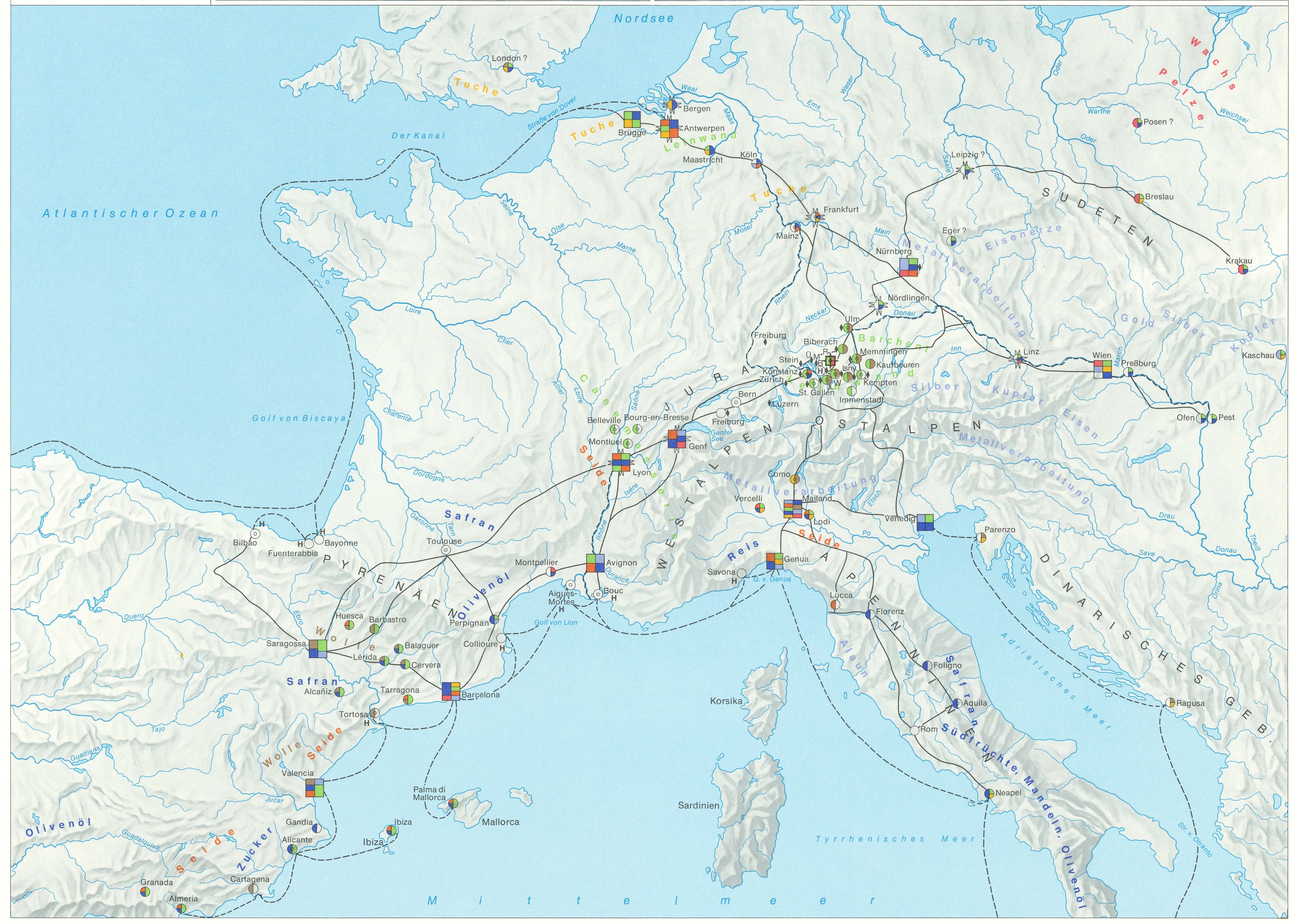
The first was the transalpine route across the Gotthard, Simplon and Splügen passes to Milan and from there to the main Mediterranean ports of Genoa and Venice. Then there was a land route west via Constance, Zurich, Berne, Geneva, Lyon and from there into southern France or Spain. An eastern route followed the Danube from Ulm, all the way to Vienna and Hungary. And finally, there was the Northern route to Frankfurt, Cologne, Antwerp and Bruges.

HABW_11_03_Ravensburger_Handelsgesellschaft.jpg (4957×3535)

The challenge for these trading houses was the same we encountered in our discussion about the Hanseatic League. Merchants who wanted to scale up could no longer travel with their merchandise as had been the case in the early Middle Ages. They stayed at home in their counting houses and kept an eye on the wares that flowed back and forth across their network of correspondents and clients. And once that is the business model, two things matter more than anything else, trust and information.

Merchants need to know what goods are in demand at the destination and what prices are at the point where they want to procure them. And they need to trust the people who act on their behalf, the apprentices or shippers who travel with the goods and the agents who buy or sell the goods on their behalf.

In the Hanse system, this problem was solved through an elaborate surveillance operation. Each merchant would have several correspondent agents in each city that he or she would trade with. These correspondent agents would not only keep an eye on the market, but also on the behaviour of the other correspondents. That way a merchant would know fairly quickly if say the creditworthiness or honesty of one of his agents was placed in doubt. And the higher a merchant rose within their city, the more access he would gain to information. As a member of the city council, he would hear about the state of negotiations with kings and princes, where pirate activity was most intense and what would be done about it etc. And finally, long standing relationships, intermarriage and the fact that Hanse traders all spoke Low German created trust between the participants in that network.

The downside of that model is that it keeps the average size of the firms comparatively small. If every merchant has to split their orders amongst several agents to maintain the surveillance system, neither of these agents can become dominant. And vice versa. If you want to dig into this system and its underpinnings, check out the season on the Hanseatic League, specifically episodes 119 and 120.

The southern German trading system was built on a very different model, a model developed earlier in Italy. The great Italian firms relied heavily on networks of agents employed directly by the firm, and most often members of the family. These agents held a stake in the firm and were hence incentivised to procure accurate information and try to achieve the best possible prices.

The main constraints to this model were the number of family members and trustworthy business partners one could recruit. That is likely one of the reasons the three firms of Humpis, Mötteli and Muntprat joined forces in Ravensburg in the early 15th century. They all had been extremely successful merchants, but growth has hit a wall as they had run out of individuals they could send out as their representatives. By pooling their resources, they could establish a much larger network of agents than they could set up individually. Another key benefit was that the combination reduced competition, increased pricing power with suppliers and customers and reduced risk.

This was a real company, meaning the partners would put in capital in the form of cash or wares and would in return receive dividends proportionally to their share of the capital. Membership quickly expanded beyond the three families, bringing in roughly 40 to 90 further usually smaller partners. They came from all over the place, from Wangen, Isny, Lindau, Memmingen, Costance, Biberach, Ulm, Nördlingen, Freiburg and Fribourg as well as Lucerne. Most partners were active in the company, often as agents abroad. They would get their expenses covered and received an additional bonus based on their trading performance.

The company would do a full account of the books every three years to determine the dividend payments and bonuses. This happened under the supervision of the three regents, effectively the management board. This is again a difference with the Hanse, where the accounts were only done once, upon the death or bankruptcy of the merchant.

One of the regents tended to be in Ravensburg at the headquarters on Marktsrasse 59 where the books were kept, whilst the other two were travelling, inspecting the counting houses or accompanying particularly valuable shipments.

Which gets to the question, why did they choose Ravensburg instead of the much larger and better positioned Konstanz where the Muntprat family came from. The answer lies most likely in the more stable political situation. Following the great Church Council that had lasted 4 years from 1414 to 1418, Constance experienced a prolonged period of internal conflict between patricians and artisans and between the major families. Ravensburg had found a more stable balance between patricians and artisan interests that kept disruptions to a minimum. 

In terms of trading goods, one of the key products were textiles, namely linen and what is called barchent or fustian. Linnen is made from flax, which grew all over the area north of lake Constance. Barchent as it is called in German or fustion as it is known in England was a heavy, hard-wearing cloth made with a cotton weft and a linen warp. Meaning that on a loom, the vertical yarn is made from linen and the horizontal yarn that is the one that travels back and forth, is made from cotton. The advantage of that technique is that fustian was hard wearing and at the same time more flexible than pure linen. And we still wear a type of fustian, which we call Denim.

In other word, this was not a top end luxury product, but a very useful one, specifically for the working classes from Flanders to Saragossa. Another advantage was that it could be produced on small looms by peasants during the winter months, providing them with an extra income.

I have not found an analysis of how well this was working out for the peasants making the Fustian or linen. But historically this kind of piece work was a form of pretty merciless exploitation. And given that in case of the fustian, the buyers were also delivering the cotton, the labourers were almost completely dependent upon these merchants.

So, margins in this business must have been pretty good. What further helped margins was that in some markets, like for example Barcelona and Saragossa the Ravensburgers gained a monopoly on these kinds of textiles. But shipping it all the way to Flanders and Hungary where they had competition seemed to have worked as well. The Handelsgesellschaft established strict quality controls for their textiles that ranked the product into three levels and were marked with one, two or three crowns.

The other export from Ravensburg was paper. One of Germany’s earliest paper mills opened in 1407 and was again held to high quality standards, making it popular and competitive with the Italian luxury paper Gutenberg had insisted upon.

The return shipments concentrated more on luxury items, for example from Spain silk, rabbit furs, wool, pearls, coral, olive oil, almonds, dates, figs, raisins, cumin, wine, indigo, and very importantly sugar and saffron. Sugar, usually purchased in Spain and Saffron from Spain and Aquilea in Italy became one of the hallmarks of the Ravensburger Gesellschaft. Again, their seal of quality was widely recognized and commanded a significant premium.

At some point they even opened a sugar factory near Valencia.  In Italy they again bought spices and fruits, but also weapons, nails and other metalwork, which Milan was particularly famous for. On their returns from Flanders, they brought the fine woolen cloth that was in demand all across Europe. And they participated in the great local trades, the copper, tin, pots and pans from Nürnberg and Bohemia and they went to the fairs of Nördlingen and Frankfurt.

Their trade was not just operating on a hub and spoke basis. They would ship Spanish products directly to Cologne or Antwerp and buy textiles in Bourg-en-Bresse for sale in Spain.

It was a truly pan-European operation on a scale few northern trading houses could compete with. There is again a map of their trading network on this episode’s webpage, the link to which you find in the show notes. It made its partners, in particular the three founding families immensely rich. To put that into context. Heinrich Toppler at his peak was worth about 31,000 gulden. The Möttelins capital in the society was 150,000 gulden, the Humpis brought in 131,000 gulden and the next one down had 100,000, so the company as a whole accounted for many multiples of what the King of Rothenburg possessed.

Which gets us to the question why the company ultimately dissolved in 1530. As always, there are many reasons.

One was that after the death of one of the founders, Henggi Humpis, several members fought over the post of regent, the board membership. And this was not a polite fight with occasional harsh words, this could get physical with attempted kidnappings and incarcerations of the clients of the other side.

But by that time several original members, including the extremely wealthy Mötteli family had already left the company. They had disagreed on strategy in Spain and went to St. Gall where they founded a new organisation. Meanwhile competitors like the Diesbach-Watt families and later the Vohlin-Welser from Memmingen competed aggressively. In 1477 another group of Partners left to set up their own shop that became known as la Chiqua, the little Ravensburger Company.

Another fatal blow came with the shift in trading patterns during the age of exploration. Vasco Da Gama found a way to India, disturbing the route spices moved and after Columbus sugar production moved to the Caribbean.

But the true weakness was the inherent conservatism. The Great Ravensburg Trading Company was very much still a medieval institution. When one of their associates opened a printing press in Saragossa, the first in Spain, some of the partners objected to the point that they left. And the company observed the strict ban on usury the church still insisted upon. That barred them from any outright banking activities except for money transfer and letters of credit. When the Fugger and Welser with their willingness to fund the great princes and emperors and their expansion into the new world come on to the scene, the Ravensburger stood no chance.

In around 1530 the Great Ravensburg Trading Company appears to have ceased to operate. Some of the founding families kept staying in trading, but mostly they turned into landed gentry, having converted their mercantile wealth into castles and manor houses.

 Which begs the question, how come the accounts of the society were found covered in bird droppings in the home of Prinz Max von Baden in 1911. As it happened, the last accountant of the company did take all the old account books with him when he shut up shop on Marktsrasse 59 in Ravensburg.  He kept them at home, probably out of sentimentality, something his son and grandson shared. At least to the point that when said grandson joined the Cistercians at the great monastery of Salem, he took the papers along and deposited them in the monastery archives. There they were registered as “useless old trading documents” and put into a drawer in a dark corner. And when that drawer was opened by accident or on purpose, the swallows moved in. And thanks to their care, we now have this extraordinarily detailed account of a late medieval trading operation, a truly unique document.

In the faint hope that this podcast will not end up in a dusty corner of the internet, covered in AI bird droppings, I would appreciate any help you can give the show. That does not necessarily mean financially by going to historyofthegermans.com/support, but also by leaving a review, a comment on social media or Spotify, YouTube or whatever you can think of could bring in new listeners.

See you again next week when we may or may not talk about the richest or maybe not the richest man who ever lived.

The consequences of the Hussite Wars 1419-1434

This week we bring the series about the reformation before the reformation to an end. It is time to take stock. What changes did 20 years of opposition to the established church and 15 years of war bring to Bohemia? How did Jan Hus, Jan Želivský, Wenceslas Koranda and Petr Chelčický influence Luther, Calvin, Zwingli, Müntzer and von Hutten? How did Zizka’s reform impact the Swiss mercenaries and the German Landsknechte?

Listen on Spotify

Listen on Apple Podcast

Listen on YouTube

Transcript

Hello and welcome to the History of the Germans: Episode 183 – The Aftermath of a Revolution, also Episode 20 of the Reformation before the Reformation.

This week we bring the series about the reformation before the reformation to an end. It is time to take stock. What changes did 20 years of opposition to the established church and 15 years of war bring to Bohemia? How did Jan Hus, Jan Želivský, Wenceslas Koranda and Petr Chelčický influence Luther, Calvin, Zwingli, Müntzer and von Hutten? How did Zizka’s reform impact the Swiss mercenaries and the German Landsknechte?

But before we go there just a very brief reminder. The History of the Germans is, was and will be advertising free thanks to the generosity of our patrons who have signed up on historyofthegermans.com/support. And this week we want to thank Sven Klauke, Frandookie, Carl J., Shannon S., Dennis, Travis D., Werner G. and Niv Gal Waizer who have already signed up.

And with that mercifully short intro, back to the show.

Last week we came to the end of the Hussite revolution, which is usually set at 1434 the battle of Lipany that broke the power of the radical sects, the Taborites and Orebites, or 1437 the ascend of Sigismund to the throne of Bohemia as the universally accepted ruler of the kingdom.

This may be a sensible place to take a break and survey the outcome of these 20 years of upheaval.

Lets start with the toll in terms of human life.  

As always in the Middle Ages, numbers are very unreliable. Wikipedia has an unsupported but weirdly precise set of numbers indicating a loss of 1.3 to 1.8 million over the entire period all the way to 1526. However, the central academic estimate for the death toll of the Hussite Wars is around 100-200,000. The majority of the losses weren’t battle casualties, but civilian losses due to the devastation of fields and vineyards. In pre-modern times food supply was always precarious so that even temporary disruptions from foraging armes or deliberate destruction of fields could cause disastrous famines.  

That feels like a modest number compared to the millions who perished I the religious wars of the 16th and 17th century. But Bohemia is a small country so that modest number still adds up to roughly 10% of its population at the time. To put that in context, the French military deaths in World War One were 1.3-1.5m plus maybe another 0.5 to 0.8m civilian losses from starvation out of a population of 39.6 million, so roughly 5%. If you are looking for a death toll of 10% or more in recent times there is the Soviet Union which lost ~13.5% of its population during World War II, which included famine, genocide, deportation and disease.

As Laurence of Brezova, an eyewitness to these events, said quote: “As I consider the ruin, as varied as it is enormous, of the once famous and fortunate kingdom of Bohemia, [..[which [..] has been everywhere devoured as by a serpent and devastated by [..] internal conflict, my senses are dulled , and my reason, distraught with grief, declines from the vigour of its faculties.” End quote.

The recovery from this devastation took not only years but centuries. One key reason for this prolonged impact was the massive damage the Bohemian economy sustained during the conflict.

The pillar of the Bohemian economy in the High Middle Ages had been mining, specifically silver mining. We have been going on about the Mines of Kutna Hora so often, you must be tired of me taking about them. One of the outcomes of the conflict was that the trained mining engineers, most of whom had been German and catholic, left Kutna Hora in 1422 and the Czechs struggled to bring the production back to the levels they had been before the war. Plus the easier seams were exhausted and the remaining shafts were prone to flooding so that silver production dropped sharply. The other great mine in Joachimstal, the one which gave its name to the Thaler and ultimately the Dollar, opened only in 1512. So for much of the time during and after the Hussite wars, there was only moderate mining activity.

And we should not forget that in the 14th century Nürnberg devised a technology to separate silver from copper ore, something that yielded enormous profits for the city but left the localsy in Bohemia and Hungary with just the crumbs that fell off the table.

Then, before the Hussite Wars, Bohemia had not only experienced a massive building boom, in particular the construction of the New Town of Prague, the kingdom had also become more deeply integrated into the expanding European trade networks. Emperor Charles IV had tried to establish a new major trade route from Venice via Prague to Leipzig and into the Hanse territory as well as into Poland and Russia. Though this grand plan was only partially successful, mainly German speaking long distance merchants settled in Prague, Pilsen, Kutna Hora and many other cities.

As we have heard during the season about the Hanse, late medieval trade was largely based on trust. A merchant who sent his wares or his money to another city usually placed it with a dependable business partner or a branch of his own firm. These were pretty much the only options. The logistics of recovering  funds or merchandise lost to fraud were simply insurmountable. The duped trader would have had to go to the place where the fraud was committed, bring a case before the local court, in some cases under a legal framework different to what he was used to at home, and then hope the conman wouldn’t skip town. Hence we have trade networks like the Hanse which were based on a shared language, culture and social surveillance or the great Italian and Southern German firms with offices in all major trading centres.

By embracing the Hussite beliefs, even in its most moderate form, the Bohemians had made themselves suspects in the eyes of a still 100% catholic europe. Nobody wanted to trade with someone who had been labelled a heretic, whether justified or not. Once most Catholics had left Prague following the defenestration in 1419, the city was literally cut out of international trade. Staunchly catholic cities like Pilsen might have been able to maintain their relationships with the outside world, but the regular sieges and the incursions by Taborites and Orebites must have made things difficult. And for what that was worth, the Catholic church and the empire had issued a trade embargo on all of Bohemia.

After that embargo was lifted in 1437 and Catholics trickled back into Prague, reconstructing the old links remained a slow and painful process, often interrupted by the wild swings of Bohemian politics in the 15th and 16th century.

The second boost to economic activity that Charles IV had bequeathed the crown of Bohemia was the pilgrimage trade. He had placed literally hundreds of venerated relics into the churches of Prague and the great monasteries. The imperial regalia and the crown of St. Wenceslaus,  themselves objects of veneration, were displayed once a year in a grand procession that had brought in visitors from all across Europe.

But at the end of the Hussite wars, many of these relics had been destroyed and the monasteries burned down. The imperial regalia had transferred to Nürnberg. So that trade had also ceased.

Finally, the last great gift Charles IV had granted Prague had been the University. But the expulsion of the German nations in 1409, a withdrawal of the papal charter during the council of Constance, the burning of the books by the archbishop left the institution a mere shadow of its former self. Its role as the pre-eminent academic institution in the empire had initially gone to Heidelberg and Leipzig and many of the foundations of the 15th and 16th century still outpaced the oldest university in the empire.

To provide at least a little bit of silver lining, the translation of the bible into the common tongue and the emphasis Hussite beliefs placed on preaching, led to a rapid development of Czech as a literary language. As you may have noticed, I do not speak Czech, but I am sure some friendly Czech listeners may be able to point us to some interesting works from the period.

But overall, Bohemia lost touch with much of the early modern developments in art and philosophy. The emerging humanist ideas and writings took a long way to get there, as did the art of the early renaissance. At a time when Matthias Corvinus was creating his famous library in Hungary and Italian artists were busy embellishing Krakow, Bohemia clung to a late gothic style which I find very appealing, but wasn’t exactly cutting edge at the time.

As we are talking about philosophy and theology and in case you want to go deeper, I have an excellent Philosophy podcast for you! The Partially Examined Life is a philosophical podcast by 4 guys who were at one point set on doing philosophy for a living. For each episode, they pick a text and chat about it with some balance between insight and flippancy. You don’t have to know any philosophy, or even have read the text they’re talking about to follow and enjoy! With a 13-year-plus catalogue of episodes, The Partially Examined Life has probably covered any philosophical topic you’re interested in, from practical ethics to the theoretical foundations of science. They go deep into the history of philosophy while making it personal and funny.

You can join the over 45 million downloads already pondering with The Partially Examined Life. Find new episodes wherever you find your podcasts or at partiallyexaminedlife.com

We have done population, economics and culture, which means we can now move to our more familiar territory of political history.

When a revolution comes to its end, it usually leaves behind winners and losers. And that is the case here too. The winners, by a wide margin were the barons, Hussite and Catholic alike. For one, they seized the vast majority of the former church lands and incorporated them into their personal property. It is quite remarkable that in the four articles of Prague it says explicitly that the church owning property is “to the disadvantage of their spiritual office and also of the temporal lords”. I will be looking out for a similarly blatant statement when we get to the Reformation.

Before the Hussite revolt, the church in Bohemia controlled around 30% to maybe even 35% of the arable land. At the end of the process, that had dropped to about 12%. And most of this land went to the barons and to a few members of the gentry who had become successful military leaders during the conflict. And it was not just the Hussite barons who salivated at the prosect of expelling monks from a rich abbey, the Catholics were at it as well.

Alongside the increase in wealth came another uplift in political influence. Bohemia was, as we know from way back in episode 146, an elective monarchy. That is how Sigismund’s grandfather, the blind king John gained the crown in the first place. Charles IV tried to shift this, but never managed to formally rescind the elective nature of the kingdom and had to confirm it in his Golden Bull. But like in the empire under the Ottonians and Salians, if there was a male heir who was competent, the election was more of a formality.

But now, after 20 years of war, which at least in part was a war over Wenceslaus IV’ succession, the elective element of the monarchy was put to the forefront. Sigismund had to confirm the right of the Land Diet to choose the monarch, and that diet was dominated by the great barons. The elective element would become even more important as Sigismund’s heir, Albrecht of Austria died after just 2 years on the throne in 1439, leaving behind a son who was born posthumously. And when that son died in 1457 without ever really taking control of Bohemia, the barons saw themselves entirely free to grant the crown to whoever they liked, which turned out to be one of their own, George of Podiebrad.

Beyond the right to elect their king, Sigismund had to make even further concessions. He had to accept the transfer of royal cities and castles to the barons, leaving the kings of Bohemia without resources. He passed a ban on promoting foreigners to any of the high offices of state and an obligation to consult the assembly of the kingdom on appointments, which turned into a de facto approval right. During the 1460s the barons also gained control of the local courts, rendering royal justice effectively defunct.

Since there wasn’t an effective king for almost the entire period between Sigismund’s death in 1437 and Georg of Podiebrad’s election as king in 1458, the running of the kingdom was in the hands of the Bohemian diet where the barons outnumbered the gentry and the cities.

Which then gets me to the cities. As we have seen Prague, Pilsen and Tabor featured as major players during the Hussite wars, fielding armies and signing treaties. Other places like Hradec Kralove, Kutna Hora etc. also mattered. These cities had developed a significant degree of autonomy, held something akin to elections to the city council, and in the case of Tabor and its affiliates, had a very distinct history and culture. Hence one would expect them to remain of importance post the revolution. But that wasn’t the case. The barons teamed up with Sigismund to strip the cities from the right to appoint their military captains. Without control of their military force and subject to the courts owned by the barons, the cities were defenceless and lost more and more influence.

That being said, the biggest losers were the peasants. In a republic of barons, you do not want to toil the land. Whilst in most of europe the Black dDeath had led to an increase in wages for labourers and a reduction in feudal obligations, in Bohemia, serfdom returned with a vengeance. Peasants who had fled into the cities, even into places like Tabor, could be forced to return to their previous home and bondage. In the persistent economic depression and the continued upheaval even free peasants were gradually pushed into submission under a tiny landowning elite.

Bohemia would be a land ruled by a few dozen barons who controlled the state and the royal assembly, up until 1618. When the Habsburg monarchs tried to impose not just religious but also political control on the Bohemians, it came to the second Prague defenestration, which triggered the Thirty Years war, a war even more devastating than the Hussite Wars.

Having done Politics, it is time to move on to the other topic one should never raise at a dinner party – religion. In the broadest of brushes, the situation developed as follows.

The formerly moderate Hussites moderated further and further as time went on. At the beginning of the 16th century there was really very little that distinguished the Hussite Utraquist church from traditional catholic Christianity, except for the offer of bread and wine during services and the veneration of Jan Hus as a saint. The formally catholic church had never disappeared from Bohemia, as we know several regions, around Pilsen and in southern Bohemia had remained catholic all throughout. But as part of the compacts of Basel catholic priests and monks were allowed to return. They reopened the monasteries and churches, collected endowments from the faithful and slowly and steadily rebuilt their presence. It is also important to remember that the crown of Bohemia comprised not just Bohemia but also Moravia, Silesia and Lusatia. These territories had in the main rejected Hussitism. That meant that as the crown of Bohemia reconsolidated, the overall entity was almost split 50/50 between the now very moderate Hussites and the old school Catholics.

Then what happened with the Taborites and Orebites and some of the even more radical splinter groups? Well, as we heard last week, their military power was broken at the battle of Lipany in 1434. However, they were able to continue their spiritual independence. They had their own bishop and their own liturgy. But that lasted only until 1452 when Tabor got caught between the political powers in the land, was besieged by king Georg of Podiebrad, defeated and turned into a royal city under the Utraquist church.

Those who did still yearn for a different approach formed the Unity of the Brethren. The Brethren were a lot closer to the original ideas of Jan Hus.  Their founding thinker was Peter Chelčický. He is another one of these people I would produce a whole episode on if this show was called the history of europe and not the history of the Germans. But briefly. He took his cues from the sermon of the mount. That led him to reject the institutions of the church and the state, but most importantly led him to reject any form of violence. He preached tolerance and turning the other cheek, not to repay evil with evil. He embraced many early Taborite ideas on communal living and sharing of resources.

The brethren being strict pacifists were tolerated within Bohemia until the counterreformation. After the battle of White Mountain in 1620 any non-catholic beliefs were persecuted so that the brethren were forced underground. Some moved to Moravia, others further afield. Of those who lived in hiding in Moravia, a small group left for Berthelsdorf a noble estate near Gorlitz in Saxony.  Its owner, Nikolaus Ludwig von Zinzendorf welcomed them and gave them land where they established a new village they called Herrnhut. The community thrived and triggered a revival of the Unity of Brethren. They became known as the Moravians and thanks to a proactive missionary activity are today a protestant community of over 700,000 with a strong presence Tanzania, the Caribbean and in the US. Their ideas had a major impact on Methodists, Baptists and the evangelical movement more broadly.

Which leaves the most important question for us, how did the Hussite revolt impact religious thought in the German speaking parts of the empire.

The first thing to say, and I believe that it is not at all controversial is that there are an incredibly large number of parallels between the ideas of Jan Hus, Jan Zelivsky, Wenceslaus Koronda, Petr Chelčický, the Taborites, Zizka, the Orebites etc. on the one hand and Luther, Calvin, Zwingli, Melanchthon and so forth on the other.

Both demanded freedom to preach based on the bible in the vernacular language. They demanded a return to the church of the apostles, where priests did not yield temporal power or had enormous wealth. They offered the sacrament in the form of bread and the wine, dismissed the saints, the adoration of the Virgin Mary and had an iconoclastic bent.

And even some of the set piece events have an eery similarity. The offer of safe conduct to Constance and to Worms, an emperor present at the disputations. Then there was the expansion of Ottoman power that forced both Sigismund and Charles V away from the centre of religious dissent, giving the reformers enough breathing space to disseminate their ideas.

But as we bankers say, correlation is not causation. The fact that both movements came to similar conclusion could have been down to Luther, Calvin or Zwingli reading the books of Hus or the millennial sermons of the Taborites.  Or it may have been down to the fact that the bible is pretty unambiguous in its description of the primitive church and the gap between that ideal and the lived reality of the church in the 15th as well as the 16th century was totally obvious.

As you know we have not yet done the Reformation and my experience after four years of doing this podcast is that I usually regret statements I make looking forward in our timeline. Therefore, with the caveat that I have only read a limited set of sources, it is my understanding that Martin Luther had at best only a sketchy understanding of the Hussite revolt when he drafted his 95 theses. It was only when his opponent, Johann von Eck pointed out to him how close his ideas were to Jan Hus’ writings that he realised the similariies. He first read Hus’ main works, de Ecclesia in 1519 and it took him until 1522 before he publicly stated that Jan Hus and Jerome of Prague had been innocent.

It is therefore difficult to argue that the Hussite revolt directly influenced the Reformation. But it may well have had an indirect influence. Luther himself may not have been aware, but it is unlikely that such audacious ideas and dramatic events as we have discussed these last few weeks left no imprint in the collective memory of the empire. Or did it?

There is something that strikes me as odd. We have been talking about the relationship between empire and papacy for years now. And in this context we have noticed a strong anti-papal, if not anti-clerical undercurrent in the general opinion of the German speaking people of the empire. After all, a half dozen emperors had been excommunicated and could still rely on the support of their people, even their bishops. Ludwig the Bavarian was the most obvious example of an emperor who remained outside the church for most of his reign, was never legally crowned and gathered the Kurverein zu Rhense that rejected papal influence on the empire.

At which point one wonders why the Hussite ideas did not resonate with the German speaking peoples. Instead they mustered crusades against them and their ideas did seemingly not circulate broadly amongst theologians in German universities.

And that gets us to the bit which may become controversial. The idea that springs to mind is that the Hussite revolt had some very strong nationalist overtones. And that not just in 19th century historiography, but our friend Laurence of Brezova who write his chronicle right in the midst of these events, never misses an opportunity to paint the Germans as evil. And likewise, the towns and cities near the Bohemian border may not have looked fondly on to the Hussite armies that came across burning and plundering.

But I am not sure that Hussitism was really mainly a national movement for the Czechs that the Germans rejected as foreign.

Because the idea all Czechs were Hussites is obviously not true. Cities like Pilsen and barons like Ulrich von Rosenberg were catholic and undeniably Czech. The accusers of Jan Hus in Constance weren’t Germans but Czechs and their judges included more French and Italians than Germans. Meanwhile Prokop the Shaven, the military leader of the Taborites for 10 years was from the German minority in Bohemia and during the time of Jan Hus, sermons were also preached in German at the Bethlehem Chapel.

The reason the Germans in Bohemia sided in the main with the Catholics had probably more economic than spiritual reasons. Their networks as long distance traders or mining specialists stretched beyond the borders of the kingdom and if they wanted to maintain these links, they had to at least formally stay with the catholic church. That does not justify the massacres in Kutna Hora, but it does explain why this community in the main refused to join the Hussite movement.

So my thesis is a fairly simple one. The reason that Jan Hus and the other Hussite thinkers were unknown in German speaking lands lay in the fact that they discussed and published much of their ideas in Czech. Sure many foundational texts were initially written and published in Latin. But the scholarship that developed around it was conducted in Czech.

And if you realised one thing over the last few episodes, it is that Germans really cannot pronounce Czech words. And that may be the main reason Jan Hus revolutionary and I find profoundly convincing ideas did not make it to Germany. Luther had to find it out all by himself, like Peter Valdes, the Cathars, St. Francis, St. Peter Damian, Michael of Cesena, William of Ockham, Marsilius of Padua and dozens and dozens and dozens of others.

There was however one thing the Hussites developed, that was unique and that the Germans embraced enthusiastically. And that were the military innovations of Jan Zizka. The transfer was not direct but went through the Swiss mercenaries who were the first to take on Zizka’s military doctrine of discipline, meritocracy and equal sharing of the loot. They replaced the Wagenburgs with pike and shot squares which are based on a similar idea of defending against cavalry attacks through interlocking units, low cost cut and thrust arms and the use of artillery.

Their version of Zizka’s ideas was then absorbed by the Landsknechte in Maximilian’s military reforms. I am sure we will discuss this change in military tactics and the subsequent change in the social hierarchy in more detail in an upcoming episodes, so I will not elaborate too much at this point.

Which brings us to the end of this episode and the end of this season. I hope you enjoyed our somewhat elongated excursion into Bohemia. We will almost certainly return when we discuss the rise of the Habsburgs and it is unlikely to be the last time our story will take us to foreign shores. It is one of the weird things about German history that a lot of the action consists of the key protagonists heading out to neighbouring places. For a long time the empire was simply too big for anyone to invade. But once they did, they did not stop for 200 years, and boy will we be busy talking about that.

But before we do any of this, we will do our little tour of the empire, taking it all in in its late medieval, half-timbered glory. I am still in the process of planning it so that I cannot guarantee we will start immediately next week. I might slot in a short episode on Barbara of Cilli or simply take a week off. Let’s see. I hope you will join us again…

And in the meantime, if you want to induce me to work harder and faster, there is always the historyofthegermans.com/support page where you can make a contribution.

The Disastrous 14th Century

In around 1320 near the lake Issy-Kul in Kyrgysistan the rats started dying. Shortly after the inhabitants became affected with terrible diseases. Some started coughing up blood and all who did, died within 3 days. Others developed swellings of the lymph nodes, particularly in the groins and armpits. Roughly half of them died within five days. A small number saw their feet and fingertips turn black. All of those died.

Everyone who could still leave sought refuge in towns and villages that had not been affected. The disease travelled with them. By 1330 Chinese chroniclers recorded a plague affecting the Mongol hordes. In 1346 a Mongol army besieging the Genoese trading city of Caffa on Crimea succumbed to the disease. In their final push to cow the defenders they catapulted the diseased corpses of their comrades into the city. The siege lifted grain transports from Caffa to Italy resumed. The disease reached Messina in Sicily in 1347. In 1348 it had enveloped most of Italy. 1349 it crossed the alps, by 1350 people died in their thousands in Northern Germany and Scandinavia. It took until 1353 before this wave of the plague petered out, leaving between 20 and 60% of the population of Europe dead. The disease returned in 1361-1363, 1369-71, 1374-75, 1390 and 1400. After that intervals became longer but the plague never went away completely and still today a couple of 100 people die worldwide of Plague every year.

Despite having lived through a pandemic only recently, we have all realised that the impact of such an event goes far beyond the gruesome statistics. It is much too recent an event to get a grasp of the impact COVID 19 had on the economy, political system and society in general, but clearly something has changed. Now imagine the plague, which in terms of death toll was between 10 and 30 times worse and crucially affected young and old equally. The fallout was exponentially greater not least because it came on the back of several other calamities. It is these impacts we will mainly focus on in this episode. So let’s dive in..

TRANSCRIPT

Hello and welcome to the History of the Germans: Episode 157 – The Black Death and other Calamities, also episode 19 of Season 8 “From the Interregnum to the Golden Bull”

In around 1320 near the lake Issy-Kul in Kyrgysistan the rats started dying. Shortly after the inhabitants became affected with terrible diseases. Some started coughing up blood and all who did, died within 3 days. Others developed swellings of the lymph nodes, particularly in the groins and armpits. Roughly half of them died within five days. A small number saw their feet and fingertips turn black. All of those died.

Everyone who could still leave sought refuge in towns and villages that had not been affected. The disease travelled with them. By 1330 Chinese chroniclers recorded a plague affecting the Mongol hordes. In 1346 a Mongol army besieging the Genoese trading city of Caffa on Crimea succumbed to the disease. In their final push to cow the defenders they catapulted the diseased corpses of their comrades into the city. The siege lifted grain transports from Caffa to Italy resumed. The disease reached Messina in Sicily in 1347. In 1348 it had enveloped most of Italy. 1349 it crossed the alps, by 1350 people died in their thousands in Northern Germany and Scandinavia. It took until 1353 before this wave of the plague petered out, leaving between 20 and 60% of the population of Europe dead. The disease returned in 1361-1363, 1369-71, 1374-75, 1390 and 1400. After that intervals became longer but the plague never went away completely and still today a couple of 100 people die worldwide of Plague every year.

Despite having lived through a pandemic only recently, we have all realised that the impact of such an event goes far beyond the gruesome statistics. It is much too recent an event to get a grasp of the impact COVID 19 had on the economy, political system and society in general, but clearly something has changed. Now imagine the plague, which in terms of death toll was between 10 and 30 times worse and crucially affected young and old equally. The fallout was exponentially greater not least because it came on the back of several other calamities. It is these impacts we will mainly focus on in this episode. So let’s dive in..

But before we start the usual reminder that this show is advertising free and that I also have shortened this section to the absolute minimum. So, please give generously on patreon.com/historyofthegermans or on historyofthegermans.com/support. And thanks so much to Jan M., Isaac B., Robin G. George b., Clive S. and Ben E. who have already signed up

Now back to the show.

The 14th century wasn’t off to a good start. In 1309 weather patterns changed and for 8 years Europe experienced a sequence of wet summers and extremely hard winters. Crop failures weren’t uncommon in the Middle Ages, but they tended to be short lived. This sequence of 8 bad years was exceptional and it had a compounding effect. Yields in 14th century were quite low. I saw numbers of just 3 to 4 grains per seed. That was above the levels of the 10th century but not much. Improved agricultural technology such as the horse-driven plough and crop rotation were offset by 200 years of expansion of agricultural land into less and less productive parcels.

The problem was that if one seed produced just 4 grains, a quarter of the harvest had to be set aside as seed for next year. In normal years about 10-30% of the produce was sold at market, depending on proximity of urban centres. The rest aka 2 grains per one seed was needed to feed the peasant and his family. In a crop failure the harvest dropped to half of the normal yield or less. Now we have just 2 grains per seed, 1 of those is needed to seed the next harvest and only 1 grains is available to feed the farmer and for sale. Given the producers used to have 2 grains just for themselves, they are now starving even if they do not sell anything. But not selling anything would be difficult since the peasant owed rent to the local lord in cash or had to deliver a fixed amount of produce in lieu of payment. Having given away some of their scarce grain, farmers had to dip into the grain reserved for seeding next year’s crop. Which means that even if the following year is a good year, not all fields will have been seeded and the total harvest is lower than normal.

If you have several years of crop failure in a row, the seed reserve shrinks and shrinks so that even in years with decent yields the absolute amount of harvest is down dramatically. That is what happened in 1309 to 1317. The series of crop failures exhausted the system. Even though the Hanse merchants were now busy bringing grain from the Prussia, Lithuania and even Ukraine into the empire, famine gripped almost all of Europe.

As always children were the worst affected. Childhood malnutrition has long-term outcomes for its survivors, including impaired growth, altered body composition, greater cardiometabolic disease risk, cognitive impairment, and behavioural problems. Not an ideal starting point for these children who are in the 30s and 40s when we get to the Black Death.

But before that we have a plague of locusts in 1338 and 1346 and a massive earthquake in 1348.

And then comes the big one:

Quote: “The mortality began in Siena in May 1348. It was a cruel and horrible thing and I do not know where to begin to tell of the cruelty and the pitiless ways. It seemed to almost everyone that one became stupified by seeing the pain. And it was impossible for the human tongue to recount the awful thing. Indeed, one who did not see such horribleness can be called blessed. And the victims died almost immediately. They would swell beneath their armpits and in their groins, and all over dead while talking. Father abandoned child, wife husband, one brother a brother; for this illness seemed to strike through the breath and sight. And so they died. And none could be found to bury the dead for money or friendship. Members of a household brought their dead to a ditch as best they could, without priest, without divine offices. Nor did the death bell sound. And in many places in Siena great pits were dug and piled deep with the multitude of dead. And they died by the hundreds both day and night, and all were thrown in those ditches and covered over with earth. And as soon as those ditches were filled more were dug.”

This how Agnolo di Tura, called the Fat, a citizen of Siena who had buried his five children with his own hands described the seminal event of the 14th century, the Black death that lasted from 1346 to 1353 in Europe.

As a listener to the History of the Germans you have already heard me giving a number of accounts of the Black Death so I will not repeat all the well known details. But there is something I came across recently that I hope you will find interesting.

For a long time it was believed that the Black Death had been a unique event resulting from a specific mutation sometime in the 14th century. But it is now firmly established that the plague had been around for thousands of years earlier. Researchers have found DNA of Yarsinia Pestis the bacteria that caused the disease in human remains from 3600BC. And there had been several other outbreaks, the best known of which was the Justinian Plague in the 6th century that petered out in the 8th and killed about a third of the population around the mediterranean rim.

The Black Death of 1346-1353 in Europe was followed by a number of regular outbreaks until it disappeared in the 18th century. A hundred years later we had several large outbreaks in Asia and even today people die of the plague, mainly in the democratic Republic of Kongo, Madagascar and Peru.

Which leaves us with the question, why can such a devastating disease appear seemingly out of nowhere then reappear in 10 to 15 year intervals before seemingly vanishing for centuries? Most other communicable diseases, Cholera, Malaria, Smallpox and COVID 19 etc. circulate in the human population until defeated by vaccination or changes in sanitation. The Plague mysteriously disappears leaving not even immune carriers amongst the human population behind.

Two zoologists, Keeling and Gilligan published an article in Nature in 2000 that provides a hypothesis that at least I find very convincing.

Their starting point is a fairly obvious observation, the plague isn’t a predominantly human disease, but first and foremost a disease of rodents, namely rats. The fleas that transmit the disease only attack humans if they cannot find a rat nearby. Basically, they prefer rat blood to human blood. So as long as there are enough rats for the fleas to feed on, the plague does not get transmitted to humans.

There are separate populations of rats where the plague is endemic but thanks to widespread immunity in this population, the bacterium remains contained. And these populations might have existed all over the world, and – spoiler alert – they still do.

Looking at it that way, it becomes clear how these spontaneous outbreaks happen. One scenario is that a population of mostly immune rats comes into contact with another population that is not immune, the bacterium kills them very much the same way it kills humans. As the fleas run out of rats they attack humans. Or alternatively, the rats die for another reason, for instance the lack of food due to widespread crop failure, the same things happens. Fleas run out of rats to feed of and move on to humans.

So, what likely happened is that somewhere in the Mongol empire, most probably near lake Issy-Kul in Kyrgysistan for some reason the rats died and the disease then spread to humans. Once it hits humans, it can be conveyed not just by fleas, but also by coughing, which may account for the rapid dissemination across Asia and Europe.

And that also explains why the disease reappeared randomly over the following centuries all across Europe. After the first outbreak the bacteria was still circulating in rats that were largely immune but not in humans. When those rats died for whatever reason, for instance because the humans killed the rats as a way to protect themselves from diseases, the hungry fleas spread the disease to humans again. The disease then peters out once the rat population recovers and the flea no longer jump on the humans.

Now here is the worrying bit. There are still populations of rats and other mammals in North America that carry the plague bacteria. These are mostly wild rats living outside the major cities and so far no outbreak has occurred. But as the plague has had extended periods of being dormant, it could show up any moment. And once it does, the last thing we want to do is eradicate the rats. If we did that, the hungry fleas would overcome their disgust for human blood, and the impact would be even more catastrophic. Ah, and some of these strains have become resistant to antibiotics…. Top tip from the History of the Germans podcast: Don’t kill rats, we may need them.

Now let’s get back to the 14th century and look at the impact.

The first wave of the plague took 3 years from the first reported cases in Messina in Sicily in 1347 until the disease took hold in Scandinavia and another year to make it to Poland. But when it came, it came with force. In 1350 the city Council of Bremen ordered to list the names of everyone who had died from the Plague and collected 6,966 names. Add to that an estimated 1,000 unknown corpses and assuming the city had about 12,000-15,000 inhabitants at the time, more than half fell victim to the disease.

Hamburg reported the death of 12 out of its 34 bakers, 18 of its 40 butchers, 27 out of its 50 civil servants and a staggering 16 out of 21 members of its council. Similarly, Lübeck, Wismar, Reval and Lüneburg reported death rates of 30% and more amongst the members of their city councils.

We have less detailed numbers for the south of Germany and Bohemia, but the estimates range from 20 to 60% of the population dying from the Plague. We than have another series of pan-European outbreaks in 1361-1363, 1369-71, 1374-75, 1390 and 1400, each taking another material percentage of the population.

The Historian Joerg Hoenisch expects the population in what is today Germany to have fallen from 6-7 million to 4-4.5 million and in the empire overall from 12-13 million to 8-9 million. We also notice that the reproduction rate during the period declined and given the high mortality, population numbers kept declining consistently until 1420.

Unsurprisingly such a massive cull did have huge implications for the economy, society and politics.

Let’s start with economics. And spoiler alert, as horrible as that sounds, it wasn’t all bad.

Imagine a world where practically overnight 30% of the population disappears, more in the densely populated cities and maybe somewhat less in the countryside.

The first thing is that there are simply less mouths to feed – demand for foodstuff drops dramatically. When demand drops prices drop. Prices for foodstuff were determined in the cities, With urban populations contracting even faster, grain prices in particular declined rapidly in nominal terms. In real terms the decline was even more significant because the gold and silver coins did not vanish with its previous owners, causing material inflation in other goods.

This fall in grain prices had a major impact on the economics in the countryside. By the 14th century the legal situation for most peasants in the empire had improved significantly. Serfdom had largely vanished and had been replaced by rents, most often paid in cash rather than produce. As the farmers received less and less coins for their hard labour, they found themselves unable to pay the rents. The landowners, the knights, lords, abbots and bishops saw their income drop and put pressure on the peasants to pay them in full. In this situation of falling income and rising rents, lots of peasants left for the cities, where the decline in population had created new opportunities.

At which point the landowners had an even bigger problem. A significant percentage of their peasants had died in the plague. Of those that survived, a lot have run away to the cities. To keep the remainder to toil on the land, there were two options. Carrot or stick. The carrot was to pay agricultural labourers a fair wage and or reduce rents. The other was to exert force, turning them back into serfs. Depending on political conditions and geography, in some regions we have a return to serfdom, but the more common outcome was that the remaining rural population resisted, sometimes in the form of peasant revolts until they saw their incomes improve.

At the same time the rural landscape changed. With fewer people available to work on the land, the marginally productive parcels were abandoned. To improve security and efficiency small villages and outlying farms were abandoned in favour of larger villages. About 40,000 settlements, roughly a quarter of the total disappeared during the 14th century.

The shortage of labour and the concentration in the larger villages further improved the bargaining power of the peasants. Many villages were able to establish their own administration led by a Vorsteher or Schöffe who would also assume the role of judge for minor crimes and civil disputes.

Having got rid of the marginal fields, yields improved to five grains per seed and by concentrating in the larger villages, production could be diversified. These higher value products found markets in the cities at better prices, leading to a further improvement of the material situation for the rural population. According to an analysis by the Bank of England, this period was the one and only time between the 10th and 18th century that real incomes of the working population material improved, the one and only time.

The big losers in this game were the landowners, in particular the Reichsritter, the knights or what we used to call the Ministeriales. So far, they had maintained a fairly comfortable existence as the lion’s share of the monetary proceeds of agricultural activity ended up in their pockets. But this had now shifted. The knights saw both the total and their share of the agricultural income decline. As the value of labour rose, the value of land shrunk. At the same time their relevance as a military force was also rapidly eroding as commoners with longbows, halberds and crossbows were mowing down the lower of French, Habsburg and any other chivalry. Shut out from their main sources of income, they were left with two options, brigandry or submission under a more powerful player. A lot chose brigandry, but that turned out to be no more than a stepping stone to submission.

The territorial princes, a growing force since the days of the early Hohenstaufen got a major boost from the Black Death. Not that their resources weren’t affected but they were less impacted than the knights. They had already built a rudimentary administration and had sources of income not associated with land ownership such as taxes, tolls and the ability to reduce the content of precious metal in their coins.

As a consequence, the princes were able to incorporate many knightly holdings into their territories. Either by convincing them that this was their only option, or if the knight had turned brigand, by defeating and expropriating them.

But not all knights submitted to territorial lords. Many preferred to align themselves with the big cities that recovered surprisingly quickly.

The cities had suffered the brunt of the mortality of the Black death. Many had vanished, but those that survived were able to replenish their populations with peasants fleeing the oppression of their local lords and the lawlessness caused by the brigands.

What happened in the cities with these peoples is still subject to debate. On the one hand the plague and the regular outbreaks that followed created a shortage of labour, not just simple manual labour but also artisans and merchants. Hence ambitious men willing to build up their skills found ample opportunities to step into the shoes of their deceased predecessors. On the other hand, the richest families, the patricians found themselves even richer than before, provided they survived. The patrician families were an intermarried oligarchy so that the inheritance of the plague victims was distributed within a small pool of survivors. These survivors held all the levers of power. In most cities the council was refilled by appointment from within a small number of patrician families, not by election.

Into this situation stumbled the impoverished knights asking for help in fending off the greedy princes on their doorstop. The cities were happy to take them in as so-called Pfahlbürger, citizens but – despite their aristocratic background – not patricians. They could stay on their castles and would form part of the city’s military force. As a consequence we find now cities in the German speaking part of the empire like Nürnberg, Rothenburg ob der Tauber or Zurich with large territories around their cities, a bit like the Contados of the Italian communes.

This structural change in the cities caused serious frictions. On the one hand the patricians flouted their inherited wealth and were less and less interested in economic activity, whilst the artisans, some of whom had become successful entrepreneurs found themselves shut out of political power. And the social underclass of labourers, apprentices, maids and servants found themselves often in circumstances not better and sometimes even worse than the villages they had left.

Insurrections against the patricians and the city councils they controlled happened in regular intervals all across the empire. They were often triggered when the inept patrician administration had borrowed excessive amounts for prestige projects leaving the community overindebted which subsequently required tax increases. These insurrections were most often suppressed, usually with the help of patricians from neighbouring cities and the Pfahlbuerger, the knights who had joined the cities. But over time in particular the Southern and Western German cities allowed the artisans representation on the city council. The Hanse was an exception since the patricians were closely linked across the core cities and suppressed these attempts to overthrow their regime, something we discussed in the series on the Hanseatic League.

All these economic and political changes leave behind a quite fundamentally different empire. An empire where the population shrinks, economic activity shifted towards the big cities, the knights see their role eroding and turn to brigandry, peasants gain more freedom and self-determination.

But beyond these material changes, something also changed in the minds of people.

The initial reaction is best described by Agnolo di Tura, called the Fat, our friend from Siena: quote  “And then, when the pestilence abated, all who survived gave themselves over to pleasures: monks, priests, nuns, and lay men and women all enjoyed themselves, and none worried about spending and gambling. And everyone thought himself rich because he had escaped and regained the world, and no one knew how to allow himself to do nothing. Each person lived according to his own caprice, and everyone tended to seek pleasure in eating and drinking, hunting, catching birds, and gaming. “ End Quote. He clearly leaves out the bits not suitable for a family show.

Emerging from the trauma, suddenly rich beyond their expectations and having realised how short life could be, people went all out for hedonism. This is the time when fashion went from shapeless tunics into tight fitting leggings and shirt jackets for men and body-hugging dresses for women. Bocaccio published his Decameron which is full of stories about practical jokes and erotic adventures, Chaucer, who writes not much later too has his fair share of saucy stories.

But beyond this outbreak of fun or debauchery, depending on your viewpoint, the society of the 14th century was asking the obvious question: Why? Why did they have to live through a century of plague, famine, war and death? Why did God release the four riders of the apocalypse on us.

The reaction to this question varied. The Avignon church, its corruption, wealth and ostentation made a great scapegoat, in particular in the empire where anticlerical sentiment was already deeply ingrained. But also in the Decameron or in Chaucer, the dissolute cleric is a classic trope.

Others saw the failure in themselves, their sinfulness and lack of repentance. The flagellants appeared across all of europe, groups of initially only men who would whip themselves three times a day, twice publicly and once in private in the knight. The reason for that was from a letter, allegedly written by Jesus where he promised not to destroy the world as long as there would be regular lashings and people would honour the Sunday rest.

Contrary to the usual perception, few flagellants joined these groups permanently. The idea was to do penance for 33 1/3 days, one day for each of Jesus life on earth. People from all walks of life took part, from the desperately poor to rich merchants and even nobles. Women were admitted only fairly late in the movement’s short history

The flagellants as a concept had been around since 1261. But they only turned into a mass movement when the plague hit, and probably helped a lot in spreading the disease. The official church opposed the movement as it further exposed their worldliness and they succeeded in suppressing it by the 1350s.

The Flagellants were a  pretty gruesome spectacle, but largely harmless. Then there was another, a horrific way, how people tried to make sense what happened. As so many societies before, they laid the blame on the Other, and the most other group in the world of the 14th century were the Jews. They had their own language, laws, communities and above all, they were the only non-Christian religion tolerated in Europe.

By 1348 there were 350 Jewish communities in most towns and sometimes villages along the Rhine river and its tributaries. Most of these communities were small. The larger ones in Mainz and Trier counted about 250-300 people, Cologne was significantly larger and Nurnberg might have had as much as 1,500 Jewish inhabitants out of maybe 25,000 citizens overall.

Jews had been living in this area since the time of the Romans. The Jewish community in Cologne is recorded from the 4th century onwards. In the 11th century Worms and Mainz had been centres of Jewish learning, law and culture of international significance.

Life for the Jewish communities became more and more constrained since the time of the crusades. We have talked about the massacres of the Jewish communities in the build-up of the First Crusade in episode 53, still the only episode of this show with an NSFW rating.

Ever since the 11th century Jews in the empire enjoyed the protection of the emperor, not because he recognised them as fellow monotheists, but because that was how he justified taxing them especially hard. Frederick II being the notable exception, not for the taxation but for the respect he paid them. This protection was not always effective as central authority declined so that the obligation to keep them safe and the associated taxes were increasingly assumed by the territorial princes, often the bishops.

Despite the promise of safekeeping there were persecutions and pogroms in 1298 that killed about 3,000 people, and another one in 1336 and 1338 in Bavaria. The leader of one of these attacks, a knight Uissingheim was finally apprehended by the bishop of Wuerzburg and executed, though by that time 900 jews of Wuerzburg lay dead already.

Persecution of the Jews wasn’t specific to the empire. King Edward I had expelled the Jews from England in 1290, following a long tradition, whilst in France expulsions were ordered in 1254, 1306 and 1322. This may explain the relative density of Jewish populations in the empire where they enjoyed a still precarious but somewhat safer existence.

All that came to a dramatic end when the plague hit in 1348. Rumours had spread from the South of France that the Jews had poisoned the wells in order to wipe out the Christians, adding to previous notions that Jews had murdered Christian children in satanic rituals and desecrated the host, all baseless – just in case I need to say that.

These rumours were taken up with great enthusiasm across the empire and a terrifying mass murdering and killing began. Some of these pogroms were driven by a mop that had formed spontaneously. But more often than not the persecution of the jews was tied in with local politics if not authorised by the authorities.

One example happened in Strasburg. The city had been in the midst of one of these constitutional crises that I have described before. The artisan guilds and lower classes demanded participation in city politics from the patrician rulers of the city. The leaders of the revolt took advantage of the febrile atmosphere and blamed the Jews for the plague and demanded the council should therefore  kill them all. The Ammeister, the senior city magistrate refused and the city guard protected the Jewish community. But public pressure was such that the Ammeister was forced to step down and as the chronicler recorded: quote “On Friday they caught the Jews. On Saturday they burned them. There were about 2,000 of them. Those who converted were spared. And children were taken out of the fire against their parents wishes, baptised and brought up by Christian families. All the debts owed to the Jews were cancelled, their pawns and letters of credit returned. The cash was distributed amongst the guilds.” End quote. Just to complete the story, the Ammeister who had tried to protect the Jews was exiled and his fortune split amongst the patricians

It was often the debt, including the debt of the city itself that enticed the authorities to join and sometimes even organise the persecution. Nurnberg owed 70,000 gold guilders, roughly the cities annual budget. Their Jewish community perished…

Some cities tried to protect their Jewish neighbours, like Frankfurt and Ulm, though the mob in Frankfurt did get its way in an orgy of bloodshed in the end.

Which leaves the question, where was the emperor, the official protector of the Jews. That emperor was Karl IV, king of Bohemia. He did well in his own homelands, in Luxemburg, Bohemia and Moravia where the Jewish communities remained largely unmolested. As for the rest, not so much. Some have argued that given he had only just gained full recognition as king of the Romans in 1349 and was heavily indebted, his ability to provide any material protection was limited. But that is only part of the story. In his negotiations with the cities and with Ludwig of Brandenburg he disposed of Jewish property even before the owners had been killed. In Nurnberg he approved the destruction of the Synagogue and its replacement with a church, which made clear that Karl would not raise a finger to protect the largest Jewish community in his realm. Two days later the burning began.

With that – at least in my eyes – he had moved from heartless passivity to collaboration. A stain on his character he never recognised or even mentioned.

As for Jewish life after the Black Death, some communities recovered, often those where the territorial lord had kept them safe, but Jewish life remained a shadow of its form vibrancy. Many jurisdictions imported the Venetian concept of a separate quarter for Jews, the Ghetto. Their former role in high finance was assumed by the banking families of Augsburg and Nurnberg, forcing them down to being small time traders and moneylenders to the poor. They were made to wear a special headgear, the Judenhut and a yellow marker on their clothes. As time went on they were formally expelled from various cities and territories, namely Strasburg in 1389, Prague in 1400, Vienna in 1421, Augsburg 1440, Breslau 1453 and Carinthia in 1496. Many jews left for Poland where King Kasimir the Great welcomed them with open arms and where they helped the cities and the country to prosper.

Was this all that followed from the Black Death? Probably not. But this is all I have time for today. I have not yet decided what we will look at next week, but probably the much more cheerful topic of Karl IV’s expansion of the city of Prague, turning it into the largest city in the empire leaving behind monuments that still take your breath away today. I hope you will join us again.

Before we go, just the usual reminder that all this is only possible because some of you are generous enough to support the show either by becoming a patron by signing up on patreon.com/historyofthegermans or by making a one-time donation on historyofthegermans.com/support