The emergence of the duchy of Mecklenburg

This week we will follow the history of two men who could not be more different. On one side is Gottschalk, leader of the pagan Abodrites, who first comes to prominence as a brutal raider killing Saxons all across Holstein in revenge for his father’s killing. The other is Adalbert, son of a count, brother of the count palatinate of Saxony, friend and confidant of Henry III, a man who refused the offer of becoming pope for his ambition to convert all of Scandinavia and the Baltic. These two men formed an alliance against the Saxon magnates in general and the Billungs, dukes of Saxony in particular.

It is a story of greed and violence, of Christian conversion and attempts to break out of strategic gridlock…

Listen on Spotify

Listen on Apple Podcast

Listen on YouTube

Transcript

Hello and welcome to the History of the Germans: Episode 101 – Gottschalk and Adalbert

This week we will follow the history of two men who could not be more different. On one side is Gottschalk, leader of the pagan Abodrites, who first comes to prominence as a brutal raider killing Saxons all across Holstein in revenge for his father’s killing. The other is Adalbert, son of a count, brother of the count palatinate of Saxony, friend and confidant of Henry III, a man who refused the offer of becoming pope for his ambition to convert all of Scandinavia and the Baltic. These two men formed an alliance against the Saxon magnates in general and the Billungs, dukes of Saxony in particular.

It is a story of greed and violence, of Christian conversion and attempts to break out of strategic gridlock…

But before we start let me tell you that the History of the Germans Podcast is advertising free thanks to the generous support from patrons. And you can become a patron too and enjoy exclusive bonus episodes and other privileges from the price of a latte per month. All you have to do is sign up at patreon.com/historyofthegermans or on my website historyofthegermans.com. You find all the links in the show notes. And thanks a lot to J. Lawton, Tracy J and Roger who have already signed up. And special thanks to Paul Huehnermund whose generosity and regular support on Twitter is much appreciated.

Last week we did a recap of the Saxon war that pitted the emperor Henry IV against the Saxon magnates, led by Otto von Northeim. This story you may remember from Season 2 and we will get on to the follow-on of it. But before we do that, I want to talk about the second strain in our narrative, the fate of the Wends, the Slavic peoples who live between the Elbe and Oder river, specifically their federations, the Abodrites and the Lutizi.

We have met the Abodrites before. They are a federation of several Slavic tribes who live in the March of the Billungs, across modern day Holstein and Mecklenburg. They had played a leading role in the great Slav uprising when their leader Mistivoj brought his troops up to and then through the gates of Hamburg, burning the city and all its wooden churches. According to the chronicles of Helmond of Bosau the leadership of the Abodrites, including Mistivoj had accepted Christianity but were provoked into revolt by the oppressive tributes the Billungs extracted as well as their refusal to accept them as their equals and marry their daughters to them as they had done with the Poles.

After the uprising of 983 Mistivoj seems to have returned to at least nominal Christianity. We do know that his son and successor, Udo was officially Christian, though the chronicler Helmond of Bosau describes him as lax in his religious devotion. Honestly, I can’t blame him.

Udo’s son was Gottschalk, born sometime between the year 1000 and 1015. Young Gottschalk was brought up in a monastery in Luneburg. We do not know what role the academic reputation of this establishment played in Udo’s decision to hand over his oldest son to preceptors in the hometown of the occupying duke of Saxony. 

In 1028 or 1031 Gottschalk’s father was stabbed in the back by a Saxon in his retinue. Gottschalk flees from his monastery, sheds Christianity and takes over his father’s job, and goes out for revenge. For years he devastates what is today Holstein so that in the end only the garrisons in Itzehoe and Boeckelnburg remain standing. In the end he is captured by the duke of Saxony. The duke releases him after the two men had found an agreement. What the content of that was is unclear, but most likely a combination of a payment and promise to go into exile. Gottschalk went to Denmark and joined king Knut in his endeavour to gain the crown of England. He stayed in Denmark for almost 15 years and got involved in the various wars of succession that followed the death of the great Knut. It is during this period that the Abodrites show up on the Danish border. What exactly they were doing there is unclear. Some argue they were on migration, others that they had taken part in the wars of succession in Denmark. In what appears to have been an exceptionally brutal battle, the Slavs are beaten and allegedly 15,000 Abodrites lay dead on the field. Their leader, Ratibor fell in battle and his seven sons were caught to perish in Danish captivity. King Magnus of Norway and Denmark son of Saint Olaf wielded his father’s battle axe, curiously named Hel after the Nordic goddess of death…

Nominally the Abodrites had been allied with Sweyn Estridsson, one of the various claimants for the Danish throne, which makes it likely that Gottschalk was involved in this affair. We hear later that he married a daughter of Sweyn Estridsson, by now king of Denmark.

By 1047 he is definitely back in the land of the Abodrites where, probably with the help of his father-in-law, he had regained his position as the leader of the federation.

By now Gottschalk had converted back to Christianity. Not just that, he had become a strong promoter of the Christian faith. He founded monasteries in all the major towns, allowed new bishoprics in Mecklenburg and Ratzeburg to be erected until the whole land was full of churches and the churches full of priests as the Adam von Bremen noticed enthusiastically.

Which begs the question why he had done so? Sure Canute and his court were Christians, and they would probably have demanded nominal adherence to the new religion, as did Magnus and Sweyn Estridsson. But in a world where the saintly king of Norway calls his battle-ax Hel, this could only have been a thin veneer of Christianity. Gottschalk’s activity once he is back in charge is different. He means it. He is going to great length to convert his people. Chroniclers report that he joined the missionaries and translated the sermon into their language.

If you leave aside the possibility of a Damascus moment experienced in a Saxon prison cell, there might be another explanation. Imagine you are a pagan Slavic rule,r and you look at your list of long term options. Well, it isn’t a very long list.

Option 1 is to keep doing what you are doing which means at regular intervals the local margrave will come round and demand an outrageous amount in tribute. When you refuse, the margrave will come back with an army, devastate your land, steal everything that isn’t nailed down and take your women and children away as slaves. Or you can accept the tribute which requires you to gathe everything that isn’t nailed down yourself and hand it over.

Option 2 is to accept conversion. But that means you now have to pay the bishops and archbishops on top of the margrave. And even then you may find that the local rulers find ways to provoke you into fighting anyway. You remember grandpa Mistivoj who was called a dog by margrave Dietrich?

And then you look at Poland and realise things aren’t fair. The Poles had been pagan seventy years ago. Now look at them. There are churches everywhere, they have their own archbishop, their king had forced the old emperor Henry II to sign a humiliating peace agreement. And even though right now Poland is a mess, still their nobility is linked by marriage into the highest levels of the Saxon aristocracy, even the imperial family.

If you can set aside your religious scruples, that is where you want to get to. But how?

Just paying lip-service to the new gods is something the powerful Danes and Norwegians can afford, but that is not cutting the mustard out here in the Wendish lands. The solution has to be a close alliance with the one force that provides a counterweight to the Saxon magnates, the church, and most specifically the almighty archbishop of Hamburg-Bremen, Adalbert.

Adalbert you may remember was a close ally of Henry III who saw his role in being the patriarch of the north, bringing Christianity to Scandinavia and all the shores of the Baltic Sea. Gottschalk is likely to have met Adalbert before he returned to his homeland since Adalbert had been a regular visitor to the Danish court. The return of Gottschalk may have been supported, if not even conceived by Adalbert.

Adalbert and Gottschalk worked closely together. The new bishoprics in Ratzeburg and Mecklenburg became part of the archdiocese of Hamburg and Adalbert put competent men into those positions, including a man called John who had come from Scotland where he had been bishop of Glasgow and possibly of Orkney. I mention him because he will reappear again a little later.

Tagging on to Adalbert looked like a winning move already in 1047. Adalbert was already hugely powerful at court. He had accompanied the emperor on his journey to Rome which included the famous council of Sutri where the emperor deposed three popes and replaced them with German bishops.  Adalbert was offered the job but refused claiming he was needed for missionary activity in the north. A good move since the man who took the job, Suitger, bishop of Bamberg, died within months from the unhealthy climate in Rome.

If not at court, Adalbert’s main area of operations was Scandinavia. Adam von Bremen describes regular interaction with the kings of Norway, of Sweden and of Denmark. This is a period of constant coming and going on the Scandinavian thrones, though more often than not the going party wasn’t moving under its own propulsion any more. Adalbert seems to have managed these political upheavals deftly and held on to his position as the leader of the Scandinavian church.

Now let us move on to the year 1056. Two things happen. One, the emperor Henry III dies and two, the Lutizi achieve a major success destroying the army of William, Margrave of the Northern March. The first is a major problem for Adalbert, since Henry III was his great sponsor and as always in a regime change, the old advisors are chucked out. The latter was a real issue for Gottschalk who was trying to prove that a former pagan Slavic tribe could become an integral part of the empire. Ah, and if you remember last episode it was also a problem for the boy-king Henry IV who was nearly killed over it.

Now the next thing we hear is that a year after their great success the Lutizi begin to fight amongst themselves. The Lutizi are not a tribe itself but a federation of several small tribes, namely the Rearii, Tollensi, Kessini and Circcipani. No, you do not need to remember those. The Kessini and Circipani fell out with the Redarii and Tollensi on the other. We do not know what exactly drove the disagreement. Some have argued that the Redarii had been a sort of elite amongst the Lutizi and this was basically a revolt from below. It could also have been a falling out over strategy now that they had beaten the empire and the throne was occupied by a child. Or it was some clever undercover work by Gottschalk and Adalbert.

All that is fact is that the two sides went at it hammer and tongs. Adam von Bremen tells us of three separate campaigns that always ended with a defeat for the Redarii. The Redarii in their distress went for help to the most motley of crews. They first ask Gottschalk, prince of the Abodrites, then they ask Sweyn Estridsson, king of the Danes and then duke Bernhard of Saxony. All three of them are happy to help. So happy they bring along a colossal force that easily overwhelms the Circipani. Thousands of them die and the slaughter only ends when the defeated Circipani pay a fine of 15,000 pounds of silver. Adam von Bremen summarises the events as follows: Our soldiers returned home triumphant; there was no mention of Christianity, all they cared for was plunder.”

Adam von Bremen goes back to this again and again. In his view it was only the greed of the Saxons that stopped progress of the missionaries.

For Gottschalk this was at least outwardly a success. Fighting alongside his father in Law, the king of Denmark and his lord, Bernhard Billung, the duke of Saxony against the pagans makes him out as a Christian prince and reliable ally. The initial worry that the rebellion would force his strategy to unravel was put to rest. Gottschalk ploughs on in his project to convert his people and become a proper prince.

Adalbert meanwhile had other matters to take care of. We are now in the year 1057 and the imperial government under the regent empress Agnes is starting to get into heavy weather. The first year Agnes could rely in the pope, Victor II who had been the last of her husband’s appointees. Victor had been a relative of Henry III and fiercely loyal to the imperial family. But Victor II passed in 1057 and the inexperienced French empress was stumbling from one political mistake to the next. In 1061 she backed the bishop of Parma as pope Honorius II. Honorius had been part of a backlash against the progress of church reform. He and other prelates found the lifestyle restrictions proposed by the reformers around Peter Damian utterly cumbersome. Supporting the right of bishops to have mistresses and enjoy their wealth went completely against the grain of popular opinion. When Agnes sided with the counterreformers, the empire lost the lead in church reform, which was one of the reasons her son Henry IV ended up in the snow before the walls of Canossa.

Concerned about the implications of that decision the archbishop of Cologne, Anno, intervened. He had the boy king Henry IV kidnapped by luring him on to a ship he had moored in the Rhine River. Henry IV tried to flee by jumping overboard and nearly drowned. Child secured, Anno took over the government and formed a regency council on which Adalbert of Hamburg Bremen was the other prominent member. Adalbert and Anno did not like each other one bit, but shared a love for money and power. The chroniclers, even those who were on Adalbert’s side, tell tales of corruption and greed. Adalbert and Anno plundered the royal treasury, passing wealthy abbeys between each other.

Adalbert’s power increased further as young Henry IV grew older. Henry IV had never forgiven Anno the kidnapping. That made it easy for Adalbert to gain the young king’s confidence. The chronicler Bruno claims that Adalbert had encouraged the young king to give in to all his most base instincts. Henry supposedly always had two or three mistresses at the same time, lusted after his courtiers wives and daughters and even tried to get one of his guys to seduce the empress he had planned to divorce. That latter guy was by the way caught and beaten half to death by the enraged Bertha. Adalbert, instead of challenging his behaviour is supposed to have reassured the  the king that he could always confess later and be absolved and that he would be a fool not to give in to all his urges

Whether any of these stories are true is unclear though increasingly historians tend to the opinion that Henry IV was definitely more prone to sinful behaviour than his all so saintly forebears. What is very much true thou is that Adalbert gained an ever stronger hold over the young king to the point that any of the nobles saw him as a de-facto dictator. Even the Hamburg-based chroniclers like Adam von Bremen and Helmond von Bosau took a dim view of Adalbert’s entanglement in high politics and his sheer limitless ambition and greed.

What might have gone down really badly with the aristocracy was his personal behaviour. In particular in his later years he became too big for his shoes. Applicants, even the most powerful ones would have to wait as much as a week before they are admitted into his presence. And would later find out that Adalbert had made fun of them at dinner with his friends. As Adam von Bremen said, he shed all his virtues he once possessed and brought the hatred of the magnates upon him.

At the beginning of 1066 the opposition to Adalbert had firmed up to the point they were seeking an open confrontation. The king had spent the last three months in Goslar mainly because the princes, including the archbishops of Mainz and Cologne refused to entertain the royal court. That was not only a major logistical problem, as the large retinue had literally eaten every morsel of food within the vicinity of Goslar, but it was also an insult bordering on rebellion. And the princes went one step further when they called an assembly at Trebur, something so far had only ever happened upon the invitation of the king. The purpose of the meeting was to get rid of Adalbert, as “nearly all the princes and bishops of the kingdom were unanimous in their hatred and conspired that he should perish”.

When he hears about this, Henry IV, Adalbert and some of his followers raced to Trebur to confront the princes. Thietmar reports of an event en route to Trebur where the royal guards forced the inhabitants of a village to hand over food. The villagers resisted and the commander of the royal bodyguards was severely wounded. He was brought before the abbot of Hersfeld who refused to grant the man the last rites before he had passed over some property the abbot claimed was his. If a mere abbot can treat a man under royal protection like that, it does not bode well for an archbishop everybody hates.

Upon arrival in Trebur, the assembled magnates tell Henry IV that he has a simple choice. Sack Adalbert or resign the throne. Henry IV is still a teenager at this point, so he twisted and turned and hesitated to make a decision. Adalbert advised the king to pack up the insignia of kingship and flee back to Goslar in the night. Orders are given to load the treasury on to wagons but all that made such a noise that the others woke up and stopped the proceedings. Guards were posted so that nothing untoward could happen.

The next morning the magnates confronted Adalbert and it was only by intervention of the king that he wasn’t struck dead right there. That was the end of Adalbert’s time in the limelight. He did beat a hasty retreat to his diocese protected by the few soldiers the impecunious king could spare.

Adalbert’s ordeal wasn’t over though. As his power was broken, the eternal enemy of the archbishops, the dukes of Saxony came out for their pound of flesh. Magnus Billung at this point only son of the reigning duke took his soldiers and laid siege to the city of Bremen where Adalbert had sought refuge. The threat was such that Adalbert was forced to sign an agreement that handed over almost 2/3rds of the assets of the archbishopric to the Billungs. Adalbert was allowed to leave Bremen and fled to Goslar.

The fall of Adalbert brought his entire political construct to collapse. Led by a man called Kruto the Abodrites rose up against the Christian Gottschalk and had him murdered as was appropriate together with a priest on the altar of a church. This kicked off a general persecution of Christians, in particular the priests. In Ratzeburg two monks were stoned.

Gottschalk’s wife, the daughter of the king of Denmark was pulled out of her palace and dragged naked through the town of Mecklenburg.

But the worst ordeal was reserved for John, the Scotsman who had come down to be bishop of Oldenburg. He was hauled from town to town across the lands of the Abodrites and Lutizi until he arrived at the religious centre of the Wends, a place called Rethra. Thietmar von Merseburg describes the place as follows:

Their holy of holies was a triangular building with three doors, built deep inside a holy forest. The building can be entered by all through two of the three doors. The third door is reserved to a special caste of priests. It opens onto a path that leads to a lake, that according to Thietmar, was “utterly dreadful in appearance”. The outer walls of the building were adorned by marvellous sculpted images of the gods and goddesses. Inside, in the centre was a skilfully made shrine that was standing on a foundation composed of the horns of animals. There were full-sized free-standing sculptures of the gods, each inscribed with their name and clothed with helmets and armour. There was a senior god Thietmar calls Swarozyc, though other sources call him Radogast, the same as the name of the place.

The Lutizi had a priest class whose role was preside over the drawing of the lots to make major decisions. The process was divided in two parts. In part one the priests would throw the lots and divine from how they lay what they believed the correct decision was to be. Next, they would bring in the sacred enormous horse that would walk over the lots and thereby declare its reading of the omens. Only when the priests and the horse agreed would the decision be implemented. If they disagreed the proposal is rejected. And if the omen suggested that internal warfare was imminent, a giant boar would emerge from the lake. All that again is what we are told by a Christian chronicler not a Slavic one.

The temple at Rethra was not the only one, but the most sacred. There were other religious centres for the different tribes in the federation. These tribes would take their decisions, namely about war and peace jointly and unanimously. Unanimous the decision might be, but there was a rule that anyone who opposes the decision in the assembly was to be beaten with rods until he agrees and if he opposes after the assembly, he loses everything, either by burning or confiscation. Clearly it does not always pay to be contrarian.

Part of the decision over war and peace was to determine what offers have to be made to the gods in case of a successful completion of the campaign.

We do not know whether what happened next had been the result of such a pledge. Adam von Bremen tells us that when the Bishop John of Oldenburg refused to renounce his faith, he had first his hands and then his feet cut off. They then decapitated him and threw his body into a ditch by the road. The head was planted on a spike and then sacrificed to Radegast, allegedly the god of hospitality.

After these atrocities the Abodrites consolidated again, this time under the leadership of Kruto, the man who had led them in their rebellion. The duke of Saxony spent the next 12 years trying to suppress Kruto but this time the Slavs were better trained and better equipped. These campaigns failed again and again. Things got so bad that the duke of Saxony was becoming the butt of jokes about his inability to defeat the Slavs.

Seemingly there was a third option for Slavic leaders.

Gottschalk’s sons and his wife survived the carnage. The older one called Butivoj allied with the duke of Saxony and attempted to regain his father’s position. This attempt ended in the picturesque city of Ploen. Ploen is surrounded by lakes and was only accessible by a land bridge. Butivoj had come to the town with an army of auxiliaries provided by duke Magnus of Saxony. To his surprise he found the city empty of enemy soldiers. Though he was warned that this could be a trap, he stayed the night in Ploen. By morning he found the land bridge occupied by a vast army of Abodrites. A quick survey of the town revealed that the retreating enemy had stripped the stores of all foodstuff and, even worse, had taken away all boats. Butivoj’s position was hopeless. He negotiated terms with the Kruto who allowed him and his men to go, provided they leave their weapons and precious items behind. That they accepted. As they came out rumours swirled around the camp that Butivoj’s men had raped the women left behind in Ploen during their short stay. The Abodrites got so enraged they murdered the defenceless Butivoj and his men before Kruto could stop them.

Gottschalk’s wife and younger son, Henry, had fled to Denmark where they had family. Henry was more successful than his brother. With Danish assistance he forced Kruto to let him back in as leader of a part of the Abodrite federation in 1093. Kruto was at that point quite old, but still wasn’t willing to give up neither his throne nor other pleasures of life. He had recently married a young lady called Slavina. According to Helmond von Bosau this lady was young and of a fun-loving disposition. And clearly not interested in spending the rest of her life with a decrepit old man. Or she may have acted out of self-preservation since some of the pagan Slavic tribes practiced Sati, the burning of widows upon the death of their husbands. Either way, when Slavina heard that Kruto planned to kill Henry, she warned him. Henry decided to get on the front foot, invited Kruto to a feast, plied him with immense amounts of drink until the old man was barely able to stand. As the old lord stumbled to his bedchamber, one of Henry’s Danes split his head with an axe.

That elevated Henry to prince of the Abodrites and he married Slavina. The other Slavic tribes, presumably the Lutizi and some disaffected Abodrites raised an army to unseat Henry. However, Henry prevailed with the help of Magnus Billung at the battle of Schmillau in 1093.

With that Henry became a vassal of duke Magnus of Saxony. He chose Liubice as his main residence, a place we know better by its modern name, Lubeck. Under his rule the Abodrites flourished. The economy improved and it seems the tributes had become more acceptable.

Though Henry was a Christian, he did not force his people to convert as his father had done. Being a vassal of the duke of Saxony and not the archbishop of Hamburg-Bremen, the pressure to do so must have been less. He also remembered his father’s demise in a pagan revolt. So he gave his people religious freedom. They no longer journeyed to the temple at Rethra where bishop John Scotus had found his end because that had been destroyed sometime around these decades. Instead  the centre of the pagan faith was now the sanctuary of Cap Arcona on the island of Rugen.

It is around the time of Henry, whose reign went on until 1127, that the policy towards the marches is changing. Instead of raiding the lands to the east for plunder and slaves, the Saxon leadership is encouraging economic growth and colonisation. This is a decision with far, far reaching consequences.

We will hear more about that, the Abodrites, Henry and his descendants as we go along. But not next week. Next week we catch up with the high politics of the empire, the role the Saxons play in the Investiture Controversy and how once again a Saxon rises to become emperor. I hope you will listen in again.

You may not believe it but if all goes to plan I will still be sailing somewhere in the middle of the Atlantic. If you want to follow along, you can do so on a website and app called Marine Traffic. Search for sailing vessel Purple Rain under French flag. Being away has a number of implications, apart from working like a dervish to get enough episodes recorded to cover the time. It means that my marketing efforts trickle down to zero. That is where you my listeners come in. I was wondering whether you would be prepared to help promote the show. Why not send a link to the History of the Germans to a friend or family member who might be interested, write a comment on one of my older posts which tends to revive them or even write your own post on social media. That would be massively appreciated, as would obviously signing up on Patreon at patreon.com/historyofthegermans.

The Leipziger Teilung

When two brothers, Ernst and Albrecht of Saxony divided up their enormous inheritance that comprised Thuringia, Meissen and the electorate of Sachsen-Wittenberg, they not only undermined their power base as the de facto #2 amongst the imperial principalities and planted the seed for a conflict that would play a key role in the Reformation but they also laid the foundations for the modern Länder of Thuringia and Saxony.

And this division was not driven by the usual family feud but came after 20 years of largely harmonious government and a shared childhood trauma. Why they took, or had to take this fateful step, is what we will discuss today.

Listen on Spotify

Listen on Apple Podcast

Listen on YouTube

Transcript

Hello and welcome to the History of the Germans: Episode 200 – Divide and Lose, the Leipziger Teilung, also episode 15 of season 10: The Empire in the 15th Century.

When two brothers, Ernst and Albrecht of Saxony divided up their enormous inheritance that comprised Thuringia, Meissen and the electorate of Sachsen-Wittenberg, they not only undermined their power base as the de facto #2 amongst the imperial principalities and planted the seed for a conflict that would play a key role in the Reformation but they also laid the foundations for the modern Länder of Thuringia and Saxony.

And this division was not driven by the usual family feud but came after 20 years of largely harmonious government and a shared childhood trauma. Why they took, or had to take this fateful step, is what we will discuss today.

And big thanks to all of you who responded to the question I asked last week about whether you enjoy going down the various rabbit holes that opened up as the empire fragmented. I was expecting a somewhat biased result – after all, anyone who was keen on a straightforward and more rapid narrative is unlikely to listen for two years in the hope such an acceleration may finally appear. But what I did not expect was that so many of you contacted me on various channels to tell me they enjoyed these deviations, even going so far as to describe them as the core and main value proposition of the show. So, no further debate, we will continue our meandering walk around the empire.

And since this is the 200th episode, instead of mentioning those patrons whose turn it is to have their names called out, I will today honour 11 patrons of the show who have been supporting continuously from as long ago as 2021 have hence made an outstanding contribution to the show. And so, in no particular order, I want to thank Margreatha H., Tom J., Misty A. S., Nathan S., Peter F., Simen K., Sherylynn B., Ed and Karri O., Nina B.R., Michael B., and Warren W. Normally I would say that you should bask in the warm glow of the admiration of your fellow men but ,sweating in 35 plus degrees heat as I guess many of you are as well, I wish you to be fanned over by thousands of fans…

And with that, back to the show

If you are, like me, a huge fan of the tv drama Succession, you may imagine that disputes over the inheritance of great wealth are always a ballet of broken alliances, foul accusations and backstabbing that Shiv, Kendall and Roman performed to such utter perfection and ended with all of them losing.

But it does not always have to be like that to create an equally disastrous outcome, as it happened to Ernst and Albrecht the sons of Frederick, elector and duke of Saxony. To explain why they divided their lands and fatally weakened themselves, we need to get back to where we left off in the story off the House of Wettin in episode 107.

They had only just emerged from an all-out conflict between father and sons. This turned from family squabble to dominating political issue for the empire when king Adolf von Nassau concluded that the Landgraviate of Thuringia would be the asset that could propel his family from little counts to proper princes. Well, it didn’t. When it was all over, in 1307, the last man standing, Frederic the Bitten was confirmed as the lord of all the ruins.

His lands may have been broken, but they were extensive. The Landgraviate of Thuringia with its great fortress-palace of the Wartburg and the margraviate of Meissen where the cities of Dresden and Leipzig were rising. For the next hundred or so years, Fredrick the Bitten and his successors rebuild the economy of their devastated principality.

Friedrich der Gebissene

And they were very successful at doing that. As we mentioned in episode 107, their territory contained several silver mines that provided a big chunk of their income. And as their economic fortunes improved, they were able to acquire more of the adjacent territories, some by purchase, others by more aggressive methods.

They also played the grander political game very astutely. When Ludwig the Bavarian emerged victorious in his war of succession, they formed a marriage alliance with him, which they immediately ditched when Ludwigs fortunes declined, and the pendulum swung to the Luxembourgs under Karl IV. They then took full advantage of the complete collapse of imperial authority under Wenceslaus the Lazy and Ruprecht of the Palatinate. Net, net, the overall possessions of the house of Wettin grew by about a another third during that century. I could give you a list of all the little counties and lands, which would bore you to infinity and beyond, so I will instead put a map into the transcript you can find on my website: historyofthegermans.com. The link is in the show notes.

When we get to Sigismund and the Hussite wars, the House of Wettin became even more indispensable to the emperor. The Wettiner lands bordered the kingdom of Bohemia. Relations between the margraviate of Meissen and Bohemia had been close for centuries – they had traded both goods and blows, their rulers held lands either side of the borders and information and ideas moved seamlessly between the two. The university of Leipzig got its big break when Wenceslaus expelled the German speaking professors from the university of Prague.

The intellectual exchange also brought subversive ideas going round in the early 15th century. Several of Jan Hus predecessors, associates and followers had come from or gone to the margraviate of Meissen, most prominent amongst them Nicholas of Dresden.

As one can imagine that once the councillors of Prague’s Newtown had hit the pavement in 1419, the Wettins became extremely concerned these dangerous concepts could take hold in their lands too. To snuff it out at source, they enthusiastically followed Sigismund’s call for an imperial war against the Hussites in 1420 and 1421. How not so well this went you can hear in more detail in episodes 178 following. After a string of defeats, first before Prague, then at Kutna Hora and Nemecky Brod, the emperor Sigismund gradually handed over responsibility for the fight against the Hussites to the margrave of Brandenburg and the Wettiner. Most of the action between 1421 and 1433 was led by these two, including the devastating battle of Aussig, where in 1426 the whole of the Wettin force perished (episode 182 if you are interested).

This kind of effort demanded a reward, and that reward was a new set of titles for the House of Wettin – that of electors and dukes of Saxony.

In the Golden Bull of 1356 (episode 160) the emperor Karl IV had awarded the electoral vote of Saxony to the dukes of Sachsen-Wittenberg. These dukes were members of the House of Anhalt, the descendants of Albrecht the Bear (episode 106). These guys had been rather minor figures in imperial politics of the 14th century despite their elevated rank as prince electors. Their territory was rather small and not particularly rich, at least at that time. They never made a bid for the top job and could not even fully leverage their electoral vote due to their cousins in Lauenburg making competing claim.

And in the early 15th century the family was befallen by some bizarre mishaps. Though there were a good dozen male members of the family around in the 1380s, by 1422 they had completely died out. Some failed to reproduce, and others died in battle, which was standard, but then all the sons of the reigning duke, together with six-page boys and their tutor died when the tower of their caste in Schweinitz collapsed. The last of the line fried in a burning farmhouse a few years later, leaving this fief vacant.

As per the covenants of the Golden Bull, Sigismund had to award the fief and the electorate to another prince. Several threw their hats into the ring, Fredrick of Hohenzollern, who just a few years earlier had already received the electorate of Brandenburg, then the Elector Palatinate, some of the other Anhalt princes, and from the house of Wettin, Frederick the Belligerent, margrave of Saxony.

Friedrich der Streitbare

Sigismund pretended it was a hard choice, but frankly he would have been mad to give a second electoral vote to the margrave of Brandenburg and the Count Palatine on the Rhine who were already electors. The other princes from the House of Anhalt were all non-entities who could not help Sigismund with his never-ending to-do list and his money problems, so Frederick of Meissen, rich and powerful prince and bulwark against the Hussites, was the natural choice.

And with that in 1422 the titles of elector and of duke of Saxony came to the House of Wettin, where they would remain until the end of the Holy Roman Empire.

You may have noticed that I have not mentioned many names of individual margrave and landgraves from the House of Wettin. The reason is not just that there were a whole lot of them, and they were sharing just four first names amongst them. The other is that all these Friedrichs, Georgs and Wilhelms did get two things right. First, they found enough opportunity to expand their share of the inheritance by going after their neighbours rather than their cousins, and secondly, they dropped their sperm count.

So, by natural causes in 1440 the further enlarged Wettiner lands were again under a common government, led by two brothers, Fredrick II and William III. Frederick was the elder by 13 years which meant he ruled alone for a fairly long time. By 1445 the younger, William III became disenchanted with the idea of being the second in command. Egged on by his councillors he demanded a division of their lands. The way this was normally handled by the House of Wettin was the same we use at home for dividing up cake, i.e, one cuts the slices and the other one chooses. Usually, the eldest does the slicing and the younger does the choosing. Only one territory was excluded. As was set out in the Golden Bull, the electorate and the duchy of Sachsen-Wittenberg belonging to it, had to go to the eldest son.

Once the brothers had agreed they wanted to divide it all up again, the elder, Frederick presented his suggestion for the division, William turned it down. Then Frederick said to William, o.k., you do the slicing, and I do the choosing then. All went o.k., in as much that Frederick accepted the slicing and then chose the part that comprised Thuringia. At which point William said, no, I wanted Thuringia. Friedrich said, this is no way to do business, and the whole case was put before a commission comprised of local princes, including Brandenburg, Hessen and the archbishop of Magdeburg. They sided with William, granting him Thuringia, leaving Frederick with the other bit, the lands around Meissen, Dresden and Leipzig he did not want.

That is the moment where even Frederick, who carried the moniker “the Gentle”, had enough. You cannot both divide and choose. And war was on.

Some have claimed that the devastation this Saxon brother’s war wrought on Thuringia was worse than anything either World War II or even the 30-years war managed to do. We have no way to assess that, but the way the war was conducted makes this not improbable. Both sides sought out allies amongst the neighbouring princes whose sole reason for taking part was pay and plunder. And amongst these neighbours were the Hussites of Bohemia who broke into Thuringia on several occasion, largely unopposed on account of their fearsome reputation gained under Jan Zika and the two Prokops. Anyone who did not get behind the walls of one of the major cities in time, ended up raped and slaughtered, their fields burned, their vineyards pulled up and their villages set alight.

We did talk about the Hussite Cherry Festival in Naumburg in episode 182. It is most likely the siege it refers to took place during this war between the brothers. Naumburg celebrating the event for near 600 years now, may be an indication of how traumatic this Hussite invasion had been.

The whole thing lasted 4 years and ended in 1451 with Frederick accepting the decision of the commission and took the Meissen lands, whilst William received Thuringia.

This rather disastrous war had a follow-on that would in turn traumatise the future heirs to the house of Wettin. There was a knight, Kunz von Kaufungen, who had served the elector Frederick during the brother’s war but felt he had not received the agreed reward for his services. He sued the prince, and after proceedings before various courts, the parties met for negotiations. They traded arguments back and forth. Frederick made clear he was not going to budge, and Kunz von Kaufungen left the hall of his lord.   

As negotiations had broken down, according to the medieval understanding of the law, Kaufungen was now allowed to enforce his claims by way of a feud. Kaufungen found some supporters who shared his legal position and on the night of the 7th of July 1455, 16 armed men entered the castle of Altenburg and kidnapped the two sons of Frederick, called Albrecht and Ernst. The idea was to use them as a pawn in the next round of negotiations. The two boys, 12 and 14 were put on horses and their captors tried to bring them to one of Kaufungen’s castles. Kaufungen and the other nobles who had joined his feud, had sent Fehdebriefe, a formal declaration of hostilities when they rode away with their hostages. 

Frederick ordered all his subjects to hunt down the kidnappers. Kunz von Kaufungen was the first to be apprehended, already on the first day by colliers who freed Albrecht. A few days later the nobles who had joined the attack surrendered and released Ernst in exchange for freedom from prosecution.

Six days later, Frederick, whose moniker “the Gentle” may actually be a bid of a misnomer, had Kaufungen and his brother beheaded. Over the next few weeks several other co-conspirators felt the wrath of the enraged father.

This event had two outcomes. First, by executing Kaufungen and his friends, the Prince Frederick asserted a different, a modern understanding of the law. What Kaufungen did might have been allowed under the medieval rules of feuding, but were a capital crime under Roman Law, which was more and more penetrating the practice of the courts.

The other, even more material impact of the event was the trauma it inflicted on the two boys. They both attributed Kaufungen’s act quite accurately to the Saxon Brother’s war. The conflict had so weakened princely authority and finances, that even minor nobles felt entitled to challenge their lord, first in court and then in the field. They committed to never letting that happen to them should the time come.

Which is why the brothers accepted their Father’s last will and testament that set out that the land should not be divided between them – and this is now important – the elder brother was supposed to rule the land both on his own and his brother’s behalf. That was not outright primogeniture, more of a sort of unlimited guardianship. The younger brother was not disinherited but was just obliged to stay out of the way and was given a generous pension.

Ernst von Sachsen

The system worked brilliantly for the next 20 years. Ernst was formally in charge, but he did give Albrecht a bigger share in the government of the estate than he had to. Ernst focused on domestic politics, improving the economy and repairing devastation from the brother’s war, whilst Albrecht’s interest lay more in external relations and chivalric exploits. The brothers lived together in the castle of Dresden, thereby preserving the ability to react rapidly to the ever-changing political environment.

Dresden castle in ~1450

Success followed success under the joint government. Their father had already achieved a permanent settlement between the Wettins and the Kingdom of Bohemia that ended the perennial border conflicts.

The brothers fought a number of feuds against neighbouring counts and incorporated their lands. And they used their substantial resources to place two sons of Ernst onto important episcopal seats, Magdeburg and Mainz. A sister became abbess of Quedlinburg, and when she faced a rebellion of the townspeople, her brothers came to her aid, making Quedlinburg dependent upon them in the process.

Albrecht even put his head in the ring for the crown of Bohemia when his father-in-law, Georg Podiebrad had died. The attempt was ultimately unsuccessful, but 10 out of 10 for trying.

Albrecht duke of Saxony

The rise in their political profile came alongside a material economic boom. Leipzig had already established close links eastwards along the Via Regia, but in the 15th century this route via Breslau and Krakow to Russia, Ukraine and the Baltic states was taking trade away from the Hanseatic League in the North and the older route via Regensburg.

Screenshot

In 1466 the city of Leipzig gained the right to hold a fair, the event that turned into the Leipziger Messe, until today one of the great industry get-togethers only rivalled by the Frankfurter Messe.

Leipziger Messe

In 1480 a printing press was established there, the beginnings of Leipzig as one of the main centres of publishing in Germany.  

And on top of that the brothers hit another jackpot in the world of mining. The original mine in Freiberg had already been a major source of income that had allowed the family to sustain the many self-inflicted pains of the previous century. But in 1470 another deposit was discovered in Schneeberg, triggering a silver rush, or as the Germans called it at the time, a Berggeschrei. The deposits discovered at that time included not just Schneeberg, but also Annaberg-Buchholz and Marienberg. I just found out that the most famous one, Joachimsthal, just across the border in Bohemia was owned by descendants of Kaspar Schlick, chancellor of the empire and hero Silvio Aneas Piccolomini’s, aka pope Pius II’s, erotic novel mentioned in episode 184. Sorry, you wanted more cross-references, and that is what you get.

The good news continued. In 1482 their uncle, William III, the man who had fought their father in the Saxon Brother’s war, passed away without offspring. William had remained erratic and full of temper to his end. Though he had inherited the lands that were most affected by the devastation of the war, he kept fighting feuds with all and sundry.  Though the biggest disagreement he had with his wife, the daughter of the Habsburg King Albrecht II. Despite her august heritage, he treated her appallingly. At some point when she tried to rekindle their failing marriage, he threw a shoe at her, a form of insult he may have picked up during a journey to the Holy Land. In the end he had her incarcerated where she died barely 30 years old. William married his mistress of many years, but this relationship did not yield offspring and less surprisingly, neither had his first marriage. So as per the family law, Thuringia returned to the brothers.

Under the joint government of Albrecht and Ernst the house of Wettin had reached its largest geographical extent and arguably the height of its power. Which must mean it is downhill from here….

And the best way for a princely family to fall off the wagon is to divide up their lands, which Ernst and Albrecht did in 1485.

Some argue a rift had been building up between the brothers during Ernst’ pilgrimage to the Holy Land. Instead of passing the ducal authority to his brother for the time of his absence, Ernst had forced him to share decision making with his councillors. A snub that indicated a lack of trust.

A short time later, Albrecht moved out of their joint residence in the castle of Dresden. He took himself and his now quite large family to the castle of Torgau.  

And there are again councillors who are blamed for the estrangement between the brothers, claims that are confirmed by the accusations Albrecht would later make.

In 1482 the two brothers began discussions over a division of the lands. It is hard to believe that these relatively minor disagreements could overshadow 20 years of successful joint rule, a communal childhood trauma and the explicit wish of their father.

Two arguments have been brought forward. One is that both Ernst and Albrecht had large families. And as they were reaching late middle age, their thoughts may have turned to the fate of their sons. Albrecht had full 5 sons and Ernst 4. The maths no longer worked. The chance that more than a half dozen dukes could manage the principality in full agreement, as Albrecht and Ernst had done, was highly improbable. If Albrecht and Ernst would each designate just one of their sons to be joint duke and elector, what about the younger ones? And then there was the long-established Wettin tradition of divisions, how can that be overcome?

The other argument is that before they had inherited Thuringia, division of their lands would have pushed them back down the league table of the imperial princes. But now, with Thuringia included in the basket, a division was possible. Albrecht still insisted that the division would seriously impact the standing of the family, but it seems Ernst was less concerned.

Ernst could also not refuse a division since his father had not established full primogeniture but had only given Ernst the right to rule for life on behalf of both brothers.

So, over a period of 3 years the brothers swapped proposals, until on June 17, 1485, they agreed the Leipzig Division. Ernst, being the eldest inherited the Electorate as per the Golden Bull and chose Thuringia as his territory. Albrecht received the Meissen lands. Some rights and territories, in particular the silver mines remained under joint management.

Surprisingly, this arrangement held, at least for over fifty years. Sure, there were frictions between the two branches, but either side found ways to keep themselves busy. Albrecht himself became a well-rewarded paladin of the emperors Friedrich III and Maximilian, establishing a tradition. From here forward, the Albertine line, based in Dresden would be found siding with the emperor, even across boundaries of religion. And Albrecht made the step his father had failed to take, he established full primogeniture for his lands.

His brother Ernst did not do it or did not get around to doing it. He died in 1487, just two years after the Leipzig division. His heirs, Frederick and John will probably get their own episode. The elder, Frederick became known as Frederick the Wise and he is the elector of Saxony who founded the university of Wittenberg, hid its most famous lecturer,  Martin Luther in the Wartburg, where he translated the bible, whilst his brother and successor was a key figure in spreading the Reformation. But that is something we will do when we get to the Reformation.

The two lines, known as the Ernestine and the Albertine line of the house of Wettin would never be reunited. Since the Albertiner established primogeniture from the beginning, their land became a large and coherent state, one of Germany’s richest. And it became synonymous with the name Saxony, an irony, since it lies outside the original stem duchy of Saxony.

The Ernestiner went through several further divisions, leaving the resulting statelets far too small to play a significant political role, aside from the momentous decisions of Frederick the Wise and his brother. Thuringia became the posterchild for the Holy Roman Empire of tiny principalities; the Duodez Fürsten, whose lands extended no further than 12 miles in any direction, but boasted a large palace, gardens, a theatre, opera, a princely court with regular balls and entertainments. Places that could barely field more than a 1000 soldiers but could make the writer Johann Wolfgang von Goethe its chief minister.

Some have argued that a united Saxony comprising both Thuringia and what is today Saxony would have been powerful enough to keep Prussia from rising to dominance in the 18th and 19th century. Maybe, but we will meet the elector Friedrich August II of Saxony, and you can make up your mind whether a few battalions more would have shifted the outcome of the Silesian Wars.

I am not yet sure what we want to do next episode, but since you encouraged me to do deviations, I may put in something I have been thinking about for a while, talking about two products Germany became famous for in this period, map making and armour. Let’s see.

In any event, I will take a week off now, not for any other reason than that I feel a bit drained….

Three components that make a territory in the HRE successful

The counts, dukes and ultimately kings of Württemberg had risen to the top by winning the genetic lottery. Their eldest sons tended to be competent, some even extremely so, their wives brought in dowries and sometimes entire counties, and they ruled for long enough that the next generation took over when they were ready.

But all that falls apart in the 15th century. They are suddenly afflicted with the disease of dynasties; states being inherited by babies and buffoons, some of them managing to be both. That would normally be the death nail for a noble House, but not this time.

The Landtag, the Estates of Württemberg step in to protect the fledgling state, deposing buffoons when necessary and ruling on behalf of the babies. This is one of the lesser known and even more extraordinary political histories in europe and well worth listening to.

And as a bonus we also investigate why the region around Stuttgart, Mannheim, Karlsruhe and Freiburg has become a hub of technology and precision engineering, an area where there was no coal, no mining or any other natural advantage – except for the wine – no seriously, it was the wine.

Listen on Spotify

Listen on Apple Podcast

Listen on YouTube

Transcript

Hello and welcome to the History of the Germans: Episode 192: Württemberg, or How to Build a Success, which is also episode 8 of season 10 – the Empire in the 15th Century

The counts, dukes and ultimately kings of Württemberg had risen to the top by winning the genetic lottery. Their eldest sons tended to be competent, some even extremely so, their wives brought in dowries and sometimes entire counties, and they ruled for long enough that the next generation took over when they were ready.

But all that falls apart in the 15th century. They are suddenly afflicted with the disease of dynasties; states being inherited by babies and buffoons, some of them managing to be both. That would normally be the death nail for a noble House, but not this time.

The Landtag, the Estates of Württemberg step in to protect the fledgling state, deposing buffoons when necessary and ruling on behalf of the babies. This is one of the lesser known and even more extraordinary political histories in europe and well worth listening to.

And as a bonus we also investigate why the region around Stuttgart, Mannheim, Karlsruhe and Freiburg has become a hub of technology and precision engineering, an area where there was no coal, no mining or any other natural advantage – except for the wine – no seriously, it was the wine.

But before we start let me uncork a Nebuchadnezzar of gratitude for all the patrons who keep this show on the road by signing up on historyoftyhegermans.com/support. And specifically I want to thank: Christian Wencel, Carrie, Jakob of the CrookedShade with a big apology for the delayed response to his super-nice message, Andreas, Lin, Stuart Eaves and Kurt who have already signed up.

And then I wanted to point you to another independent history podcast. Daniele Bolelli’s History on Fire has been around for neigh on a decade but has not lost its footing. Daniele is a university professor, so everything is meticulously researched and sourced. And then there is the drama! He looks for the places where history and epic collide, there is always a lot of passion, humor and immersive storytelling, with a sprinkle of martial arts. His recent episodes are about D’Annunzio in Fiume and it made me hold my breath. The show is History on Fire, and you find it where you have found this show.  

And with that, back to the History of the Germans.

Last week we did not get very far on our journey upriver on the Rhine. We went from Heidelberg via Mannheim to Karlsruhe and Baden-Baden. We passed Speyer without a glance at the largest Romanesque church in the world, but then we had given it almost an entire episode in July 2021, that was episode 25 – Konrad II and the Construction of an Empire.

Since we have quite a long journey ahead, we will not spend time climbing up to the castle of Hohenbaden – destroyed by the French – or investigating the remains of Baden’s Roman baths. Instead, we head straight down south. As we get slowly pulled upriver, we can already see in the distance one of the tallest buildings in Europe, the cathedral of Strasburg. The one tower we can see stretching to 142 meters had only just been completed. As of right now, i.e., the year 1454, this is not the tallest tower in Christendom. That would be Lincoln cathedral, and when that collapsed in 1549, it was St. Mary’s in Stralsund, which fell in 1647, leaving this solitary tower as the tallest thing on earth, until in 1847 Hamburg built St. Nikolai, followed by Rouen, Cologne, the Washington Monument, the Eiffel tower and so forth and so forth until the Burj Khalifa in Dubai.

Strasburg was by far the foremost economic hub of the area, a key element in the wine trade shipping barrels to England, Scandinavia and even Poland and Russia. It was the place Gutenberg went to make his millions from pilgrim’s mirrors and soon one of the largest centers of printing and publishing in Europe.  Nearby Colmar too was a great trading city and its Unterlinden Museum still holds some of the most magnificent late medieval, early renaissance paintings you will ever see. And in case you are planning your summer holiday, the food is beyond divine.

But that is well known. What is a lot less well known is that the food on the other, the German side of the river is a least as good. Just 60km east from Strasbourg cathedral lies Baiersbronn, a small town of 15,000 souls that can boast two 3 Michelin star restaurants, one 2 star, and in the surrounding area another 4 one- star places, and then much more important, 4 Bib Gourmands. That is more than Chicago. If you do not know what a Bib Gourmand is, look it up, it will change your life for the better.

Given that few restaurant guides have made it down from the 15th century, we do not know where our hungry crew would have gone, but almost certainly the food had been heavenly even then. This is the warmest and most fertile part of modern-day Germany, and, if you add in Alsace, probably the agriculturally richest part of Northern Europe. And as such it was able to sustain fairly small political structures that in other areas would have been subsumed by larger neighbors. We talked about the 101 members of the Schwäbischer Reichskreis last week. Many of these were located in the upper Rhine area, the Black Forest and north of Lake Constance. Where we are now are the lands of the bishops of Strasburg, one of the larger and richer bishoprics, the cities of Strasburg, Offenburg, Colmar, Freiburg and Basel, as well as various counts, abbots and knights.

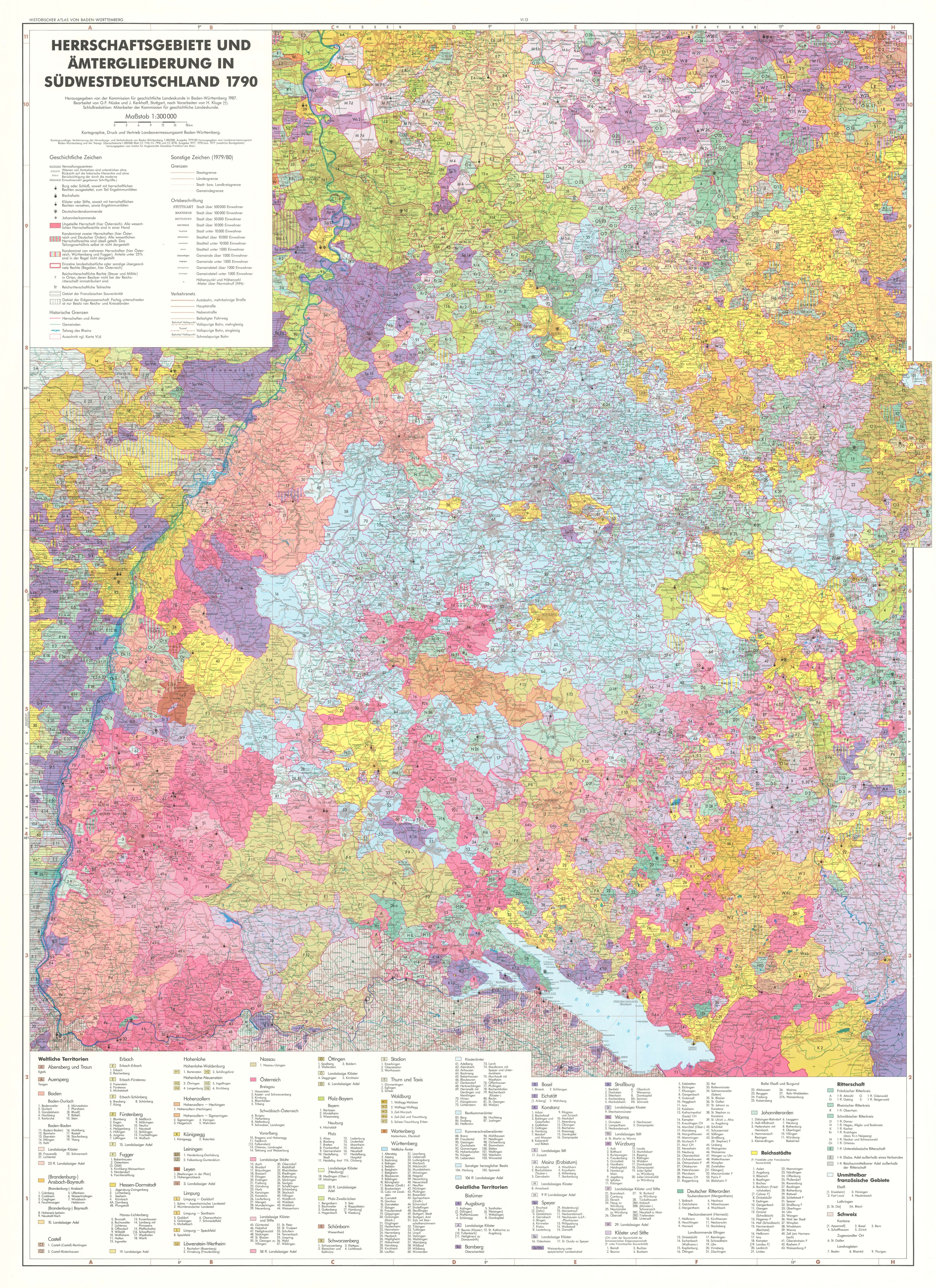
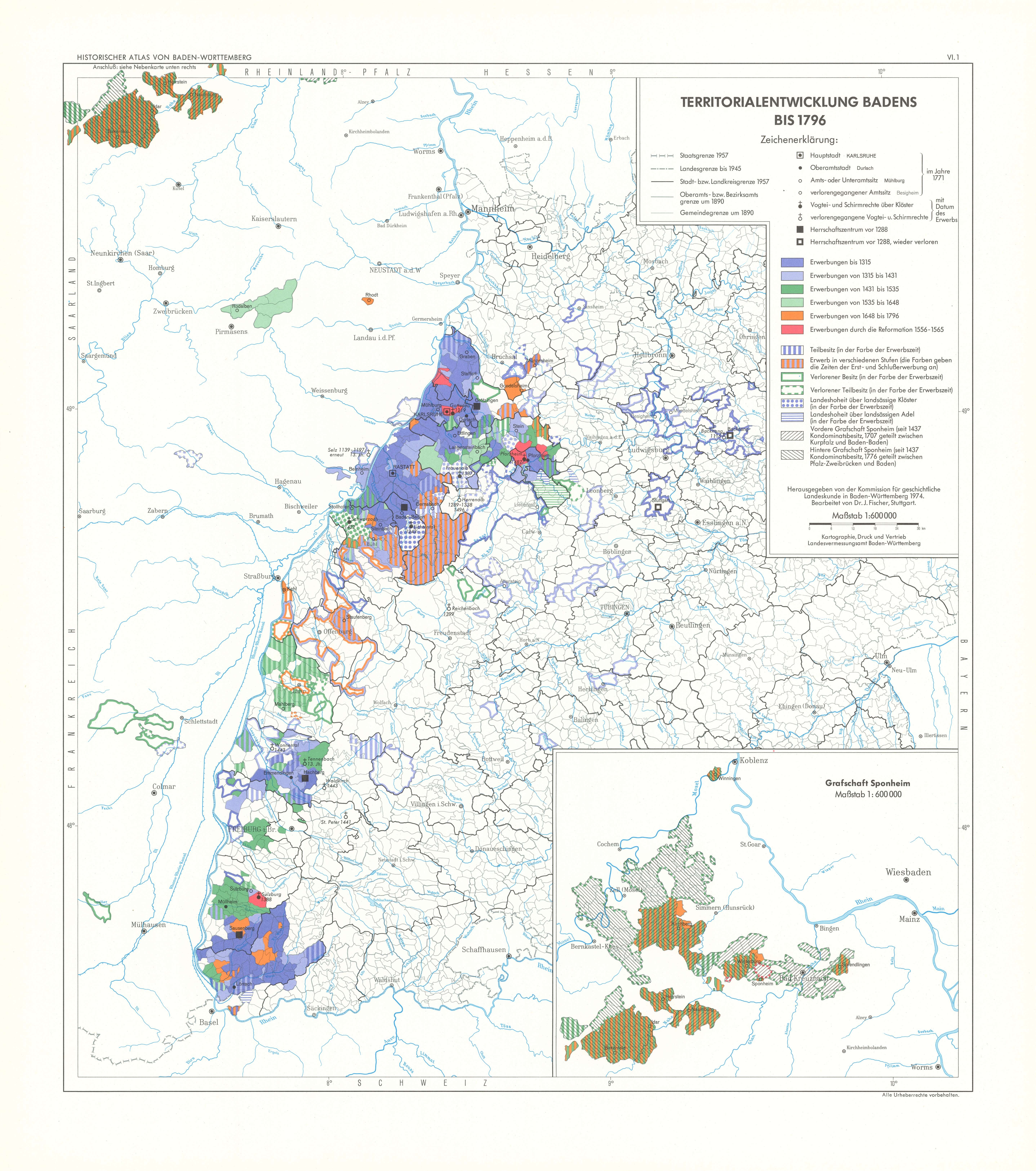
HABW_06_13.jpg (5000×6883)

The big power looming over all of them was the House of Habsburg whose ancestral home is not far in the Aargau in modern day Switzerland. This area between Freiburg and Constance was known as further Austria and the Habsburgs held on to it until Napoleon passed it wholesale to the Grand Dukes of Baden.

U.a. Vorderösterreich, heute südliches Baden-Württemberg. Maßstab 1:600.000. Repro aus: Historischer Atlas von Baden-Württemberg / / Kommission für Geschichtliche Landeskunde in Baden-Württemberg. – Stuttgart : Landesvermessungsamt Baden-Württemberg, 1972-1988, Bl. VI,4

Further up the Rhine lies the mighty city of Basel, where the great church council, the successor to the Council of Constance had just closed down in 1449. Whilst we covered the Council of Constance extensively in episodes 171 to 174, we have only touched upon the one in Basel when we came to the end of the Hussite wars in episode 183. And with good reason, Basel was not much of a success. We will certainly look at their modest efforts to sort out the decaying catholic church when we get to the season on the Reformation.

For now, we leave this free Imperial city in our rear-view mirror as we continue up the gradually narrowing Rhine, until our journey is rudely interrupted by waterfalls. These are not exactly the Niagara Falls, but at 23 meters height and a water flow of 600 cubic meters, it makes for a decent enough tourist attraction. What it also does is make the citizens of Schaffhausen rich, as we have to unload all our gear and hire local mariners to take us further.

And ever moving forward towards our next stop, Constance, we see looming on our left, the Hohentwiel, once home to the dukes of Swabia whose power had now vanished so completely. Further on, in the midst of the Untersee, the lower lake, rises the monastery of Reichenau, the place where the undisputedly most artistically significant 10th century illuminations had been produced. But now, this once rich and powerful imperial abbey that controlled the entire surrounding area had fallen on hard times and the day when the bishop of Constance took it over was not far.

There is no need to describe Constance to you, I did this before. So, after a brief rest we are now turning up north to meet the family that will soon take over the Hohentwiel and much of the land to the North, the Counts of Württemberg, soon Dukes of Württemberg and ultimately Kings of Württemberg.

The Counts of Württemberg were in almost every conceivable aspect the direct opposite to the margraves of Baden. That even begins with the family background. The margraves of Baden can trace themselves reliably back to the House of Zähringen, i.e., back to 962, and arguably even beyond. And they have the title to show for it. They became margraves as margraves of Verona in the 11th century, they had to drop Verona, but they kept the margrave. A margrave was well above a mere count, automatically a direct vassal of the emperor and hence an imperial prince.

The House of Württemberg may have had some august lineage. There are some archeological remains in their ancestral castle in Untertürckheim near Stuttgart that indicate a close link with the Salian house, Konrad the Red and then Otto of Worms, mentioned in dispatches during episodes 6 and 22.  

Schloss Wurttemberg in 1819

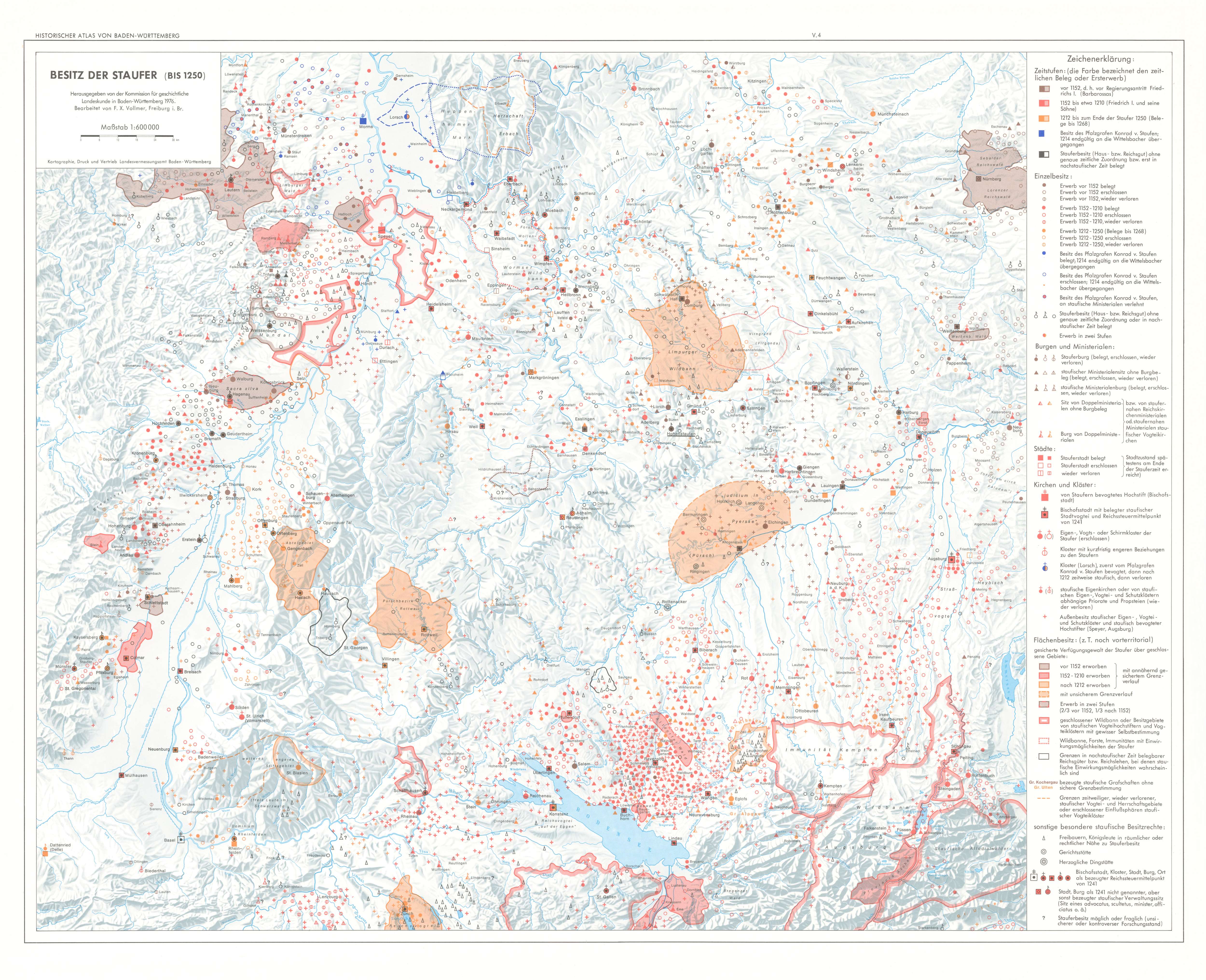
But once the Hohenstaufen had taken over the duchy of Swabia, these early Württemberger counts were kept well below the line of sight of history or may have died out altogether. I will post a map on the website which shows the possessions of the Hohenstaufen up until 1250. And that shows quite clearly that the area they were based in was Hohenstaufen heartland. The castle called Hohenstaufen was just 50km to their east, and Waiblingen, the place they named themselves after, is just on the other side of what is today Stuttgart.

HABW_05_04.jpg (5000×4063)

In other words, the Württemberger had been sucked into the imperial vortex and failed to be seen as loyal vassals worthy of sponsorship as the House of Baden had been. So, all throughout this period, they kept their head down, fortified their castle, took on some minor role in the Hohenstaufen administration and waited for their opportunity.

That opportunity came in 1245 when emperor Frederick II was excommunicated and an anti-king, Heinrich Raspe was sponsored by the pope (episode 89 following).

Ulrich I of Wurttemberg teamed up with several other Swabian nobles to take advantage of the situation. When Konrad IV, the son of emperor Frederick II went to confront Heinrich Raspe in battle, Ulrich I and his friends, all of whom had nominally been vassals of the Hohenstaufen, left the camp, leaving young Konrad hanging out to dry.

Ulrich I – drawing of his grave

Ulrich lost no time expanding his territory at the expense of King Konrad IV. It is important to understand how that worked. We are not in the modern age, where a conqueror would attack an enemy stronghold, defeat its garrison and replace it with a new garrison.

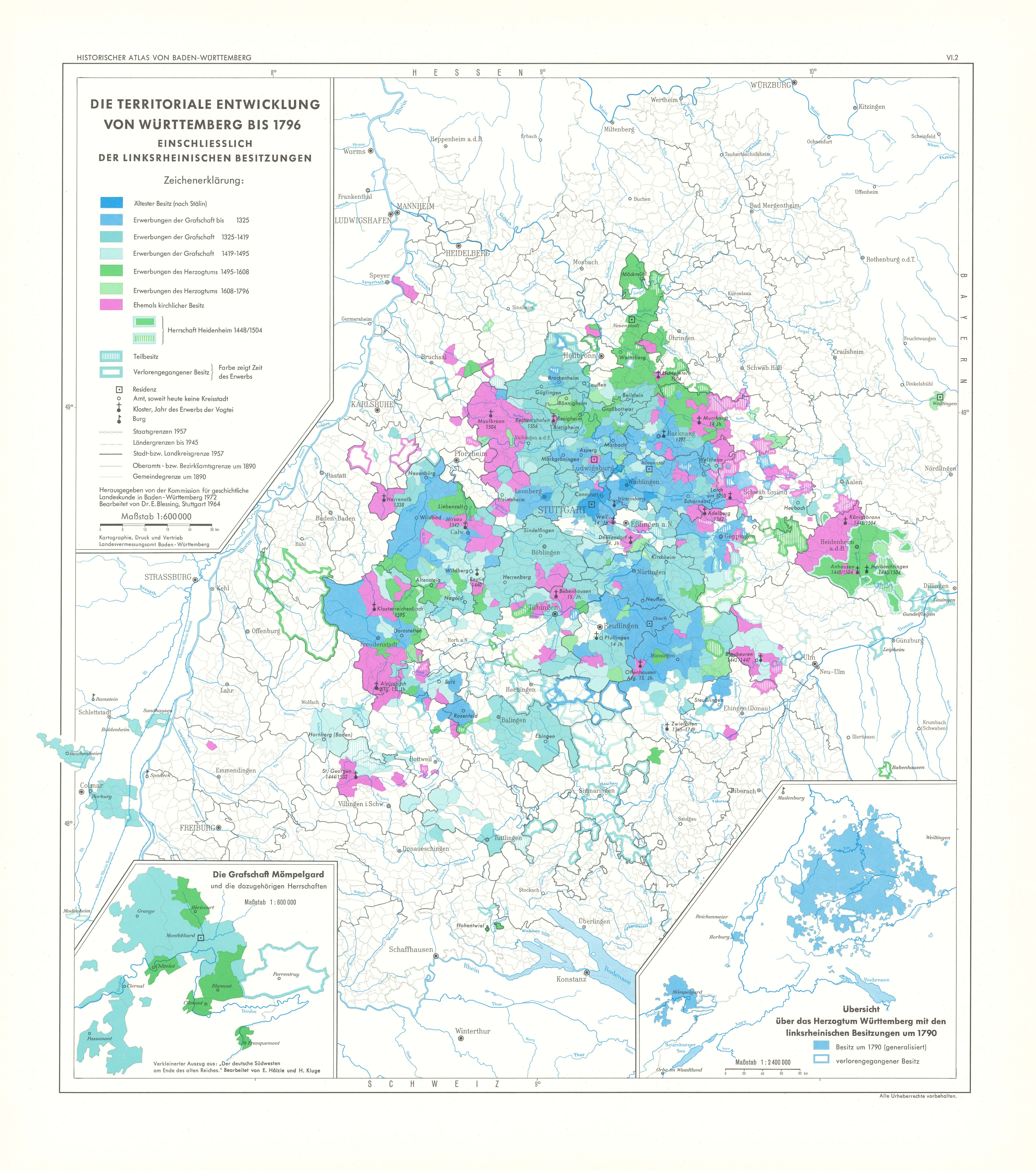
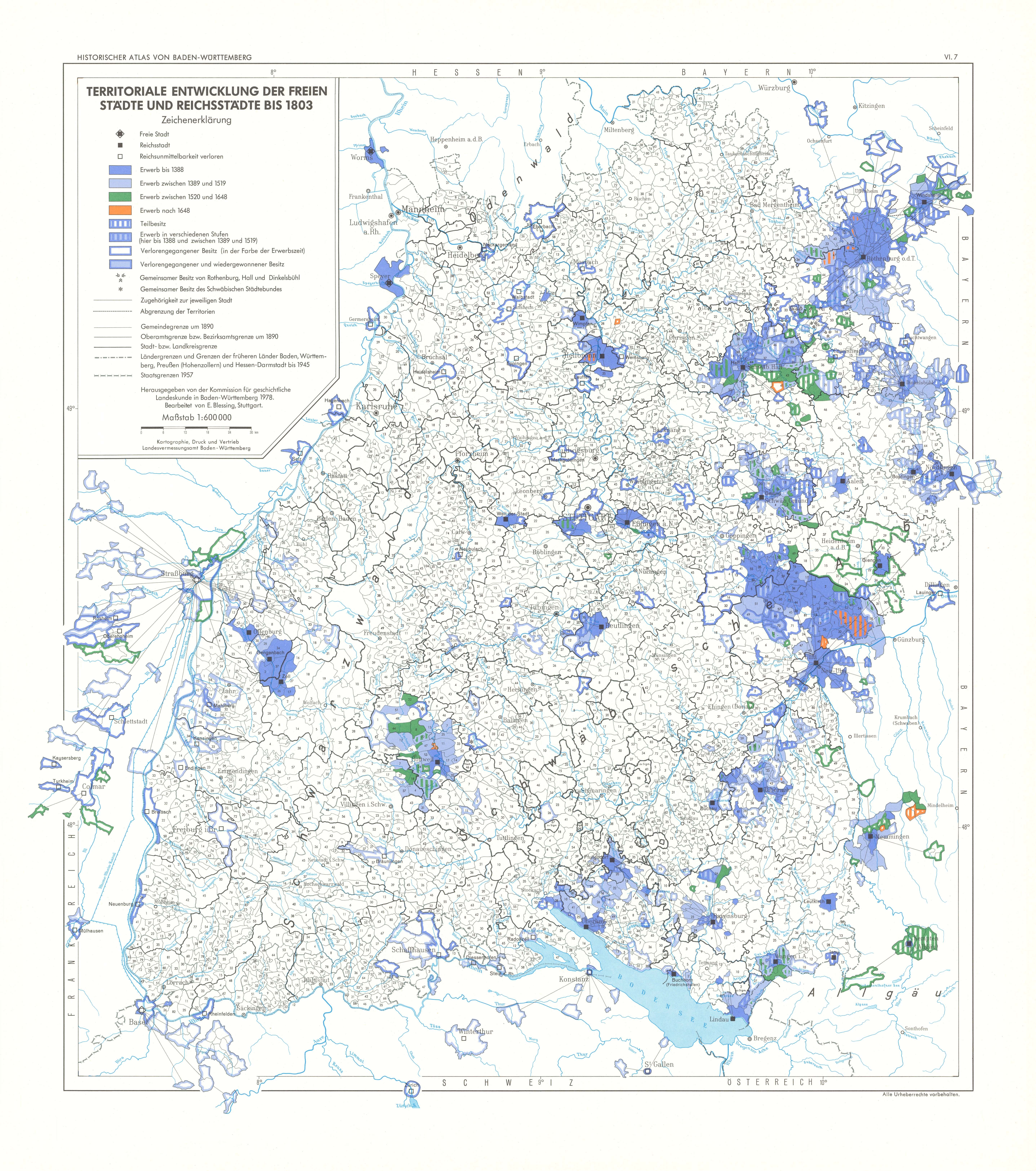
HABW_06_02.jpg (5750×6500)

In the Middle Ages, all these Hohenstaufen strongholds were held by vassals or ministeriales, not by soldiers subject to military command. Under the feudal law arrangements of the time, a vassal was supporting his lord voluntarily, based on an oath given when he received his fief. But this oath was not unconditional. It could be adjusted or even disregarded if the lord failed in his obligations.

The ministeriales were in principle unfree serfs trained in warfare, meaning they served under command, not voluntarily. But many of these families of ministeriales had been sitting on their castles for generations. They trained like knights, they lived like knights, they married like knights, and they looked like knights, so they were knights. And as knights, they too assumed they had the freedoms of vassals.

What that meant in practical terms was that any vassal or ministeriale who gets attacked, has the option to swap sides, or at least can make an argument that it was legitimate to swap sides. For most of the Hohenstaufen period few, if any, Swabian vassals and ministeriales did take the option to swap sides and join one of the many enemies of the ducal family. They knew that they could rely on support from the dense network of other vassals and ministeriales. They also knew that if they surrendered prematurely, the king or emperor may come down later and throw them out of their castle.

In 1246 this scenario changed fundamentally. First up, the Fronde of nobles led by Ulrich von Württemberg comprised many of the vassals a Hohenstaufen supporter would have expected to come to their aid in case of an attack. And then Frederick II died in 1250. His successor in the role of duke of Swabia was Konrad IV who went to Italy in 1251 never to return. The duchy was left in the tiny hands of 2-year-old Konradin. In other words, retribution for abandoning the Staufer cause became a remote risk.

That is why so many Ministeriales and Vassals opened the gates to their otherwise hard to penetrate castles to Ulrich and his friends. In this period Ulrich acquired the two main seats of the family, Stuttgart and Urach, one by marriage and the other by purchase. But most of his territory, he gained by convincing the local vassals and ministeriales to recognize him, rather than the baby duke Konradin. In 1254 Konradin, or more precisely his regents, accepted the gains he had made in exchange for recognizing Konradin as duke.

Ulrich I ruled the county of Wurttemberg for a further 11 years, until 1265 – continuously expanding his territory.

This was not the first and certainly not the last time that an ambitious man seized an opportunity to build a princely domain. But for it to become a political structure that endured in the family until 1918 and in its name until today, a couple more things are needed.

First up, you need to win the genetic lottery. And not just once and not just in one way. For the next couple of generations, the family needs to produce competent offspring. But it is not enough to have at least one competent child per generation, but that child also has to be the eldest son. And he needs to live for a very long time to make sure his successor is old enough and well trained to take over smoothly. Then that son needs to marry a woman from a family that is losing the genetic lottery, i.e., is dying out. Which puts the whole thing at risk. What happens when these less successful genes percolate within the rising family, cutting down either reproduction or competence? And then there is Mr. Mendel mixing things up anyway.

You can see how becoming a major territorial dynasty is harder than it looks. The typical staying time is around 10 to 15 generations, which is 250 to 400 years.

There is obviously not a lot that one can do about these genetic preconditions. But there are a few options that make success more likely.

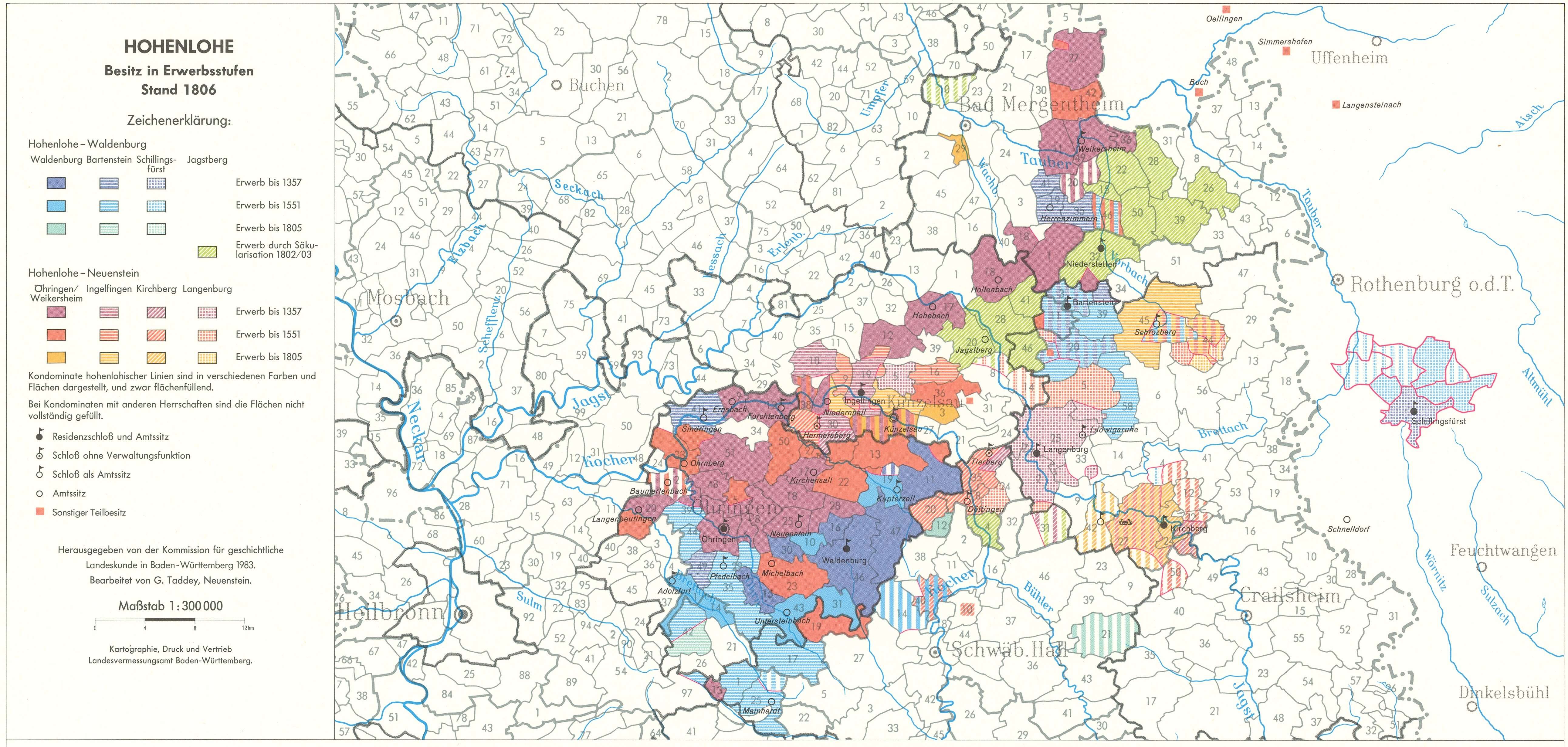
Then they set up a system that prevented the division of their territory between their sons. They signed an endless number of family compounds where they committed themselves not to split themselves into insignificance. Their northern neighbors, the counts of Hohenlohe, who had started out in a much stronger position in the 12th century, managed to cut up their territory into more and more sperate entities.

HABW_06_06_Hohenlohe.jpg (5167×2461)

You can today walk from the capital of the principality of Hohenlohe-Niederstetten to their cousin’s main residence in Hohenlohe-Weikersheim in a comfortable 90-minute stroll, and in the meantime you can spot their summer palace along the way. And if you find this too far, you can visit the princely state of Hohenlohe-Bartenstein, another cousin, in an even shorter 60-minute walk.

Niederstetten
Weikersheim
Bartenstein

The next item on the – how to become a king in the empire checklist – is choose your targets wisely. The vagaries of dynasties dying out, power balances shifting and imperial influence rising and falling, there is a huge temptation to seek acquisitions long way from home.

But that should be avoided. The most successful approach is one of block and tackle. You tackle your neighbor, capture some of his castles and lands, and then you block. Block, block, block, and then forward tackle, and again, block, block, block, block, block, block, block, block, block, block, and again tackle. And by doing that rather than jumping all across the playing field, picking up territories here and there, you end up with a contiguous piece of land that is much easier to defend. It also raises your profile amongst the other great landowners, the abbots and abbesses. They do require an advocate, a Vogt who protects them against marauding soldiers and greedy neighbors. A powerful lord who happened to be around a lot is a great choice as Vogt.

So, how did the Württemberger do?

First up, they mostly lived and ruled for a very long time. Ulrich I – 24 years, his successor, Ulrich II – 14 years, Eberhard I – 46 years, Ulrich III – 19 years, Eberhard II: 53 years and Eberhard III – 25 years. That is pretty impressive. But what is even more impressive is that they were all pretty competent.

They established primogeniture very much from the days of Ulrich I. There were situations where younger brothers wanted a division of the territory, but for now that could be avoided.

Then the Württemberger either deliberately or by chance placed hardly any of their male offspring into church roles. So, if an older brother got knocked out in the game of whack-a-mole, the younger one and his sons could take over.

As for the game of block and tackle, they did well, at least in their core territory. Their lands became a coherent block around the cities of Stuttgart, Tübingen and Urach. They even built a defensive border against the Palatinate, the Württembergische Landgraben. Border defenses were rare since lands were usually too fragmented for such efforts to make sense. They existed around major free Imperial cities like Rothenburg ob der Tauber and Schwäbisch Hall, but rarely around princely territories. This wall also acted as a customs barrier, which was one of the count’s most important sources of funds.

From the late 13th and then again in the late 14th century their progress south ran into an even larger and even more coherent political entity, the house of Habsburg.

With the north blocked by the Palatinate and the east by the Bavarians, they looked west, leapfrogging the Badenian cousins and digging into Alsace. Lorraine too came into view, until in 1397 count Eberhard IV married Henrietta, sole heiress of the county of Mömpelgard, or Montbéliard.

That territory, between Besancon and Mulhouse had once been part of the kingdom of Burgundy and therefore part of the Holy Roman Empire. By 1397, when the House of Württemberg took it over, it was half imperial and half subject to the Dukes of Burgundy, causing no end of complications. Montbéliard will remain under Württemberg control until the French Revolution.

If this was the first deviation from the game plan for total domination, things got derailed further when the family no longer won the genetic lottery. Yes, there was still at least one extraordinarily competent heir to come, but what was needed is consistency. Not every one of them had to be a genius living until he was sixty. It is more important to keep the babies and buffoons to a minimum. Spoiler alert – lots of babies and buffoons coming up.

The calamities started with the early death of Eberhard IV, the husband of Henriette of Mömpelgard. Their sons were both minors, so Henrietta led a regency government that was dominated by the local nobility. Once her sons had grown up, they proceeded to split the territory into two, one centered on Urach, one centered on Stuttgart.

Count Ulrich V of Wurttemberg-Stuttgart is the same one we met last week, the one who was defeated in single combat at the battle of Seckenheim. Following this misadventure, Ulrich V and his state were essentially bankrupt but at least not dead.

Ulrich V der bVielgeliebte (the much loved)

His brother Ludwig II lasted 9 years as the sole ruler of his half of Württemberg. Then he died leaving behind two sons who were minors. So, regency fell to his wife, Mechthild of the Palatinate, the sister of our friend Friedrich der Siegreiche and driving force between the foundation of Freiburg and Tübingen university. In 1453 her eldest son reached maturity. But since he suffered from epilepsy, he was considered unable to rule. So, the regency continued.

In this vacuum of an incapacitated ruler in Urach and a bankrupt one in Stuttgart stepped Friedrich der Siegreiche. He exerted influence through his sister, the regent in Urach and through his financial hold over the bankrupt Ulrich V. Württemberg was again at risk of being sucked into the vortex of a more powerful state, this time the Palatinate.

Cometh the time, cometh the Landtag. At this crucial point it is not a man or woman that gets up to protect the independence of Württemberg, it is an institution. And this institution is the Landtag, the estates of Wurttemberg.

To explain, we have to look at one more criterion for a successful territorial state, the sense of communal purpose, or you can call it territorial nationalism. In principle a territorial state is nothing other than a collection of properties that happen to be under the control of one person. But as these territories developed, some rulers managed to instill a sense of belonging to their territory. Much of that came into being during the 14th and 15 century and it lasts until today. Germans who identify as Hessen, Badener, Sachsen, Hannoveraner or Preussen are referencing a territory created not by geography, ethnology or ancient culture, but a random collection of lands owned by a single family. And it is a strong sentiment. My grandfather, who was from Baden would every year celebrate the battle of Königgraetz in 1866 as the last day you were legally allowed to shoot at Prussians.

And Württemberg was one of the territories that developed such a sense of belonging and territorialism earlier and stronger than many others. That was in part a function of the contiguous territory.

It had also something to do with the interior structure of Württemberg. Other than their neighbors in Baden, the Württemberger liked to have cities. They liked the economic power they brought. And since most of their income came from customs stations along the main North-South trading route from Italy to the Rhine, they had an interest in their prosperity.

Many of these cities had become free imperial cities after the Hohenstaufen had fallen. So, to incorporate them into Württemberg over time, the counts waged war against them. Where they succeeded, the peace settlement often included the right of the cities to participate in the state decisions. So, from 1316 onwards we know that 8 cities sent their delegates to the Landtag, the meeting of the estates of Württemberg to “advise and support the count”.

HABW_06_07.jpg (5750×6500)

The strategy towards the nobility was the opposite. The counts tried at any time to suppress them, to force them to become subjects rather than vassals, and where that failed, left them outside the operation of the state.

The Landtag became the glue that kept Württemberg together during this period when the land was divided between the two lines and ruled by ineffective counts.

And they really stepped into the limelight in 1457 when the epileptic count Ludwig II of Württemberg-Urach died. His younger brother Eberhard V was now count, but only 12 years old. His uncle Ulrich V of the Stuttgart branch became his guardian and de factor ruler of the combined entity. But in reality, he was a puppet of Friedrich of the Palatinate. And if you remember the episode on the Palatinate, such a scenario could easily end in the sudden demise of young Eberhard V and a takeover of Württemberg first by Ulrich V and then by the Palatinate.

To push back the Palatinate, the Landtag staged a coup. Against the wishes of his guardian, the representatives of the cities declared Eberhard V of age. Ulrich failed to raise the resources to suppress the Landtag and had to withdraw.

Eberhard V called im Barte turned out to be one of the most competent of the family. He fostered economic activity, founded the university of Tübingen, married an immensely rich Italian heiress and reformed the bureaucracy. On the negative side of his accounts stood the expulsion and arrest of the Jews in Württemberg.

His main objective was to reverse the division of the territory. In 1482 he achieved that by making a deal with the son of Ulrich V and heir to the Stuttgart branch. The two territories would be rejoined. The childless Eberhard im Barte would run it until his death and afterwards the whole would go to the son of Ulrich, called Eberhard the younger. Under Eberhard im Barte Württemberg reached an extent and wealth that not only rivalled but superseded many duchies. So, in 1495, Eberhard im Barte was elevated from count to duke, and with that the duchy of Württemberg was born. The duchy was made indivisible, and succession was based on strict primogeniture.

And within the duchy the Landtag, the Estates of Wurttemberg gained an important role. They were consulted on decisions over war and peace, and most importantly they held the right to approve new taxes. They were even granted the right to resist the duke in case he breached any to the arrangements.

In terms of membership, there were 14 abbots of the main monasteries, 30 knights and nobles and 120 representatives of the cities. The voting was not by estate, so the prelates, the nobles and the commoners each have one vote, but by all representatives together. That and the unwillingness of nobles and abbots to pay taxes shifted the power in the assembly towards the commoners, mainly patricians in the cities.

Eberhard im Barte died in 1496 a year after the creation of the duchy. His heir was, as agreed, Eberhard the younger, the son of Ulrich V. This Eberhard was no longer younger, he was in fact already an old man, 49 years, when he took over. When he had handed over control of his share of the duchy to Eberhard im Barte he had not only gained the right to inherit the whole but also a generous annual pension. Free from dealing with boring admin tasks he went travelling, picking up expensive habits at the courts of France and Burgundy.

When he took over in 1496, he was remarkably ill-suited for the management of a complex duchy in the crossfire of Habsburg and princely interests. And given his love of bling, he almost instantly clashed with the Estates, the Landtag.

He demanded more money, for his court, his mistresses and an army. The Landtag refused. Words were had, and then, in a completely unprecedented move, the Landtag deposed the duke Eberhard II of Württemberg. The state apparatus, the councilors, administrators, bureaucrats and armed forces agreed. Eberhard II fled to Ulm, appealed to the emperor to put this rebellious rubble under the interdict. The emperor responded by siding with the Landtag and installing a new duke, Ulrich I, who was, again, a minor. But instead of having a regency council made up of nobles, it was a government made up of members of the Landtag, some prelates and nobles but manly commoners who ruled the duchy until young Ulrich was 16.

Ulrich started out as a great hero, gaining victories in the War of the Landshut Succession in 1504 that restored all the losses the duchy had sustained during the Mainzer Stiftsfehde.

Armour of Ulrich I, duke of Wurttemberg

But things then gradually went sideways. Ulrich, like many Renaissance princes, enjoyed the good life and felt compelled to show off. His spending on feasts and feuds drained the coffers of the state. In 1513, he had to give major concessions to the Landtag to get them to approve another tax.

This tax then triggered a revolt. This revolt, called the revolt of the poor Konrad, spread like wildfire across the land of Württemberg. To suppress it, he had to again seek help from the Landtag. By then a subsection of the Landtag, a group of roughly sixty interconnected patrician families had formed an association they called the Ehrbarkeit, best translated as the Honorables.

The Ehrbarkeit was willing to bear the cost of the military campaign and pay off all the duke’s debts, in exchange for some massive concessions. On July 8, 1514, duke Ulrich signed the Tübinger Vertrag, the Magna Carta of Swabia. In it he guaranteed the Landtag’s rights to decide taxes. They were given influence on decisions over war and peace, and they could refuse the sale of any ducal territory. Citizens of Württemberg were given the right to due process, and the right to emigrate.

Ulrich did one more thing to cement the new order. In 1515 he went out hunting with his equerry Hans von Hutten. Von Hutten had married one of Ulrich’s mistresses. And when the duke demanded that Hutten would take a back seat in the marriage, Hutten refused. Hutten resigned his role as equerry and planned to leave Stuttgart with his wife. Ulrich invited him to come on one last hunting trip to reconcile their differences. Hutten could not refuse and arrived in light hunting gear, whilst the duke showed up in full armour. Once they reached the forest, the duke sent away his staff and then went after von Hutten. He chased him around a tree, striking him with his sword seven times, five of which in the back. Then he strung him up with his own belt.

That was the scandal that broke the camel’s back. 18 of his vassals revoked their oaths, his wife left him. Hutten’s family sued him in the imperial courts. The poet Ulrich von Hutten, a cousin of the victim, wrote immensely powerful satirical pamphlets about the duke. Ulrich was placed under the imperial ban, and in 1519 the Swabian League invaded Württemberg and duke Ulrich had to flee into exile. He stayed there until he was restored by force of arms in 1534. For 15 years the duchy was again ruled by the Landtag, led by commoners, members of the Ehrbarkeit. When Ulrich returned, he had to confirm the rights of the Landtag and the Ehrbarkeit.

A political structure with a duke constrained by the tax raising authority of the estates was not that unusual. Most territorial states had these. So did in fact France and obviously England.

Where Württemberg differed was a) in the composition of the estates, i.e., being dominated not by the nobility, but by the cities and even at some point peasants and ordinary people, b) in the fact that it retained full control over taxation even during a time when most others succumbed to absolutism. And c) it differed in the sense that it granted rights directly to ordinary citizens.

The rest of Württemberg’s history, which I am sure we will touch upon as we go through the next few centuries were dominated by the conflict between duke and Ehrbarkeit. Dukes tried to suppress it or get past it through imaginative financial shenanigans, but in the end all of these attempts failed. The Landtag and within it the power of the Ehrbarkeit stayed on, until 1805.

Which gets me to the third topic for today. We talked about what it takes for somewhat obscure nobles to become important imperial princes, we talked about how a territory developed its own identity and political structure beyond being just a collection of rights in the hand of one man. And finally, we are now going to talk about the reasons for the economic success of Württemberg.

If you ask any Brit to name a German city other than Berlin or Munich, Stuttgart comes up fairly often. Which is odd, because neither the clubbing scene nor the Christmas markets are much different to the rest of the country. The Cannstatter Wasen may be almost as old and almost as large as the Octoberfest, but few people outside Germany, arguably outside Swabia, have heard of it.

The reason Baden-Württemberg is so well known is the extraordinary cluster of high-end manufacturing in the place. Porsche, Mercedes Benz, Bosch, ZF Friedrichshafen, SAP, Heckler & Koch as well as dozens and dozens of engineering and technology companies are based here. Why there are there today is self-evident. There is a skilled workforce, some excellent technical universities, physical infrastructure and suppliers of key components nearby. The companies are competing fiercely against each other, spurning each other to become better and better, whilst serving a customer base that demands to drive safely at 130 miles around corners.

But the question remains, why did they come here? Yes, Benz patented the first Motorcar in Ladenburg near Mannheim and Gottlieb Daimler together with Wilhelm Maybach created effective engines and later motor cars in Stuttgart. Ferdinand Porsche had worked at Daimler in Stuttgart before he set up his own firm in the city.

But inventor’s personal affinity to a location is rarely enough for industry clusters to emerge.

If you look at the early industrial centres in europe, they are often driven by natural resources, water energy in the English Midlands, coal and iron ore in the Ruhr, Wallonia and Lorraine. Mining in particular can be a catalyst, as it had been in the Ore mountains, in Saxony and Thuringia. And that is not just because of the material they dig up, but also the technologies required bring about specialisations and skills that can be deployed elsewhere. Neither Baden nor Württemberg had much, if any coal, mining or came in early enough to take advantage of water-based energy.

Another driver can be capital. Large cities tended to be places full of rich people, some of whom were willing to support entrepreneurs. So, you find industry springing up in Cologne or Berlin. But Stuttgart, Mannheim, Heidelberg and Karlsruhe were all mid-sized towns, not metropolis full of venture capitalists.

What the region could call upon were the universities, not just the old foundations in Heidelberg, Freiburg and Tübingen but also the technical universities in Karlsruhe, founded in 1825 and Stuttgart founded in 1829.

The Tübinger Vertrag had guaranteed due process since 1514, and the rule of law was further strengthened in the comparatively liberal constitutions of the post Napoleonic period. As we talked about before, the rule of law is an important facilitator of economic growth, reassuring investors that they can get their money back and entrepreneurs that they will be benefitting from the fruits of their labours.

Some argue the fact that Baden and Württemberg were mid-sized state made careers in politics and military unattractive. Ambitious people who wanted to change the world would not find a large enough stage in Karlsruhe or Stuttgart. Hence, they directed their efforts into areas like science and engineering where territorial borders are largely irrelevant.

And finally, we have or may have another major contributor to the success story, one very close to my heart – wine. If you compare maps of ancient wine growing regions and areas of technological innovation in Baden- Württemberg, you see a very clearly discernible overlap.

This triggered two scholars, Thilo Huning and Fabian Wahl, from the universities of York and Vienna to investigate why that may be the case. They produced a paper just 2 months ago, arguing that winegrowing had a material impact on modern economic development in Baden-Württemberg.

I will put a link to the article in the show notes for this episode, but here is what I understand to be their line of argument:

The first point is that in areas where wine was grown, the tradition of sharing inheritance equally could be retained. We should remember that parents have always tried to love each of their children equally and that leaving all the assets to just one on the grounds of seniority and gender is unnatural. This idea is only adopted out of necessity. So, in regions where productivity per acre is low and hence dividing the farm between several children would make each of them unviable, that is where primogeniture takes hold. Henry the Fowler introduced primogeniture in the kingdom of East Francia not out of spite for his younger son, but in order to preserve the viability of his state. The same goes for the counts and dukes of Württemberg.

In the winegrowing areas of Baden and Württemberg we find mostly equal inheritance rights. The issue with winegrowing is that it is extremely labour intensive, seven to eight times greater relative to grains. And wage labour is fairly scarce in the wine industry because vines can be easily and permanently damaged if the pruning, ploughing, and hoeing operations are badly carried out. Hence these had to be family businesses. Moreover, wine is as much about quality as it is about volume, meaning that relatively small plots, if well-tended, can sustain a family. Which in turn means, there is less need to establish primogeniture, forcing younger siblings to fight for themselves.

The labour intensity and egalitarian inheritance rules resulted in a higher population density in wine-growing areas at the dawn of industrialisation. This provided the necessary excess labour force, that was also flexible enough to go back to the vineyard when an entrepreneurial venture had failed.

As an aside, wine was also a very expensive commodity, allowing merchants in the wine-trading cities to make huge profits and build up significant capital. That capital could then be mobilized as venture capital.

Available flexible labour and capital are important factors, but there is something else wine-growing areas benefit from.

Winegrowing is a gamble, creating the need to share the risks. You have a perennial plant that takes decades to reach top quality production, meaning you have no flexibility in terms of crop. If climate changes or markets shift, you cannot nilly willy replace vines with rye. So, when times are tough, you have to take it on the chin. But since your neighbours go through the same hardship, wine-growing villages developed a closer sense of community and an ethos of mutual support.

And that also manifests in the good days. Whilst growing grapes itself is not capital intensive, a wine press, the barrels and cellars are. Wine growers have always and still often do share these costs in the form of collectives. This requires co-ordination, compromise and the development of trust between the members of the society.

In other words, in wine growing areas society is more collectivists, a place where people are willing to co-operate and share resources, both in good and in bad times.

These attributes create trust in individuals and in the community as a whole. Trust is one of the most valuable commodities. When trust is absent, society wastes valuable resources on verification, monitoring, and enforcement mechanisms that could otherwise be directed toward productive activities. All these costs fall away when people trust each other, making the allocation of resources much more efficient. The world bank estimates that 60-80% of the wealth of developed nations is made up of social and institutional capital, i.e., in the trust that individuals and institutions are broadly acting fairly. Now that figure is heavily disputed, but it is not a long shot to believe that a tradition of working collectively and supporting each other makes challenges easier to overcome and saves tons of money on lawyers, forensic accountants, party donations and lobbyists.

Our two scholars, Thilo Huning and Fabian Wahl, are scientists. They deal in facts, not beliefs. So, they measured the correlation between wine growing and economic activity in Baden-Württemberg down to the level of the individual municipality. They collected data on wine growing in the 9th and 17th century as well as at meteorological conditions and compared those to population density, density of firms, nighttime luminosity, distribution of rare given names and various control variables.

Can Winegrowing Cause Rural Development? Evidence from Baden-Württemberg | European Review of Economic History | Oxford Academic

I am not very good with the Greeks they come up with, but their conclusion is quote: “This study underscores the role of wine in the shaping of modern Southwest Germany.”

Bingo. So, if you want to lay the foundations of economic growth in a wine-growing area of your choice, get yourself a few bottles and bask in the glow of general goodness. You get the same feeling by the way if you sign up on historyofthegermans.com/support.

And with that, see you next week.

The rise from minor principality to Grand Duchy

What is it like to be a prince? Well, not quite what it is set out to be, in particular when you are a smaller prince, not in stature, but in land.

The margraves of Baden are such princes. In the 15th century their main territory, a slither of South-West Germany, just 60km long was too small to play on the European, even on the German stage, but too big to escape the need of massive palaces and warfare.

What makes Baden so fascinating is that despite its handicap, it managed to become a medium sized state, one half of Baden-Württemberg. The way there was a long one, involving friendship and loyalty to the death, piratical princesses, alchemy, someone called the Türkenlouis, a sun-shaped city and some skilled diplomacy.

Listen on Spotify

Listen on Apple Podcast

Listen on YouTube

Transcript

Hello and welcome to  the History of the Germans: Episode 191 – The Margraviate of Baden, also episode 7 of season 10 – The Empire in the 15th Century

What is it like to be a prince? Well, not quite what it is set out to be, in particular when you are a smaller prince, not in stature, but in land.

The margraves of Baden are such princes. In the 15th century their main territory, a slither of South-West Germany, just 60km long was too small to play on the European, even on the German stage, but too big to escape the need of massive palaces and warfare.

What makes Baden so fascinating is that despite its handicap, it managed to become a medium sized state, one half of Baden-Württemberg. The way there was a long one, involving friendship and loyalty to the death, piratical princesses, alchemy, someone called the Türkenlouis, a sun-shaped city and some skilled diplomacy.

But before we start the usual plea for support. Making this show has gone from being a hobby and side hustle to being my obsession and even main occupation. If I want to keep it up and avoid having to set up an additional income stream from piracy, I need your support. There are various options on historyofthegermans.com/support to protect shipping in the English Channel. Special thanks from the Coastguard go to John S., Brian – Gutenberg’s apprentice, Sasha Sirota,  Elliot W. J., Michael Dane from Australia, Conor G., Charlie J. and Zachary Levine. By the way, if you are a supporter and you want your full name read out or me saying something silly, send me a note.

And with that, back to the show

After last week’s detour into the history of the German universities, we now alternate back to our journey through the Holy Roman Empire in the 15th century. We are travelling back down to where Mannheim does not yet exist and resume our journey up the Rhine River towards Basle.

As we do this, we are entering one of the most fragmented parts of this ancient political structure that had once been the stem duchy of Swabia, one of only 5 duchies that existed in Henry the Fowler’s kingdom of East Francia.

In the 500 years since Henry’s reign, the duchy of Swabia had been divided into smaller and smaller principalities.

The first time in the 12th century when it broke up into three entities, the Hohenstaufen duchy of Swabia, the duchy of Zähringen in the Southwest and the lands of the Welf in the East.

Frederick Barbarossa and his successors consolidated the Welfish and the Hohenstaufen lands and penetrated the territory with castles and cities. In 1218 the Zähringen dukes died out and their vast territory was distributed amongst the mighty cities like Zurich, Berne and Basle, the Habsburgs and various offshoots of their own family as well as their vassals.

The next atomization happened when in 1268 the House of Hohenstaufen fell under the executioner’s axe.

And as in the case of the Zähringer, it was the cities, the Habsburgs and a brace of more or less powerful counts who seized what had once been the power base of the emperors of the High Middle Ages. In 1521 the imperial constitution recognized 101 different princes, cities and immediate lords in Swabia, more than in any other of the imperial circles.

These 101 territories varied dramatically in size and economic power. The dukes of Württemberg were by far the biggest, accounting for about a quarter of the population, followed by the Margraves of Baden with 8% and the bishopric of Augsburg with 4%, and everybody else was even smaller than that, with the abbey of Heggbach with 600 inhabitants bringing up the back.

Which gets us to the question, how did this work? What room to act did you have as one of these entities? What were sensible policies to follow? How do you come out on top?

There are several ways to approach this issue. One would be to follow chronologically every move of every one of these players, shuffling villages and abbeys back and forth to trace the growth or contraction of each of these territories. This is what I did in my first draft of this episode. But then I read the following sentence out loud: “it is highly likely that even before Rudolf I’s marriage to Kunigunde von Eberstein, property belonging to this family, which had risen from a noble rank and was mainly based on fiefs from Speyer and the inheritance of the Counts of Lauffen, came to Baden. Rudolf also acquired Liebenzell and Alteberstein, today’s Ebersteinburg.”. And that is when I realised that there are various ways of getting rid of listeners, even such loyal listeners as yourselves. 35 minutes of that kind of stuff, and I will be all alone shouting into the podcast ether.

So, I came up with another idea.

We did know who came out tops, the dukes of Württemberg and the Margraves of Baden, because the state is now called Baden-Württemberg. And whilst the dukes of Württemberg are a fascinating subject, the rise of the margraves of Baden was a lot steeper, meaning we may be able to learn more from them.

And we will not go through all the acquisitions and divestments that got them there. That would sound like reading the land registry out loud. If that is of interest, there is a great map available on a website called LEO-BW that shows the territorial expansion of the margraviate of Baden up until 1796. I have put a copy of it in the Maps section of the historyofthegermans.com website, the episode artwork and in the transcript to this episode for you to look at. That should cover this, leaving us with a lot of room to discuss potential strategies for success.

Economic development

The first thing a prince could do is also the most sensible thing to do, he could develop the economy of his territory.

And the margraves of Baden could look to a very successful set of precedents in their own family. They were one of the cadet branches of the dukes of Zähringen. The Zähringer ruled a territory in what is today Switzerland as well as the furthest South West corner of Germany. There they founded important cities, namely Berne, Freiburg in Germany and Fribourg in Switzerland and promoted the growth of Zurich, Murten, Burgdorf, Offenburg, Villingen Schaffhausen and many others.

However, their descendants in Baden were not that interested in the foundation of cities. That may be down to the fact that these cities had a habit of asserting their independence once their economy got going. Mainz, Worms Speyer and the mighty Strasburg all had thrown out their bishops, whilst Freiburg, ungrateful as it was, had kicked out their local count and put themselves under the protection of the Habsburgs.

There was an established opinion that the margraves of Baden had founded Stuttgart in 1219. They did own the stud farm that gave the city its name for a while, but that does not mean they founded a city there. No evidence of a foundation has been found and the originator of that thesis has become subject of some controversy. It would have been so deliciously ironic if that had been true, but probably isn’t.

As a consequence, the margraviate featured just one urban settlement, Pforzheim, which in the 15th century was one of the main residences of the margraves. Pforzheim is today best known as a centre for jewellery and watchmaking. But that only came about when in 1767 the margrave established  a jewellery and watch manufacture in an orphanage. Most of the period between the 15th century and 1767, the city was left to fend for itself.

Then there is the Weinordnung of 1495, that prohibited the dilution of wine with all kinds of cheap ciders and fruit alcohol and established fines for the use of sugar, sulphur and poisonous substances. A Reinheitsgebot before the more famous beer purity law of 1516. The margraves claim it was the first of its kind, but there was already an imperial order in 1487 and the more meaningful imperial regulation that came in 1498.

Loyalty

If the House of Baden was not hugely successful in promoting economic activity, there was one thing they were excelling at – loyalty, specifically loyalty to the House of Hohenstaufen. The idea being that loyal vassals were rewarded with more fiefs and could expect favourable imperial court decisions in the regular disputes with neighbours and cousins.

They were there right from the word go! Margrave Hermann III fought with Konrad of Hohenstaufen in his civil war against emperor Lothar III and followed him on the ill-fated second crusade. His son, Margrave Hermann IV accompanied Barbarossa to Italy, fought with him before Milan and at the catastrophic battle of Legnano. He too came along on an ill-fated crusade, the third one, where he also died. The next margrave, Hermann V fought for Philipp of Swabia in these civil wars and joined the Frederick II when he showed up at Constance in 1212.

But the title of most loyal and most romantic of paladins must go to margrave Friedrich I. Barely 18 he followed his best friend and liege lord, Konradin, duke of Swabia and grandson of Frederick II to Southern Italy. Beaten at the battle of Tagliacozzo in 1268 they were imprisoned together in the Castello de Ovo in Naples. Legend has it that the two friends were playing chess when they were told that the king of Sicily had condemned them both to death. They heard the message, looked at each, and resumed their game. This whole story, including this scene became a bit of a cornerstone of German national mythology which also developed some rather unexpected homoerotic undertones. Tischbein painted the scene in 1784. Look at the picture, and you will get what I mean. 

[Bildindex der Kunst und Architektur]

So, was it worth it? Well, the last bit that ended with young Friedrich decapitated on the market square of Naples certainly did not. But on the other hand, it could have been the by far most rewarding bet in medieval history. Because Friedrich was not only the heir to the margraviate of Baden, he was also the grandson of the last Babenberger duke of Austria, aka, the golden boy in Tischbein’s picture was in play to become duke of Austria. He did not have the cards though; king Ottokar of Bohemia had already occupied the duchy. But if Konradin had succeeded in Sicily and then returned to the empire like his grandfather had done, thrown out Richard of Cornwall and been crowned King of the Romans, well then the new king would have supported his best mate’s claim on Austria. And if that had happened, then it would have been bye-bye Habsburg and all hail the Badenian emperors.

Ok, that did not work out and instead of world domination, we have a tragic tale of friendship and chivalry. But that does not mean  that a century of loyalty had gone unrewarded.  The core of the Baden lands, that stretch on the eastern shore of the Rhine from Bruchsal to Baden-Baden was at least in large part given in compensation for services rendered. They also were able to expand their traditional homeland way upriver between Freiburg and Basle, the area still called the Markgräflerland, and they acquired the county of Sponheim, quite a way further north, along the Nahe River.

When the Hohenstaufen fell, the margraves of Baden took over much of what they had held on behalf of the imperial family as their own and added a few bits and pieces, though they were nowhere near as successful in this grab and run as the Habsburgs or Württembergers had been.

Military prowess

So loyalty, sort of tick, but not a huge one. They did all right, but not massively so. Hence, if you cannot get it by charm, can you get it by force of arms?

Well, they tried, once, in 1462 in a conflict that involved almost everyone we have met so far. What I am talking about is – of course – the Mainzer Stiftsfehde.

I have mentioned it several times before, but there was no point in trying to describe it unless we have all the protagonists around the table. That we do now, so here it goes.

On May 6th, 1459 the archbishop of Mainz, Dietrich Schenk von Erbach passed away. He had led the archdiocese for 25 years, 25 years during which they lost again lands and rights to the landgraves of Hesse who had now pushed through Mainz territory almost all the way to the gates of Frankfurt. 

When the cathedral chapter proceeded to elect a new archbishop, two candidates were put up, Diether von Isenburg and Adolf von Nassau. Diether von Isenburg gained the upper hand, 4 against 3 votes. He then asked the pope, who was – drumroll – Pius II, formerly Aeneas Silvio Piccolomini, author of fruity prose, friend of the podcast, but also now a conservative hardliner. Piccolomini demanded that Isenburg submits to him, not only as it concerned his activity as shepherd of his sizeable flock, but also in his role as Prince Elector. Isenburg remained non-committal, but Pius II thought he had won and gave him the pallium together with a bill for 10,000 gulden, twice the usual papal tax on newly appointed bishops.

Diether von isenburg

That payment became the crunch point. After his predecessors had lost so much of Mainz territory and income,  the new archbishop did not have the money for the standard fee, let alone a double fee.

It also did not help that another papal condition was that he should wage war against the count Palatine. That Isenburg did, not realising that his opponent was none other than Friedrich der Siegreiche, Frederick the Victorious, who was, well, victorious.

That lost battle further reduced the resources of the archbishopric. Which is why Isenburg now outright refused to pay the papal fee. At which point Pius II deposed him and promoted his erstwhile rival, Adolf von Nassau to the archepiscopal throne.

Adolf II von Nassau

Great result. We now have again two contenders for the most senior prince electorship in the empire, a principality that was already in trouble. So the sharks start circling.

Isenburg secured the support from the city of Mainz, and in an interesting 180 degree shift, the help of his erstwhile enemy, Friedrich der Siegreiche of the Palatinate. Friedrich’s change of allegiance had not come out of a deep conviction on points of canon law, as you can imagine but was brought about by the promise of valuable archepiscopal territory, namely Lorsch and Heppenheim.

Meanwhile Adolf von Nassau too is busy offering generous rewards to nobles willing to support his cause. He was particularly successful amongst the neighbours of Friedrich who feared the continued strengthening of the Palatinate. Duke Ulrich V of Wurttemberg signed up, the bishop of Speyer, Nix von Hoheneck signed up, and then there was the question of whether the Margrave of Baden would sign up too. This Margarve, Karl I, was a sensible, calculating man. He knew the Palatinate was militarily and economically much stronger than his territory. But the margravial family had just hit a temporary pinnacle of power. One of his brothers was the archbishop of Trier, and another the bishop of Metz.

And then news came that Friedrich of the Palatinate was also involved in another, equally sizeable feud in Bavaria, and had left his lands with an army to go to Landshut.

That was it, now or never. Karl von Baden had an alliance of Württemberg, Trier, Speyer, Metz and half of Mainz to go after their overbearing neighbour in the north, who was also out of the country. So, let’s do it.

They gathered their army of allegedly 8,000 and invaded the Palatinate. As per standard procedure, they got busy burning down towns and villages, believing the Count Palatine was away. You can imagine their surprise when they came to the village of Seckenheim, now a part of Mannheim and encountered 300 palatinate riders and 2,000 infantry and the man himself.

It was time to fight. The Badenians called up their 700-800 knights, whilst Friedrich received reinforcements of 300 armoured riders from Mainz. The battle was fierce and lasted all day. As was becoming more common, the deciding factor was the infantry, specifically the militia of Heidelberg who targeted the horses and fought the knights on foot. But there was still good old chivalry going on. The commander of the invading force, duke Ulrich of Württemberg refused to accept the defeat and kept on fighting ferociously. He was then called up for single combat by a knight called Hans von Gemmingen. Ulrich was defeated and taken prisoner, as were margrave Karl von Baden and his brother, the bishop of Metz.

YAKUMO DIGITAL STILL CAMERA

They all had to pay huge ransom and Karl von Baden had to hand over parts of his county of Sponheim and take his city of Pforzheim as a Palatine fief. There was a rematch in 1504 at which Baden was more successful, but that was the end of their ambition to conquer lands.

The true loser in all that was the city of Mainz. A few months later Adolf von Nassau managed to convince some citizens to open the gates to his army. His soldiers pored in, killed a lot of people, including the brother of Johann Fuss, the printer. The next morning Adolf called up 800 citizens, including Johannes Gutenberg and tells them to leave. The city was stripped of its autonomy and rights and was from then on no longer a free imperial city.

But this is not the end of the martial history of the margraves of Baden. They never had the resources to fight a major war, but once they divided their already small lands even further, into Baden-Baden and Baden Durlach that was completely out of reach.

Though they could not fight on their own behalf, they could do so on behalf of others. One who went down this route was Ludwig Wilhelm, Margrave von Baden-Baden. Though he was a reigning prince, he spent his entire life in the service of the Austrian Habsburgs. He fought at the siege of Vienna in 1683 and rose through the ranks during the Ottoman wars, becoming Imperial Field Marshall and supreme commander in the Great Turkish war in 1689. In 1691 he won the battle of Slankamen that secured Hungary for the Habsburgs. All this happened against the simultaneously occurring war of the Palatinate Succession where French troops deliberately devastated South West Germany, and amongst others destroyed Ludwig’s home in Baden-Baden. To save his lands he transferred to the Palatinate front and handed over command in Hungary to his cousin, Prince Eugene of Savoy, who promptly won the battle of Zenta that ended the great Turkish War making Eugene, not Ludwig into a great Austrian hero. Ludwig, affectionately called the Turkenlouis remained in imperial service and was given huge amounts of money, the booty from his wars and a rich heiress. All that was enough for him to build the vast palace of Rastatt, the first of the great baroque German palaces modelled on Versailles.

Splendour

If there is one trait that defines these principalities in the empire, than it’s one-upmanship. Sure, if you are a successful general, by all means go and build yourself an enormous castle, you literally earned it. And yes, if your cousin, successor and rival builds himself an even larger and even more splendid palace in Vienna, aka the Belvedere, then it is a blessing to be dead before it is finished.

But not all imperial princes can be great war heroes. In fact very few were. That did not stop them spending vigorously. The house of Baden has its fair share of tales of profligacy, two of which are quite extraordinary.

The first involves margrave Eduard Fortunat of Baden-Rodemachern (1565 to 1600). Despite his name Fortunatus, he was not a very fortunate man.

Let’s start with his father, Christoph, margrave of Baden-Rodemachern had been the second son of the margrave of Baden-Baden. To avoid another division of this already minuscule territory, Christoph agreed to get an annual pension and a few villages around Rodemachern. If you won’t find it on the atlas, it is because it is now called Rodemack, and is one of the Plus Beaux Villages en France, but not exactly a metropolis. In 1564 he married Cecilia of Sweden, daughter of king Eric XIV. How come a man with a glorious title but not more income than an English squire married a Swedish princess? The only case I can think of went the opposite way, the king of Sweden marrying a German Olympic hostess.

Well, as it happens, Cecilia was a bit of a wild child, having trysts with her brother in law and racking up astounding debts. A margrave with no cash and no questions was a suitable marriage candidate for a promiscuous princess, in fact he was the only marriage candidate.

Unsurprisingly, Cecilia preferred the royal courts of europe to Rodemachern, which explains why Eduard Fortunat was born in London and why Elisabeth I was his godmother. To fund her lifestyle at court his mother employed pirates challenging Hanseatic trade. But this side hustle  wasn’t enough to pay for it all and so she piled up debt on a staggering scale. It went so far that her husband had to flee to avoid getting put into debtor’s prison. Well, he still ended up there when he tried to sneak back into the country. He was only released when Elisabeth I covered his debts to avoid a diplomatic clash with Sweden. Cecilia, her husband and son had to leave and moved to Stockholm. There she expanded her pirate fleet and converted to Catholicism. It is all very chaotic, which is why her husband and son left and returned to tiny Rodemachern. When little Eduard is 10, his father died. His mother showed up 4 years later with the Spanish ambassador in tow, giving birth to a girl shortly afterwards.

Everyone in the little castle of Rodemachern is broke. Ceclia’s income from Sweden has been cut because she tried to have her brother, King John killed, which is just not the done thing. The scandal about the little girl also does not help. The Ambassador buggered off. Still, Eduard Fortunat adds a nice palace on his village hill.

Things suddenly brighten up when young Eduard inherits the much bigger margraviate of Baden-Baden. Ok, Baden-Baden is also deep in debt and profoundly mismanaged, but at least bigger than Rodemachern. So it is party, party, party all the way, until Eduard Fortunat’s habits collide with financial realities. His debts are such that most of the income of the margraviate goes straight out to the big bankers, the Fuggers and Welsers. At that point he asks the Fuggers whether they want to buy the margraviate, but they turn him down. So he goes to Brussels to live with mum who seeming had found someone willing to lend her some more cash.

In Brussels our not very fortunate Eduard Fortunat meets Maria von Eicken, a lady of some wealth and beauty, but not of equivalent status to a margrave. He initially tried to fool her into a fake marriage to get hold of her money but not grant her the status of margravine. But she figures it out and pressures him into an official marriage on Schloss Hohenbaden. Where he appears reluctantly and wearing slippers.

And he had a point. This mesalliance – and his profound mismanagement- was taken as the reason for Eduard’s cousins, the Margraves of Baden-Durlach to occupy his territory.

At which point he comes up with a great new plan. He had met two Italian alchemists who had promised him to turn base metal into gold. He takes his last funds and puts them up in one of his few remaining castles, at Yburg near Baden-Baden. Turns out making gold is hard, but they were able to make poison. So they hatch another plan – to poison the Baden-Durlach cousins and take over their margraviate in return. That, I am afraid, that did not work out either. The whole sorry tale comes to an end in 1600 when Eduard the unfortunate, has an unfortunate fall.

A sad story, which now needs to be followed by a more positive, if equally profligate one.

In 1709 the margraviate of Baden was still divided between two the lines, the House of Baden-Baden living in the massively oversized palace in Rastatt, and the Baden-Durlachs who resided in a in the small township of Durlach. Today it takes about 10 minutes to cross either of these states on the motorway.

They were tiny and after the 30-years war, followed by the War of the Palatinate Succession and then the War of the Spanish Succession, all of which involved troops marauding across the Badenian lands, their economies were all pretty much wiped out.

In the case of the margraves of Baden-Durlach, all their homes and castles had been burned down by the French.  That is why the new margrave, Karl III Wilhelm decided that he needed a new palace. And he called it Karl’s rest, Karlsruhe in German. I guess the name rings a bell, but if you have never been there, let me explain it to you.

Karlsruhe is the most absolutist city design you can imagine. It was built entirely from scratch. At its centre stands the Schlossturm, the castle tower. From the tower, 32 roads emerge in a straight line, like rays from a sun, reflecting the 32 sections on a mariner’s compass. Three quarters of the alleys go out into the vast hunting forest, whilst in the southern quarter, 8 avenues adorned with buildings stretch out like a fan. Wherever one is in the designed city, one can see the castle tower, the seat of the ruler, a true sun king, only that this king was a mere margrave.

The original design did not designate space for a town hall, nor did the concept recognise any form of representation of the estates. Baden Durlach was so tiny, its cities had shrunk to mere towns and its nobility had been subjected, so that absolutist rule found little resistance.

But again, there is that disconnect between baroque ideal and economic reality. Karl III really wanted to be an absolutist ruler, a benevolent one who moves his little statelet forward, but an absolutist ruler all the same. But when it came to filling up his grand design with actual people, he realised, he needed to give them incentives. Money he did not have, nor was there any industry or  university yet. All he could offer was, freedom. So he gave them religious freedom, freedom of opinion, press freedom, within limits of curse, but still, freedom.

So, despite its uberauthoritarian design, it is not an oppressive structure. The palace surrounding the Schlossturm is of course vast, it had to be. The cousins down in Rastatt had just added the Fasanerie to their already immense Schloss and the bishop of Speyer had hired the greatest of German baroque architects, Balthasar Neumann to build his residence at Bruchsal, a mere 25km north, whilst the gigantic block that is the Mannheimer Schloss loomed another 30km further on.

 The right man at the right time

Ok now you say, thanks, this is all very amusing, but how did these little margrave with their tinpot statelets and oversized palaces acquire a territory that stretched 260km from Mannheim to the gates of Basel, including most of the Black Forest and the cities of Heidelberg, Mannheim, Karlsruhe, Offenburg, Freiburg and Constance.

There are two ways to tell this story, one is about diplomatic genius, and the other is about being in the right place at the right time.

Let’s do the hero story first.

When Karl III of Baden-Durlach, the founder of Karlsruhe died in 1738, the title went to his grandson, Karl Friedrich who was just 10 years old. He did take over officially in 1746, but most what he did was having a great time, fathering children and losing money playing cards. In 1751 he got married and it seems his wife straightened him out.

From now on he took an interest in the wellbeing of his lands that held roughly 90,000 people. And she got him interested in the latest development in philosophy, sciences and economics. She herself corresponded with Voltaire, received Herder, Goethe, Klopstock Gluck and Wieland at her court.  He in turn struck up friendships with the Physiocrats and went to Paris to meet Mirabeau. Pierre Du Pont de Nemours briefly acted as chief minister for Baden.

Karlsruhe became another of the centres of enlightened absolutism in the German lands. He banned torture in 1767 and serfdom in 1783, 30 years after Frederick the Great, but at least he did it. After all some of his colleague were selling troops to the Brits to suppress the American Colonies at the same time.

And then Karl Friedrich inherits. In 1771 the last of the margraves of Baden-Baden shuffles off his mortal coil, and according to a century old arrangement, his lands are reunited with those of his cousin. That now more than doubles the size of his little state to roughly 200,000 peoples.

20 years later the French Revolution and with it the revolutionary wars begin. And Baden, on the Rhine, just across from Alsace was straight in the firing line.

At which point we have to introduce another hero, Sigismund von Reitzenstein. He was a lawyer who had studied at the university of Göttingen and joined the Baden administration in 1788 where he quickly rose up the food chain. Just as an aside, he would later reform the university of Heidelberg along the lines of Göttingen and Berlin as we discussed last week.

In 1796 things came to a head. This is the War of the First Coalition and things are moving back and forth. The French have made gains, but they have also experienced reversals of fortune. Napoleon is an unknown general being given command of the ragtag army of Italy. Jourdain and Moreau are attacking along the Rhine. Baden has to make a choice, stand with the Austrians or submit to the French.

Baden signs a ceasefire with France. Reitzenstein negotiates a separate peace with the French. Not a great one, Baden was to give up its territories on the left bank of the Rhine, about 10% of their total and pay 2 million in compensation. His prince refused to sign it. But a few month later, after the Austrians had caved under Napoleon’s onslaught, he signs on the dotted line.

Meanwhile Reitzenstein had moved to Paris as the envoy of the margraviate of Baden. And whilst there he made many friends, convinced them of Karl Friedrich’s enlightened convictions and general amenity towards the French. At home Reitzenstein kept pushing for ever closer alignment with the French, preventing Baden from joining the war of the Second Coalition, as for instance Württemberg had done.

And in 1803 in the Reichsdeputationshauptschluss the rewards poured in. Baden received territory of the dissolved prince-bishoprics of Speyer and Strasburg as well as several abbeys, and – drumroll – the whole of the Palatinate on the right bank of the Rhine, including Mannheim and Heidelberg. And to top it off, Karl Friedrich received the Electorate of the Palatinate as well.

Stephanie de Beauharnais
Capturefile: D:\Daten\Bleckmann_EBV\Scans f??r Projekte\VB BW SSG\VB-BW 10.2006\LMZ496533.tif
CaptureSN: CQ010670.001852
Software: Capture One DB for Windows

But that wasn’t all. Reitzenstein, who had been ill for a while returned to Paris in 1806 and negotiated the real coup,  a marriage between the heir of Baden and Stephanie de Beauharnais, Napoleon’s adopted stepdaughter. That marriage only came about in 1807, but in advance of it, Baden received the Breisgau, former Austrian lands in the southwest, including the city of Freiburg. Then the counties of Leiningen and the principality of Fürstenberg. And all the prince bishops and abbeys, places like Constance, St. Blasien and St. Peter that lay in between, they were all incorporated into Baden. When Karl Friedrich died in 1811, his state had over 900,000 inhabitants, up from 90,000 when he set out 73 years earlier.

Reitzenstein did one more thing to protect the state he helped create. In 1813, after the battle of Leipzig, he convinced the new margrave to withdraw his troops and join the anti-French coalition. That was late, but not too late. And definitely not too late for a prince who was also Napoleon’s son-in-law.

Within this story, there is an epilogue. The allied forces demanded that the new margrave divorced his wife, Stepahanie Beauharnais. He refused, not out of love, but out of common decency, which could have resulted in the restitution of land to the deposed counts and princes. Baden was saved by his sister, wife of Zsar Alexander of Russia who intervened on his behalf and the general reluctance to return to the tiny states pre-Napoleon.

Stephanie de Beauharnais had no surviving son. One boy was born but was declared dead soon after. Then, in 1828, a young man appeared in Nurnberg who said he had been raised in total isolation in a darkened cell. Some claimed that this man, who was given the name Kaspar Hauser, was in fact the son of Stephanie de Beauharnais who had not in fact died and was hence the true heir to the Grand Duchy – something for a whole episode I think.

All these stories about diplomatic genius and daring marriages are however only half the story. The underlying reason Napoleon reorganised the states of the Holy Roman Empire was to create entities that were large enough to provide him with viable auxiliary forces, but too small and too divided to stand up against him. And for the South-West, Baden was not just the natural, but the only option to create such a state.

Let’s go through the other principalities in the area. First up, the bishops and abbots are a no go for obvious reasons. Then there is the Palatinate. But the Electors Palatinate had inherited Bavaria in 1777. Bavaria had already gained significantly, so that adding the South West would have made Bavaria far too big.

A major expansion of Württemberg would in principle have been possible. However, the current duke, Friedrich had joined the Second coalition, was the son in law of king George III of England and Napoleon did not like him. Friedrich was an extraordinarily tall and even more extraordinarily obese man, prompting Napoleon to say that he was put on earth to test how far human skin can stretch. Friedrich in return wondered how so much poison could be contained in so small a head as Napoleon’s. No, that was not an option.

The next contender would be the house of Hohenzollern-Sigmaringen. Apart from being a tiny state, this was the Hohenzollern family, linked to the king of Prussia, which also did not work.

And finally, the largest landowner in the south of what is now Baden were the Habsburgs. The area was called Further Austria after all. Giving them more land was explicitly not the plan.

So, by a process of elimination, the Margrave of Baden was the only viable option if Napoleon wanted a medium-sized state in the South-West ruled by a client king, or more precisely a client Grand Duke. Sure Reitzenstein’s diplomacy, Karl Friedrich’s affinity to the French enlightenment,  his granddaughters being the wife of Zsar Alexander and the marriage of Stephanie de Beauharnais were helpful, but I am wondering how crucial.

So, here we are. How do you rise from having a tiny statelet squeezed between powerful neighbours and the need to keep up with the palace-building Joneses: be in the right place at the right time, and then do not muck it up.

Next week we will take a look at another one of Baden’s powerful neighbours, Württemberg and follow up on a theory I recently read about how this region, the ancient stem duchy of Swabia became one of Europe’s centres of innovation. Prepare to be amazed.

And in the meantime, why not catching up on some of the topics we touched upon today, namely:

How the Hohenstaufen rose to become dukes of Swabia in episode 43 – All Change, All Change and then how Barbarossa settles the conflict between his family and the Zähringer in episode 50 “Barbarossa Begins”. .

I often guide listeners to episode 91 – the Hohenstaufen Epilogue to relive the end of Konradin and the House of Hohenstaufen, but there is another story that involved the margraves of Baden, the sad story of Frederick II’s eldest son, Henry, the King in Brackets, episode 81.

Then there is the fall of the Zaeringer, the struggle over Austria and the rise of the Habsburgs we discussed in episode 140: Rudolf von Habsburg and the Golden King.

I hope you enjoy those, and if it makes you want to support the show on historyofthegermans.com/support, you know where to find it.

A journey upriver from Worms to Heidelberg

This week it is back to the political landscape of the empire. We will travel upriver from Mainz via Worms and the not yet existent cities of Mannheim and Ludwigshafen to Heidelberg, my old  hometown. And there we will meet the man who held one of the empire’s most confusing titles, the count Palatine of the Rhine, Elector and High Steward of the Empire. His name is Friedrich, Friedrich der Siegreiche, Frederick the Victorious, and being victorious is barely half of what is interesting about him.

Listen on Spotify

Listen on Apple Podcast

Listen on YouTube

Transcript

Hello and welcome to the History of the Germans: Episode 189 – The Count Palatine on the Rhine, which is also episode 5 of Season 11: The Empire in the 15th Century.

This week it is back to the political landscape of the empire. We will travel upriver from Mainz via Worms and the not yet existent cities of Mannheim and Ludwigshafen to Heidelberg, my old hometown. And there we will meet the man who held one of the empire’s most confusing titles, the count Palatine of the Rhine, Elector and High Steward of the Empire. His name is Friedrich, Friedrich der Siegreiche, Frederick the Victorious, and being victorious is barely half of what is interesting about him.

I would normally at this point place another appeal to support the podcast, but quite frankly, looking at my Bloomberg screen we are all best served holding on tight and see where things are going. Which is why we should be even more grateful to Arnar Thor Petursson, Bruce Gudmundsson, Arthur S., Christian M., aryeh Y., Sam from Rhode Island and CJ who have not only signed up on historyofthegermans.com/support but have stayed the course all the way to now.

And with that, back to the show

Last week we discussed how printing had changed the world, and if you have missed it, listen. Even if I say so myself, I think that was a pretty good one. But this week we will leave Mr. Gutenberg in his workshop, busy printing bibles and set off again on our tour of the empire.

Our journey takes us south, which in the 15th century meant we travel by boat, on the Rhine, upriver. Right – but how do you get a boat upriver without steam or diesel power? All you had was rowing or sailing. That works ok on the parts of the river where it is wide enough and where there is enough wind. Where we are, halfway between the Netherlands and Basel, the river is no longer wide enough nor is there enough wind to sail. Therefore, all this way, the boats have to be pulled along with ropes, either by men or by animals. That required tow paths along the shores of the river. The towpath on the left bank was the ancient Roman road from Augusta Raurica, near modern day Basel to Lugdunum Batavorum, modern day Katwijk in Holland. And by the 15th century there was another towpath on the right bank, also going all the way.

We are in 1454, long before the Rhine had been regulated by Johann Gottfried Tulla in the 19th century. That means for most of the journey the Rhine is a 2 or 3km wide mix of river arms, loops, small islands and floodplains, making the distance considerably longer than it is today. The settlements we pass were all built on the high banks created when the river had dug its bed during the ice age.

Then and now, the river is busy. Today, almost 50% of the total volume of goods transported on inland waterways in europe, travel on the Rhine between Basel and the Netherlands. And that was likely the same in the 15th century, only that a much larger proportion of goods were carried on rivers rather than over land.

This trade is what had turned Mainz into “the golden city”. Mainz, like Cologne had the right of the Stapel, meaning every transport of goods going up or down the Rhine had to stop in Mainz, unload and offer their wares at a “reasonable” price for sale to the local merchants. The Staple was a real pain. In particular for traders who had rare merchandise that had a ready market either up or downriver. Say you had a few barrels of the finest Alsace Riesling, say some Clos St.Hune from Hunawihr and what you, or more precisely your principal wants, is to get that exact barrel over to London. But if you have to offer it at the Mainz Staple, you run the risk that someone else buys it and ships it to London. And what will you tell the earl of Burlington about what happened to the wine he had ordered. So, Messrs. Justerine and Brooks ordered their shipper to offload the precious Riesling upriver from Mainz, load it on carts and transport it overland.

There are various routes, some shorter, passing just below where Frankfurt airport is today, some longer giving rise to new trading cities in Darmstadt and Wiesbaden.

The bypassing of the staple was not the only issue the city of Mainz had been struggling with. By 1454 the city could look back on almost 200 years of financial mismanagement. Its ruling elite, the patricians had gradually stepped away from trade and had become rentiers, living of the income of their estates, and most importantly their annuities. Annuities were financial instruments issued by cities or princes which offered an income more or less to eternity. Mainz sold lots of these and since there was no end date to the interest payments, their debt kept growing and growing. The Patricians, who had bought these annuities controlled many of the levers of power, forcing the city to pay these annuities. And where did that money come from? The rich oligarchy, the Patricians were exempt from paying tax, so the city put the burden on local artisans and foreign traders. When that was not enough, they borrowed even more from the patricians, issuing even more annuities. On several occasion the city either tried to tax the patricians or haircut the annuity payments, resulting in often bloody clashes between the guilds of artisans and the patricians. Meanwhile more and more trade tried to avoid the egregious charges levied by Mainz.

So to avoid any more taxation and levies, we need to get back to our boat. As the set of strong horses move on, and the ropes tighten, we watch Mainz, its famous cathedral and church towers and just beyond it the city of Wiesbaden fading away in the distance.

As we go upriver, we get into the heartland of the high medieval emperors. This is the ancient stem duchy of Franconia, the lands where emperor Konrad II came from and where he built his massive cathedral of Speyer. It is the land that Friedrich of Hohenstaufen took over from Henry V and where he bult his powerbase that brought his family to the imperial throne.

Our first stop is Worms, 60km upriver. Whilst Mainz had gradually been falling behind and had seen its population drop to a mere 6,000 by 1454, Worms was doing exceedingly well. Its population of over 10,000 had rapidly recovered from the plague, its trade was humming, and its finances were in a somewhat better shape than Mainz.

Worms, like Mainz had been the seat of a bishop, but Worms had been much more effective at throwing off the burden of ecclesiastical rule. In 1074 the emperor Henry IV granted the citizens relief from royal customs on the Rhine. This as the very first imperial charter ever granted directly to citizens, giving Worms a claim to be the oldest free city in the empire.

Subsequently the influence of the bishops inside the city diminished rapidly and by around 1400 they moved out to the small city of Ladenburg. From then on, their territories kept shrinking until by 1792 only 18 villages were left to sustain the episcopal coffers. Another case of the decline of the prince bishops during the late Middle Ages.

But who cares about some bishop. The city itself was doing great. Its ancient cathedral, finished as far back as 1181 had hosted the marriage of emperor Frederick II to Isabella of England in 1235 and in 1521 a Saxon Augustine monk will say the famous words “Here I stand, and I can do no other”, a scene I still hope we will cover before the year is out.

For us, Worms is only a brief stop. Soon we are back on board and the sturdy horses drag our little ship further upriver closer to our final destination for this episode.

Where Rhine and Neckar come together, the river widens, and the floodplain stretches well beyond the 2-3 km it normally extends to. At the confluence, on one of the few hills stood the Burg  Eichelsheim, a customs post of the Count Palatinate on the Rhine which had once been the prison for pope John XXII after he had been deposed at the Council of Constance – episode 173 if you want to refresh your memory.

If you go there today, nothing is left of Burg Eichelsheim. Instead, you find yourself in the center of one of Germany’s most significant conurbations, Mannheim-Ludwigshafen. Mannheim is the creation of Counts Palatinate Karl Philipp and Karl Thedore. The city is centered on one of the largest baroque palaces in Europe. The structure stretches 450 meters in length and covers 6 hectares. And it has exactly one more window than the palace of Versailles. The only problem is that it is a bit boxy and bland. And since nobody needs 6 hectares of rooms, it now houses Mannheim university, one of Germany’s leading schools of business and economics.

Schloss Mannheim, Ehrenhof

The city surrounding the Palace was built from scratch and laid out in a chessboard pattern. This is standard procedure in the US, but in europe you will struggle to find entire cities built on a grid pattern. There are a few in Italy like Sabbioneta and Palmanova and Edinburgh’s New Town extension is also on a grid plan, but Mannheim is arguably the largest grid-based city in Europe.

But in 1454 when we leave the Rhine and turn left to make our way up the Neckar, there was nothing but marchland where Mannheim now stands. Nor was there even the remotest sign of the other major agglomeration on the opposite bank, Ludwigshafen. If Mannheim was swampy, the site of Ludwigshafen was deep under water, so deep that when the city was constructed in the 19th century, they put the houses up on stilts to protect against floods.

It is probably time to let you know where we are heading, we are traveling to the seat of the most august of imperial princes and electors, to Germany’s oldest continuously operating university, and to the most visited castle ruin in the world, I talk of course of Heidelberg

Set in the Neckar valley where it is narrowing down on both sides, the town, built on the left bank of the river is long and narrow, barely three blocks wide squeezed between the river and the mountain.

As you enter the old town, look on the left and you can see the KFG, the Kurfürst Friedrich Gymnasium, founded in 1546. I know this has nothing to do with the empire in the 15th century, but it happens to be the school where I passed my Abitur, and this is my podcast, and I boast when I want to.

MINOLTA DIGITAL CAMERA

Moving down the Hauptstrasse, the nearly 2km long straight main road that has been the central artery of the city since 1392, we pass the university square, a place we will talk about lots more next week. Moving on we get to the Heiliggeistkirche which housed the Bibliotheca Palatina, one of the worlds most admired libraries, until it was carried off to the Vatican during the 30-years war, where it still remains.

But finally, we find ourselves face to face with the enormity of the Heidelberger Schloss. This is not an architecture podcast, nor is this medium suitable to convey the impression of this structure, even in its ruined state leaves.

fot. Radoslaw Drozdzewski /Wikipedia

Such a mighty castle was clearly the home of an important territorial ruler, a duke of somewhere, margrave of X, maybe even a king.

But no, it was the home of a count and a count of somewhere that is not really a place, or at least wasn’t a place until the place was named after the count’s title. Heidelberg was the seat of the Counts Palatinate on the Rhine which is one of the most peculiar in the long list of rather peculiar German titles.

The first to use the title was Konrad of Hohenstaufen, the half-brother of Frederick Barbarossa, though it goes back much further. The original title was that of the count Palatinate of Lothringia, held in the11th century by a certain Ezzo (episode 17 if you are interested). Count Palatinate means Count of the palace or Administrator of the royal palace. Each of the stem duchies had one of these counts palatinate whose role was exactly that, keeping an eye on the houses, castles and manors on behalf of the king. They liked what they saw and over time kept the houses, castles and manors of the king for themselves.

When Ezzo’s family died out title and lands were then passed through a number of different noble families, until in 1156 the aforementioned Konrad von Hohenstaufen, half-brother of Frederick Barbarossa takes over. By now the title and the holdings of their bearers had detached from its original geography. Much of the property in the duchy of Lower Lothringia had been lost and Konrad made his seat on Burg Stahleck, above Bacharach on the edge of Upper Lothringia. Being a Hohenstaufen, he had also inherited some of his family holdings on the upper Rhine, the area we had just traveled through on our little boat.

You may remember vaguely that Barbarossa changed tack after his defeat in Northern Italy in the 1170s. Instead of acting as the honest broker between the imperial princes, he decided to build out the royal territories in the German speaking lands as a way to exert power. In the process he amassed a sort of inverted L-shaped territory that stretched from base in the south along the Rhine to North of Frankfurt ad from there east, all the way to Bohemia.

Not only were these rich lands on important trade routes, but they also locked in the Southern princes. These princes found themselves surrounded by the Hohenstaufen on their Northern and Western side and by the Alps in the south and Bohemia in the east. Anyone stuck inside this cauldron better did what the emperor asked.

Barbarossa’s half-brother Konrad, the Count Palatinate, played a significant role in that plan. His job was to gain control of the area we have just crossed.

In 1184 an opportunity emerged to acquire the advocacy over the monastery of Lorsch, the richest and most august abbey on the upper Rhine, on the opposite bank from Worms. Lorsch had important possessions between the Neckar in the south and Frankfurt in the North.

Being the advocate was supposed to mean to look after the monk’s lands and make sure nobody came and took it away. Well, he was successful in as much as nobody came to take it away, he did that all by himself. Though it remained nominally property of the monks, he took all their vast territory for himself leaving the holy men in unheated halls and bare clothes. Lorsch is today a modest establishment, even though its Carolingian gatehouse is one of the most venerable remains from the days of Charlemagne.

The next churchmen he robbed was the bishop of Worms. In the 11th century the bishopric had still been rich and powerful, but once Konrad had fulfilled the obligations of his “advocacy”, the venerable institutions was down to a handful of villages. Konrad meanwhile had acquired the Neckar valley and the site of what would become the mighty castle of Heidelberg.

Konrad died in 1195, but for as long as the Hohenstaufen ruled, the Counts Palatinate supported the emperor, even though they weren’t members of the imperial family.

In 1214 emperor Frederick II gave the Palatinate to Ludwig von Wittelsbach, duke of Bavaria. Ludwig was the son of Otto von Wittelsbach, Barbarossa’s loyal paladin who had already been rewarded with the duchy of Bavaria. Though Ludwig was by no means as steadfast a supporter as his father had been, by and large the Palatinate continued its function as a link in the imperial chain of control.

This period of being a faithful vassal ended with the end of the Hohenstaufen. The kings of the interregnum had no control of the royal lands, and a mad feeding frenzy set in. The entirety of that inverted L that stretched from Basel to the Main River and then from there all the way to the Bohemian border came up for grabs. We have already heard how the Habsburgs snatched vast tracts of the Swiss and Alsatian positions (episode 140).

The Counts Palatinate on the Rhine were another one of these princes who profited from the demise of imperial power. Arguably they walked away with the biggest price. The next time a king of the Romans worth the name was elected, in 1273, only 7 princes were seen worthy to perform the sacred act of election. Who chose them and on what grounds is a mystery we explored in episode 139. But what had never been in doubt was that the count Palatinate on the Rhine was one of the 7 electors. The Palatinate wasn’t the largest and certainly not the richest of the principalities of the empire, but centuries of being close to imperial power, regularly acting as regent or guardians of the younger sons of emperors had elevated them to the count palatinate not just of a stem duchy, but the Count Palatinate of the whole empire, Reichstruchsess or High Stewart of the empire. As such the Counts Palatinate were part not just of the election process, but as the Golden Bull set out, part of the collective government of the empire.

Palatiate in 1329

By 1329 they had amassed a nicely contiguous territory around Heidelberg and Mannheim as well as various lands and territories to the west of Mainz. By some weird internal Wittelsbach machinations they also held the Oberpfalz, the Upper Palatinate, a sizeable territory between Nurnberg and the Bohemian border a solid 300km east of Heidelberg. And then they held a number of customs posts along the Middle Rhine. These latter positions were the most valuable bit. There are no statistics about the trade volume that went up and down the Rhine in the pre-modern period, but if we start off with 50% of current inland waterway trade going over the Rhine and then take into account that the majority of transportation in the Middle ages was on water, then it would not be excessive to assume 10%, maybe 20% of all European land-based trade passed the various customs houses of the Counts Palatinate. I think you would be hard pressed to find another way to explain the splendor of Heidelberg Castle and the scale of Mannheim Palace. Whilst this activity added to trade frictions and the economy of the German lands gradually falling behind France and England, at least they had the decency to build one of the most photographed castles in Germany, the Pfalzgrafenstein near Kaub, that castle that sits on a river island with its curtain walls shaped like a ship’s prow.

The next big expansion push came when Ruprecht displaced Wenceslaus the Lazy as king of the Romans in 1400. Ruprecht holds the record for King of the Romans with the shortest appearance in the History of the Germans Podcast. I gave the guy less than 3 minutes at the end of episode 165.

So whilst his impact on imperial politics, despite a solid 10 years on the throne was negligible, his impact on the Palatinate and Heidelberg in particular was considerable. He was also one of, if not the first territorial ruler to set up a bureaucracy that was worthy of the name. He established a registry of rights, lands and privileges of his state, introduced a system of taxation and recruited civil servants tasked with collecting these rights. This produced the revenues that allowed him to establish the university of Heidelberg in 1386 and might have given him the confidence to reach out for the imperial title in 1400. That latter move turned out to be a double-edged sword. For one, he used his role as king of the Romans to bring in various royal territories or positions, like the landgraviate of Alsace which expanded the Palatinate’s zone of influence all the way to the gates of Strasburg. On the other hand, the expenditure associated with the royal title bankrupted him.

His son learned from his father’s mistake and made no attempt at succeeding to the royal or imperial title. Instead, he held on to his father’s gains, improved the bureaucracy and hey presto –  the Count Palatinate on the Rhine swiftly became one of the richest territorial princes again.

This gentleman, Ludwig, the third of the Counts Palatinate of this name had four sons. The Wittelsbachs had always been fecund, which is great when it comes to continuing the dynasty but causes all sorts of mayhem when it comes to inheritance.

Ludwig III died in 1436. By then his eldest son was already dead, leaving three younger ones, aged 12, 11 and 9. The youngest, Ruprecht was designated for an ecclesiastical career, whilst the eldest was going to inherit lands and title. Which leaves the cursed middle child, Friedrich.

As the younger son of a father reluctant to divide his territory, his outlook was to either be an idle squire, become a bishop or pursue a military career. When he turned 18, he accepted his fate and formally gave up his right to a share of the Palatinate in exchange for a regular income. And that could have been the end of the story. Friedrich might have ended up as a competent general fighting wars for his brother, the emperor or as a mercenary in the service of Charles the Bold of Burgundy.

But things changed suddenly, when his elder brother Ludwig IV unexpectedly died in 1449. Ludwig IV left behind a young boy, Philipp from his marriage to the daughter of the antipope Felix V. I thought I just drop that pope thing in because it is so weird – check it out if you are interested, Felix V previously duke Amadeus VIII of Savoy.

More significant than the boy’s parentage was the fact that he was merely a year old. He needed a guardian, who would be a better candidate for that than his good old uncle Fritz. Friedrich had proven his allegiance to the territory by forsaking his inheritance, he was a well-educated young man as well as a good soldier.

The estates and the people of the Palatinate liked and supported him, expecting a long and fruitful regency. And in any other period of history, that is likely what would have happened. But these weren’t normal times. The empire was effectively rudderless. Sigismund had just died, his successors, Albrecht II and Friedrich III were largely absent focusing on Hungary and their own territories, the dukes of Burgundy were breathing down the necks of the principalities in the west and the Hussites were still around.  

For a territory like the Palatinate that stretched all along the Rhine, from Colmar to Koblenz but was utterly fragmented with huge gaps between the different exclaves, it was vital to be able to project stability and strength. And even a solid guardianship was not enough to achieve that.

That meant the politically expedient solution would be to let little Philipp experience some tragic mishap. Child mortality was high in the 15th century, and nobody would bat an eyelid. But that was not Friedrich’s style.  Instead, he sat down with his cabinet of highly trained lawyers and drilled deep into roman law, until they came across a legal instrument not used since the days of the ancient roman emperors, the concept of arrogation or adrogation.

Here is how that worked. In a first step, Friedrich adopted his nephew Philip as his own son. But that did not yet get us very far. If it had been a normal adoption, then Philipp would still take over the rule of the Palatinate once he reached majority, all the adoption would achieve is that Philipp would now inherit Friedrich’s personal fortune.

In an Adrogation the adoptee submits his or her own rights and fortune to the adoptimg parent. In other words, once Adrogation had happened, Philip would not become elector Palatinate until Friedrich had died. It made Friedrich Elector for life, just without the right to pass on his title and territory to anyone other than Philipp. To make this agreement watertight, Friedrich promised not get married and never to have legitimate children.

As I said, nobody had done this since the roman empire. But in the Roman Empire, it had worked extremely well. The succession from Hadrian to Antoninus Pius and then to Marcus Aurelius was executed via Adrogation, i.e., Marcus Aurelius as the legitimate heir was adrogated to Antoninus Pius.

The five good emperors were not a bad precedent, Friedrich was competent, and Philipp was allowed to see his 16th birthday. Hence the nobles and cities of the palatinate supported this move. Even Philipp’s mother signed up for the deal. Friedrich then went to the pope and the other Electors, and they all agreed. Only one person refused, and that was the most important one, the emperor Friedrich III. He objected to the concept of adrogation on the back of the specific rules about guardianship in the Golden Bull. For the next 25 years Friedrich I will call himself Elector Palatinate but will never be formally recognized by the imperial court. Towards the end of his reign, he will be placed in the imperial ban as a usurper, in part for the adrogation. But given the state of imperial power and the strength of the state he built and the reputation he had acquired, nobody came out to enforce that verdict.   

Friedrich is known as Frederick the Victorious, and he is called the victorious because, well because he was victorious. There is not enough time left in this episode to discuss the wars he fought and battles he won, but what we can do is look at the reasons why he was victorious.

As we have seen these last 50-odd episodes, the world of the late Middle Ages saw two ways of being successful in war. Either you had a hugely motivated and ingenious military force, like the Hussites and the Swiss, or you had money.

Friedrich I had money. Not just because he had inherited one of the richer principalities in the empire, but because he transitioned it from a bundle of rights into a more coherent and more productive entity.

He could build on his grandfather’s institutional changes and expanded from there.

He reorganized the university in 1454, expanding the teaching of roman law. Graduates of this course were snapped up and deployed in the elector’s bureaucracy. Given the territories were heavily fragmented, the elector established a number of Aemter, effectively regional offices charged with administrating these lands. It is in these offices that his law graduates are put to work.

When we talk about administration, much of it simply meant collecting dues and taxes. But it could also involve managing road infrastructure, building city walls and strongholds, organizing flood defenses and so forth. During time of famine, a good lord would procure foodstuff from abroad and distribute it through the Aemter.

Alongside the modern bureaucracy stood the old feudal organization. One of the weaknesses of the feudal organization was the lack of documentation. Throughout the High Middle Ages lords and nobles would show up with ancient charters claiming this or that exemption or privilege, and nobody could refute them. Friedrich I created a Lehnsbuch, a book of feudal rights that documented all the rights and privileges that applied in the relationship with his vassals, of which there are dozens from the dukes of Julich in the North to the towns and abbeys of Alsace. By writing them all down in a compendium, they are fixed and can be enforced and false claims refuted.

Finally, he tried to consolidate his lands into a contiguous territory, filling in the gaps. In part that was achieved by simple conquest, occasionally by purchase or by acquiring a mortgage.

But in the main it was done through agreements of mutual support signed with the small counts, knights and abbots whose territories interspersed within the palatinate lands. These agreements may sound all chivalric and honorable but appear to me a bit more like protection money. I guess if someone called Frederick the Victorious, unbeaten general in dozens of battles, shows up in front of my modest castle with 300 of his closest friends offering me protection against some unexpected raid by person or persons unknown, I am well advised to take such generous offer. This kind of treatment extended not just to counts and abbots but was also applied to the prince bishops of Worms and Speyer, themselves imperial princes, but in many ways bound to the Count Palatinate.

And finally, he operated through flattery and bribery. He would appoint counts and knights to his council, which came with the privilege of a life at the splendid court of Heidelberg as well as a regular salary.

In this manner Friedrich helped the Palatinate to achieve its largest territorial extent. At its height it comprised the lands around Heidelberg and Mannheim, the Upper Palatinate around Amberg, but also a near contiguous territory covering the modern state of Rheinland Pfalz.

But the most significant job a prince had, be it a territorial prince, a king or an emperor, was to maintain peace and justice, which was more or less the same thing. In 1462 he established the Pfaelzer Hofgericht, the Palatinate High Court. This court, again staffed with graduates from Heidelberg university, gained a reputation for its just and equitable judgements. Which meant that in the same way modern contracts often specify the London courts as the place to settle disputes, parties from all over southwest Germany brought their squabbles to the court in Heidelberg.

And Friedrich was able to enforce these judgements. On the one hand he had this elaborate system of regional offices, feudal oaths, agreements of mutual support and courtiers who were bound to follow his orders. But he also had a small but very loyal and efficient military force. It was a lot larger than a bodyguard, but not quite a standing army. The important thing was, that they were his own subjects or vassals, were generously paid, well trained and available in war as well as peacetime. Again, you would not want to mess with them.

And, surprise, if there is stability and the rule of law, trade flourishes. Subjects who find value in the way their territory are managed, find payment of taxes, levies, court fees and so forth just that little easier to bear.

What also helped was Friedrich’s comparative frugality. He ploughed most of the income back into the expansion of the principality. His court was and had to be splendid in order to attract the local nobles, but not excessively so. His main interest beyond work lay in the emerging Renaissance ideas. He himself had a thorough education and was fluent in Latin. He brought scholars to his court like Peter Luder, an early humanist who tried to introduce ancient Roman and Greek ideas to the university, Matthias Kemnat a historian, Michel Behaim a poet and many more.

Giovanni Bellini, Portrait of a Humanist

Which gets us to the next thing we will discuss on the podcast, the emergence of the German universities. Every nation revers their universities, be it Oxford and Cambridge for the English, Harvard and Yale for the US, Bolognia, Parma and Pavia for the Italians, or Coimbra for the Portuguese. But for the Germans, the universities, be they Wittenberg or Göttingen, Heidelberg or Marburg, Tübingen and Leipzig matter in a very specific way. How, that is what we will explore next week. I hope you will join us again.

Mainz and Hessen

This week we are setting off on our tour of the empire for real. And where better to start than with the most senior, most august of the seven prince Electors, the archbishop of Mainz, archchancellor of the empire, and holder of the decisive vote in imperial elections.

We have already encountered a number of archbishops of Mainz in this podcast, from the treacherous Frederick who tried to overthrow Otto the Great, to Willigis, the eminence grise of the empire under Otto II, III and Henry II, Adalbert, first advisor and then adversary of Henry V, Peter von Aspelt, the man who put the Luxemburgs on the Bohemian throne and lots more.

But this series is not about grand imperial politics, but about the grimy territorial skullduggery inside the empire. And for Mainz this is a story that is deeply entangled with the history of Hessen.

Where Mainz is ancient, tracing its’ eminence back to a saint who had come across the water, Hessen was a new kid on the block amongst the imperial princes. But a very successful one. And at its beginning stood the 24-year-old daughter of a saint holding up her baby son to be acclaimed lord by the people, or some such thing.


Listen on Spotify

Listen on Apple Podcast

Listen on YouTube

Transcript

Hello and welcome to the History of the Germans; Episode 186 – Origin Stories, which is also episode 1 of our new series, the empire in the 15th century.

This week we are setting off on our tour of the empire for real. And where better to start than with the most senior, most august of the seven prince Electors, the archbishop of Mainz, archchancellor of the empire, and holder of the decisive vote in imperial elections.

We have already encountered a number of archbishops of Mainz in this podcast, from the treacherous Frederick who tried to overthrow Otto the Great, to Willigis, the eminence grise of the empire under Otto II, III and Henry II, Adalbert, first advisor and then adversary of Henry V, Peter von Aspelt, the man who put the Luxemburgs on the Bohemian throne and lots more.

But this series is not about grand imperial politics, but about the grimy territorial skullduggery inside the empire. And for Mainz this is a story that is deeply entangled with the history of Hessen.

Where Mainz is ancient, tracing its’ eminence back to a saint who had come across the water, Hessen was a new kid on the block amongst the imperial princes. But a very successful one. And at its beginning stood the 24-year-old daughter of a saint holding up her baby son to be acclaimed lord by the people, or some such thing.

But before we start just a quick reminder that the History of the Germans Podcast is advertising free thanks to the generosity of our patrons who have signed up on historyofthegermans.com/support. This week our special thanks go to Tom B., Christopher P., Jocelyn, Cristy Z, Jakub P., Sean Ryder and Jeff B.

Last thing, I have given an interview on the History Flakes Podcast that came out yesterday. History Flakes is a great show presented by Pip and Jonny, two comedians, historians and tour guides from Berlin. I have been listening to their show for a while and really enjoy it. So, tune in, either to hear me hurtling through the history of Brandenburg from the fall of the roman empire to Frederick of Hohenzollern in just about 60 minutes or to one of their other episodes, on the Karl Marx Allee, on Christmas in Berlin or Josephine Baker. The show is called History Flakes, a Berlin History Podcast.

Welcome to History Flakes – The Berlin History Podcast — Whitlam’s Berlin Tours

And with that, back to the show.

Let’s start at the beginning. The city of Mainz was founded by the Roman general Drusus, stepson of Augustus, father of emperor Claudius as well as the grandfather of the emperor Caligula. A most ancient and most august provenance at least by German standards. In the 1st century CE, Mainz became the military and administrative center of the Province of Upper Germany.

Mainz, like the other important roman cities of Cologne and Trier probably had bishops since the second century, though records and names were lost due to the persecutions and the simple passage of time. Once Christianity became first recognized by the emperor Constantine in 313 and was then made the state religion by Theodosius in 380 AD the bishops of Mainz became more tangible.

These bishops of the 4th to the 8th century were occupied with acquiring martyr’s bones, building churches and dabbling in the violent politics of the Merovingian and Carolingian courts. We know very little about their background but is likely that as in other parts of the former Roman Empire the bishops were recruited from the ancient imperial elite, who spoke and wrote in Latin as opposed to the political elite who were descendants of Germanic tribesmen. Gregory of Tours, patron saint of this podcasts, kept going on about the senatorial rank of his family and sneered at the uncouth habits of his political overlords. But sneering from the sidelines gets you only so far.

The turning point for the bishopric of Mainz came with the arrival of a man called Wynfreth. Wynfreth was born around the year 675 somewhere in Anglo-Saxon England. He had received his education in benedictine monasteries, potentially in Exeter and Winchester. This is the time when England and even more so, Ireland were the great repositories of knowledge in western Europe.

In 716 he joined a number of Anglo-Saxon and Irish missionaries going into the wilds of Frisia. And that is the time he took on the name he became best known by, Boniface, or Saint Boniface to you and me.

That Friesian project collapsed when Karl Martell wielded his hammer to close to the intended converts, but Boniface had found his calling. Other than his colleagues, Boniface realized that to be successful on a truly continental scale, he needed the endorsement of both spiritual and temporal authorities. His genius was in forging an alliance between the papacy and the mayors of the palace, the de facto rulers of the Merovingian empire. These mayors of the palace were looking for a way to remove the Merovingian kings, who had turned into purely ceremonial figures, whilst the popes needed both military protection against the Lombards in Italy and a way to get a better handle on the church organization in the Frankish empire.

Boniface became the go-between for the two sides and in the process acquired more and more influence. Part of this political capital was invested in reforming the church, making it less dependent on the Frankish aristocracy and more oriented towards Rome. But his other great task he set himself was to convert “the Germans”.  Though we know that such a term did not really exist in the 8th century, apart from the name of the now defunct Roman provinces, what was meant was all of the territory east of the Rhine River. For this task Boniface was given the title of Archbishop which came with the right to create dioceses and appoint bishops.

And creating dioceses and appointing bishops was what he did. Some, like Büraburg, Erfurt, Eichstätt und Würzburg, he created from scratch, others, like Regensburg, Passau, Salzburg and Freising he reorganised. He also founded monasteries, the most significant of them was Fulda, where he was also buried.

But he did not get everything the way he wanted. His original plan was to have one unified German missionary church structure, led by an archbishop based in Cologne. But that ran into opposition from the political forces so that he had to settle for Mainz as the seat of his archbishopric. Boniface never really warmed to the place, which is why he spent more time in Fulda, deeper in the pagan heartlands. He died in 754, murdered whilst again attempting to convert the Frisians.

Though Mainz harped on about St. Boniface for centuries after this, the true founder of the Archbishopric of Mainz was his successor, Lullus the Great. Silly name, impressive politician. He wrangled the notion that Mainz was the primate of Germany, though there never was a shred of paper that awarded this title. And he did expand the number of suffragan bishoprics, that is bishops who were under the supervision of the archbishop of Mainz. It did not all happen in one go, but over time the archbishopric of Mainz acquired 14 dependent bishoprics from Chur in modern day Switzerland to Hildesheim in Niedersachsen and from Mainz in the West to Prague in the east. It included such important seats as Speyer, Worms, Constance, Strasbourg, Augsburg and Paderborn. During the Middle Ages, the ecclesiastical province of Mainz was the largest administrative entity in the catholic church after the papal states.

But this role as church administrator was only one of the three pillars of the power of the archbishops.

The second pillar was his political position in imperial politics. St. Boniface was widely and erroneously believed to have crowned Pepin the Short, the first Carolingian king, so that the archbishops of Mainz demanded the right to crown the king of East Francia. And that right was broadly recognised until Archbishop Aribo refused to crown the empress Gisela in 1024 on the grounds of her being too closely related to her husband the emperor Konrad II. The archbishop of Cologne was less tied up with canonical red tape, crowned Gisela, and from that point forward the archbishop of Cologne became the sole legitimate coronator of kings.

What Mainz retained however, was the role as imperial arch chancellor. Though the chancellery travelled with the emperor and the emperor would appoint whoever he wanted as chancellor, the ceremonial responsibility for the Chancellery resided with the archbishop of Mainz. That unfortunately did not include the obligation to maintain complete and accurate archives, which would have done a whole lot of good to the organisational effectiveness of the empire and the accuracy of the historical record. But what it meant was that Mainz was crucial in all imperial elections and imperial diets. When the elections had been unanimous as they were until the 13th century, Mainz was the first to vote, which made this vote the deciding one. How impactful that can be, check out episode 43, All Change, All Change where the archbishop dramatically tilts the wheel of history. When elections became contestable Mainz voted last of the seven electors, giving it again the deciding vote. Mainz did not only take the lead in deciding who should be next in line for the throne, but also when it came to removing kings deemed unsuitable, like Adolf of Nassau, episode 142 and Wenceslaus the Lazy episode 165. The attempt to depose Sigismund after his blunders in Bohemia we discussed in episode 179 were also led by the archbishop of Mainz.

And then we have a third pillar of the power of the archbishop of Mainz the bit we focus on today. If you remember way back when we discussed the Ottonian and Salian emperors, we talked about the Reichskirchensystem, the organisational structure unique to the empire. The early medieval emperors had granted the bishops and sometimes the abbots temporal lordships. The idea was that the bishop, who was appointed by the emperor would administer these lordships on the emperor’s behalf and would send money, food or soldiers as required to support the ruler. This system, though never working in exactly this neat way, was pursued for roughly a hundred years, from Otto the Great to Henry IV, and even after the emperors were no longer free to appoint bishops at will, emperors would still prefer to grant a vacant county or lordship to a bishop rather than to a great aristocratic rival.

As a consequence, bishops in the empire became prince bishops who not only administered their diocese or ecclesiastical province but also lands and rights they had received as vassals of the emperor. These lands could be and often were rich and extensive. Just take a look at the baroque palaces of Würzburg, Brühl, Bruchsal, Münster and Aschaffenburg and compare these to say the Palais du Tau, home of the archbishop of Reims, the primate of the French church.

Normally the bishoprics had received lands and rights fairly close to their seats. The emperor had no reason to give a county in say Thuringia to a bishop in Bavaria. There was always a bishop nearby who would be much better at administrating this entity than one hundreds of miles away.

But Mainz was different. And that goes back to good old Boniface. As I mentioned, Boniface had founded a number of bishoprics when he set out on his mission. Two of these, Erfurt and Büraburg were not given a new bishop after 755 and instead fully integrated into Mainz. And with them came all their territory.

The next important gain came with the Veronese Donation in 983. This came about after emperor Otto II was defeated at the battle of Capo Colonna in 982. Episode 10 if you want to check back. Otto II needed support from his bishops and so he granted Willigis, the most powerful archbishop at the time, a huge amount of territory south of Frankfurt as well as the Rheingau up to Bingen.

Another territory they acquired much later, in 1230 was the former imperial monastery of Lorsch, between Heidelberg and Darmstadt.

At which point we come to the limitations of audio podcasts. What we now need is a map. I will link one in the show notes, so if you are in a position to do so, click the link and take a look. But the basic problem was that the easternmost possession, the city of Erfurt, is about 300km from Mainz. And hence to create a contiguous territory, the archbishops of Mainz needed to build a land bridge from the western shore of the Rhine all the way to Erfurt in Thuringia.

That was an enormously ambitious undertaking, but not entirely impossible. The territorial entities that dominated the land between Mainz and Erfurt were the counts of Nassau, the Landgraves of Thuringia and the abbey of Fulda as well as dozens and dozens of counts, knights, free cities and the like.

The initial idea was to incorporate Fulda into Mainz. The 8th century archbishop Lullus had already tried this on the back of Fulda’s link to St. Boniface but was ultimately rebuffed. In the centuries that followed the emperors kept supporting Fulda against the incursions of Mainz, largely because Fulda kept sending money and soldiers to the emperor. And whilst many other royal monasteries found themselves incorporated into bishoprics or territorial principalities, Fulda kept going and in 1220 the abbot of Fulda was made an imperial prince.  

A great opportunity to turn this around came in 1247. To explain, we need a bit of context.

We are back in the final years of the last Hohenstaufen emperor, Frederick II, episode 89 to 91. Pope and emperor have entered their final battle and the pope was winning.

The archbishop of Mainz was Siegfried III of Eppstein. He was the most significant of the four members of the Eppstein family who occupied the archepiscopal seat of Mainz for 77 years in the period from 1200 to 1305. He had taken over from his uncle in 1230. Though the Eppsteins had risen to power in Mainz with the support of the Welf Otto IV, they had quickly switched sides when Frederick II appeared on the scene and had been supporters of the Hohenstaufen for almost 3 decades. But when Frederick II was excommunicated in 1241, they switched sides again and joined the pope against the emperor.

The pope was grateful and declared the abbot of Fulda incapacitated and made Siegried III the administrator of the Abbey and its huge territory. So, step one in gaining the land-bridge to Erfurt was achieved.

The next step was to crown Heinrich Raspe, the landgrave of Thuringia as king and future emperor. In part this was on Pope Innocent IV’s behalf, but there might have been a territorial calculus at play. If Heinrich Raspe succeeded and Frederick II and his sons were defeated, the new king might give his benefactor in Mainz some of the land he controlled between Mainz and Erfurt.

All seemed to be going swimmingly for our ambitious archbishop, until Heinrich Raspe died from wounds received in a battle against the Hohenstaufen in 1247, just a year after his coronation.

Heinrich Raspe was the last of the Ludowigers, the landgraves of Thuringia. The landgraves controlled a large territory stretching from Naumburg to Wetzlar, effectively a large part of modern-day Thuringia and the northern part of the Bundesland Hessen.

Now that the landgrave was dead, all this territory was up for grabs.

Even though we are in the allegedly lawless Middle Ages, the idea that someone could just go and take some land without any justification, be it a contract or inheritance or imperial charter, was simply not possible. Some of the claims were flimsy, but everyone had the decency of at least making something up.

As for Siegfried of Mainz, his claim was that much of the lands in Northern Hesse and Thuringia had been in the ownership of his archbishopric since the day of saintly Boniface. The only reason the landgraves controlled it was down to the Vogt or advocacy rights granted to the landgraves in the past. But now that the landgraves had died out, the advocacy rights should revert back to the archbishopric.

Then there were other contenders for the inheritance of the great landgraves., first amongst them Heinrich der Erlauchte, Henry the Venerable, margrave of Meissen, member of the house of Wettin (episode 107 if you are interested). Heinrich der Erlauchte had an awful lot going for him. First up, his mother was the daughter of Landgrave Hermann I of Thuringia and the sister of the last landgrave, Heinrich Raspe. He was also the grandson of Frederick Barbarossa and a faithful supporter of the Hohenstaufen. Hence the emperor Frederick II had already enfeoffed him with the landgraviate of Thuringia should Heinrich Raspe die without heir.

But Frederick II was excommunicated, so what does it matter that he had already made a decision. Enter stage left the third set of contenders, Sophie of Brabant and her son Heinrich.

Sophie of Brabant had been born Sophie of Thuringia. And not only was her father the older brother of Heinrich Raspe and his predecessor as landgrave, her mother was even more significant, her mother was a saint, and not any odd saint, but Saint Elisabeth of Thuringia or Saint Elisabeth of Hungary, one of the most revered saints of the 13th century. And whatever you think about saints, in the 13th century that can go a long way.

xr:d:DAEsaN3QT1s:131,j:4979083993,t:23051816

I produced an entire bonus episode on Elisabeth you can listen to if you have signed up on Patreon or on my website.

But in broad brushes. Elizabeth was the daughter of king Andreas of Hungary and at the age of 4 was betrothed to Ludwig, the future landgrave of Thuringia. As was customary, she grew up in her future husband’s household, which was one of the greatest chivalric courts in the empire, full of tournaments, dances and Minnesänger. Wagner created a whole opera about that court. When Elisabeth was seven, her mother, who had organised her marriage, was brutally murdered. That made her politically worthless as a bride.

Still living on the Wartburg, she was subjected to all sorts of abuse and bullying by courtiers and members of her intended husband’s family who were trying to get rid of her. At which point all that chivalry rang a bit hollow to her. She avoided going to the grand festivities and instead focused on charitable work. This made her even less suitable as a bride for one of the great princes of the realm, but Ludwig did the decent thing and married her anyway.

DCIM\100MEDIA\DJI_0001.JPG

They had three children, a boy and two daughters. Sophie was the middle child. As time progressed, Elisabeth’s focus on helping the poor became her preoccupation. She admired Saint Francis of Assisi and his commitment to poverty and charity. When her husband set out for a crusade and died at Brindisi (episode 77), she fell under the spell of a new spiritual rector, who turned out to be a religious sadist, Konrad of Marburg. He made her swear off the world and give away her entire property to the building of hospitals and to feed the hungry. Stripped of their income, Elizabeth and her children lived more and more like beggars, suffering hunger and depravation. The great countess of Thuringia worked as a mere nurse in the great hospital she had built in Marburg, going around in the simplest of clothes, doing good works. And she underwent extreme religious exercises and possibly beatings by Konrad of Marburg.

Having not only the dowager countess living like a peasant but also her children, including the heir to the landgraviate living in a pigsty was a political impossibility. That is why the aforementioned Heinrich Raspe, Elisabeth’s brother-in-law, had her children, including the heir to the landgraviate, removed from her care. Heinrich Raspe sidelined Sophie’s brother, the true heir to the landgraviate, and officially succeeded him when the young man died in 1241.

Elisabeth died aged just 24 when Sophie was 7. Already during her lifetime, the fame of Elisabeth as a holy woman was spreading far and wide. She died in 1231 and already by 1235 she was declared a saint. In 1236, in one of the great displays of medieval faith, her body was laid to rest in a specifically built chapel in Marburg. Her pallbearers were the greatest princes of the realm, led by the emperor Frederick II himself.

As for Sophie, she was shipped off to marry Duke Henry of Brabant when she was 17 years of age, the same year her brother had died. That was not an advantageous marriage as the duke of Brabant already had six children and an heir.

What I want to say is that Sophie’s upbringing had been tough, more than tough. Suffering hunger and poverty, watching your mother living in a deeply toxic relationship with a religious fanatic, being taken away by an evil uncle and shunted out of the way after her brother had suddenly died was a lot to take in. And on top of that seeing all this extreme adoration for her mother who probably had little time for Sophie and was by all accounts the reason for her difficult life. God knows what that does to a person. And nobody at the time wrote it down.

What the chroniclers did mention however was her toughness and determination, and specifically her key determination was to provide for her only son, Henry. The death of her uncle Heinrich Raspe in 1247, when little Henry was just 3 years old, was the one great chance she had to secure him a principality.

Did she have a legal claim to the landgraviate of Thuringia? Well, sort of. She was the daughter of one of the pervious landgraves, which was on par with Henry the Venerable’s claim that derived from Heinrich Raspe’s sister.

Under the Mainzer Landfrieden, this conflict should have been brought before the imperial court to decide or arbitrate. But in 1247 there were two imperial courts, one of an excommunicated emperor and another by an anti-king only some of the princes recognised. So, there may as well have been none.

We have three claimants to the landgraviate, the archbishop of Mainz, Heinrich der Erlauchte, the margrave of Meissen, and Sophie of Brabant on behalf of her son also Heinrich. And with no court to file for probate, it was “first come, first served”.

Heinrich Raspe had died on February 16th, 1247. Three weeks later the archbishop Siegfried Eppstein of Mainz is up in Fritzlar and appoints episcopal administrators for various bits of the landgravial territories.

In May 1247 Sophie of Brabant shows up in Marburg together with her husband and takes control of the lands between Kassel and Wetzlar, an area that at this point was already called the county of Hesse.  She might have progressed up to the Wartburg, the main residence of the Landgraves and tried to take possession of the whole of the landgraviate, though this is unclear.

There are two stories about how she took control. One is that she simply appeared in Marburg with her little boy, went to the market square, held him up and declared that he, the grandson of Saint Elisabeth and the benign landgrave Ludwig, should be acclaimed as the new landgrave and count of Hesse. Everybody clapped and then the estates of Hesse, the nobles and cities of the land approved the young man in his title. In 1989 the city of Marburg set up a statue that depicted exactly this event.

That story is likely a fabrication, since there were no estates of Hesse at the time. However, there is an element of truth to it in as much as the local powers approved the takeover by the Brabanters.

Let’s consider what these territorial lordships actually were. At this stage they consisted in a bundle of rights. There were manors and estates the lord owned outright. Then there were fiefs he held from the emperor as well as advocacies from bishoprics and monasteries. Cities that recognised an overlord on the basis that one of his predecessors had founded them. And then there were the regalia, the imperial rights to mint coins, collect tolls and taxes, build castles and so forth that had gradually transferred to a territorial lord. All these rights were interwoven, shared and dispersed between various other holders of power, local nobles, monasteries, neighbouring princes etc… So, when we look at these neat maps that delineate one princely territory from the next, they are pretty much all inaccurate before the 18th century. Every piece of land was subject to particular rights and privileges of this guy or that guy. All these colour shading means is that prince x held more rights in this place than anyone else.  

One can imagine what happens when the princely family dies out. All these various partial rights holders will at a minimum demand confirmation of their existing rights or scramble to extend them. They will produce all sorts of documents confirming this or that, some true, others false or superseded. For the incoming claimant to the inheritance the question is then whether to accept or challenge these claims. If you accept you end up with a thinner bundle of rights than your predecessors, if you challenge, you end up with a feud, or worst case, nothing at all because another contender is happy to sign the papers and beats you.

Which means that to gain control of a territory depends very much on finding an equitable settlement with the powers that be, the nobles, cities, monasteries and other power brokers.

Sophie seemed to have been very successful at this kind of diplomacy. Because her takeover of Hesse was exceptionally smooth. She did grant a wide range of privileges to the various counts and knights in the territory, guaranteed the city of Kassel its privileges and so forth.

And she had another ace up her sleeve, her mother. It would simply be anachronistic to brush over the fact that she was the daughter of a saint and the proposed heir the grandson of the great benefactor of the poor.  And that descendance from Saint Elisabeth resonated particularly well with a very special group of people inside the city of Marburg, the Teutonic Knights.

The Teutonic Knights were deeply interwoven with Elisabeth of Hungary and her family. Elisabeth was made a patron saint of the order alongside the Virgin and St. George. The church of Saint Elizabeth in Marburg, where the saint is buried was built and run by the Teutonic Order. Elisbeth’s brother-in-law, Conrad had joined the Teutonic Knights and had given them land in Marburg where they built their headquarters, which remained the overall headquarters until they transferred to the Marienburg in Prussia almost 100 years later.

As far as the Teutonic Knights were concerned it was clear that no one, but the grandson of their patron saint should be master of the city of Marburg and lord of Hessen.

Meanwhile Sophie’s cousin, Heinrich der Erlauchte of Meissen had a more difficult time to assert his position in the heartlands of Thuringia around Eisenach, Gotha and Naumburg. He went down the route of challenging the claims of his new vassals rather than accept them.  Hence, he had to fight for about three years before he could take control of the eastern part of the landgraviate. But in the end, he did.

So, by 1250 it looked as if things were settled. The archbishop had picked up a bunch of territories between Fritzlar and Hersfeld. Sophie of Brabant on behalf of little Heinrich had taken the western part, the county of Hesse between Marburg and Kassel. And Heinrich der Erlauchte had taken the eastern half, the Thuringian bit.

But it only looks like that. All three parties still maintained their claims on the whole. It is another three body problem.

Sophie has now two options. Her position was very stable. She could go after the whole of the landgraviate, try to remove Heinrich der Erlauchte first from the Wartburg and then the rest of the lands, or she could go after the lands the archbishop of Mainz had occupied. But she could not do both. And if she wanted to achieve either, she was best served to team up with one of the others.

Sophie chose to team up with her cousin Heinrich der Erlauchte against Mainz. The two parties made an agreement whereby the margrave of Meissen recognised the little boy Heinrich as count of Hesse and in return Sophie made Heinrich der Erlauchte the little boy’s guardian and regent. Together they then decided to push back against Mainz which had taken lands and territories not only in Hesse, but in Thuringia as well.

Part of this effort was military. Heinrich der Erlauchte forced the Mainz administrators out and devastated the lands of the archbishop around Erfurt and Fritzlar. These destructive raids were a classic element of aristocratic feuds. The purpose was to reduce the opponent’s resources and force him to the negotiation table.

The other leg was political.

These prince bishoprics had a fundamental vulnerability in particular during the 13th, 14th and 15th century. The procedure to appoint a new archbishop was not settled. Traditionally bishops, including the bishop of Rome were chosen by the whole congregation. During the early Middle Ages that right transitioned to the cathedral chapters and the college of cardinals. And finally, during the imperial and the Avignon papacy, the pope claimed the exclusive right to appoint bishops and archbishops. Plus, the pope demanded huge payments upon election, usually the first full year income of the bishopric.

We talked about the opposition in the German church against the papacy and its impact on imperial policy when we discussed the reign of Ludwig the Bavarian. But it also had a major impact on the way the ecclesiastical territories developed.

Given there were two legitimate ways to become archbishop, either election by the cathedral chapter or papal appointment, interested parties could intervene on either side to place a candidate of their liking on to a vacant seat. What we find throughout this period is that strong bishops and archbishops are followed by either weak ones or a schism between two competing contenders. And these periods of weakness are when the territorial princes pounce.

That is what happened here. When the aggressive and competent Siegfried II of Eppstein died in 1249, his successor as archbishop, Christian of Weisenau was a weak man. And he lasted barely two years before he was made to resign. His successor, Gerhard, Wildgraf von Daun got into big trouble right from the start and was excommunicated twice, once for blackmail and then for being disobedient. Then he was captured by some other enemies, twice, spending much of his reign in various prison cells.

Heinrich der Erlauchte ruthlessly exploited the situation and forced Mainz to return all the advocacies and right in Thuringia. But what he did not do was force Mainz to return these rights in Hesse as well.

This was very much a breach of the alliance between Sophie and Heinrich der Erlauchte. And what made things worse for the budding land of Hesse was that there was now a new archbishop, Werner of Eppstein, nephew of Siegfried and a much more forceful character than his predecessors.

Sophie now stood alone against Mainz and Heinrich der Erlauchte. So, she sought a new ally, a neighbour to the north, the duke of Brunswick, who also happened to be her son-in-law. Sophie and the duke decided to go after her cousin’s lands in Thuringia. They occupied the Wartburg and Eisenach. But the two sons of Heinrich der Erlauchte, Albrecht and Dietrich hit back hard. They took the Wartburg back and entered Eisenach where they massacred Sophie’s garrison and supporters.

Sophie returned back to Marburg tail between legs. At which point the archbishop Werner of Eppstein though it was his time to have a go. He excommunicated the daughter of Saint Elisabeth and put the whole county under interdict. And then hostilities began that lasted 2 years.

Sophie had built various fortifications for exactly this eventuality. One of them, the Frauenberg or women’s mountain near Marburg became the key to the war. Sophie and her now adult son held the castle throughout that time, whilst the land of Hesse went up in flames.  In the end, neither side could win militarily.

The war concluded thanks to the diplomatic skills the young count Heinrich von Hessen had inherited some of his mother. He brought more and more allies of the archbishop over to his side.

In 1264 the three parties were exhausted and settled their differences. Everybody recognised young Heinrich as Lord of Hesse, the archbishop gave up his rights in both Hesse and Thuringia and Heinrich der Erlauchte handed over a couple of cities to the newly created state of Hesse.

Heinrich von Hessen continued with his combination of military force and diplomacy, expanding his territory more and more. In 1292 king Adolf of Nassau did the deed and elevated the Landgraves of Hesse to imperial princes.

Over the next 200 years these two entities, the archbishop of Mainz and the Landgrave of Hesse would clash again and again. Mainz kept acquiring castles and villages across Hesse in their attempts to build a land bridge to Erfurt and the Landgraves of Hessen expanded their territory westwards. Ultimately the landgraves were more successful, coming as far southwest as Darmstadt.

And this is a story that repeated itself again and again across the empire. The bishops and abbots lost more and more rights and lands to the territorial rulers, and many were mediated, meaning they lost their independence and were subsumed into the princely territories.

And that happened even before the Reformation when many of the prince bishoprics became temporal principalities, like famously the land of the Teutonic Knights in Prussia.

As we have seen in the case of Mainz versus Hessen, there are a number of reasons for that.

One was that the bishops and the archbishop of Mainz were tied into wide ranging political conflicts across the empire and within the church, which, to use a modern term, led to management overstretch.

But the biggest problem was the competition between cathedral chapter and papacy over the right to choose the bishops. The cathedral chapter was staffed with the sons of the local powerful families who were trying to put candidates up who would help their relatives. The papacy was trying to preserve the power of the archbishops but did not know enough about the candidates and local politics. That resulted in either the selection of the lowest common denominator or the selection of two rival candidates. For almost the entire period 1328 and 1419, there were two contenders for the see of the primate of Germany fighting it out. And these conflicts were a perfect time for the greedy neighbours, the landgraves of Hessen, the counts of Nassau and the counts Palatinate on the Rhine to expand their territory at the expense of the archbishops.

All this culminates in the Mainzer Stiftsfehde of 1461/62 which we will discuss towards the end of this series.

But next week we will move to more uplifting topics. And since we were in Mainz, we will talk about the greatest gift the city had made to the world, the printing press. We will talk about who Gutenberg was, how he developed his great invention, how it spread, and how it changed the world. I hope you will join us again.

The fragmentation of the great stem duchy of Henry the Lion

These last few episodes you may have wondered how all this hangs together. This week we will try to resolve this question. What we will talk about is how the great stem duchy of Saxony fell apart. And there are two stories about that. One is the story of Henry the Lion and his fall in 1180. That story has been repeated over and over again and put into a context of rivalry between the Welf and the Hohenstaufen, between Guelfs and Ghibellines. It makes for a great story of betrayal and revenge. But it is also partly wrong and more importantly, not the whole story. The whole story is one about princely opposition against centralising tendencies, about an antagonism between the south and the north and about a broad trend of fragmentation of power that engulfed not just the empire but also Italy, Poland, Denmark and others.

It is the resulting environment of warring mid-sized principalities that allowed alternative structures like the Hanseatic League and the Teutonic Knights to emerge. So let’s get straight into it.

Hello and welcome to the History of the Germans: Episode 108 – From Saxony to Saxonies

These last few episodes you may have wondered how all this hangs together. This week we will try to resolve this question. What we will talk about is how the great stem duchy of Saxony fell apart. And there are two stories about that. One is the story of Henry the Lion and his fall in 1180. That story has been repeated over and over again and put into a context of rivalry between the Welf and the Hohenstaufen, between Guelfs and Ghibellines. It makes for a great story of betrayal and revenge. But it is also partly wrong and more importantly, not the whole story. The whole story is one about princely opposition against centralising tendencies, about an antagonism between the south and the north and about a broad trend of fragmentation of power that engulfed not just the empire but also Italy, Poland, Denmark and others.

It is the resulting environment of warring mid-sized principalities that allowed alternative structures like the Hanseatic League and the Teutonic Knights to emerge. So let’s get straight into it.

But before we start let me tell you that the History of the Germans Podcast is advertising free thanks to the generous support from patrons. And you can become a patron too and enjoy exclusive bonus episodes and other privileges from the price of a latte per month. All you have to do is sign up at patreon.com/historyofthegermans or on my website historyofthegermans.com. You find all the links in the show notes. And thanks a lot to Tej. Egefjord, Alex P., Bernhard B. and Jerry C.Z. who have already signed up.

For today’s narrative we have to – for one last time – go back to the reign of Lothar of Supplinburg. It is with him that the process of territorialisation of the principalities begins. He may not have invented the concept – that honour must go to emperor Henry IV – but he was the one who decided who amongst the magnates of the North would become the great territorial princes. He gave some minor Westphalian noblemen the county of Holstein, he gave Albrecht the Bear the Mark that became the Mark Brandenburg, and he installed the house of Wettin in Meissen and Lusatia.

But the biggest territorial decision was the great election bribe to Henry the Black, duke of Bavaria. If you remember way back in episode 43 there were two men contesting the election as king of the Romans. One was Frederick of Hohenstaufen, duke of Swabia, nephew and heir of the last Salian emperor Henry V. The other had been Lothar of Supplinburg. The electors were split right down the middle, and all depended on the Bavarians. Their duke, Henry the Black was married to Frederick’s sister and the Hohenstaufen party was confident the vote would go in their favour. But ii did not. Henry the Black switched over to Lothar, making him king and later emperor Lothar III.

The price he had to pay for that was that Lothar gave his only child, Gertrud, in marriage to Henry’s son, Henry the Proud. Since Lothar died without heirs, all of the enormous wealth he had acquired during his long and successful life came to the House of Welf. Henry the Proud became duke of Saxony on top of his title as duke of Bavaria.

What Henry the Proud did not become was king and emperor. The German princes could no longer tolerate an emperor with such an enormous personal powerbase. Hence the elected Frederick’s brother, Konrad III. Konrad turned out to be exactly as advertised, a weak king caught in a constant struggle with his largest vassal.

What saved Konrad III’s reign was the sudden death of Henry the Proud, who left behind a small boy, also imaginatively called Henry, Henry the Lion.

Henry’s grandmother, the dowager empress Richeza managed to preserve the enormous property of the House of Welf for young Henry. The only bit he had lost was the duchy of Bavaria that Konrad had given to his half-brother, the Babenberger count of Austria.

In 1152 Frederick Barbarossa becomes king and in 1155 emperor. His proposition to the princes, including to Henry the Lion who is by now 23 years old, is that he will rule as a first amongst equals. He promises to involve them in his decision making and share whatever gains they would make from rebuilding imperial power in Italy.

The capstone of his policy is the reconciliation between the Hohenstaufen and the Welf. Part of that reconciliation is the return of the title of duke of Bavaria, title the family lost under Konrad III. That is achieved by splitting the duchy into two parts, one going to Henry the Lion, the other going to the Babenbergers who are elevated to dukes of Austria. But Bavaria was only a status symbol. Henry the Lion never really cares about Bavaria and barely visits. The main plank of the deal is that Barbarossa supports any policy Henry the Lion wants to implement in Saxony.

And that policy is to turn the duchy of Saxony into a territorial principality. Henry the Lion tries to to do the same thing Konrad of Wettin did in the margraviate of Meissen and what Albrecht the Baer did in Brandenburg.

That means he builds castles across his lands in Saxony and staffs them with his Ministeriales who are to keep the peace and dispense justice. And he extends his allodial, i.e., private lands. He is already the heir to some of the richest and most powerful families in the duchy, the Brunones of Brunswick, the Northeims and the Billungs. But that is not enough.

His first target is the county of Stade. You may remember from the episode about Albrecht the Baer that the counts of Stade were an ancient dynasty that controlled the lands between Hamburg and Bremen and were margraves of the Northern March. You may also remember that the last margrave of the Northern March was killed by Dithmarscher peasants and his sole heir was disposed of by Albrecht the Baer.

That left two. One was Hartwich who had joined the church and was a member of the cathedral chapter of the archdiocese of Hamburg-Bremen. Hartwich was the heir to the family lands since the only other surviving family member was his sister. Hartwich did a deal with the archbishop of Bremen. He would make the archbishopric the heir to most his vast fortune, if the collegiate would make him archbishop once the current incumbent is dead. The archbishop was delighted by this plan.

As we know from the episode about Gottschalk and Adalbert, the archbishopric of Hamburg-Bremen had been squeezed by both the Billung dukes of Saxony and the Danish kings. Though they still harboured the ambition to become the religious centre for all of Scandinavia, their lack of resources and the creation of an archbishopric in the then Danish city of Lund meant this had been a pipe dream. Having Stade would finally provide the resources to become the head of the Christian faith on the Baltic.no wonder he was excited.

Who was not excited about the idea was Henry the Lion. He immediately declares a claim on the lands of the counts of Stade. He claims ownership of the county primarily because he is the duke and Hartwig – being a churchman – cannot perform the duties of a count, namely fighting in battle and performing executions. He also claims that his family are the closest relatives of the counts of Stade, based on some 10th century ancestor. Both arguments are extraordinary flimsy. Henry will show a similarly flexible approach to legality throughout his career.

In 1145 the Saxon nobles get together to adjudicate the dispute between Henry the Lion and the Archbishop. As henry sees that things are not going his way, he unsheathes his sword, has his men holding back the judges and apprehends the archbishop and Hartwich of Stade. Legally, schmeagely.

The next inheritance is that of Hermann II of Winzenburg. He is another of the Saxon noblemen who amassed a fortune after the duchy had moved outside of imperial control. He created an almost completely coherent territory from Hannover to Northern Hesse.

He was a brutal man, even by the standards of the time. He had angered and enraged many, but the ones who really hated him were the bishops of Hildesheim and his Ministeriales. Two of them decided to put an end to all of this and broke into the count’s bedchamber, murdered him and his wife. This wife was – yes you may remember – Liutgard, the sister of Hartwich.

And again, who would claim the inheritance? Henry the Lion of course. His great-grandmother was the sister of Herman’s great grandfather. So a much closer relation that count Herman’s two daughters. Or Albrecht the Baer, who also lodged a claim. But by now the decider is Frederick Barbarossa and Frederick and Henry have a deal. The possessions of the count of Winzenburg are added to the already massive fortune of Henry the Lion.

So far so normal. This is the bit where Henry the Lion emulates Konrad of Wettin and his descendants, adding territory bit by bit and deepening his hold on them.

Where he is the equivalent of Albrecht the Bear is in the March of the Billungs, the land of the Abodrites. You may remember that we talked about Henry the Lion’s campaigns in the episode about the Foundation of Lübeck. He first tries in 1147 during the Wendish crusade and then again in 1160, in the latter case with a lot more success. During the 1160 campaign he establishes his own centrally controlled march centred around Schwerin. He invites settlers to come and wrestles Lübeck out of the hands of Adolph II of Schauenburg.

The final cornerstone of his power structure and where he goes well beyond the other two is in his handling of the church. Henry the Lion intended to bring the major bishops in his duchy under his direct control. As for the archbishoprics, this had to be done by force. Hartwig of Stade, the man Henry had expropriated had become archbishop of Hamburg-Bremen and was unsurprisingly an implacable enemy. Henry used military force to keep the archbishop down and even used his mate Frederick Barbarossa who expropriated further bits of the Bremen church in 1155. As for Magdeburg, the other archbishopric in Saxony, that was held by bishop Wichmann. Wichmann was a close confidant of Barbarossa and his former chancellor. That gave him a stronger position and duke and archbishop were constantly facing off against each other at the castle of Haldensleben.

Whilst the archbishops were under pressure, the bishops were properly subjected. The bishop of Halberstadt, Ulrich was stripped of his fiefs by Barbarossa in 1155 for failure to take part in the Italian campaign and then expelled in 1159 when he sided with pope Alexander III during the schism. Henry the Lion then placed a docile man of his choosing on the episcopal throne who handed over fiefs of the Halberstadt church to the duke. In Hildesheim the bishop fund himself entirely surrounded by Henry the Lion’s lands. The bishop’s Ministeriales and vassals shifted allegiance to the duke putting an end to ambitions to grow episcopal territory. The same happened in Verden and Minden.

Where Henry the Lion had even more influence was on the bishoprics in his march. In 1154 Barbarossa granted Henry the Lion the royal rights of investiture over Ratzeburg, Oldenburg and Mecklenburg. That is an unprecedented grant that elevates Henry the Lion’s position to a vice-regal if not quasi-regal position.

These regal ambitions of Henry the Lion manifested themselves in his enormous palace of Dankwarderode, today part of Brunswick. This construction easily rivalled any of the imperial palaces like Hagenau and Gelnhausen.

Another elevation of his status came when he married Matilda, the daughter of Henry II of England and sister of Richard the Lionheart. This marriage was again the result of the close relationship between Henry the Lion and Barbarossa. Barbarossa had intended to forge a closer link with Henry II as both rulers were in conflict with pope Alexander III. The agreement was to be sealed by a marriage alliance. One of the English princesses was to marry the eldest son of Barbarossa and the other should marry Henry the Lion. The marriage to Barbarossa’s son did not take place in the end, but in 1168 the wedding took place in the cathedral of Minden.

By that time Henry the Lion was at the zenith of his power. He had expanded the already vast territory he had inherited and his plans to turn all this into a territorial principality were proceeding at pace.

But what about the Saxon nobles? All these freedom-loving, hard-edged warriors, who had raised their arms at the slightest indication of imperial overreach. Where are they?

Well, many of their families, like the Northeims, the Stades and the Winzenburgs have simply died out and their land has gone to, well to Henry the Lion himself. The counts of Holstein who had risen to prominence owed their elevation to Lothar III and were hence loyal vassals of Henry the Lion.

But there are powerful men who saw the rise of Henry the Lion as a major threat to their position. One was Albrecht the Baer who had tried to take over the duchy of Saxony in the days of Konrad III and had ever since hankered at replacing Henry the Lion. Then there are the counts palatinate of Saxony who had been tricked out of various inheritances by Henry the Lion. And then there are the churchmen, Wichmann of Magdeburg and Hartwig of Bremen I already mentioned but other bishops, like the deposed Ulrich of Halberstadt and the encircled bishops of Hildesheim and Verden were equally opposed to Henry the Lion. In 1163 these men got in touch with other imperial princes, including the landgraves of Thuringia, the duke of Austria and the king of Bohemia to go after Henry the Lion.

It is again Barbarossa who comes to the Lion’s rescue and convinces the major princes to abandon their plan. In 1164 Albrecht the Aber and the count palatinate of Saxony try again but get defeated. It seems that as long as Barbarossa was on the Lion’s side, he was untouchable.

But in 1166 Barbarossa sets off on his fourth and largest Italian campaign. The oppressive imperial rule in Italy had exhausted the patience of even Barbarossa’s closest allies like Cremona, Pavia and Lodi. He went down to Italy with one of the largest forces ever mustered by a medieval emperor.

With the emperor out of the country, the conspirators decided to strike. Their ranks had been swelled by the sons of Konrad of Wettin who had intermarried with Albrecht the Baer’s family. They attacked the castle of Haldensleben, one of Henry the Lion’s key fortresses. Their side got an enormous boost when the archbishop of Cologne joined their side.

By 1167 Henry the Lion is so distressed he reconciles with Pribislav, the prince of the Abodrites who he had fought for five years in an attempt to gain control of the March of the Billungs. In this agreement Henry concedes him Mecklenburg and opens up the way for a Slavic ruler to become duke of Mecklenburg and an imperial prince.

Throughout 1167 and 1168 the situation became more and more difficult for Henry the Lion. His enemies were ravaging his lands and he was losing supporters. But in 1168 the greatest of Henry’s supporters was back. The emperor Frederick Barbarossa stepped in. He demanded an end to the war that he blamed on the defeat in his Italian campaign. Had only the soldiers engaged in this civil war come to the aid of the emperor, the war against the Lombard League and the pope could have been won. Whether Barbarossa believed that is doubtful given his huge army was defeated, not by a human enemy, but by infection.

Still, Henry the Lion prevailed, and he could even leave his duchies in 1172 to go on a crusade to the Holy Land. If you want to hear more about that journey, there is a bonus episode in the Patreon feed about it.

I guess you have now clocked the pattern. Whenever Henry’s expansionist ambitions run into obstacles, the emperor Barbarossa appears like a genie in a bottle and sorts everything out. Which begs the question, why would he do that?

On obvious reason is that Henry supported Barbarossa with men and weapons during his Italian campaigns. He played an important role in the first and second siege of Milan where he brought in as many as a 1000 armoured knights with equipment etc.

The other reason was that Barbarossa had seen his uncle Konrad III fight an endless war against the Welf that rendered his predecessor unable to pursue any kind of long-term strategy. His main value proposition to the empire had been that he would be the capstone that reconciled the two families.

We, having followed Saxon history since 800 in this series, we know this is not just a family conflict. Saxony had moved into a semi-autonomous relationship with the empire ever since the latter years of Henry IV’s reign. All an emperor could hope for was to have some nominal overlordship over Saxony mediated by whoever the Saxons chose to be their interlocutor. The concept was that Saxony remained part of the empire but would organise its internal affairs without imperial interference. The emperor would interact with the Saxons via an intermediary. These intermediaries were initially Hartwig of Magdeburg and Henry the Fat for emperor Henry IV. Henry V hoped Lothar of Supplinburg would be that link but found that relationship hard to manage. When Lothar ascended the throne Saxony was temporarily folded back into the imperial power structure. That may have been the reason that Konrad III thought he could operate more forcefully in the North, an attempt that ultimately failed.

Barbarossa’s policy versus Henry the Lion was hence a return to the approach taken by Henry IV and Henry V. Henry the Lion’s job was to keep Saxony on an even keel, appear at court and act as a faithful vassal, even though both sides knew he was largely independent and, if possible, support the imperial policy with military resources.

A third reason why Barbarossa was less concerned about the expansionary policies of his most powerful vassal was that he himself had not tried to build his own power-base, his Hausmacht before 1167. Barbarossa’s policy North of the Alps had been to stay above the squabbles for land and local power his magnates engaged in so forcefully. His strategy was to re-establish the imperial regalia in Northern Italy which would give him the resources to pursue his policies on the European stage. Given how much richer Northern Italy was compared to Germany, this would have made him infinitely more powerful than even Henry the Lion.

All these reasons fell away in the decade after 1167.

After the catastrophic loss of his army before Rome in 1167, Barbarossa’s Italian strategy was broken. The dream to build a pan-European empire funded with the riches of Northern Italy had become unrealistic. Barbarossa needed another source of funds. Hence he did what his magnates were doing. He picked up the inheritances of the men who had died in his service during the 1167 campaign, built castles manned with Ministeriales to expand control vertically and even engaged in some light colonisation in the Pleissenland and the Egerland.

That not only brought him into conflict with many of his magnates, including his Saxon magnates, it also eroded his political standing as an emperor who floats above the grubby spats over land.

As for Henry the Lion’s ability to keep Saxony on an even keel, the war of 1167/68 had shown quite clearly that Henry did not command the respect of his Saxon peers. In fact he was the source of the unrest.

And finally there is the famous meeting in Chiavenna. In 1177 Barbarossa had made one last attempt at bringing Northern Italy under his control. That failed already before Alessandria, the city of Straw we talked about in episode 59. But he kept ploughing on and demanded for more troops to be brought down from Germany. Some magnates, including the archbishop of Cologne, complied. Chroniclers who wrote about events decades later report that Barbarossa had asked Henry the Lion to meet in Chiavenna, on the Italian side of the Splugen and Septimer passes. There Barbarossa first demanded and then begged Henry to supply him with additional troops. Barbarossa may or may not have knelt before Henry the Lion as a last resort to sway his mind. Kneeling or even prostrating themselves is something emperors and other powerful men used in the Middle Ages as a last resort sway someone’s opinion. Henry II did it and even Konrad II, the mightiest of German warrior rulers had done it. Henry the Lion still refused, making it an unforgivable affront.

That was compounded by the fact that Barbarossa suffered his final defeat at Legnano where his relatively small contingent of soldiers was defeated by a Milanese army. This defeat brought an end to Barbarossa’s campaigns in Italy and forced him to reconcile with pope Alexander III and the Lombard League.

German historians have been debating whether the footfall of Chiavenna had really happened or not for centuries. Many, in particular in the 19th century built an entire narrative around this snub and its devastating consequences. This was the reason, so they argue, that the alliance between Barbarossa and Henry the Lion broke letting the fight between Welf and Hohenstaufen, between Guelfs and Ghibellines re-emerge.

Modern historians are less certain it happened, though the most recent biography of Henry the Lion by Joachim Ehlers argues quite forcefully for a prostration.

In the end we do not need the whole drama of an imperial footfall to explain why Barbarossa dropped the support for Henry the Lion.

The Lion had stopped being useful. He no longer kept peace in Saxony, he did not act as the emperor’s intermediary, and he could no longer provide military support given his precarious situation. And he wasn’t even a threat anymore. During the previous conflict between Welf and Hohenstaufen, the Welf could count on the support of many of their fellow Saxon nobles. By 1178, that was no longer the case. They almost all hated Henry the Lion.

That is why the conflict between Henry the Lion and the Saxon nobles resumed in 1178. There were various campaigns that I will not bore you with. The main protagonists were the archbishops Philipp of Cologne and Wichmann of Magdeburg as well as the children of Albrecht the Baer and Konrad of Meissen. Henry’s position deteriorated rapidly, many of his castles capitulated without a fight and when Barbarossa joined the campaign in person in 1180 it was over quite quickly.

Henry was stripped of both his ducal titles, the one of Saxony and the one of Bavaria. He lost vast tracts of his lands as his enemies took advantage of his defeat. The archbishop of Hamburg-Bremen even got Stade after all. Henry the Lion had to go into exile to his father-in-law, king Henry II of England.

The great stem duchy of Saxony was split up. The western part became the duchy of Westpahalia and was given the archbishop of Cologne. The eastern part went to Bernhard of Anhalt, the youngest son of Albrecht the Bear. But mostly what happened is that the ducal institutions disappeared. Westphalia became a territorial principality owned by Cologne and the now shrunk duchy of Saxony became an empty title. The counts of Holstein, the Margraves of Brandenburg, the margraves of Meissen, the dukes of Mecklenburg and the Landgraves of Thuringia became medium sized powers. Not large enough to challenge the emperor but string enough to resist any attempts by the central authority to take them over as we have seen last episode.

Henry the Lion returned in 1185 and rebuild some of his personal possessions. It was still a major agglomeration of power and his son, Otto IV, will rise to become king and even be crowned emperor. If you want to hear this story, go to episode 73 to 75. But that involved a civil war against Barbarossa’s son Philip of Swabia, a war that cemented the power of the territorial princes. When Frederick II becomes king and emperor, there is not much he can do to re-establish central power. The empire has become a mixed monarchy where the emperor just coordinates the other princes rather than rules them.

And that is even more true in the North than elsewhere. Imperial power had already been weak since the 11th century but is now virtually non-existent. Nor is there a ducal co-ordination mechanism for the vast territory north of the Main and east of the Rhine. Power is fragmented.

And that situation is mirrored in the two other centres of power in the Baltic, Denmark and Poland. Denmark’s constant wars over the succession are endemic. Though there is a period between 1154 and 1241 under Waldemar I and II when Denmark is united and expansionist, it fell into civil war and what the Danes call “the Decay” right afterwards.

Poland as well had suffered many a civil war as different pretenders for the crown fought each other. Boleslaw III, called wrymouth, managed to unite the country again in 1106 but upon his death in 1138 Poland was divided into 5 separate duchies, Silesia, Masovia, Greater Poland, Sandomierz plus the duchy of Pomerania. Theoretically one of the dukes was the princeps or head of the clan, but de facto, each pursued their own policies.  

Which gets us to the last question, which is why we end up with so many Saxonies in Germany. There is Niedersachsen, Sachsen and Sachsen Anhalt today, but there were lots and lots of duchies of Sachsen-suchandsuch in German history.

Let’s start with Niedersachsen or Lower Saxony in English. This Bundesland came into existence in 1945. That being said, the name goes back to the 14th century and the empire had put together several principalities, mainly that of the Welf duchy of Brunswick and Lueneburg as the Kreis of Lower Saxony. Though Niedersachsen comprised a large part of the old stem duchy of Saxony the territorial princes that formed its Kreis did not have any ducal Saxon title.

The title of duke of Saxony went a you may remember to Bernhard of Anhalt. He then passed it on to his descendants until in 1252 the possessions of Bernhard were divided into three lines. One retained the title of duke of Saxony, the other called themselves princes of Anhalt. Each of them then divided into even more lines, each multiplying the title by adding another placename to it, like Sachsen-Lauenburg and Sachsen-Wittenberg. The one that mattered most here was Sachsen-Wittenberg because with it came the rank of elector. So when the dukes of Sachsen-Wittenberg died out in 1422 the title was reassigned and came to Frederick, margrave of Meissen. His family from then onwards used the title duke or elector of Saxony. The Wettiner then split into two lines in 1485, one who held on to the margraviate of Meissen and the other to the landgraviate of Thuringia. The ones in Thuringia. Both sides used the title duke of Saxony plus location, except of the one who held the electoral position. That moved initially to Thuringia and then to Meissen.

And that explains it all, right? Maybe not. Maybe the simplest way to explain it is that there was no real power or territory associated with the title duke of Saxony, so emperors and other princes tolerated it that the title was granted to all surviving sons of a family, leading to this proliferation of dukes of Saxony. Hence Saxony could gradually wonder off towards the east. And even more bewildering, when Sachsen-Anhalt was created in 1945, the constituent states were the Prussian province of Saxony and the lands of the princes of Anhalt, but no dukedom with Saxony in it. On the other hand, the Bundesland of Thuringen contained no less than four duchies of Saxony, Sachsen-Weimar, Sachsen-Meiningen, Sachsen-Altenburg and Sachsen-Coburg-Gotha. The lands of the Wettiner electors then became simple Saxony. It is a mess. Maybe it is easier to forget about all these tiny Saxonies. All that matters is that the old stem duchy of Saxony was once a hugely powerful political entity in the empire and was now fragmented into a thousand pieces, some more powerful than others, but none truly powerful.

It is this world of fragmented power that allows for the rise of the Hanseatic League and the Teutonic Knights in Prussia. We will get into their story in two weeks’ time as I need to prepare a bit more for this next season. I hope you will join us again.

There are two items of housekeeping that I want to address.

The first is from listener and most generous patron Sherrylyn. She asked for a bibliography at the end of each episode so that she can read up in more detail. I will add book titles at the bottom of the transcripts that you find on my website “historyofthegermans.com. For this episode I relied heavily on Joachim Ehler’s biography of Henry the Lion, on John B. Freed’s biography of Barbarossa and Adam Zamoyski’s Poland.

And further as our story is moving east and north, we are likely to run into geographically contested territory. The way I want to handle this and hopefully get it broadly right is as follows:

When I am talking about the political entities at the time, say the margraviate of Brandenburg or the free city of Gdansk, I will use the English name. where such a name does not exist and the place lies outside modern day Germany I will use either the currently used name or both German and the currently used name. So for instance, I would use the Duke of Silesia, The mayor of Visby and the city of Koenigsberg/Kaliningrad.

When I am talking about geographic locations rather than political entities, I want to use current borders. So, when I speak about Russia in the context of Hanseatic trade routes, I mean the current country of Russia. When I want to talk about the political entities it may be the principality of Nowgrord or of Moskva.

I know that I will make mistakes in that respect, so please correct me if you feel I am getting this wrong.

And now, before I finally go, let me thank all of you who are supporting the show, in particular the Patrons who have kindly signed up on patreon.com/historyofthegermans. It is thanks to you this show does not have to do advertising for products you do not want to hear about. If Patreon isn’t for you, another way to help the show is sharing the podcast directly or boosting its recognition on social media. If you share, comment or retweet a post from the History of the Germans it is more likely to be seen by others, hence bringing in more listeners. My most active places are Twitter @germanshistory and my Facebook page History of the Germans Podcast. As always, all the links are in the show notes.    

Bibliography

The rise of Albrecht the Bear

This week we continue our walkabout of the major centres of power in the North of Germany that emerged during the 12th and 13th century. We talked about Holstein and Lübeck and now it is time to talk about the march of Brandenburg which means we need to talk about a character that had bit part roles on the podcast for quite some time, Albrecht the Bear. He was one of the longest lasting protagonists in the story of the German Middle Ages, playing a role in the reigns of Henry V, Lothar III, Konrad III and Frederick Barbarossa, though his lasting impact was on the Eastern European stage where he founded the March of Brandenburg, the political entity that through a lot of twists and turns becomes the Kingdom of Prussia and the heart of the Second Empire. So, let’s see what he was up to.

Hello and welcome to the History of the Germans: Episode 106 – How to make a Mark in Brandenburg

This week we continue our walkabout of the major centres of power in the North of Germany that emerged during the 12th and 13th century. We talked about Holstein and Lübeck and now it is time to talk about the march of Brandenburg which means we need to talk about a character that had bit part roles on the podcast for quite some time, Albrecht the Bear. He was one of the longest lasting protagonists in the story of the German Middle Ages, playing a role in the reigns of Henry V, Lothar III, Konrad III and Frederick Barbarossa, though his lasting impact was on the Eastern European stage where he founded the March of Brandenburg, the political entity that through a lot of twists and turns becomes the Kingdom of Prussia and the heart of the Second Empire. So, let’s see what he was up to.

But before we start let me tell you that the History of the Germans Podcast is advertising free thanks to the generous support from patrons. And you can become a patron too and enjoy exclusive bonus episodes and other privileges from the price of a latte per month. All you have to do is sign up at patreon.com/historyofthegermans or on my website historyofthegermans.com. You find all the links in the show notes. And thanks a lot to Thor E., Andreas S., Evan L. and Zoe S. who have already signed up.

I am sorry but to explain the story of the march of Brandenburg we have to go back to the appointment of Lothar III as duke of Saxony in 1106, again. I know, you must be wondering how often we are going to do this. Is this guy really that important. The more I look into the backstories of the key players in Northern Germany, the more obvious it becomes that yes, Lothar III is really important. I cannot understand why German historians have regarded him as a mere transitional figure between Salians and Staufer for so long.

So, we are back in the early 12th century. Lothar III is consolidating his hold over the duchy of Saxony and part of that was to appoint Albrecht, count of Ballenstedt, nicknamed the Bear as margrave of Lusatia. As you may remember that decision was taken against the will of the emperor Henry V whose job it was to appoint margraves. When this appointment happened Albrecht was 23 years old and had just inherited his father’s lands. The other thing he had inherited from his father was an unquenchable desire to become duke of Saxony. His father, Otto of Ballenstedt had been duke of Saxony for all of six weeks when Henry V deposed Lothar of Supplinburg in 1112 but shortly thereafter reconciled with him.

Just generally Albrecht was an ambitious man, a ruthlessly ambitious man, a man so ruthless, he did not shy away from murder to get what he wanted.

As we said two episodes before, there is no clear rationale why Lothar appointed Albrecht as margrave of Lusatia in 1123, apart from the fact that Lothar may have thought – as Lyndon B. Johnson would say – it is better to have him inside the tent urinating out, rather than outside the tent doing the same in reverse.

The lack of alignment between the new margrave and the duke held at least into the first few years of Lothar’s reign as emperor. Albrecht accompanied his liege lord on a catastrophic campaign into Bohemia that ended with the imperial army comprehensively defeated and in particular Albrecht’s forces wiped out.

Once back home in Saxony, Albrecht began making a bid for the Northern march, the margraviate that lay just north of Lusatia. The Northern Marches had been run by the counts of Stade, a family we had already encountered before. They are the ones who saw themselves ousted by Frederick of Stade, one of their Ministeriales. I talked about that in the episode 103 “All the duke’s men”. However, the loss of control did not involve the Northern March which mostly stayed with the family of the counts of Stade. The fate of this ancient Saxon family was not a happy one. The last branch of the family descended from Rudolf I, margrave of the Northern Marches. Rudolf had regained the ancestral lands of Stade when the usurping Frederick had died. His eldest son, Rudolf II came to an ignominious end in 1128 when his squeezing out of peasants resulted in a peasants’ revolt. His daughter Lutgard first married the count palatinate of Saxony who she was forced to divorce on grounds of being too closely related. Then she married king Eric III of Denmark, called Erik Lamb for being a too mild mannered. That marriage ended when she was accused of adultery, divorced and exiled back home. Finally she married count Hermann II of Winzenburg who so angered the bishop of Hildesheim, he and his pregnant wife were murdered by the bishop’s men.

His second son Hartwig became Archbishop of Hamburg-Bremen and will feature in one of the next episodes, which gets us to his last male offspring, Udo of Frecksleben, who should have inherited the Northern March from his murdered brother in 1128.

On what grounds Albrecht believed he had a claim to the Northern March is totally unclear. But as we will see, such niceties never bothered him much. He simply declared he wanted it and that was it. So he entered into a feud with Udo of Frecksleben, a feud Udo did not survive. Albrecht’s men killed him not in open battle or a straight fight man to man but ambushed him in a churchyard and ran him through.

Though seemingly most counts in the period died a violent death, this particular version sat uncomfortably with Lothar who had by now become king. Lothar not only denied Albrecht the Northern March, he even took away his march of Lusatia.

Albrecht now had to grovel and joined Lothar’s campaign in Italy in 1133/34 where Lothar gained the imperial crown from pope Innocent II. Albrecht did apparently quite well in this campaign, or Lothar recognised that he could not keep such a powerful magnate on the side lines for too long. So he was finally granted the Northern March he so desired.

Which gets us to the question, why Albrecht wanted it so badly. The Northern March, like the March of the Billungs north of there had been nothing but a theoretical concept ever since the Slavic uprising in 983. There were theoretically two bishoprics there, Brandenburg and Havelberg, but both cathedrals had been destroyed and whilst the archbishop of Magdeburg kept appointing bishops for both places, neither of them ever was ever able to set foot into these places. There were no castles or estates in the Northern Marches and the land was ruled by Slavic peoples. There were the Heveller whose central place was the great fortress of Brennaburg or Brandenburg and another leader named Wirikind had his seat at Havelberg. The Slavs had suffered setbacks in the mid-11th century when the Lutizi federation had first fought amongst themselves and was then defeated, and their main temple destroyed. But that did not mean there was much income to be had from these territories, apart from the occasional tribute paid by the Slavic rulers.

For any external observer the march of Lusatia that Albrecht lost in 1131 was a much more attractive position than the Northern March. But Albrecht had an ace up his sleeve that not many people knew about. And that has to do with one of the more unusual events in the encounter between Slavs and Saxons.

The Slavic prince of the Hevellers was a man called Pribislav-Henry. Pribislav was obviously his ancestral name, whilst Henry was a name given to him when he was baptised. So Henry-Pribislav was a Christian, though his people mostly remained pagan, quite similar to what Henry, the Prince of the Abodrites had done. He had come to power in 1127 when his predecessor, a certain Meinfried had been murdered. In 1128 Pribislav-Henry stands godfather to Albrecht’s eldest son, Otto and gives the little boy the region of Zauche as a godfather’s present. All that is accompanied by a further, secret side deal. And that deal says that should Pribislav-Henry die without heirs, his lands would go to Albrecht the Bear.

Right. There is remarkably little speculation why Pribislav-Henry would do such a thing. Church chroniclers mention that Henry Pribislav wanted to suppress the pagan beliefs, but that feels a bit contrived since he does no such thing in the 22 years he actually rules the Heveller.

I find the coincidence of the murder of Meinfried and Albrecht’s attempt at gaining the Northern march but killing the incumbent a bit too much of a coincidence. Clearly the Pribislav/Albrecht agreement was the result of a coup.

But it will take 22 years before Pribislav dies and Albrecht is pretty busy in the meantime.

When he becomes Lord of the Northern march in 1134 he goes after the other Slavic tribe in the area, the ones who occupy Havelberg. Their lord, Wirikind had been toppled by his sons who destroyed a church their father had built and reintroduced the pagan cult. That was the perfect excuse for Albrecht to attack and, as the chroniclers said, raided and pillaged until its population was much reduced.

Albrecht took Havelberg and then, like his colleague in Holstein invited settlers from Holland, Flanders and the Rhineland to come to Havelberg. He re-established the bishopric in Havelberg and laid the foundation for a new cathedral. This is the pattern we see him deploying with all his conquests in the Northern March. He pushes the Slavs out and instead invites Christian settlers to come and take over.

We are now in the 1137 and Albrecht is still in the early stages of his career, even though by the standards of the age he is now middle aged. Though he saw great potential in the Northern march, his true ambition was to become duke of Saxony. And the moment to make his claim came at the end of that year. Lothar III died in December 1137. Lothar had not only been king and emperor, but also duke of Saxony.

Lothar had designated his son-in-law, Henry the Proud, duke of Bavaria and head of the house of Welf as the heir to his personal fortune as well as his duchy and his crown. As his nickname suggested, Henry was not a man of high EQ. Many of the magnates who knew him and had journeyed with him on the recent Italian campaign despised him. Nor did they look forward to the prospect of an emperor whose personal power base was as large as last seen when Henry III ascended the throne.

At that point two most probably unconnected events took place. One was that Konrad of Hohenstaufen, nephew of the last Salian emperor Henry V and sworn enemy of the house of Welf organised a coup. He got himself elected by a small number of princes and then crowned by the archbishop of Trier. How he pulled that off is described in more detail in Episode 47 – Conrad’s Coup.

Albrecht the bear had not been amongst the princes who elected Konrad III. There was however a crucial element in this sequence of events that involved the margrave. Part of Henry the Proud’s strategy to get himself elected was to bring together the Saxon magnates and take them as a major voting bloc, together with his Bavarians to an election assembly. As we have seen before the Saxons had a habit to pre-discuss their election strategy before meeting up with the other stems. They had done so in the run-up to the election of Henry II, Konrad II and Lothar III. The idea had always been that their negotiation position was always stronger if they acted as a unified duchy, even if they chose not to participate.

Hence Henry, or more precisely his mother, Richeza the dowager empress called for an assembly of all the Saxon magnates at Quedlinburg for February 2, 1138. It is likely that the assembly was also meant to confirm Henry as duke of Saxony, a position he may or may not have already received from his father-in-law.

Albrecht immediately musters his troops when he hears about this event and takes them down to Quedlinburg. He takes the town and its abbey and blocks access. He declares that he himself has a claim to the ducal title as he is the grandson of Magnus Billung, the last Saxon duke of the Billung house. Plus he was an actual Saxon who had spent most of his life in the duchy. Henry the Proud, he argues may too be a grandson of Magnus Billung, but he had spent all his life in Bavaria and Italy, barely ever visited his mother’s homeland. And even after marrying Lothar’s daughter did he not have any presence north.

The main beneficiary of this inner-Saxon conflict was Konrad III, since the absence of a Saxon contingent allowed him to get crowned a month later. It is hard to piece together what happened next on the level of the kingdom, but suffice to say that Richeza handed over the imperial regalia to Konrad, thereby recognising his imperial title. If the idea was that Konrad should in return recognise Henry as duke of Bavaria and Saxony, the deal did not come together. Negotiations broke down and Henry gathered troops to force Konrad into submission. Konrad managed to escape and immediately declared Henry a traitor for trying to lay hand on his royal person. Henry was divested of his duchy of Bavaria and shortly afterwards of Saxony as well.

Things could not have gone better for Albrecht. His dream of becoming duke of Saxony was in his grasp. And indeed, the grateful Konrad raised him to duke of Saxony.

Henry the Proud, as one can imagine, was not prepared to take it laying down. 12 months ago he was the shoe-in for the imperial crown and instead he now finds himself stripped of all princely titles, a traitor and outlaw. He musters his soldiers and – to his surprise – the magnates who just before were sceptical about his overbearing character and excessive powerbase flocked to his banner. Konrad III in turn musters an imperial army to enforce his ruling over Henry. The two armies meet in Hersfeld.

But instead of mounting their horses and strapping on their armour, the assembled nobility of the empire set up camp opposite each other and envoys pass between both sides. The principals, Konrad III and Albrecht on one hand and Henry the Proud on the other are forced to watch the goings on. As it happens, none of the great princes want this war. They do not want the house of Welf wiped out, making the Staufer as dominant as they feared Henry the Proud would have been. So they negotiated a one-year truce during which the two sides were supposed to negotiate a permanent solution. The end of hostilities was celebrated by drinking the 30 wagonloads of wine the archbishop of Trier had brought along on the campaign.

Once the hungover princes and their men had turned round, all these agreements became null and void. Henry the Proud, barely 30 years old, died on October 20, 1139. Rumours of poison went round immediately, as Henry had been still fairly young and in robust health. When they dug up his body in 1976 they discovered a mesh of tissue and the stones of sloe berries near his pelvis. This suggest he had consumed the berries whole and they had blocked his intestines. Raw Sloe berries are extremely tart and are impossible to slip through undetected. Plus the seeds contain hydrogen cyanide and are known to be poisonous. That suggests Henry had consumed them as an ill-devised treatment against another ailment. So, for once it wasn’t Albrecht himself who killed his opponent.

Henry the Proud left behind a small boy, imaginatively called Henry as well. That should now really be the moment Albrecht gets what he wants. But still, he doesn’t. The little boys mother Gertrud and most importantly, his grandmother Richenza, widow of emperor Lothar III fight for the boy’s inheritance. They bring together an alliance of Saxon nobles that in its later stages even include the two closest allies of Albrecht the Bear. They beat his small army and burn down his castles including his great fortress at Anhalt until only the ancestral seat of Ballenstedt is left. Abrecht flees to the court of Konrad III in 1140, having lost all his ancestral possessions as well as the Northern March.

 In 1142 he concedes and abandons the title of duke of Saxony. Konrad III elevates Henry, the future Henry the Lion to be duke of Saxony. Albrecht gets his family lands back as well as his Northern march. For the next 20 years the east becomes the main focus of Albrecht’s efforts.

His efforts to populate his lands, both the devastated territory in his family possessions as well as the lands east of the Elbe focus on bringing in more and more settlers from the west. Helmond of Bosau is positively giddy with excitement about the achievements of Albrecht’s colonisation. Quote: “strong men came from the Oceans’ shores and have settled in the lands of the Slavs. They have built cities and churches creating wealth beyond counting” end quote.

In 1147 he took part in the Wendish crusade. The split of the crusade into two parts I mentioned before had likely to do with the rivalry between Henry the Lion and Albrecht.  Albrecht’s contingent went to Pomerania only to return without much to show for it. Upon the return journey some members of the crusader army did however stay behind, forced some Slavic villages under their power and created baronetcies around their castles. There they invited colonists, driving the colonisation further east. Some of their names, like Gans, Putlitz and Plotho will reappear regularly in the history of Prussia.

In 1150 it is finally time for the big transition. Henry-Pribislav, prince of the Hevellers died. As we said earlier on, he had made Albrecht the Bear his sole heir – for reasons unknown. Henry-Pribislav’s widow conceals her husband’s death for several days as messengers hurtle down to Ballenstedt to summon the new prince. Albrecht arrives, armed to the teeth and takes over the Brandenburg.

Brandenburg is not just an important fortress that had stood here for hundreds of years, it is also an important symbol. It was first taken by king Henry the Fowler in the early 10th century and was the epicentre of the Slavic revolt in 983. And even though its ruler Pribislav-Henry had been nominally a Christian and allowed the construction of a church on the outskirts of the town, inside still stood the holy temple of Triglaw, a three headed pagan deity. Bringing Brandenburg under control of a Saxon margrave and replacing a pagan altar with new cathedral was a hugely symbolic event. That was further underlined when work begins on the rebuilding of the cathedral of Havelberg.

When Albrecht arrived, he immediately cleansed the town of quote “heathens who had been known as bandits and idolaters”. How thorough this expulsion was is hard to judge. Probably not that thorough since he left behind a garrison of Saxons and Slavs.

Things seem to have held together reasonably well until 1157. That is when a certain Jaxa or Jasca of Koepenick appears on the scene. Jasca may have been a relative of Pribislav Henry, in any event he made claims for Brandenburg. One has to assume that Brandenburg has as much significance for the Slavs as it has for the Saxons. At some unknown date Jazco bribed the garrison of Brandenburg and takes the great fortress back for the Slavs. Albrecht gathers a large army and besieges Brandenburg. We have no contemporary description of its defences. What is likely is that Brandenburg was constructed in the way Slavic fortresses had been bult for centuries. There is reconstruction of a Slavic fortress at Raddusch between Dresden and berlin. These are built into a wooden frame that is filled with earth from the surrounding mount. These castles had to be rebuilt roughly every 20 to 30 years as the wood deteriorated. These castles despite the somewhat crude construction technique were extremely effective and hard to capture.

Albrecht encircled Brandenburg and only after a long siege did Jazco’s garrison surrender. They were allowed to leave and on June 11, 1157 Albrecht the bear raised his flag on top of the castle. From then on he would use the title margrave of Brandenburg in most of his charters.

In the following decade the Slavic population of Brnadenburg was either assimilated or expelled. In their stead a large number of again, Dutch, Flemish, Rhenish and people from the Harz mountains moved in. In 1165 Albrecht laid the foundation stone for a new cathedral of Brandenburg.

In the meantime he expanded his territory further east. Potsdam and Spandau were his forward positions, the latter is today part of Berlin.

Whilst Albrecht expands and consolidates his territory in his family land and in the Mark of Brandenburg, Henry the Lion does the same with Saxony. His attempts to further centralise the duchy and gather the lands of magnates whose families had died out led to opposition. Finally Albrecht finds some powerful allies against his foe and for a moment his hope to become duke of Saxony after all rekindles. But all these efforts run into the opposition of the emperor Frederick Barbarossa and his longstanding policy to support Henry the Lion in all and everything. The only side-effect of this uprising is the reconciliation between Henry and the Abodrites that allowed the descendants of Niklot to become the dukes of Brandenburg.

In 1170 Albrecht is present at the consecration of the new cathedral of Havelberg, his last recorded act and a suitable one, highlighting both his success in the Northern march and his failure to become duke of Saxony.

Albrecht left behind a truly astounding number of sons, seven in total plus 4 or five daughters. And since he was a nobleman and agnate, but not a ruling king, he split his inheritance amongst 5 of his sons. Two had become clerics, one of whom would become archbishop of Hamburg-Bremen.

His oldest son, Otto inherited the March of Brandenburg. He turned out to be a worthy successor of his father. He continued the policy of bringing in settlers from the West. Under his sons their successors the margraviate expanded north- and eastward. The Margraves took full advantage of the fragmentation of Polish power and expanded their territory well beyond the Oder River and north into Perania. Most of the cities in Brandenburg were founded in the 13th century, including Berlin in 1251. The descendants of Albrecht the Bear ruled the margraviate until 1320 when the last of Ascanian margraves died. Though there were a plethora of other branches of Albrecht’s family, emperor Louis IV, the Bavarian granted the margraviate to his youngest son. His descendants had little interest in what was called the Holy Roman empire’s sandbox on account of its poor soil. Ownership was pushed around between the houses of Wittelsbach and Luxembourg before in 1415 the emperor Sigismund enfeoffed the march to Frederick, Burggraf of the castle of Nürnberg. He was the first of the house of Hohenzollern to rule the march. His descendants inherited the land of the Teutonic knights in Prussia, and as they tried to rise to royal rank, chose the title of King in Prussia to avoid an affront to the emperor.

What made the margraviate stand out though was that despite its rather modest wealth it was one of the 7 Kurfuersten, the Electors who had the right to choose the emperor. Whilst this was only confirmed in the Golden Bull of 1356, the system of electors predates it by more or less a century, making the Ascanian margraves of Brandenburg one of the preeminent imperial princes.

Which brings us swiftly to the other son of Albrecht, his youngest, Berthold. Berthold had received the castle of Anhalt, one of the three main holdings of the Ascanier family. 10 years after the death of Albrecht Berthold will achieve what his father had forever dreamt of. He became the duke of Saxony. In 1180 Henry the Lion’s regime in the stem duchy fell under opposition from his magnates. Frederick Barbarossa had to let his old ally go and the duchy was split up. The archbishop of cologne received Westphalia, the western part, whilst Berthold of Anhalt was nominally in charge of the east. But he did not get much of the lands that Henry the Lion held, not even Luneburg which was originally part of the Billung inheritance and hence part of the ducal estate. In fact the house of Welf, elevated to dukes of Brunswick were infinitely more powerful than poor Berthold. Many of the smaller territories in Saxony gained immediacy, making them imperial princes outside the reach of the duke of Saxony. The only really valuable part of the title was that he too was an Elector. But even though the Ascanier controlled two electoral votes out of seven, none of them ever rose to imperial rank. They compounded their problem by uncontrolled fecundity. A plethora of tiny states were created from the inheritance of Albrecht the Bear. Some, like Weimar, Sachsen Lauenburg and Sachsen Wittenberg died out or transferred to the House of Wettin, the descendants of Berthold, the House of Anhalt lasted as princes of Anhalt-Zerbst, Anhalt-Koethen, Anhalt-Dessau and Anhalt-Bernburg into the 19th century. Their most famous member was in fact a woman, born Sophie of Anhalt Zerbst who married Peter III, Zsar of all the Russians at which point she took up the name Catherine, Catherine the Great.  

The house of Ascania is one of the classic examples of a German princely house that had its greatest moments early on and thanks to constant divisions managed to disappear into insignificance. Next week we will continue our walkabout of the north and the main centres of power that emerged during this period. So next week we will talk about Albrecht’s fellow traveller Konrad of Wettin and the dynasty he founded. That will give us the opportunity not just to talk about an interesting set of characters, but also to clear up, once and for all, why there is not just one Saxony, but lots. There are Sachsen Anhalt, Sachsen-Weimar, Sachsen-Lauenburg, Sachsen-Coburg-Gotha and lots more, most of which aren’t even in the old stem duchy of Saxony but in Thuringia and the Marches. Brace yourself for a lot of geography and a lot of names. Some are quite cool like Albrecht der Entartete (Albert the degenerate in English) and best of all, Friedrich der Gebissene, (That is Frederick the Bitten in English). I will try to keep it concise, but this will be even more of a challenge than usual. So, I hope you will join us. And concentrate, this time there will be a quiz up at the end.

Before I go, let me thank all of you who are supporting the show, in particular the Patrons who have kindly signed up on patreon.com/historyofthegermans. It is thanks to you this show does not have to do advertising for products you do not want to hear about. If Patreon isn’t for you, another way to help the show is sharing the podcast directly or boosting its recognition on social media. If you share, comment or retweet a post from the History of the Germans it is more likely to be seen by others, hence bringing in more listeners. My most active places are Twitter @germanshistory and my Facebook page History of the Germans Podcast. As always, all the links are in the show notes.    

In today’s episode we finally get closer to the history of the Hanseatic League. We will take a closer look at some of the fundamental changes in the Saxon policy towards the east that were ushered in during the reign of Lothar of Supplinburg and shaped events for a long period thereafter. It is in these decades that the Saxon magnates will realise that raiding and plundering of the lands east of the Elbe is no longer the financially most attractive option. A great organised migration from the overpopulated Rhineland, Holland and Flanders into Northern Germany begins.

What we will look at specifically is the county of Holstein and its brand-new counts, the lords of Schauenburg. These ambitious and proactive family will develop these lands and found or re-found two of the most significant cities of the Hanseatic league, Lubeck and Hamburg.

Hello and welcome to the History of the Germans: Episode 104 – The Making of Holstein

In today’s episode we finally get closer to the history of the Hanseatic League. We will take a closer look at some of the fundamental changes in the Saxon policy towards the east that were ushered in during the reign of Lothar of Supplinburg and shaped events for a long period thereafter. It is in these decades that the Saxon magnates will realise that raiding and plundering of the lands east of the Elbe is no longer the financially most attractive option. A great organised migration from the overpopulated Rhineland, Holland and Flanders into Northern Germany begins.

What we will look at specifically is the county of Holstein and its brand-new counts, the lords of Schauenburg. These ambitious and proactive family will develop these lands and found or re-found two of the most significant cities of the Hanseatic league, Lubeck and Hamburg.

But before we start let me tell you that the History of the Germans Podcast is advertising free thanks to the generous support from patrons. And you can become a patron too and enjoy exclusive bonus episodes and other privileges from the price of a latte per month. All you have to do is sign up at patreon.com/historyofthegermans or on my website historyofthegermans.com. You find all the links in the show notes. And thanks a lot to Anders B., Sherrylyn B., Felipe A. and Andreas A. who have already signed up.

Last week we talked about Lothar of Supplinburg and how he transformed the political structure of the duchy of Saxony, turning it from a loose federation under a nominal duke into a much more centralised entity. Part of his success was down to his HR policy. He installed loyal men into key positions, often by disregarding the wishes of his emperor Henry V who he had comprehensively defeated at the battle of Westenholz.

These men, and at this stage they are all men, will found dynasties that will determine the fate of Northern Europe for centuries to come. And these are Konrad of Wettin, whose family will become the electors of Saxony and ultimately kings of Poland, Albrecht the Baer, who will create the margraviate of Brandenburg and whose family, the Ascanier or dukes of Anhalt will rule lands in Sachsen Anhalt until 1918, Henry the Proud, head of the house of Welf whose family will be best known to the Anglo Saxon listeners as the kings of Hannover and then the kings of England. The fourth of these men was Adolph of Schauenburg who was given the county of Holstein, and Holstein is what we will talk about today.

Geographically Holstein is the lower part of the Jutland Peninsula, that piece of land that separates the North Sea from the Baltic. Its southern border is the river Elbe and its northern border is the river Eider, or in terms of cities, it stretches from Hamburg to Kiel and from Lubeck to the North Sea coast.

Holstein first appears in the historic records when Charlemagne shows up in the 770s. The people who lived North of the Elbe were the most obstinate of the Saxon tribes. To break their resistance Charlemagne had large numbers of them deported into the south. If you see names like Sachsenheim or Sachsenhausen in Franconia, these may be places where these unfortunates have been brought. Then Charlemagne invited the Slavic Obodrites, specifically the tribe of the Wagrarians to settle in Holstein. In 811 Charlemagne had confirmed Denmark in its control of Schleswig, the territory north of the Eider River. The Wagrarians were supposed to form some sort of buffer state against an invasion by the Danish Vikings.

However, by 814 some of the Saxons had returned and Holstein was split between the Wagrarians and other Obodrites in the eastern parts and the Saxon population in the west. Between them lay what Adam of Bremen called the Limes Saxoniae. That was a bit of an exaggeration suggesting a sort of Hadrian’s wall similar to the Roman Limes that separated the Roman empire from the Germans. In reality it was just a no man’s land between the two populations made up of bogs and thick forest with barely any walls or fortifications.

The Wagrarians were part of the Abodrites Federation, the same federation you may remember that was led by our friend Gottschalk. These Federations are relatively loose arrangements and as we will see the Wagrarians were not always aligned with the other Obodrites.

As for the Saxons in the western parts of Holstein, they comprised three distinct groups. There were the Holsten who gave their name to the county, then the Stormarns who lived around Hamburg and the Dithmarscher who settled along the North Sea coast.

These groups had retained their ancient Germanic traditions well into the 12th century. That means that instead of succumbing to the feudal order under some count or baron, the free peasants of Holstein bowed to no one. They organised their society through the ting where all decisions were taken, and temporary military leaders were chosen should the need arise. This system of a free peasant’s republic persisted in Dithmarschen until the late 16th century. Dithmarschen is today a part of Holstein, but had remained under the rather theoretical overlordship of the counts of Stade and later the archbishop of Hamburg-Bremen until the 16th century, not the Schauenburg counts of Holstein.

Interspersed within the western part of the county were some castles initially built and maintained by the dukes of Saxony and now enfeoffed to the Shauenburgs.

In terms of towns or larger villages, there was Hamburg. But at the time, Hamburg, despite being formally the seat of an archbishop was not much to write home about. The first archbishop, Ansgar had built a wooden cathedral, but in the subsequent centuries the settlement had been regularly attacked and burned down by Vikings and Slavs, so that the population had shrunk to maybe a few hundred huddled around the sole church that stood on what is today the Domplatz.

The major trading centres in the region were Stade, on the western shore of the Elbe and hence not in Holstein and Haithabu, the Danish trading port just outside modern-day Schleswig, i.e., also not in Holstein.

The major settlement of the Wagrarier was Oldenburg and it seems that Ploen had also become at least a large village. And finally as we have heard in the episode about Gottschalk and Adalbert, the son of Gottschalk and his successor as leader of the Abodrites, Henry had based himself in Liubice, or old Luebeck, a Slavic settlement at the mouth of the Trave River just outside the modern city of Luebeck.

As for the relationship between all these groups, we can read in Helmond von Bosau that the Saxon communities in Holsten and Stormarn would regularly come to the aid of Henry, the prince of the Abodrites in his conflicts with other Slavic tribes, be that the Wagrarians or the Rani. The Rani, inhabitants of the island of Ruegen had replaced the Lutizi as guardians of the most important shrine of the pagan deities and general shield bearer of the old gods.

In 1111 this patchwork of peoples and castles was granted to Adolph of Schauenburg as the County of Holstein. He was a nobleman from further south. Their castle, the Schaumburg lay between Minden and Hannover.

The County of Holstein was, to use modern management speak, an opportunity. Not only did the new count have to deal with the Slavic neighbours, the hostile Wagrarians who had just killed his predecessor as well as Henry, the powerful prince of the Abodrites. On top of these two he also had to contend with the local Saxon population that had as much desire to subject themselves to some southern aristocrat as their Slavic neighbours. In terms of resources, he had a handful of castles and that was pretty much it. And before I forget, his other neighbours, the archbishop of Hamburg-Bremen and the King of Denmark both did not much like ducal authority in their backyard either and that animosity extended to the duke’s vassal, the count of Holstein.

At this point the question for our brand-new count is, what shall he do. Until now the standard strategy for a count put in charge of a territory bordering the Slavic lands was simple. Raise an army or failing that a band of thugs and go burning and plundering in the east.

This has been going on for nearly 200 years now and the strategy has run its course. There is only so many times you can steal the same man’s purse. Economic activity and population in the Slavic territories has likely shrunk under the permanent onslaught. In particular after the defeat of the Lutizi in the 1060s the Saxons had taken the last large remaining stores of gold held at the temple in Radegast. The only large temple and treasure left was now the one on Cap Arcona on the island of Ruegen. Helmond of Bosau tells us that Henry, the prince of the Abodrites had already picked up some of that treasure when he forced the Rani of Ruegen to part with 4,400 mark of silver to avoid their destruction. Plus Ruegen was a long way from the border and any attack required the consent of Henry, who was after all a Christian and technically an ally.

Not only were there no more valuables to be found, the slavery business was also struggling. The end-markets, the Muslim kingdoms in Spain and the court of Constantinople had had begun their 300-year long fight for survival. The former from the Reconquista as small Christian kingdoms led crusades south, and the latter from the dual pressure of Turkish tribes and Frankish crusaders. There was simply not much money available for such fripperies as a root and stem eunuch.

And then we have the gradual Christianisation of the Slavs which made it harder to justify the constant raiding. There is a new generation of missionaries heading east. The first waves led by Adalbert of Prague and Bruno of Querfurt had often been very brief and ineffective affairs. Its protagonists seemed keener on a spectacular martyr’s death than on actual conversion of the heathens.

This next group is better organised and more focused on getting the job done. Two men stand out here, and they could not be more different. On the one hand there is the bishop Otto of Bamberg, scion of the dukes of Meranien. He took it upon himself to convert the Pomeranians, or so we are told. There are some doubts a grand prelate like Otto would actually have spent years going from hovel to hovel convincing the victims of chivalric brutality that Christianity is the religion of forgiveness and love. This work was probably done by members of his church whose names are lost to history. Still he staged two missionary journeys into Pomerania accompanied by 20 priests and a large retinue that so impressed the locals, 22,000 of them took baptism in one great session in 1128.

His counterpart was Vizelin, a man, as Helmond of Bosau writes, who was born to parents who were distinguished more by the probity and goodness than by nobility of birth. Translate – poor people. Vizelin had studied in Minden and Paderborn, had led the cathedral school in Bremen and went to France to further his studies. Vizelin’s first posting as a missionary was in Wippendorf, a nominally Christian village near the no-man’s land that Helmond of Bosau described as an empty wasteland full of misguided half heathens. Vizelin founded a monastery there that he called new minster or Neumünster the name the city has to this day. Vizelin and his comrades did proper missionary work. Preaching relentlessly and where possible protect their flock from attacks.

Vizelin had initially put his hopes in Henry the prince of the Abodrites who was a Christian and hence sympathetic to missionaries. But Henry died before Vizelin really got going and the two sons of Henry began a civil war that killed both of them. After the last member of the family, a small boy, was murdered Knut Lavard, one of the claimants to the ever-disputed Danish throne brought the Abodrites under his control. That did not last long either since Knut too was murdered in the endless Danish succession wars. At that point the Abodrites split up, one part, the Wagrarians were led by Pribislav and the other, based around Mecklenburg by Niklot. Neither of them were Christians and so missionary work slowed down.

In his last act in Holstein, Vicelin convinced the emperor Lothar to build a castle in Segeberg. This castle, one of only three mountaintop castles in Schleswig Holstein became the key military position from where the counts of Holstein controlled their territory. After that Vicelin departed to proselytise amongst the Hevellers in the Northern Marches.

So, thanks to the efforts of Otto of Bamberg, Vicelin and presumably hundreds of unnamed others, the Slavic peoples of the north gradually became Christians making it increasingly difficult to justify attacks on them.

With the plundering model becoming less and less attractive, the question arises, what to do in its stead. For the counts of Holstein and many other territorial lords in the east, the answer came from events elsewhere and well outside their control.

By the 12th century the great economic boom that started around 950 through a combination of climate change and improvements in agriculture is slowly petering out. Not that things got worse, just they did not get better at the same rate they did before. Or more precisely, economic growth did not keep pace with population growth. That means cities and villages are still growing in wealth and power, merchants got rich and tax income for the bishops and princes was still expanding, but the average income per head of population did not.

The region where this was most impactful were Flanders, Holland and the Rhineland. These regions had already been fairly well developed at the beginning of the millennium and by the early the 12th century they reached the end of the line. Most of the forests had been cut down and turned into fields. Wherever it was possible land had been reclaimed from the sea, the swamps had all been drained and the riverbeds straightened. Farmers were using modern ploughs and horses and field management had been refined.

At the same time the traditional landowners who had seen their holdings fragment be it by inheritance, donations to the church or simple mismanagement were replaced by more entrepreneurial ones who reconsolidated holdings and expelled smallholders wherever they could generate more income than the rents they collected. By the 1100s we find a huge population of landless paupers in the western parts of the empire who are living day by day, eating only when they find work.

Bad harvests and freak weather events such as the flooding of the recently reclaimed Dutch lowlands could quickly turn a precarious situation into catastrophic famine. People are leaving their homes to seek new lands where they could farm and feed their children. Hearing of the vast and by now almost depopulated rich farmland in the east many are prepared to leave to seek their fortunes.

The first wave of migrants we hear about dates back to 1106. The Archbishop of Hamburg, Frederick I signed an agreement with a group of settlers allowing them to take land between the Weser and Elbe Rivers. This was uninhabited swampland that was regularly flooded when the tidal Elbe and Weser rivers breached its banks. The Dutch and Flemish immigrants had experience with building dams and ditches and the idea was that they could drain these lands and make them fertile.

The deal sets out that each settler would get a very long and thin strip of land, 140m wide and 3,400m long. This he would hold as a tenant with the right to pass the tenancy to his descendants. The initial rent was extremely generous at just one penny a year and they were released from paying the tithe at least for a time. Where exactly this group went is not explicitly stated but may have been either in what is today called the Alte Land near Hamburg or the mouth of the Weser downriver from Bremen, a region that is still today called Hollerland and where later settler’s contracts have been agreed.

The settlers were allowed to live by their own rules, had their own lower jurisdictions, their own priests and probably maintained their language. Many terms they used in particular as it relates to agriculture and the construction of dykes and ditches remain in the lower German dialects to this day, as do the shape of the fields.

These early waves may have been initiated by the desperate people in Holland or Flanders, but the territorial rulers in the east quickly realised how profitable these new settlements could be and set up a veritable immigration pipeline.

The lord would identify a suitable piece of territory, initially lands that had lain fallow for a long time, either because nobody had ever lived there, or the previous Slavic inhabitants had been wiped out in one of the incessant raids of the last centuries. They would then send agents, so called locators to the large cities in the west and recruit settlers for this territory, offering terms not dissimilar to what had been offered by archbishop Frederick. The locator would organise transport and – once they had arrived – the allocation of the strips of land, the supply of materials and seeds, the design of the villages etc. These guys would then either appoint or become a Schulze, a sort of lower magistrate/mayor of the settlement who would dispense lower justice and collect the rents and tithes for their territorial lord.

If you find villages not just in Holstein that have a first name and -dorf at the end, such as Petersdorf, Sipsdorf, Lubbersdorf, these are typically named after the locator who had brought the settlers there.

The settlement process in Holstein started on the Elbe River as Dutch and Flemish immigrants drained the swamps on the Northern shore. They built dykes for instance in Vierlande south of Hamburg that turned this empty stretch into a breadbasket famous for its fruit and vegetables. Other centres of colonisation were in the no-man’s land between the Holsten and the Slavs, around Segeberg, Neumuenster and Oldesloe. After the Slavic Wagrier had been comprehensively defeated in the 1140s, the colonisation moved further east. The first settlements there were around Eutin and Lutjenburg. Oldenburg in Holstein had been an old Slavic settlement and you may remember that Gottschalk established a bishopric there that had to be abandoned after his fall. The bishop now returned, and a new church is constructed.

After 1160 recruitment spread wider and locators were sent into Westphalia and Eastphalia as well as the low countries. TheWestphalians settled further south around Ratzeburg.

A church tax inventory gives an idea of the scale of the change. In 1194 the bishopric of Ratzeburg counted 35 villages as payers of tithes in its area. By 1230, 35 years later, this had risen to 125. In the next 70 years it would grow by another third.

All this gets us to the question to what extent these settlements were created at the expense of the Slavic population who had lived there before, a question that is obviously highly contentious.

As far as we can see the population density in Holstein was very low at the start of the 12th century. This was frontier country and as we said, there was a large strip of no-man’s land between the Saxon and the Slavic peoples. And there were large areas that were continuously flooded and hence had not ever been used for agriculture. These latter territories are genuinely new lands not taken from anyone. As for the no-man’s land there are two ways to look at it. One way is to argue that these places were empty before the colonists arrived. The other is to say that the constant raids and attacks were the reason population density was low and that these lands were empty.

And finally, we can find German villages with names that indicate they had initially been founded by Slavic peoples. Charles Higounet counted as many as 50 out of the 125 villages that were mentioned in the Ratzeburg register of 1230. We also hear that the count Adolph II of Schauenburg had granted the Wagrarians the island of Fehmarn and territories near Oldenburg as a sort of reservation, suggesting they had been expelled from their homes. And finally we find villages with names that start with wendisch-such and such, which indicates that these were Slavic villages within areas now mainly inhabited by German speakers. And finally we find evidence that in some villages Slavs and Germans lived side by side.

I have seen commentators comparing the colonisation of the lands north and east of the Elbe to the colonisation of the American west. And there are some similarities, namely the organisation of the treks, the allocation of equal strips of land to the settlers, the perception that the land was empty and the creation of reservations for the indigenous population. But there are also material differences. One fundamental one is that both Slavs and Germans were a settled people making a living from agriculture. Hence what we do not have is an equivalent of the destruction of the herds of American Bison as a means to starve out the locals.

That does not mean that there weren’t periods the process of eastern colonisation in the 12th century descended into outright genocide. One of those was the so-called Wendish crusade of 1147, initiated by the famous Saint Bernhard of Clairvaux, very much my candidate for Worst Saint ever. The background to the Wendish crusade had been political. Lothar III’s successor, the new king, Konrad III had taken the cross in 1146. His reign was dominated by his conflict with the House of Welf, led by Henry the Lion, the new duke of Saxony.

Konrad III could not dare to leave for the Holy Land whilst his adversary remained in the German lands. On the other hand, Henry the Lion had no desire to serve under a king he despised and had deprived him of his ancestral duchy of Bavaria. To break the gridlock, Bernhard devised a separate crusade for Henry the Lion and the Saxons to go and convert the heathen Slavs. That crusade, called the Wendish Crusade would keep both sides apart and busy.

What distinguishes this effort from the previous raids into Saxon territory was the instruction Bernhard of Clairvaux, via his pope Eugene III issued to the crusaders. The crusaders were to receive the same absolution for all their sins on condition that they would not make peace until (quote) “either the heathen cult or its nation has been utterly destroyed”. That is different to what we had before. Before the raids were done for plunder and as Adam of Bremen stated, there was no mention of Christianity or conversion at all. Saint Bernhard’s instruction is an order to force conversion by the sword and where there is resistance to kill those who refuse. Forced conversion is by the way uncanonical. Hence catholic sources had tried to re-interpret these instructions as solely an obligation to break the nations, i.e., the political infrastructure of the Wends. I doubt that is what Bernhard meant, but then I am biased against pretty much everything he stands for.

If you want to contemplate whether this makes a difference, here the definition of genocide as set out by the UN: (quote)

“In the present Convention, genocide means any of the following acts committed with the intent to destroy, in whole or in part, a national, ethical, racial or religious group, as such:

  1. Killing members of the group
  2. Causing serious bodily harm to members of the Group
  3. Deliberately inflicting on the group conditions of life calculated to bring about its physical destruction in whole or in part;
  4. Imposing measures intended to prevent births within the group;
  5. Forcibly transferring children of the group to another group.”

(unquote).

The crusade started slowly. Many of the participants, including our friends, Albrecht the Baer, Konrad von Meissen and Adolph of Schauenburg were hesitant. Part of that hesitation was because the whole policy framework had already shifted, and they all had arrangements with their Slavic neighbours. Mostly they were paying tribute and had promised not to attack the new settlements. Adolph of Schauenburg had gone furthest and had signed a treaty of friendship with Niklot, the prince of the Abodrites. Now he tried to find a way through his commitment to the crusade and his obligations to Niklot. In the end he could not avoid the war. Niklot struck first and destroyed some settlements of Westphalian and Dutch settler in Holstein. It seems that Niklot himself had held back, but the Christian Holstens and Stormarn peasants were taking the opportunity to get rid of the new arrivals.

When the crusade finally sets off, they split into two groups. One, led by Konrad von Meissen and Albrecht the Bear headed for Pomerania. They besieged Dobbin with not much vigour and then headed for Stettin. However, bishop Adalbert of Pomerania, one of the missionaries who had come there with Otto von Bamberg convinced the crusaders to abandon the siege so as not to jeopardise the hard work of the saintly bishop. So the they lifted the siege and went back home. In total this part of the crusade had lasted just a few weeks.

The other contingent led by Henry the Lion went down to besiege Dobin, a castle Niklot had built as a stronghold for his people. Then something very, very unusual happened. According to Helmond of Bosau the vassals of Henry the Lion went to their duke and said: “Isn’t this our own land that we are burning down and our own peoples who we are fighting? Why are we acting as if we were our own enemies, destroying our own incomes?” And that was it. This is one of the vanishing few instances in history where rational economic thought beat religious fanatism. I have been wrecking my brain for another case where an army sent out to fight for whatever ideology is held back by the simple realisation that their quest creates more harm than good.

So, the Saxons signed an agreement with Niklot. Niklot found some volunteers who were willing to endure some water being spilled over their head and some prayers mumbled and hey presto, the crusaders declared victory and went home.

From that point onwards, the process of colonisation goes into overdrive. It is not just the Saxon magnates who give lands to immigrants from the west, Slavic princes as well as the dukes of Poland understand the huge benefits these energetic and skilled peoples can bring to their lands. At risk of receiving another 1-star review bemoaning me referencing modern politics, here is just another example for the fact that immigration is one of the most efficient engines of economic growth.

Again, let’s talk about the scale of the move. Historians estimate the total number of migrants moving east between 1106 and 1250 at around 200,000. That is followed by a second wave of a further 200,000 who go further afield, from as far south as Transylvania to Lithuania in the North.

This feels like a small number compared to the roughly 5m Germans who emigrated to the US between 1820 and 1900, but those made up less than 10% of the total German population. The medieval migration east is estimated to have involved about 7% of the empire’s population north of the Alps. This makes it one of the greatest migrations in Europe between the Dark Ages and the 19th century.

I am so sorry. This episode has gone on for quite some time now and I will now not get to the re-founding of Luebeck and Hamburg. So we will do this next week, which isn’t so bad because it gives us a chance to talk about King Waldemar of Denmark and his best mate Absalom inadvertently giving Luebeck its first break as well as the origins of the duchy of Mecklenburg.

I hope you find this interesting and are going to join us again. If you have comments on these episodes, for instance want me to go faster or slower, leave a comment on my website or in the Q&A option on Spotify.

Before I go, let me thank all of you who are supporting the show, in particular the Patrons who have kindly signed up on patreon.com/historyofthegermans. It is thanks to you this show does not have to do advertising for products you do not want to hear about. If Patreon isn’t for you, another way to help the show is sharing the podcast directly or boosting its recognition on social media. If you share, comment or retweet a post from the History of the Germans it is more likely to be seen by others, hence bringing in more listeners. My most active places are Twitter @germanshistory and my Facebook page History of the Germans Podcast. As always, all the links are in the show notes.