


PODCAST
The music for the show is Flute Sonata in E-flat major, H.545 by Carl Phillip Emmanuel Bach (or some claim it as BWV 1031 Johann Sebastian Bach) performed and arranged by Michel Rondeau under Common Creative Licence 3.0.
OVERVIEW
Most histories of the German Middle Ages cut off with the fall of the Hohenstaufen. That would be a mistake. The Holy Roman Empire is still enormous, stretching from the gates of Rome to Hamburg and from Rostock to Arles. Its cities are still thriving and its peasants are bringing in rich harvests.
But by the time King Richard of Cornwall dies in 1272, the empire as a political construct had suffered from 50 years of neglect, of rulers disinterested or disengaged. The resources of the office, the imperial regalia and castles and estates are lost. When Henry the Fowler took on the kingdom of East Francia, it was a hospital pass, but that still looks like a lottery ticket compared to becoming King of the Romans in 1273.
Still, this next crop of rulers, often derided as “minor kings” were in fact much more successful than their more glamorous predecessors. The first will lay the foundation for a family fortune that at its hights grows into an empire where the sun never sets. Another will finally break the hold of the papacy over the empire and again another will create one of the most beautiful, if not the most beautiful medieval capital the world has and will ever see.
That is what this coming season is all about, the 100 years from the Interregnum to the Golden Bull of 1356 or how the medieval empire becomes the Holy Roman empire with its prince-electors, its imperial diets, courts and ceremonies. An empire often derided as ineffective and antiquated, but that survived for centuries, and bestowed a legacy of regional cultural centres that are some of the greatest attractions of modern Germany.
I hope you come along on the journey as we find out how all this arise from the debris of the medieval universal empire.
TRANSCRIPT LINKS AND EPISODE DESCRIPTIONS
Catch-up Episode – The Holy Roman Empire from 919 to 1250
This episode is something I never thought I would do, it is a run through the history of the Holy Roman Empire from 919 AD to 1250, pretty most of the periods I have covered so far. Why do it? If you’re one of those who have listened religiously to all 137 episodes so far and feel completely up to date with what happened in the past, this will not contain much news. However it has been a year since we last talked about the emperors and you may like a refresher about the Ottonians, Salians and Hohenstaufen. Just to get your bearings. Or if you have only recently joined the HotGPod family – welcome. These next 40 minutes or so should give you a solid rundown of “The story so far”. And if you follow by reading the transcript on my website historyofthegermans.com, you can find links in the text that connect you to episodes that go deeper into the stories behind the short summaries you find here.
For Episode Website and Transcript – click here
Rudolf von Habsburg (1273-1291)
Episode 139 – The End of the Interregnum
On October 1, 1273 seven princes elected a new king of the Romans. Their choice was a momentous one that set European history further down its path away from a universal empire to separate kingdoms and principalities. The pope had demanded that they come to a unanimous decision so that the empire could again participate in a crusade to stop the remains of the Kingdom of Jerusalem to be swept away for good. So why did they chose a modest count from what is now Northern Switzerland and not any of the kings, dukes and princes who had been vying for the job and who could count on support from Naples, Rome, Prague and Paris is what we will look into in this episode, the first of our new season “from the Interregnum to the Golden Bull – the Holy Roman empire 1250-1273.
For Episode Website and Transcript – click here
Episode 140 – Rudolf von Habsburg and the Golden King Ottokar II of Bohemia
This week we will look at what the poor count Rudolf of Habsburg does once he had been elected King of the Romans. This is not the first time the electors have chosen a man of much more modest means than themselves. William of Holland and Hermann von Salm had failed to leverage their elevated status into tangible gains. But Rudolf is different. Through a combination of charm, cunning and fecundity he managed to wrestle the duchies of Austria, Styria and Carinthia from its current owner, the immeasurably rich and profoundly vain king Ottokar II of Bohemia. A story of political acumen, personal bravery and dishonourable tactics.
For Episode Website and Transcript – click here
Episode 141 – Rudolf von Habsburg – Semper Augustus Allezeit Mehrer des Reiches.
Martin Rady in his highly amusing and exceptionally well written book on the Habsburg said quote “The remainder of Rudolf’s reign up to his death in 1291 was a failure. He did not manage to have himself crowned emperor by the pope and had to make do with the title of king…it was a false dawn, both for the Holy Roman empire and for the Habsburgs” end quote.
I most humbly disagree. The 13 years following the battle of Durnkrut are some of the most transformative for the Empire and the fledgling concept of German and Germany. This episode will try to make the case for Rudolf I, founder of the house of Habsburg and one of the most impactful medieval rulers of the empire.
For Episode Website and Transcript – click here
Adolf von Nassau (1292-1298)
Episode 142 – Adolf von Nassau – A Shadow of a King?
After the death of Rudolf von Habsburg the electors chose another, now truly impecunious count, Adolf von Nassau to be king. They chose him over Rudolf’s son Albrecht and over the overwhelmingly most powerful prince in the empire, King Wenceslaus II of Bohemia.
This cultured and competent man became known to German history as a Schattenkönig, a shadow of a king, unable to wiggle out of his ties to the overbearing electors. Acting as mercenary in the pay of king Edward of England and failing to create his own Hausmacht in Thuringia, many history books skip over his six years on the throne.
Nevertheless, the events of his election and deposition form another crossroads in the history of the German lands that set the Holy Roman empire further down the path to become neither Holy, nor Roman nor an Empire.
For Episode Website and transcript – click here
Albrecht I (1288-1308)
Episode 143 – The Murder of a King – Albrecht I von Habsburg
The late 13th century was the sniper’s alley for many a powerful family. The disappearance of great dynasties, the Arpads of Hungary, the Premyslids of Bohemia, the Zaehringer, Babenbergs, the counts of Holland to name just a few wasn’t down to lack of fertility but down to violence. Murder became so common, even those who did not have swords sticking out of their chest were presumed poisoned. To save them, some were suspended from the ceiling to flush out harmful substances. Violence was not limited to temporal princes, even the pope was getting slapped down for declaring that every Christian ruler was subject to the Roman Pontiff.
The fact that Albrecht I von Habsburg the new King of the Romans was murdered is therefore not the most interesting thing about him. What is astonishing is how far this man “with only one eye and a look that made you sick” got in his ambitions. Pressured from all sides, the Prince Electors, his own vassals in Austria, the Pope, the Bohemians, still he ploughed on, picking up principalities like others picking daisies. And a wrath of daisies is what did for him in the end…
For Episode Website and transcript – click here
Heinrich VII (1308-1313)
Episode 144 – The Rise of the House of Luxembourg – Election of Emperor Henry VII
On November 27th, 1308 the prince electors chose Henry VII, count of Luxemburg to be their new king of the Romans and future emperor. Little did they know that this decision will give rise to a dynasty that will rule the empire for as many decades as the Ottonian, the Salian and the Hohenstaufen had. A dynasty that featured such emblems of chivalric pride as the blind king John of Bohemia, builders of cities and empires like Charles IV and finally, in a faint mirror image of the height of medieval imperial power, an emperor who engineers the deposition of three popes and the appointment of a new one, whilst foreshadowing the wars of religion by murdering the reformer Jan Hus.
Today’s episode explores the backstory of the house of Luxemburg who have been around since Carolingian times. They were the “Where is Wally“ of the rich tapestry of High Medieval History, always somewhere in the picture, but never really in the foreground. Two women feature highly, the empress Kunigunde, wife of emperor Henry II and Ermesinde, who successful ruled the county for 47 years.
But the real step up came when Henry VII, barely 30 years old and running a county much diminished after the disastrous battle of Worringen became the only viable candidate to kingship. How that happened is what we will talk about in this episode.
For Episode Website and Transcript – click here
Episode 145 – How to make Friends and Influence People – The Luxemburgs become Kings of Bohemia
Henry, the new king of the Romans, just 30 years of age, tall and blond, every inch his forebearer the great Charlemagne had a one track mind. There was one thing he wanted and that was the imperial crown.
It is now 60 years since there last had been a crowned emperor. We had such an interregnum before, in the 10th century between the death of emperor Berengar of Friuli, yes, me neither, and the coronation of Otto the Great in 962. This, even shorter gap, had resulted in the transfers of the imperial honour from the Carolingians to the rulers of the German Lands.
It was high time to go to Rome and be crowned emperor. Otherwise more people will ask as John of Salisbury had: Who appointed the Germans to be judges over the peoples of the earth? Who gave these brutish, unruly people the arbitrary authority to elect a ruler over the heads of the people?
But to get to Rome for a medieval imperial coronation requires more than just picking up a plane ticket. First our new Barbarossa needs to assert his position in the empire, gather followers for the journey and establish peace and justice. He needs to convince the pope to send an invitation and the king of France not to send an army to stop him.
Simply speaking he needs to make friends and influence people. And whilst he is busy making peace between the warring factions, convincing them that all he cares about is being semper Augustus, always augmenting the empire and reassuring everyone that he is not just enriching his family as his predecessors had done, that is when he walks away with the most valuable prize of them all, the kingdom of Bohemia.
For Episode Website and Transcript – click here
Episode 146 – The Return of the King – Henry VII’s Journey to Rome
In the winter of 1310 the emperor elect Henry VII not yet 40 years of age and every inch a king appears in Italy. An Italy torn apart by incessant violence, between and within the cities. Allegedly it is a struggle between the pro-imperial Ghibellines and the pro-papal Guelphs, but 60 years after the last emperor had set foot on Italian soil and seven years after the pope has left for Avignon, these designations have become just names without meaning, monikers hiding the naked ambitions of the powerful families.
The poet Dante Aligheri projects the hopes of many desperate exiles on Henry when he prays that “we, who for so long have passed our nights in the desert, shall behold the gladness for which we have longed, for Titan shall arise pacific, and justice, which had languished without sunshine at the end of the winter’s solstice, shall grow green once more”.
A lot to get done for our Luxemburg count and his army of 5,000 men. Certainty of death, small chance of success, what are we waiting for?
For Episode Website and Transcript, click here
Episode 147 – Brescia or Bust – Henry VII’s big Mistake (s)
Henry VII had gained control of most of Northern Italy in less than three months. It will take him 9 months to lose it all again. How did he go from bringer of peace and justice and all out saviour of Italy to brutal conqueror and godless tyrant? Let’s find out.
For Episode Website and Transcript, click here
Episode 148 – Imperial Swansong – the consequences of Henry VII’s campaign in Italy
The year is 1312 and Henry VII is finally embarking on his journey to Rome that will bring about the first imperial coronation in almost a century and hence the formal end to the Interregnum, the time without emperors.
For Episode website and Transcript, click here
Ludwig the Bavarian (1314-1347)
Episode 149 – The Real Ludwig of Bavaria
A few months after emperor Henry VII had died in the Tuscan village of Buonconvento and before a successor had been elected, a young man, Ludwig, second son of the duke of Upper Bavaria made his name defeating a much larger Habsburg force. This success could not have come at a more opportune time as it propelled him into contention for the title of King of the Romas and ultimately, emperor.
His rule, constantly contested but lasting 33 years would become a major turning point in German, if not European history as it triggered the modern notion of the separation of church and state.
For Episode Website and Transcript , click here
Episode 150 – The Last Chivalric Battles – Morgarten and Mühldorf
The 14th century is a time of epic change in practically all areas of social, political and economic life. It is a time when the certainties of the Middle Ages are replaced by a process of trial and error, sometimes successful, but almost always violent. New frameworks of how society and in particular the religious authorities should operate, how political power should be distributed and how economic growth could be preserved at a time when the climatic benefits of the medieval warming period has come to an end. Ah, and then there was the Black Death.
In this episode we will talk about the political dimension of this change. First how the conflict between the three dominating houses, the Habsburgs, the Wittelsbachs and the Luxemburg pans out, though whilst the mighty lords believe it is all about marriage alliances and knights dominating the battlefield, the ground on which their mighty warhorses are galloping is shifting….
For Episode website and transcripts, click here
Episode 151 – The Kurverein zu Rhens – featuring William of Ockham
This week we look at the central intellectual debate of the 14th century, did Jesus own property? If yes, then it was right and proper that the church owned land, privileges, entire counties and duchies, yes that the pope was not just the spiritual but also the secular ruler of all of Christianity. And if not, then the pope as a successor to the apostles should rescind all worldly possessions and all political power. The follow-on question from there was even more hair raising: if indeed power does not come from the grace of god as determined by the Holy church, then where does it come from. One thinker, Marsilius of Padua goes as far as stating the obvious, power comes from election by the people…
This is what pope John XXII, Michael of Cesena, William of Ockham and the cast of Umberto Eco’s the Name of the Rose discuss. But there was also a politician, Ludwig IV, elected emperor who took these ideas – and put them into actions….let’s find out just how radical this ruler they call “the Bavarian” really was.
For Episode Website and Transcripts, click here
Episode 152: The not so ugly duchess Margarete Maultasch
She looked older than her twelve years. Her thick-set body with its short limbs supported a massive misshapen head. The forehead, indeed, was clear and candid, the eyes quick and shrewd, penetrating and sagacious ; but below the small flat nose an ape-like mouth thrust forward its enormous jaws and pendulous underlip. Her copper coloured hair was coarse, wiry and dull, her skin patchy and of a dull greyish pallor.”
But this story of Margarete as hideously ugly is all hokum. Chroniclers who knew Margarete personally, like Johann von Viktring either do not mention her appearance at all, or call her beautiful, if not extremely beautiful. So, as much as I love Lion Feuchtwanger’s novel, which btw. is available in an English translation, it’s premise is simply false.
The truth is much more interesting. Her actions to defend her inherited county of Tyrol were the changes that tilted the complex equilibrium between the Habsburgs, the Wittelsbachs and the House of Luxemburg out of kilter with unpredictable, violent results.
For Episode Website and Transcripts, click here
Episode 153 – The Rise and Rise of the city of Nürnberg
“In the same way that Jerusalem is the navel of the world, is Nurnberg the navel of Germany” is how Matthäus Dresser described the city in 1581. The astronomer Johannes Regiomontanus moved to Nurnberg in 1471 because there” …one can easily associate with learned men wherever they live. Because of the cosmopolitanism of its merchants, this place is regarded as the center of Europe”.
How did this city grow within 200 years from an imperial castle far from the main transport links, without a harbour and on famously poor soil into one of the three most important urban centres in Germany whose merchants were well regarded in all corners of the world, whose printers published the works of Europe’s leading intellectuals, whose artists were and remain of global renown and whose engineers produced breakthrough after breakthrough.
For Episode Website and Transcripts, click here
Karl IV (1346-1378)
Episode 154 – The Blind King John of Bohemia
John of Bohemia wasn’t the last knight, but he was a figure of a world that was slowly fading away. What made him stand out in the eyes of his peers as one of the greatest of chivalric heroes was not just the courage to ride unseeing into the midst of a battle but also that he fought not for his own lands or material possessions, but to honour an oath he had given to another king.
His death, call it heroic or foolish, was only the end of an astounding life. John Of Bohemia, very much against his own intentions, played a crucial role in the establishment of the key counterweight to French hegemony in Europe. No, not England, but a power centred on Prague, Vienna, Buda and Pest.
For Episode Website and Transcripts, click here
Episode 155: The Youth of the Emperor Karl IV
You have heard me complaining regularly over the last 154 episodes that what we report as political ambitions or strategic plans of the kings and emperors was pure conjecture derived from their actions and public statement. But we could never know what they were really thinking because none of them kept a diary, or if they did they did not survive to today. The subject of today’s episode however did write an autobiography, which is believed to have been written by the emperor himself, at least in large parts. So, for the first time we hear an emperor telling his own story….
For Episode Website and Transcripts, click here
Episode 156 – What price for a crown
The year is 1346 and we have, yes, another succession crisis. Without checking through my 1500 pages of transcripts, I have counted a total of 14 contested imperial elections in the 427 years we have covered so far. Henry the Fowler, Herny II, Henry IV, Henry V, Lothar III, Konrad III, Philip of Swabia, Otto IV, Frederick II, Konrad IV, Richard of Cornwall, Adolf of Nassau, Albrecht of Habsburg and Ludwig the Bavarians all had to contend with anti-kings or severe opposition to their ascension to the throne.
I guess you are bored with these and so were the citizens of the empire. But here is the good news. From Karl IV’s reign onwards these succession crises will become fewer and fewer. Why? One reason is of course the Golden Bull we will discuss in a few episodes time. But there is another one, which had to do with the way Karl IV overcome the opposition. He claimed it was divine providence, but modern historians point to a much more temporal force that tied the imperial title to the heirs of the house of Luxemburg…
For Episode Website and Transcripts, click here
Episode 157 – Black Death and other Calamities
In around 1320 near the lake Issy-Kul in Kyrgysistan the rats started dying. Shortly after the inhabitants became affected with terrible diseases. Some started coughing up blood and all who did, died within 3 days. Others developed swellings of the lymph nodes, particularly in the groins and armpits. Roughly half of them died within five days. A small number saw their feet and fingertips turn black. All of those died.
Everyone who could still leave sought refuge in towns and villages that had not been affected. The disease travelled with them. By 1330 Chinese chroniclers recorded a plague affecting the Mongol hordes. In 1346 a Mongol army besieging the Genoese trading city of Caffa on Crimea succumbed to the disease. In their final push to cow the defenders they catapulted the diseased corpses of their comrades into the city. The siege lifted grain transports from Caffa to Italy resumed. The disease reached Messina in Sicily in 1347. In 1348 it had enveloped most of Italy. 1349 it crossed the alps, by 1350 people died in their thousands in Northern Germany and Scandinavia. It took until 1353 before this wave of the plague petered out, leaving between 20 and 60% of the population of Europe dead. The disease returned in 1361-1363, 1369-71, 1374-75, 1390 and 1400. After that intervals became longer but the plague never went away completely and still today a couple of 100 people die worldwide of Plague every year.
For Episode Website and Transcripts, click here
Episode 158 – Prague – The New Rome?
The creation of Prague’s New Town was the Middle Ages most ambitious infrastructure projects, creating a third city near the ancient castles of the kings of Bohemia, making the combined city larger in surface area than Cologne, only surpassed by Constantinople and the eternal city. A new Rome was to rise on the shores of the Vitava River, a place adorned with churches and monasteries evoking the holiest places of Christianity and squares on such a monumental scale that reminds one more of the 19th century than the 14th. Prague still today attracts “people to it which no one can count”
This is what we will talk about today. Not just what he built, but why and how….
For Episode Website and Transcripts, click here
Episode 159 – The rise to Imperial Power
This season has now gone on for 22 episodes. We started with the interregnum of largely absent rulers and after a brief renaissance under Rudolf von Habsburg the empire became a sort of oligarchy where 3 families, the Luxemburgs, the Wittelsbachs and the Habsburgs took turns on the throne. Succession usually involved some form of armed conflict between the contenders and a struggle with the pope over who had precedence. Whoever emerged victorious then used the ever-dwindling imperial powers to enrich his family at the expense of the others.
When in 1349 Karl/Karel/Charles IV emerged triumphant from the latest of these conflicts, chances were that the same game would start anew, civil war between the three families, excommunication and murder. But it did not. Why it did not is what we will talk about in this episode…
For Episode Website and Transcripts, click here
Episode 160 – The Golden Bull of 1356
One of the most important constitutional documents of the Holy Roman Empire was the Golden Bull of 1356. But what did it actually say, and even more important, what did it not say and how does it fit into the context of the history of the Holy Roman Empire. That is what we are going to discuss in this episode.
For Episode Website and Transcripts, click here
Episode 161 – A Luxemburg Empire
All is well in the empire. The Golden Bull had been debated, agreed, sealed and then celebrated at the great diet in Metz you just heard about. The first time in decades that all the Prince Electors had come together and performed the ancient duties of their offices. Even the Dauphin of France had come to do homage to Karl IV for the lands he held inside the empire.
But did all the princes join in the joy? No, not really. There are always some who felt left out and they will try to upturn the new order. How they tried to do that and why these efforts laid the foundations for the future Habsburg empire is what we will discuss today…
For Episode Website and Transcripts, click here
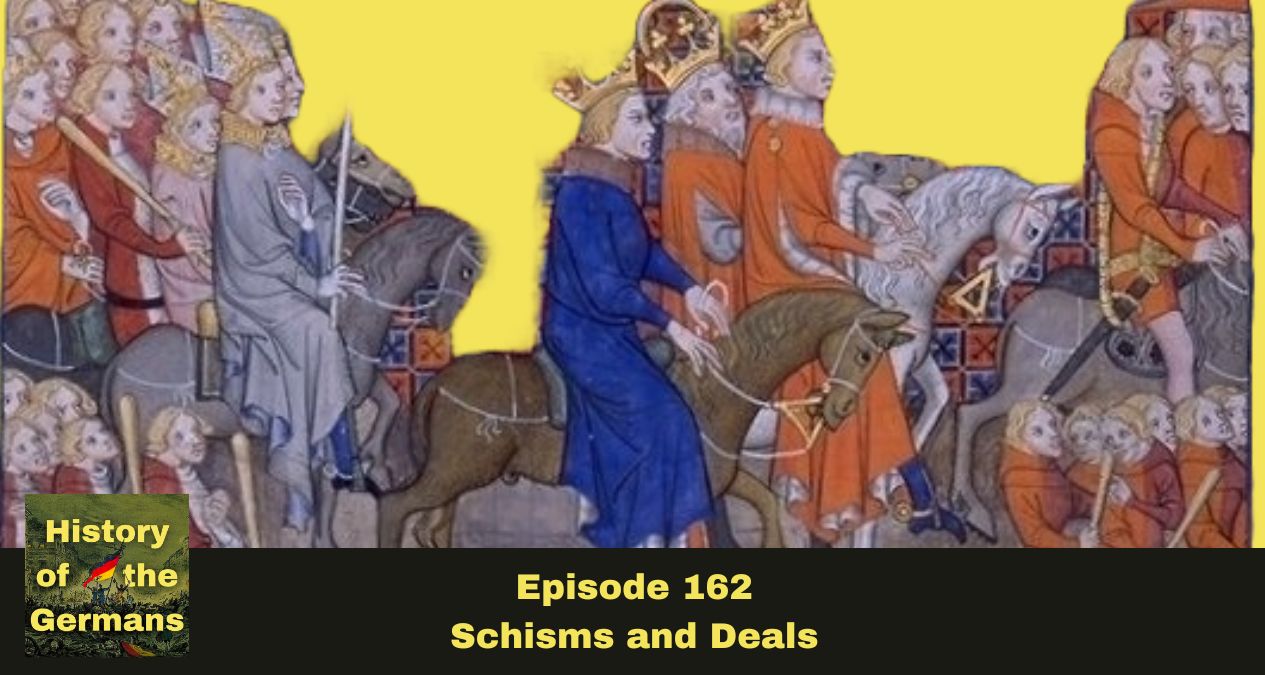
Episode 162 – Schisms and Deals
For more than a hundred years the Holy Roman Empire was a mess of constant infighting between and within the great princely families. But by the 1360s the consistent policies and elaborate diplomacy of emperor Karl IV had produced a degree of stability not seen by anyone alive.
With the home front calm, the emperor can again assume a role on the European stage, setting in train seminal events that will reverberate across the centuries…
For Episode Website and Transcripts, click here
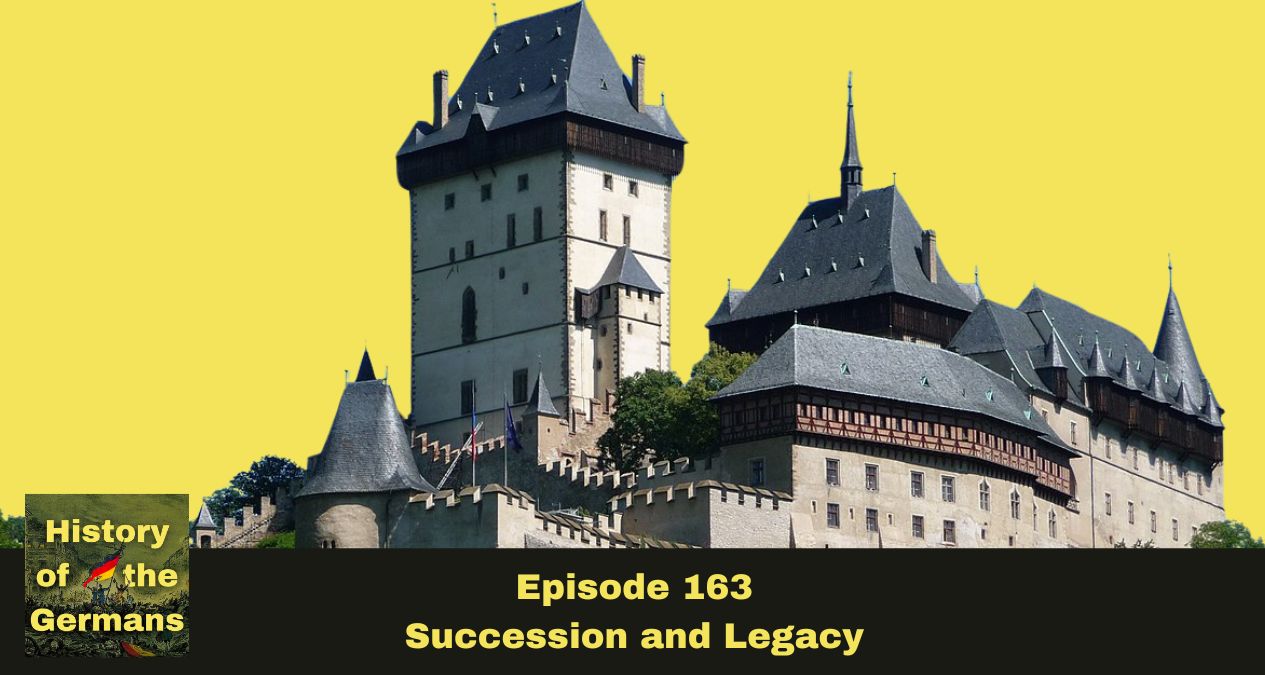
Episode 163 – Succession and Legacy
This is the last episode of this season and it is time to say goodbye to Karl IV, Ludwig the Bavarian, Henry VII, Albrecht of Habsburg, Adolf von Nassau and Rudolf of Habsburg. These have been some eventful 138 years.
When Karl IV died in 1378 he left behind an impressive list of achievements but also a number of failures. And he left behind a son, Wenceslaus he had invested with so much hope and so many crowns, it not only broke the bank but even chunks of the political edifice he had so patiently built.
For Episode Website and Transcripts, click here
Charles IV. A Portrait of a Medieval Ruler – Interview with Václav Žůrek
The Emperor and King Charles IV (1316-1378) represents today an untouchable monument in Czech history, carved into the marble of admiration and clichés. Although a new and thorough study of his reign is yet to be written, it is nevertheless useful to introduce Charles IV from a new perspective. In many regards, historical research has already brought new findings, and thus we are now able to shed new light on both his life and his reign.
The book will be published this autumn but is already available for pre-order
here: Charles IV: Portrait of a Medieval Ruler, Žurek, Stone (uchicago.edu)
Wonderful podcast, I hope you will organise this season’s page like the previous seasons with it’s timeline/emperor hyperlink and explanation of key events as it made easier to navigate.
Will you also be updating the following season’s timeline pages by any chance? the ones covering Hanse, Teutonic Knights and Eastward Expansion.