


A narrative history of the German people from the Middle Ages to Reunification in 1991. Episodes are 25-35 min long and drop on Thursday mornings every 2 weeks.
“A great many things keep happening, some good, some bad”. Gregory of Tours (539-594)
So far we have covered:
Ottonian Emperors (# 1- 21)
– Henry the Fowler (#1)
– Otto I (#2-8)
– Otto II (#9-11)
– Otto II (#11-14)
– Henry II (#15-17)
– Germany in 1000 (#18-21)
Salian Emperors(#22-42)
– Konrad II (#22- 25)
– Henry III (#26-29)
– Henry IV/Canossa (#30-39)
– Henry V (#40-42)
– Concordat of Worms (#42)
Early Hohenstaufen (#43-69)
– Lothar III (#43-46)
– Konrad III (#47-49)
– Frederick Barbarossa (#50-69)
Late Hohenstaufen (#70-94)
– Henry VI (#70-72)
– Philipp of Swabia (#73-74)
– Otto IV (#74-75)
– Frederick II (#75-90)
– Epilogue (#91-94)
Colonisation of the East (#95-108)
The Hanseatic League (#109-127)
The Teutonic Knights (#128-137)
From the Interregnum to the Golden Bull (#138 -185)
– Rudolf von Habsburg (#139-141)
– Adolf von Nassau (#142)
– Albrecht von Habsburg (#143)
– Heinrich VII (#144-148)
– Ludwig the Bavarian (#149-153)
– Karl IV (#154-163)
The Reformation before the Reformation
– Wenceslaus the Lazy (#165)
– The Western Schism (#166/167)
– The Ottomans (#168)
– Sigismund (#169-#184
The Empire in the 15th Century
– Mainz & Hessen #186
– Printing #187-#188
– Universities #190
– Wittelsbachs #189, #196-#199
– Baden, Wuerrtemberg, Augsburg, Fugger (#191-195)
– Maps & Arms (#201-#202)
The Fall and Rise of the House of Habsburg
– Early Habsburgs (#203-#207)
– Albrecht II (#208)
– Friedrich III (#209-#215)
– Maximilian I (#215-
On June 15th, 1520, Pope Leo X signed the papal bull Exsurge Domine. It listed 41 of Martin Luther’s statements as heretical, ordered his books to be burned and gave him sixty days to recant.
So, what do you do when you have sixty days left? Martin Luther wrote. Between August and November 1520 he produced three books that did not ask for mercy, but demolished the medieval church, its legal privileges, its sacraments and its view of how a human being gets into heaven.
To the Christian Nobility of the German Nation asked the emperor Charles V and the princes to bring down the three walls the papacy had drawn around itself. Not with brawn, but with brain. The Babylonian Captivity of the Church put the seven sacraments to the test: seven went in, two came out. And The Freedom of a Christian set out what Luther actually cared about, in one paradox: a Christian is a free lord over all things and subject to no-one, and a bound servant of all things and subject to everyone.
Meanwhile Johannes Eck had a terrible autumn trying to publish his bull in Saxony, Erasmus told Frederick the Wise what Luther’s two sins were, and a certain H. Tudor sat down to write a refutation.
And when the sixty days were up, the burning began, though not quite as His Holiness had intended. On December 10th, 1520, outside the Elster Gate in Wittenberg, the bull went into the fire, and with it canon law, the legal operating system of western Christendom.
In this episode
- Exsurge Domine – a Wild Boar in the Vineyard
- To the Christian Nobility of the German Nation
- A Massive Bestseller and the German Hercules
- Eck’s Terrible Autumn
- The Babylonian Captivity of the Church
- The Lord’s Supper
- The Clock is Ticking
- The Freedom of a Christian
- Burning the Bull
The music for the show is Flute Sonata in E-flat major, H.545 by Carl Philipp Emanuel Bach (or some claim it as BWV 1031 Johann Sebastian Bach) performed and arranged by [performer] under [licence].
As always:
Homepage with maps, photos, transcripts and blog: https://historyofthegermans.com/
If you wish to support the show go to: Support • History of the Germans Podcast
For do it yourself merchandise go to: https://historyofthegermans.com/merchandise/
Facebook: @hotgpod
Threads: @history_of_the_germans_podcast
Bluesky: @hotgpod.bsky.social
Instagram: history_of_the_germans
To make it easier for you to share the podcast, I have created separate playlists for some of the seasons that are set up as individual podcasts. They have the exact same episodes as in the History of the Germans, but they may be a helpful device for those who want to concentrate on only one season.

Hello and welcome to the History of the Germans: Episode 245 – On Nobility, Captivity and Freedom
“Arise, O Lord, and judge thy cause. A wild boar has invaded thy vineyard.
Arise, O Peter, and consider the case of the Holy Roman Church, the mother of all churches, consecrated by thy blood.
Arise, O Paul, who by thy teaching and death hast and dost illumine the Church.
Arise, all ye saints, and the whole universal Church, whose interpretation of Scripture has been assailed.
We can scarcely express our grief over the ancient heresies which have been revived in Germany. We are the more downcast because she was always in the forefront of the war on heresy. Our pastoral office can no longer tolerate the pestiferous virus of the following forty-one errors. [They are enumerated.]
We can no longer suffer the serpent to creep through the field of the Lord. The books of Martin Luther which contain these errors are to be examined and burned.
As for Martin himself, good God, what office of paternal love have we omitted in order to recall him from his errors? Have we not offered him a safe conduct and money for the journey? And he has had the temerity to appeal to a future council although our predecessors, Pius II and Julius II, subjected such appeals to the penalties of heresy.
Now therefore we give Martin sixty days in which to submit, dating from the time of the publication of this bull in his district. Anyone who presumes to infringe our excommunication and anathema will stand under the wrath of Almighty God and of the apostles Peter and Paul.”
This was from the papal bull Exsurge Domine, signed by pope Leo X on June 15th, 1520.
So, what do you do when you have sixty days left? Some might take a trip to Rome and beg for mercy, others would hide in a cellar or run away to Bohemia. Martin Luther wrote. Between August and November 1520 he produced three books that between them did not ask for mercy, but demolished the medieval church, its legal privileges, its sacraments and its view of how a human being gets into heaven. And when the sixty days were up, the burning began, though not quite as His Holiness had intended.
How that happened, and what is in these three little books that had half of Europe at each other’s throats for well over a century, is what we will look at today.
Thank You!
But before we start a big thank you to the supporters who keep this show on the road and free of pesky advertising, namely Lenof, Thomas W., Joshua M.W, Tim R., Peter W., Jefrrey R., the wonderful Rip, Kate H., Michael M., Samuel P. S., Raimond Z and the ever supportive Constantin R.
And if you want to be immortalised in one of these episodes, or if you are a just keen to do the good works, just go to historyofthegermans.com/support and sign up as a member.
And with that, back to the show.
Recap – After Leipzig
Last time we left Luther on his way back from Leipzig with his tail between his legs. Johannes Eck had played his skinny, exhausted opponent like a clarinet. He had lured him into an open debate on hostile turf and had then manoeuvred him into declaring that some of the ideas of Jan Hus were Christian and evangelical. Since Hus had been condemned by the Council of Constance, that made Luther a heretic, no ifs, no buts, and one who thought that even a general council of the church could err.
But the defeat did not stick. Luther simply outwrote his opponents, his friends ridiculed Eck with bodily function based humour, and within a few months Leipzig was just another chapter in the great Luther story everyone was following.
What did stick was what Leipzig had done to Luther himself. Being certain of his condemnation had set him free. If the church was going to burn him anyway, there was no longer any point in holding back. He could follow his thoughts wherever they led, including to the suspicion that the papacy was not merely misguided or corrupt, but the Antichrist the Book of Revelation had promised for the end of days.
In February 1520 he had read a new edition of Lorenzo Valla’s proof that the Donation of Constantine, the document on which the popes had based their claim to rule the west, was a forgery. The man who had put that edition out was the knight and poet Ulrich von Hutten, of whom more in a minute. Luther wrote to his friend Spalatin that he was now in such anguish that he hardly doubted any more that the pope was the Antichrist.
Meanwhile Johannes Eck had travelled to Rome to collect his reward and to make sure the Curia finally brought the case to its conclusion.
Exsurge Domine – a Wild Boar in the Vineyard
 The commission that investigated Luther and drafted the bull consisted of some familiar faces, Sylvester Prierias, Cardinal Cajetan, Johannes Eck and a couple of other senior prelates. Pope Leo X himself was not much involved in the detailed theological discussion – not his forte. He had, true to form, chosen to enjoy the papacy God had given him by spending the spring of 1520 at his hunting lodge at La Magliana outside Rome enjoying pleasures that “cannot honourably be named” as well as more conventional ones. The story goes that the draft was presented to him there, between two outings in pursuit of, well, wild boar. He might have drafted the opening words we heard at the top of the episode whilst daydreaming about an army of saints driving Martin Luther right before his spears, swords and nets.
 But despite Cajetan’s enormous intellectual firepower and Eck’s profound knowledge of the German political system, the Roman Curia was once again sloppy. The bull listed 41 statements from Luther’s writings and declared them heretical, or scandalous, or false, or offensive to pious ears, without even saying which was which. For instance Number 33 of the condemned articles was Luther’s thesis that burning heretics was against the will of the Holy Spirit. There was no serious attempt to refute this, instead the official position of the Roman church in the summer of 1520 was that the Holy Spirit loved the smell of burning flesh in the morning.
On July 24th Exsurge Domine was posted on the doors of St. Peter’s in Rome. But that was not yet enough to bring about Luther’s excommunication. Canon law, for all its shortfalls, had strong procedural safeguards. The 60 day countdown to excommunication could only start once the bull had been delivered to the defendant, or at a minimum been publicised near his home. Somebody had to go down to Germany.
That job was shared between two men. Girolamo Aleandro, the papal librarian, was to go to the emperor and the Rhineland. Responsibility for central Germany, Saxony included, went to, drumroll, Johannes Eck. Sending the man whom Luther and his friends had comprehensively humiliated to deliver his sentence had a sharp aftertaste of revenge. From the moment it crossed the Alps this was no longer the bull of the Holy Father, it was Johannes Eck’s bull.
News travelled faster than nuncios. By early summer Luther knew what was coming and knew that his survival depended on one thing only: allies. Frederick the Wise had protected him so far, but Frederick was an old man, and a single elector could not hold out against pope and emperor combined.
 And allies were available. In June a Franconian knight, Sylvester von Schaumberg, wrote to offer him the protection of a hundred noblemen. Ulrich von Hutten relayed an invitation from Franz von Sickingen, the most feared military entrepreneur in the empire, to come and stay at his castle, the Ebernburg.
Even though Luther stayed in Wittenberg, he felt emboldened by these offers. He wrote to Spalatin, quote: “Now that the die is cast, I utterly despise Rome’s fury and Rome’s favour. I do not want to be reconciled with them, nor to have fellowship with them in all eternity. Let them condemn and burn what is mine. I in turn, if I can get hold of any fire, will condemn and publicly burn the whole of papal law, that is, the whole swamp of heresies.”
To the Christian Nobility of the German Nation
Maybe as a consequence of this grassroots support he decided on his next move: to send a message to the emperor Charles and the princes, counts, knights and patricians of all Germany asking them to stand with him against the tyranny and wickedness of the Roman Curia. 
Was he mad to believe the emperor would come in on his side? Not really. Charles was twenty years old and had not yet set foot in Germany as its ruler. Nobody knew what he thought. What everybody knew was that pope Leo had done everything in his power to stop him getting elected, as we heard in episode 235. They also knew that Charles was heading for war with France over Italy and needed the pope to come off the fence. An unresolved Luther affair was a powerful political lever. Charles’ own ambassador in Rome, Juan Manuel, advised him that summer to show a little favour to a certain friar Martin at the court of Saxony, since nothing made the Holy Father more nervous.
As for the imperial princes, they had their own list of gripes: the annates, that is the first year’s income every new bishop had to send to Rome, the German benefices handed to Italian courtiers instead of their own well-deserving sons, the court cases dragged off to Rome and the endless flow of money south. All of which had been set out in the Gravamina of the German Nation at pretty much every diet for the last seventy years, and nothing had ever come of it.
That was the audience Luther now set out to win.
 In the middle of August 1520, the Wittenberg printer Melchior Lotter, son of the man who had put up the Wittenbergers in Leipzig, published “An den christlichen Adel deutscher Nation von des christlichen Standes Besserung”, “To the Christian Nobility of the German Nation, concerning the Improvement of the Christian Estate”.
It opened with the words “The time for silence is gone and the time to speak has come”.
It was perfectly tailored to that audience, the emperor and the aristocracy. It was written in German, not Latin, and it was built around an image every nobleman understood: a siege. The Romanists, Luther said, quote: “have, with great adroitness, drawn three walls round themselves, with which they have hitherto protected themselves, so that no one could reform them, whereby all Christendom has fallen terribly.”
These three walls were:
- That the clergy was exempt from temporal jurisdiction,
- That the pope had the exclusive right to interpret scripture, and
- That no one but the pope could call a church council.
Before he started the assault, Luther had a word of warning. These walls had been attacked before. Our old friends of the podcast, the emperors Frederick Barbarossa and Frederick II, had gone up against the papacy with everything they had, and had been piteously trodden underfoot.  Why? Because they had relied on their own strength, on knights and swords. This time it had to be done differently. He asked God for one of the trumpets that had brought down the walls of Jericho, because what protected Rome was only walls of straw and paper. Not brawn was needed, but brain. And the most powerful siege engine of them all, Holy Scripture.
So, what was that first wall in practice? Imagine you wanted to bring a churchman to justice. You could not take him to an imperial, royal or princely court. Under canon law, every member of the clergy, from the humble village vicar to the mighty cardinal, was exempt from secular justice. The church had its own courts, and these in-house investigations then as now tended to produce remarkably modest findings, followed by even more modest punishments.
 Luther did not argue that this was unfair, or expensive, or bad for law and order, which was what the Gravamina had said for decades. He went for the foundation. Why were priests, monks, friars, abbots, bishops and cardinals a separate estate in the first place? Were they really something apart from the rest of us?
No, he said. All Christians were of the spiritual estate. Whoever had crawled out of the baptismal font could boast that he was already a consecrated priest, bishop, even pope. A cobbler, a smith, a peasant, each had his trade, and so had the priest. That was all.
And to make sure everyone got it, he added a thought experiment. Let’s assume, quote, “a company of pious Christian laymen were taken prisoners and carried away to a desert, and had not among them a priest consecrated by a bishop, and were there to agree to elect one of them, born in wedlock or not, and were to order him to baptise, to celebrate the mass, to absolve, and to preach, this man would as truly be a priest, as if all the bishops and all the popes had consecrated him.”
Which meant that, quote: “a priest should be nothing in Christendom but a functionary; as long as he holds his office, he has precedence of others; if he is deprived of it, he is a peasant or a citizen like the rest.”
And if a priest was just a citizen with a particular job, then he was subject to the same courts as every other citizen. Justice was the task God had given to the temporal authorities, to punish the bad and protect the good, and that applied, to popes and paupers, bishops and barons, priests and purse-makers, monks and milliners, nuns and nailsmiths or whoever else it might be.
You can imagine how that went down in the chanceries of the empire. Every prince, every city council was busy building what would become the early modern state: one territory, one law, one system of courts. And in the middle of every territory sat hundreds of clerics, monasteries and church estates that could not be taxed, tried or touched. Luther had just given them a theological reason why all and everything should come under their supreme authority. What could possibly ever be wrong about that?
 On to the second wall, the pope’s exclusive right to interpret scripture. That was the ultimate get out of jail free card. If the pope alone decided what the rules meant, how could he ever be found to have broken them? Once again Luther deployed his one and only weapon, Holy Scripture: where exactly does it say that in the Bible? If it were true, we could burn the scriptures and content ourselves with the unlearned gentlemen in Rome. In the Old Testament, God once spoke through Balaam’s ass against a prophet. If he could speak through a donkey, he could surely speak through a pious Christian against a pope. And since “we are all priests and have all one faith, one Gospel, one Sacrament; how then should we not have the power of discerning and judging what is right or wrong in matters of faith?”
That was a statement he would be backpedalling from ferociously once people actually started doing it, but for now it stood.
That left the third wall, the notion that only a pope could call a council. One can sort of understand why popes were keen on that rule. The last time a council had got out of hand, at Constance, it had ended with Baldassare Cossa, aka anti-pope John XXIII, being deposed and locked up in Mannheim of all places.
But, as Luther pointed out, the most famous council of them all, Nicaea, had been called by the emperor Constantine, not by the bishop of Rome. And then he used an image every town dweller could understand. If a fire broke out in the city, would everybody stand around and let it burn because they did not have the authority of the mayor? Christendom was on fire. Whoever could call a council should call one, and nobody was better placed than the emperor and the princes.
 Three walls, three blasts of the trumpet. Now, Luther knew his audience. Imperial princes had a limited appetite for theology. What they wanted to know was: what did that mean in practice? So he gave them 27 articles for the agenda of that future council, and these were, let’s say, punchy.
No more annates, no more benefices for Roman courtiers and no court cases going to Rome. The Curia with its three thousand papal secretaries was to be cut down to size, and the pope should live off his own income. No more oaths of bishops to the pope, and no papal authority over the emperor beyond anointing and crowning him.  And no more kissing of feet, since, quote, “Christ washed His disciples’ feet and dried them, and the disciples never washed His.”
Pilgrimages to Rome should stop, the pilgrimage chapels in the countryside should be razed, most saints’ days abolished, and begging should be banned, with every town looking after its own poor. No new mendicant orders, and nobody should take a monastic vow before the age of thirty. Priests should be free to marry. Luther had real sympathy for the many village priests living with a housekeeper and a flock of children in what everyone knew was a marriage in all but name, and what the bishops tolerated in exchange for an annual fee.
Canon law – abolished. The universities should throw out Aristotle, the “blind heathen teacher” who ruled there instead of Christ. And let’s make peace with the Bohemians, since Jan Hus had been burned unjustly and in breach of an imperial safe conduct and, quote, “We should overcome heretics with books, not with fire.” Which, if you remember, was error number 33.
And since he was already at it, he had some advice for the secular authorities as well. A law against silk, velvet and other foreign luxuries, less spice trade, and above all an end to the Zinskauf, lending at interest dressed up as a purchase, a system he said the devil had invented and that, if it carried on for another hundred years, would leave Germany without a farthing. And then quote: “Doubtless we should also find some bridle for the Fuggers and similar companies.” Finally, the Germans should stop eating and drinking to excess, because it was embarrassing, and the public brothels should be closed.
He admitted himself that he had “sung a lofty strain” and that he would probably be accused of wanting to destroy the great business of commerce. And yes, Martin, I am afraid you did. If you have ever wondered why there is a top five economy in the world with a strangely puny financial sector, this Lutheran disdain for high finance is not a bad place to start looking.
A Massive Bestseller and the German Hercules
To the Christian Nobility became the biggest bestseller the young printing industry had yet seen. Lotter had started with a first run of 4,000, an unheard-of number, which was gone within a fortnight. A second, expanded edition followed before the month was out, and by the end of the year some fifteen more editions had come off the presses from Leipzig to Basel.
It was shocking and eye-opening in a way no piece of writing had been before. For once Luther had left the confines of academic theology so far behind that he was barely visible to the naked eye. And at the same time he had put his finger into wounds everyone could see: a coin-operated church, bishops who had themselves painted as St. Martin but kept the coat on, and priests pushed into concubinage and then charged for it.
 And there was an even bigger appeal. Remember the last time the church had been in a terrible mess, the Western Schism, when there were three popes at once. Who had sorted that out? An emperor, Sigismund, and the valiant German princes at Constance. Now the Germans would save Christendom again, as they had once done on the Lechfeld. The humiliations of Barbarossa and Frederick II would be avenged. Ulrich von Hutten, who had already been writing in this vein for years, could barely contain himself. He switched from Latin to German, took as his motto “Ich hab’s gewagt”, “I have dared it”, and called on his countrymen to throw off the Roman yoke. Within a couple of years Hans Holbein would draw Luther as the German Hercules, club in hand, with a heap of battered scholastics at his feet and the pope dangling from his nose.
Beware of Germans bearing solutions…
Eck’s Terrible Autumn
Meanwhile the church mustered its troops, or rather its one soldier in Saxony. On September 21st Johannes Eck had the bull posted on the door of the cathedral at Meissen, again on the 25th at Merseburg and on the 29th at Brandenburg. Formally, that was all that was needed.
In practice it was a fiasco. The bishops found reasons to delay. The University of Vienna refused to publish. In Erfurt the students got hold of the printed copies and threw them in the river. The bull is called bulla in Latin, which also means bubble, so they said: if it is a bubble, let it float.
 And in Leipzig, the scene of his great triumph a year earlier, mocking songs were sung under Eck’s window and threatening letters pinned to his door. Some 150 students came over from Wittenberg to make their feelings known. The city council had to give him a guard, and the great champion of the church ended up hiding in the Dominican friary before slipping out of town by night.
He did not help himself either. The pope had allowed him to add names to the bull at his own discretion. So Eck added Karlstadt, and then a few people who had been rude about him, including the Nürnberg humanist Willibald Pirckheimer, the presumed author of the satire with the flying, farting goat we heard about last time. That made it look even more like a private vendetta.
And when it came to delivering the bull to Wittenberg, which he was supposed to do in person, Eck sent his apologies. He said he did not have suitable clothes for the journey.
The Babylonian Captivity of the Church
Luther did not wait for the bull to arrive. Getting the princes and maybe even the emperor on side might be enough to get over the walls. But what was to be done once inside? What exactly was a council supposed to reform?
That was not a job for princes. That was a job for the intellectual elite, the theologians, the humanists, the thinkers of all stripes. And to those he now wrote, in Latin. On October 6th, Lotter published De captivitate Babylonica ecclesiae praeludium, a Prelude on the Babylonian Captivity of the Church. The title referred to the Jews carried off into exile by Nebuchadnezzar, and every educated reader also remembered that Petrarch had used the same phrase for the popes in Avignon. Only that this time it was not the pope who was the captive. The pope was Nebuchadnezzar.
And again, Luther did not just reiterate what he had said before. He opened by asking for his own books on indulgences to be burned. Why? Because he had been far too soft. All that needed saying was that indulgences were “wicked devices of the flatterers of Rome”. And as for the papacy, he thanked Eck and Emser for their instruction, quote: “For while I denied the divine authority of the papacy, I still admitted its human authority. But after hearing and reading the super-subtle subtleties of these coxcombs, with which they so adroitly prop up their idol, I now know for certain that the papacy is the kingdom of Babylon and the power of Nimrod, the mighty hunter.”
So here it was, in print and in Latin, for all of Europe to read. The papacy was not a venerable institution fallen on hard times. It was Babylon, it was Antichrist. And if that was true, the whole edifice of the church had been bent out of shape to keep the faithful away from salvation rather than lead them to it.
 The centrepiece of that edifice were the seven sacraments that accompanied a Christian from cradle to grave: baptism, confirmation, the eucharist, confession, marriage, holy orders and the last rites. Each one of them could only be administered by a priest. And that was the captivity. Whoever controlled the sacraments controlled access to heaven.
So Luther devised a test. A sacrament is only a sacrament if there is a promise of grace made by Christ himself in scripture, if that promise is attached to a visible sign, and if it is received in faith. Promise, sign, faith. Everything else might be a nice custom, but it was man-made.
Let’s do the quick ones first.
 Baptism. Mark 16:16, “Whoever believes and is baptised will be saved”. A promise, water as the sign, and faith. Tick, tick, tick. Luther even thanked God that this one sacrament had been preserved unspoilt. And what about babies, who cannot believe anything yet? There, he said, the faith of those who bring the child and the prayer of the church stand in, just as in the gospel the paralysed man was healed because of the faith of the friends who carried him. A humane answer given the appalling rate of child mortality, but not a watertight one, and the Protestant movement would have a heated and at times murderous debate about it.
 Confirmation. Jesus laid his hands on children and on the sick, the apostles did too. But nowhere did Christ attach a promise of salvation to it. A perfectly nice rite, like blessing water. Not a sacrament. Fail.
Marriage. Here the church relied on Paul’s letter to the Ephesians, where marriage is called a “sacramentum” in the Latin bible. Luther, who by now had Erasmus’ Greek New Testament on his desk, pointed out that the Greek said “mysterion”, mystery, and that Paul was talking about Christ and the church in general. And the clincher: people have got married since the beginning of the world, and the heathens do it just as validly as Christians did. Nobody ever claimed a pagan wedding conveyed divine grace.
 What really got him going was the jumble of rules the church had built around marriage. You could not marry cousin to the third degree. Nor could you marry a relative of your godparent, of your godchild or of the priest who had baptised you, nor a relative of your late husband, and so on and so forth. Unless you paid for a dispensation, in which case you could. The Romanists, he said, quote: “have become merchants, and what do they sell? Vulvas and genitals[1].”
He also discussed the case of a woman married to an impotent husband. Ideally the marriage should be dissolved. But if the husband refused, and since no court would take her word over his, Luther suggested she should, with the husband’s consent, take another man in secret, say his brother, and raise the children as her husband’s. And if he would not agree to that either, she should run off to a faraway place and marry there. I am not a great Luther fan, for reasons that will become apparent in a few episodes, but there is a pragmatism and sympathy here I had not expected. He then added that he detested divorce so much he would prefer bigamy. That sentence would come back to haunt him twenty years later in the case of Philip of Hesse.
Holy orders. Quote: “Of this sacrament the church of Chris t knows nothing; it is an invention of the church of the pope.” We know why from the letter to the nobility: everyone is a priest by baptism, and the man at the altar is simply the one the community has called to do the job. The practical effect of ordination, he said, was to create a caste that looked down on the laity and was bound to a celibacy that was a sham, since a man with a wife could not become a priest, but, quote, “if one has defiled six hundred harlots, or violated countless matrons and virgins, or even kept many Ganymedes, that would be no impediment to his becoming bishop or cardinal or pope.”
 His advice to the young men of Europe: flee, and do not enter this estate unless you want to preach the gospel. Bear in mind that the man writing this was still an Augustinian friar who wore the habit and lived in a friary.
Extreme unction. The church based the last rites on the letter of James, where the elders are asked to anoint the sick so that they may recover. But the church only anointed the dying, when recovery was the last thing anyone expected. Whatever James was describing, it was not that. Fail.
That makes four out of seven gone before lunch.
The Lord’s Supper
Which brings us to the big one, the Lord’s Supper, the Mass.
 It is hard to exaggerate the importance of the mass in the pre-Reformation church. Mass was said literally day and night. If you look at 14th and 15th century churches, they are sprouting a plethora of side chapels giving them their distinct floorplan. Today these are mostly empty. In Luther’s time they were busy, really busy. Priests were saying mass at each of these altars, not for a congregation, but for the souls of the donors who had paid for the chapel and for the priest.
 I was recently in Salamanca, where the cathedral has kept much of its original layout, and you can still see the iron grilles that kept the public out of these chapels and the walled-off choir in the middle of the nave. The mass was an act of such power that ordinary folk were not supposed to get too close. Only the ordained were trained to handle it, much like bomb disposal experts.
Luther did not deny that the eucharist was a sacrament. “This is my body, this is my blood, given for you for the forgiveness of sins”, bread and wine, faith. Tick, tick, tick. But he said it was held in three captivities.
 The first: only the priest got to drink the wine, the laity received just the bread. And yet Jesus had said “drink from it, all of you”. Not much room for interpretation there. This was of course exactly what the Hussites had fought for, and it was the Council of Constance, the same council that burned Hus, that had turned an old custom into binding law. Luther said out loud that on this point the Bohemians were right and that the Romanists were the heretics
 The second captivity was transubstantiation. This is one of the more bewildering corners of theology, so here is the short version, as far as I understand it. The church taught that when the priest speaks the words of consecration, “Hoc est enim corpus meum”, for this is my body, the bread turns into the body of Christ. But it still looks, feels and tastes like bread. How? The scholastics borrowed an answer from Aristotle. Every object has a substance, what it really is, and accidents, how it appears, its colour, weight and taste. In the mass, the substance changes while the accidents stay the same.
Luther thought this was an awful lot of pagan philosophy to explain something quite straightforward. Jesus said “this is my body”. Fine. Then it is his body, and it is bread, both at once, the same way a red-hot iron is both iron and fire. The church had managed for twelve hundred years without the word transubstantiation, which only became doctrine at the Fourth Lateran Council in 1215. One could still believe it if one wanted to, but nobody should be called a heretic for not believing it.
Please note what he did not say. He did not say it was just bread, or just a symbol. Christ was really present in it, whatever the person receiving it believed. That would become a deadly serious question once a certain Swiss gentleman called Ulrich Zwingli entered our story.
 And then the third captivity, in Luther’s eyes by far the most wicked. The Roman church at the time treated the mass as a sacrifice, as a good work. In every mass the ordained priest, and only he, offered Christ’s sacrifice on the cross to God once more, and that offering apparently won God’s favour. And because it won his favour, its benefits could be directed to a particular purpose or person, most commonly to shorten time in purgatory. The more masses, the better.
Luther said they had it exactly the wrong way round. The mass is not something we give to God. It is something God gives to us. It is a testament, a last will, in which Christ promised forgiveness, and all we can do is accept it in faith. This is grace coming down, not offerings going up.
To be fair to our Catholic listeners, the church would later clarify that the mass does not repeat the sacrifice of Calvary but makes that one sacrifice present. But that was not how it was sold in 1520, when you could buy masses by the dozen.
 And that is where the theology hit the economy. If the mass was not a good work, then all these private masses said behind iron grilles in thousands of side chapels achieved precisely nothing. Why would anyone pay for them? What did a rich donor get for his chantry? And what was to become of the army of priests who lived off nothing else? Luther knew very well what he was doing. He was attacking a thing that had been established for centuries. He was pulling the rug from under the prayer factories that had supported an elaborate ecclesiastical hierarchy and employed directly 2 to 4% and indirectly as much as 25% of the working population. He was fine with that.
And lastly, penance, or confession. Here he wobbled. At the beginning of the book it was still a sacrament, at the end it was not really, since it had a promise but no sign like water or bread. He liked private confession and wanted to keep it, but not as the church had run it since 1215, as a compulsory annual examination before your own parish priest. Any Christian, he thought, could hear a brother’s confession and tell him that his sins were forgiven.
So that was that. Seven sacraments had gone in, two had come out, baptism and the Lord’s Supper, and the latter was barely recognisable. And if everyone was a priest from baptism, what do we need priests for? Why should they have a special status? Why are monks, bishops and cardinals set above civil society? None of this is necessary any more.
 If the Letter to the Nobility was the popular bestseller, the Ayn Rand or George Orwell of theology, the Babylonian Captivity was its Road to Serfdom or General Theory. Fewer copies, but the impact on the intellectual elite was far greater. Many humanists who had happily cheered on the attack on Roman greed now stopped in their tracks.
Erasmus is reported to have said that the breach with the church was now irreparable. The emperor’s confessor, previously supportive of brother Martin, said reading it felt like being whipped from head to foot. The Franciscan Thomas Murner translated it into German so that everybody could see what a monster Luther was, which only helped to spread the word.
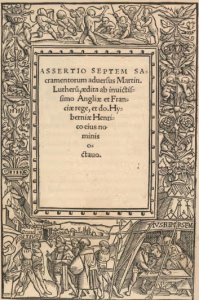 And in England a certain H. Tudor sat down to write a refutation, the Assertion of the Seven Sacraments, in which he defended, amongst other things, the unbreakable vows of marriage. “Whom God has joined together, let no man put asunder”. Pope Leo was so pleased he awarded him the title Defender of the Faith. He kept the title, not the conviction.
But it worked the other way too. In Pomerania a schoolmaster called Johannes Bugenhagen was handed the book over dinner, leafed through it and declared its author the most pestilent heretic that ever lived. A few days later, having read it properly, he told his colleagues, quote: “The whole world is blind, and this man alone sees the truth.” He moved to Wittenberg and became Luther’s pastor and confessor.
The Clock is Ticking
The Babylonian Captivity had been on sale for less than a week when, on October 10th, the bull finally reached Wittenberg. It was handed to the rector of the university by a Leipzig militiaman.
Luther’s first reaction was to pretend it was a forgery, another one of Eck’s lies. His second was relief. He wrote to Spalatin that he felt much freer now that he was certain the pope was Antichrist. He then answered in print with a pamphlet entitled “Against the Execrable Bull of Antichrist”. Come on Martin, tell us what you really think.
But the clock was now ticking. Sixty days from October 10th.

And all around him the machinery ground into motion. Already on October 8th, Aleandro had Luther’s books burned in Louvain, in the emperor’s own Netherlands. On the 23rd, Charles V was crowned at Aachen and swore to protect the Holy Roman Church. In November there was another bonfire in Cologne, and there should have been one in Mainz. But there the executioner turned to the crowd and asked whether these books had been lawfully condemned. The crowd roared no, and the executioner refused to light the fire. Aleandro had to come back the next day with a gravedigger and an audience of a few market women.
Frederick the Wise was in Cologne at the time and asked Erasmus what he made of the whole affair. Erasmus, who normally never gave a straight answer to anything, said: “Luther has committed two sins. He has struck the pope on his crown and the monks in their bellies”. Frederick laughed, and then told the emperor’s people that his professor could not be condemned without a hearing before learned and impartial judges, in Germany. And Charles, who needed the electors, agreed to think about it. That was the seed of the Diet of Worms.
 And there was one more attempt to settle things quietly. You may remember Karl von Miltitz, the papal chamberlain with the Golden Rose who had been shuttling around Saxony for two years. Even now he had not given up. On October 12th, two days after the bull had arrived, he met Luther at Lichtenberg castle and talked him into one last effort: Luther was to write a letter to the pope, saying that he had never meant to attack him personally, and to send him a little devotional book as a gift. And to make it look as if all this had been written before the bull, the letter would be dated back to September 6th.
Luther agreed. And the little book he wrote became the third and most beautiful of the three.
The Freedom of a Christian
The Nobility had been about politics. The Babylonian Captivity had been about the church. Walls and councils, rites and signs, things that happen in this world.

What Luther wrote in late October 1520 was about what he actually cared about. As we discussed in episode 240, indulgences and papal power were always sideshows for him. What had tormented him as a young friar was the question how a sinner could ever stand before a just God. And what he had found, as he later told it in the tower of the Black Cloister in Wittenberg, was that God is not a harsh judge waiting to cast us down for the tiniest transgression. God gives his grace freely. There is no good work we can do to earn it, since everything we do, good or bad, is tainted by sin. All that is asked of us is to trust in his promise. To have faith.
“Von der Freiheit eines Christenmenschen”, On the Freedom of a Christian, came out in mid-November in German and in a somewhat longer Latin version. The German one ran to thirty short paragraphs, no insults, no Antichrist, no coxcombs. If you only ever read one thing by Luther, read this.
It started with a paradox:
A Christian is a free lord over all things and subject to no-one.
A Christian is a bound servant of all things and subject to everyone.
How can both be true? Because, said Luther, each of us is two people, an inner, spiritual one and an outer, bodily one.
The inner person, the soul, is free, because nothing external can touch it. It makes no difference to the soul whether the body wears a silk cassock or rags, whether it fasts, goes on pilgrimage or sits in a dungeon. The only thing the soul needs is the word of God, and the only way to receive it is faith. And then he reached for an image that must have raised some eyebrows. Faith, he said, joins the soul to Christ as a bride is joined to her bridegroom. And as in marriage, everything they have becomes common property. Christ takes on the soul’s sin, death and damnation. The soul receives Christ’s grace, life and salvation. A rich and noble bridegroom marries a poor little harlot and makes her a queen. Luther calls this the joyful exchange.
 That is the freedom of a Christian. Not freedom to do something, but freedom from something, from the fear that you have not done enough, prayed enough, paid enough. A Christian, quote, “is free of all things and above all things, so that they do not need any good works to be righteous and saved, but faith brings everything to them in abundance.”
This idea had always met with the same objection, going back to the debates in Heidelberg two years earlier. If good works do not get you into heaven, why do any? Why help a neighbour, why obey the law? Let us be merry and do nothing.
And that is where the second sentence comes in. As long as we live, we have a body and we live amongst other people. The body needs discipline, and the other people need our help. A person who has been given everything for free does not sit back. He or she wants to pass it on. Quote: “Good, righteous works can never make a good, righteous person, but rather a good, righteous person does good, righteous works.” Just as a good tree bears good fruit, but hanging apples on a tree does not make it an apple tree.
So the Christian becomes a servant, not to earn anything, but out of gratitude. As Christ gave himself for me, I will give myself to my neighbour. And his conclusion: Christians do not live in themselves, but in Christ and in their neighbour. In Christ through faith, in their neighbour through love.
 Now, this little book is amongst the most misunderstood things Luther ever wrote. People had a habit of reading the first sentence and skipping the second. Freiheit, freedom, became the battle cry of the imperial knights two years later, and of the peasants five years later. The peasants would write into their famous Twelve Articles that since Christ had redeemed all of us with his precious blood, the shepherd as well as the lord, it followed from scripture that they were free and no man’s serf. Luther would be horrified, and tens of thousands would walk into a meat grinder.
Because already here, in 1520, Luther’s freedom was strictly confined to the inner person. The soul was free. The outer person stayed exactly where it was, in the hierarchy that God had ordained, subject to everyone.
That is one of the great contradictions in the man. He would stand up to pope and emperor when it came to his conscience, and at the same time demand near unconditional obedience to the temporal authorities. An attitude that, if we Germans did not inherit it from Luther, we have certainly been struggling with ever since.
It also explains how he could write the letter that went with the book. In it he addressed Leo X, the man whose office he had just called Antichrist, as “most blessed father” and assured him that he had never thought ill of him personally. Leo, he said, was sitting like a lamb in the midst of wolves, like Daniel amongst the lions. It was the Curia around him that was, quote, “more corrupt than any Babylon or Sodom”. As peace offerings go, this one had its limitations. And he added a sentence that made sure there would be no peace: he would accept no rules for interpreting the word of God.
There is no record that Leo ever replied.
Burning the Bull
By early December the sixty days were up. Luther had not recanted. Rome had not blinked.
On the morning of December 10th, 1520, a notice from the hand of Philip Melanchthon appeared on the door of the parish church in Wittenberg. All friends of evangelical truth were invited to assemble at nine o’clock at the Chapel of the Holy Cross outside the Elster Gate, where the godless books of papal law and scholastic theology would be burned.
The place was well chosen. It was where the town’s knacker worked and where the hospital burned the rags of people who had died of the plague.
The organisation was in the hands of Johann Agricola, and it did not go entirely to plan. He had wanted to burn the works of Thomas Aquinas and Duns Scotus as well, but not a single professor in Wittenberg was prepared to part with his copy. So it had to be the volumes of canon law, a handbook for confessors, and some works by Eck and Emser for good measure. Agricola lit the fire. Then Luther stepped forward, trembling and praying as he later said, and dropped a small printed booklet into the flames, the bull Exsurge Domine. He said: “Because you have confounded the truth of God, today the Lord confounds you. Into the fire with you.”
Then the professors went home. The students did not. They spent the rest of the day parading around town on a cart, with a bull stuck on a pole and an indulgence on the tip of a sword, sang a requiem for the papal decretals and collected more books for the fire.
We tend to remember this day for the burning of the bull. But a threat of excommunication was a piece of paper addressed to one man. What really mattered were the heavy folios underneath it. Canon law was the legal operating system of western Christendom. It regulated marriage, inheritance, contracts, oaths and the entire constitution of the church. For four hundred years church courts across Europe, and plenty of secular ones, had applied it. And an excommunicated friar had just declared it void.
On January 3rd, 1521, pope Leo X signed the bull Decet Romanum Pontificem. Martin Luther was now formally a heretic, cut off from the church and from the community of Christians.
Under the law of the empire, the imperial ban should have wed more or less automatically. But the princes had read their letter. And the emperor needed the princes. So something quite unheard of happened: a man condemned by the pope was invited to appear before the emperor and the estates of the empire. In April 1521 Martin Luther climbed on a cart and set off for the Diet of Worms.
But that is a story for next time. I hope you will join us again.
And in the meantime, if you feel like a free lord over all your things and would like to be a bound servant to this show, you can always go to historyofthegermans.com/support, where sincere, heartfelt and eternal gratitude await you.
[1] Werke. Kritische Gesamtausgabe. [Hrsg. von J.K.F. Knaake et al.] : Luther, Martin, 1483-1546 : Free Download, Borrow, and Streaming : Internet Archive
You can support the show by becoming a patron here