


Ottoman Threat, Imperial Election and Debt

A narrative history of the German people from the Middle Ages to Reunification in 1991. Episodes are 25-35 min long and drop on Thursday mornings every 2 weeks.
“A great many things keep happening, some good, some bad”. Gregory of Tours (539-594)
So far we have covered:
Ottonian Emperors (# 1- 21)
– Henry the Fowler (#1)
– Otto I (#2-8)
– Otto II (#9-11)
– Otto II (#11-14)
– Henry II (#15-17)
– Germany in 1000 (#18-21)
Salian Emperors(#22-42)
– Konrad II (#22- 25)
– Henry III (#26-29)
– Henry IV/Canossa (#30-39)
– Henry V (#40-42)
– Concordat of Worms (#42)
Early Hohenstaufen (#43-69)
– Lothar III (#43-46)
– Konrad III (#47-49)
– Frederick Barbarossa (#50-69)
Late Hohenstaufen (#70-94)
– Henry VI (#70-72)
– Philipp of Swabia (#73-74)
– Otto IV (#74-75)
– Frederick II (#75-90)
– Epilogue (#91-94)
Colonisation of the East (#95-108)
The Hanseatic League (#109-127)
The Teutonic Knights (#128-137)
From the Interregnum to the Golden Bull (#138 -185)
– Rudolf von Habsburg (#139-141)
– Adolf von Nassau (#142)
– Albrecht von Habsburg (#143)
– Heinrich VII (#144-148)
– Ludwig the Bavarian (#149-153)
– Karl IV (#154-163)
The Reformation before the Reformation
– Wenceslaus the Lazy (#165)
– The Western Schism (#166/167)
– The Ottomans (#168)
– Sigismund (#169-#184
The Empire in the 15th Century
– Mainz & Hessen #186
– Printing #187-#188
– Universities #190
– Wittelsbachs #189, #196-#199
– Baden, Wuerrtemberg, Augsburg, Fugger (#191-195)
– Maps & Arms (#201-#202)
The Fall and Rise of the House of Habsburg
– Early Habsburgs (#203-#207)
– Albrecht II (#208)
– Friedrich III (#209-#215)
– Maximilian I (#215-
The last decade of emperor Maximilian’s reign was overshadowed by all three challenges to the emerging Habsburg empire gaining strength. The Ottoman empire was piling on resources by taking over Syria, Lebanon and Egypt. A vigorous new king of France, Francois I was turning the tide in the incessant Italian wars into his favor. And finally the greatest of threats to the dynasty emerged as the Prince Electors were contemplating to raise that self-same Francois I to the imperial title.
In this episode we will look at how the prematurely aged and exhausted emperor tried to shield his grandsons Charles and Ferdinand from the ton of bricks that was coming down on them. And we will look at his last days and legacy. Clocking in at 18 episodes, Maximilian did achieve one of his objectives in life, outpacing the great emperor Frederick Barbarossa. Let’s find out whether he did this only in terms of number of HotGPod episodes, or in other ways too.
The music for the show is Flute Sonata in E-flat major, H.545 by Carl Phillip Emmanuel Bach (or some claim it as BWV 1031 Johann Sebastian Bach) performed and arranged by Michel Rondeau under Common Creative Licence 3.0.
As always:
Homepage with maps, photos, transcripts and blog: www.historyofthegermans.com
If you wish to support the show go to: Support • History of the Germans Podcast
For do it yourself merchandise go to: Merchandise • History of the Germans Podcast
Facebook: @HOTGPod
Threads: @history_of_the_germans_podcast
Bluesky: @hotgpod.bsky.social
Instagram: history_of_the_germans
Twitter: @germanshistory
To make it easier for you to share the podcast, I have created separate playlists for some of the seasons that are set up as individual podcasts. they have the exact same episodes as in the History of the Germans, but they may be a helpful device for those who want to concentrate on only one season.
So far I have:
Salian Emperors and Investiture Controversy
Fredrick Barbarossa and Early Hohenstaufen
The Holy Roman Empire 1250-1356
The Reformation before the Reformation
The Empire in the 15th century

Click here to: Listen on Apple Podcast
Click here to: Listen on Spotify
Transcript
Hello and welcome to the History of the Germans, Episode 233.: Maximilian I (1493-1519) – Last Days and Legacy
The last decade of emperor Maximilian’s reign was overshadowed by all three challenges to the emerging Habsburg empire gaining strength. The Ottoman empire was piling on resources by taking over Syria, Lebanon and Egypt. A vigorous new king of France, Francois I was turning the tide in the incessant Italian wars into his favor. And finally the greatest of threats to the dynasty emerged as the Prince Electors were contemplating to raise that self-same Francois I to the imperial title.
In this episode we will look at how the prematurely aged and exhausted emperor tried to shield his grandsons Charles and Ferdinand from the ton of bricks that was coming down on them. And we will look at his last days and legacy. Clocking in at 18 episodes, Maximilian did achieve one of his objectives in life, outpacing the great emperor Frederick Barbarossa. Let’s find out whether he did this only in terms of number of HotGPod episodes, or in other ways too.
AI Slop Attack
Before we start, I owe you an explanation why the show is a day late.
On Sunday, which is the day when I normally sit in my favorite armchair and read and prepare for the upcoming episode, I was instead glued to my screen fighting against AI slop.
Some absolute bellend had created a podcast, imaginatively called “History of the Germans Podcast”, as opposed to just “History of the Germans”. And he used a slightly altered version of my podcast logo and font. The episodes he published were AI generated, 4 minutes long, full of clickbait and SEO triggers, garnished with another four minutes of advertising.
What is so irritating with this is that the effort to get new listeners to click on the show for the first time is gigantic. I have at times spent almost as much time drumming up listeners on social media and by guesting on other shows as I have producing new episodes. Therefore if all this effort results in someone looking for the History of the Germans on a podcast player, the worst thing that could happen is for that person to find 4 minutes of adverts and 4 minutes of slop. That listener will never check out my show again.
And let’s take a look at the economics of these business models. This particular AI slopper did not just clone my show but another 74, some of them very famous ones, including Hardcore Histories, History of Rome and the History of England by my friend David Crowther – I strongly recommend! For each download the scammer gets 0.8 cents per advert, so assuming there are four adverts per podcast, he makes 3.2 cents total for one download. If he wants to generate say $2,000 a month, he would need to get 62,500 downloads. Given nobody who listened to this nonsense would ever go back there or to the original show, that means the 75 podcasts that are affected would collectively lose 62,500 potential listeners every month, every single month. To put that into context the History of the Germans has around 12,000 listeners.
You can imagine how extremely angry we all were. Thanks to the might of some of the major podcasting production firms who had also been hit and the journalism of Podnews, we had the guy shut down in a day. Which happened to be my Sunday and half of Monday. Hence research took a back seat and you get your show a day late. But it also confirms once again my utter disdain for the role of advertising in literally all media now and makes me exceedingly grateful that so many of you are allowing me to keep this show advertising free by going to historyofthegermans.com/support. And this week I want to thank Hobby Roy, Bram R., Adam W., Andrew E., Birket H., Carl J. and Deborah McK.
Once more a listener is in the final of University Challenge
And on a more positive note, once again one of your fellow listeners has made it to the final of University challenge. Tune in on April 20th and cheer on Kai Madgwick and their team from Manchester University.

Phaw, it feels good getting this off my chest. Now back to the show.
Ottoman Threat Rising
Last week we talked about the massive step change the Ottoman empire experienced between 1444 and 1517 under Mehmet the Conqueror and Selim the Grim. In this period the Sultans first took Constantinople and turned it from the dead centre of a dead empire once again into a splendid capital, but found their expansion westward stalled before the gates of Belgrade. Sultan Bayazid II spent most of his time on the throne fretting about a European invasion led by his brother Djem and religious uprisings in Anatolia. After the 40-year long stagnation under Bayazid II, his son Selim I, who the Turks call the Awesome rather than the Grim, put the Sublime Porte back into expansion mode. Selim defeated the first Shah of Safavid Iran, Ismael I. This stabilized the border between these two great powers and brought an end to the Shiite uprisings in Anatolia. And in 1517 he crowned his success with a defeat of the Mamluks, the rulers of Egypt, Syria and the Holy Cities of Mecca and Medina. That added the tax revenues from the major trading hubs of Aleppo, Alexandria and Cairo to the Ottoman treasury as well as the leadership of Sunni Islam, including the title of Khalif. Having doubled the size of the empire and no further enemies to the east, it was apparent that from now on, the might of the Ottoman power would be directed at the Eastern Mediterranean and the Balkans.

And I have to apologize for an error. It wasn’t Selim the Awesome who decreed that the sons and grandsons should be confined to the Topkapi palace until they either succeeded or were killed. It was his grandson Selim II who ordered all his younger sons to be confined to a palace, whilst fratricide had already become Ottoman law under Mehmet the Conqueror. And since Ahmed I ended fratricide in 1607, there was no period where the sons were kept permanently in the famous cage in the Topkapi palace and then murdered. The cage was specifically invented to avoid the need of fratricide. Still several of these princes went mad or suicidal in the cages, and it was surely not an ideal way to educate a ruler. Still, apologies for that. I fell for another classic trope.
But where I was right was in the mounting threat to the Balkans, Rhodes, the Venetian outposts, Hungary, Austria, Italy and finally all of Europe. The Ottoman empire was built on constant expansion and now they were coming.
16 Crusades Called and no actions
One would expect the European powers to suspend their endless quarrels in light of such an existential threat. Given Venetian and Genoese merchants were interacting with Ottoman traders and authorities on a regular basis, artists like Gentile Bellini had worked at the Sultan’s court and converted Christians were negotiating with the European powers on behalf of the Sultan, knowledge of the size and quality of the Ottoman forces was well known. Selim the Awesome had taken an army of 100,000 men, including 10,000 Janissaries armed with arquebuses and supported by modern artillery to Egypt. There wasn’t a single European power, not even France that could field a similarly sized force. Resistance had to be on a pan-European basis.
And there was already a way to organize such pan-European efforts, the crusades. But here is the problem. Since the fall of Constantinople, every single pope had called at least one crusade, in total the call to fight against the Ottoman Turks had gone out 16 times. Ever since the siege of Belgrade in 1456, the church bells rang every evening to reminding people of the Turkish danger.

How many of these sixteen calls resulted in military action? Well, there was the defense of Belgrade in 1456, though these crusaders were mainly Hungarians defending their homeland. Pius II gathered a force in Ancona but died there, so it never set sail. In 1471 crusaders took Smyrna, modern day Izmir but had to give it up almost instantly. In 1481 mainly Italian forces under a crusader banner freed Otranto. That was the last one that resulted in any military action. For almost forty years, as Ottoman power grew and grew, France, Spain and the Habsburgs talked about unity and defense of Christendom, but fought over Italy.
Arguably the Ottoman threat had not been imminent throughout this period, but by 1517/1518 it dawned on everyone, that bad things may be happening soon. Once more the pope, in this case the Medici pope Leo X called a crusade.
The Call for a Crusade in 1517/18
Our friend the emperor Maximilian, by now 59 years old and worn down by almost constant war and money worries put his hat in the ring. His propaganda team declared:
Quote: “With great diligence and earnestness, he will strive to drive back the unbelievers. A joint campaign (crusade) was to be undertaken, which is why he impressed on all the princes, that God wills that they should follow him in good time, for the relief of all Christendom.”
Going on crusade, or more specifically, leading a crusade as emperor and hence secular lord of all Christendom was a constant ambition of Maximilian. He had been talking about this since at least 1490 when he marched into Hungary following the death of Matthias Hunyadi. There are a number of things that come together in this idea. One is the very real fact that Austria had been subject to Turkish raids almost continuously since the 1470s. And the double wedding of 1515 had tied the Habsburgs to Hungary, the country most at risk of an Ottoman invasion.
But there is also a huge intellectual uberbau here. Maximilian had inherited his father’s idea of the dignity of the empire and he tried in so many ways to emulate Frederick Barbarossa who had fought most of his life in Italy and went on crusade in his last years. That then mingled with the Burgundian chivalric tradition that saw crusading as the obligation of every true knight. Hence the Burgundian dukes had proactively supported crusading, if not very effectively. John the Fearless had fought and caused the defeat at the battle of Nicopolis in 1396 . Philip the Good tried to launch a Crusade in 1454 with his feast of the pheasant. This crusading tradition was still percolating through the Habsburg extension of the Burgundian family, in Maximilian as well as Philip the Handsome and his sons Charles and Ferdinand.

Hence there was a keen interest in particular on the side of Maximilian for a preventive move on the Ottomans. But there was little faith that the other powers would respect the ancient crusader privilege, namely that one was not allowed to attack a crusader’s land when he was fighting under the cross. Generally, the failure to properly launch a single one of the 16 crusades called since 1453 has turned people into cynics. Money collected for the effort through taxes and indulgences had been misdirected into the coffers of princes, usually spent on internecine warfare. Maximilian, the last knight and heir to the crusading Burgundian dukes was particularly rapacious on account of his constant money troubles.
When cardinal Wolsey, yes the cardinal Wolsey, tried to bring about a general peace involving France, England and the Habsburgs, which after the death of Ferdinand of Aragon, also included Maximilian’s grandson Charles as ruler of Spain, mutual mistrust overwhelmed the urge to hold back the Muslim foes.
Talking about mistrust and cynicism, when Maximilian jointly with the papal legate proposed a crusading tax at the Reichstag of Augsburg in 1518, he ran into a brick wall. All estates, including the clergy pushed back. So often had they paid a crusading tax and collected funds through indulgences, and the money had disappeared into the pockets of kings and cardinals. The pope was squeezing the empire dry with his fees and annates. Remember that the empire paid far more to Rome than any other monarchy thanks to Friedrich III’s selfish concordat (episode 209). A prelate from Liege brought a petition that nobody dared to add to the official protocol. It stated that quote “Avarice had risen from the mouth of hell to disgorge the holy church. Mass and schools are suspended whilst the Roman courtesans are shearing the flock” end quote. A previously unknown professor from Wittenberg whose theses had gone viral the year before declared: “The pope is worse than the Turk”.

It was in the end Maximilian who called off the peace negotiations with England and France and thereby buried any chance of a pan-European defense against the Sultan. He did not trust the French, and with good reason.
And that reason was the question of Maximilian’s succession in the empire. In 1518 Maximilian was 59 years old. According to the counsellor of the Elector of Saxony, the emperor was in body and mind baufällig, dilapidated. He dragged one of his legs, presumably on account of one or several strokes. The man who had impressed all of europe with his love and skill for jousting could no longer mount a horse. His face was yellowing, presumably due to persistent liver damage or gall stones. He may have had some STDs as well, basically he was on the way out and everybody knew.
Maximilian did not deny it. Always thinking, sometimes dreaming ahead, he had been planning for this eventuality for decades. One of the fears he reiterated to the imperial estates on almost every Reichstag alongside the Ottoman invasion was that the imperial title would fall to the French, depriving “the German nation of its greatest honour”.
This fear was not imagined. The French kings saw themselves as successors to Charlemagne since at least the 12th century. At their coronation they received the Joyeuse, the sword of Charlemagne, a crown, again believed to be the crown of Charlemagne, his scepter and hand of justice. You may remember that king Philip le Bel put in a bid for the imperial crown in 1308 and the French had influence in the elections of Ludwig the Bavarian and Karl IV. As Matthew Paris said in 1257, quote: “Who granted the Germans the Right to choose the Emperor”
We know by now that the imperial title does not bestow actual power. There were only very modest revenue sources associated with it and the Reichstag only rarely supported military actions. But the imperial title could be a massive lever in the hands of a powerful prince. It came with feudal overlordship over what is today Germany, Italy, Benelux and Western France as well as secular leadership of all of Christendom. These claims are all theoretical, but give these titles to someone as powerful as the king of France, and they can quickly turn into tangible control. Specifically it would make the King of France the overlord of the Low Countries, the ancient Habsburg homeland on the Rhine, Tirol, Austria, Styria and Carinthia. All Francois I needed then was some legal pretext and a successful battle to chuck Charles and Ferdinand out– just remember how the Habsburgs got Austria in the first place.

That is why the death of Philip the Handsome raised such a catastrophic scenario. At that point his sons Charles and Ferdinand were six and 2 years old. Not since Otto III in 983 has the empire elected a child to the throne, nor could his daughter Margaret be elected, for being a mere woman. And these were the only Habsburg alive. Naturally, Maximilian was terrified he would die before at least Charles had reached maturity and his dynasty would be wiped out, like the family of his father-in-law Ludovico Sforza.
That meant, until 1515 when Charles turned 15, the order of the day was, hold tight, do not die. Maximilian who had always fought in the front line, often in the midst of his beloved Landsknechte, after 1506 he restrained himself to managing things remotely. As for his favorite pastime bar none, riding in tournaments, there is only one reference to Maximilian’s participation in a tournament after 1504, a Stechen in Augsburg in 1511[1]. It seems he had decided to just look at the glorious pictures in his tournament book, the Freydal.

In 1513, when Charles was 13 years old, Maximilian was for the first time contemplating how he can elevate his grandson to the imperial title whilst he is still alive. He is supposed to have said to his confidant, Frederick of the Palatinate: quote “You see, I have expended my blood, my money and my youth for the empire and I got nothing for it. If we turn our hand to it, I would like this young lord, my grandson Charles, to be elected emperor, because as you can see there is no one with the capacity or the power to uphold the reputation of the empire except him. If the Electors are willing, I would lay down this office” End quote.
Now we do not know whether this last sentence was indeed spoken and if it was spoken, whether Maximilian meant it. This succession was one of the most complicated ones to pull off for a number of reasons.
First up, when Maximilian was elected king of the Romans in 1486, his father, Friedrich III had been an old school emperor, complete with coronation by the pope in St. Peter. All the bells and whistles. There had been multiple precedents where emperors had been able to get their sons elected king of the Romans during their lifetime, for instance the Ottos II and III, Frederick II, his son Henry (VII), king Wencelaus the Laz, and of course maximilian himself.
Maximilian walked round and everybody called him emperor, but he had never been crowned by the pope. His title was based on the mildly farcical ceremony in Trento in 1508 we witnessed in episode 230. At no point in the empire’s history had a King of the Romans been elected whilst another King of the Romans was around – at least I am pretty sure that is the case. We may remember Rudolf of Habsburg’s desperate attempts to be crowned in Rome as a way to facilitate the election of his son Albrecht, which failed and delayed the creation of the Habsburg imperial dynasty by 200 years.
So, this is a big deal. It required either the recognition of his imperial title by the pope, an emergency coronation or his resignation to get this over the line.
The other problem was that the prince electors could smell the fear emanating from the head of the House of Habsburg. And where there is fear, there is greed. For the first time in more than a century, there was serious money to be made from an imperial election. If you remember, the elections of Albrecht II and of Friedrich III had not cost the Habsburg, not a single penny. The princes had offered them the crown because there was nobody else willing or able to pick up this hospital pass. The last time the Electors had made out big was at the election of Wenceslaus the Lazy in 1376. This was going to be payback time.
What followed was either three dimensional chess or pure stupidity. Maximilian opened the gambit by porposing – drumroll – his ally Henry VIII of England, and then the new king of France, Francois I as emperor. what was going on?
Hermann Wiesflecker in his five volume biography of Maximilian speculates that this was either a smokescreen or that the emperor had a side deal whereby the imperial title would come back to the Habsburgs after a period of time. I should be in no position to challenge an authority like the great Wiesflecker, but neither of these make sense. What was he planning to confuse the electors about by proposing Francois I? And seriously, a deal promising to return a crown after a set amount of time, in the Renaissance? If Maximilian had believed that, Machiavelli would have ridiculed him even more remorselessly.
My best guess is that he pursued two objectives. One was to get the Electors accustomed to the idea that a foreigner would sit the throne of Charlemagne, you know the real one, in Aachen, not that thing in Reims. Public opinion in Germany regarded Charles as a foreigner, a Fleming, who spoke hardly a single word of German. And they weren’t wrong, Charles was always a French speaking Burgundian who pretended to be Spanish and would speak German only to his horse.

Secondly, Maximilian tried to frighten the Electors with the prospect of a powerful monarch using the imperial title as a lever to suppress them. No longer would they have to deal with an impecunious Habsburg begging them for crumbs off their table in exchange for ever more rights, privileges, courts, Reichsregiments and whatnots. Instead there would be the king of France with his annual income in the millions, his armies and allies. And he will have each and every one of them for breakfast, fancy armour included.
Oh boy, did that backfire!
To start with, his precious grandson Charles it turned out was not only a foreigner, but a foreigner profoundly disinterested in the imperial crown that, as far as he could see, spelled financial ruin and entanglement with all sorts far flung places from Königsberg to Constantinople. Maximilian came up to see him in 1517 to say farewell before he set off for Spain to take up his inheritance there. Charles, heavily influenced by his Netherlandish counselors received him coldly, as if he was a statue. That is at least what he mentioned to his daughter Margaret about the meeting. A little later he would write angrily to Spain quote: ”we will feel greatly displeased that we have gone to so much trouble and effort throughout our life to aggrandize and exalt our dynasty and our posterity, and yet by your negligence everything should collapse and jeopardize all our kingdoms, dominions and lordship, and thus our succession. End quote.
And the intimidation thing did not work at all. Instead, it gave the Electors ideas. First out of the box was the archbishop of Trier. He sold his vote to king Francois for a relatively modest sum. Next up was the elector Joachim of Brandenburg who was offered 150,000 crowns, the princess Renee of France and a generous pension. Joachim’s brother had just become archbishop of Mainz and saw this as a way to defray the cost of his election and some. One of his perks was that both sides intervened with the papacy to forgive the annates, the payment of the first year’s income to the pope that newly elected bishops had to pay. Ah, and a cardinal’s hat came with the package, again no fees. The noose began to tighten. Three votes for Francois already.
The years 1517 and 1518 were taken up with frantic negotiations. The Count Palatine on the Rhine not too long ago the main opponent in the War of the Landshut succession, demanded reparations for the damage in that war, the handing over of what remained of imperial church property in his vicinity. That was steep but a bridge to a family that had opposed the Habsburgs for eighty years. Once again Maximilian’s balanced resolution to the war of the Landshut Succession paid enormous dividends.
Plus he could count on was the king of Bohemia, aka little Louis of Hungary, his adopted son and brother in law of Charles. Cologne for some reason did not take part in the feeding frenzy nor did Frederick the Wise, the elector of Saxony who was talking about the integrity of elections, sell outs, corruption and other completely outdated stuff.
As for Trier, Brandenburg and Mainz, Maximilian matched the king of France penny for penny, and as with every auction, the price became more and more detached from the value at stake. When Charles was finally convinced by his new chief minister Gattinara to lean in, he estimated the total expense to be around 100,000 gulden. In the end the total commitment came to cool 1 million, a bidding war that makes the fight over Warner Brothers Discovery look like a bargain basement offer.
The final deal was struck in back rooms at the Reichstag of Augsburg in 1518. One by one the electors came round to the Habsburg side, even the righteous Friedrich of Saxony. They all promised to elect Charles against the negotiated payments. With Austria completely exhausted, only Spain was able to pay that kind of money. But no elector was selling himself for a promise of Spanish gold. So Maximilian roped in the man in whose house he had been staying, Jakob Fugger. Only Fugger could guarantee payment of such sums, a service he was paid for with ever more mines and trading privileges.

When Maximilian then suggested to immediately proceed to the election in Frankfurt, his adversary in Paris played his trump card. Pope Leo X had been an ally of Maximilian against Francois and had been exceedingly helpful in getting the Archbishop of Mainz on board. But at this last minute, he stalled. He declared out loud what everybody knew, Maximilian was no real emperor and hence an election at this point – was not possible. Everything went back to square one. Charles will have to go through this election process once more, and without his grandfather’s help.
Maximilian dry comment on that last sucker punch of a long life full of sucker punches was, quote: “No pope, as long as I have lived, has ever honored his commitment to me.” And with that he added pope Leo X to his long list of people who had disappointed him.
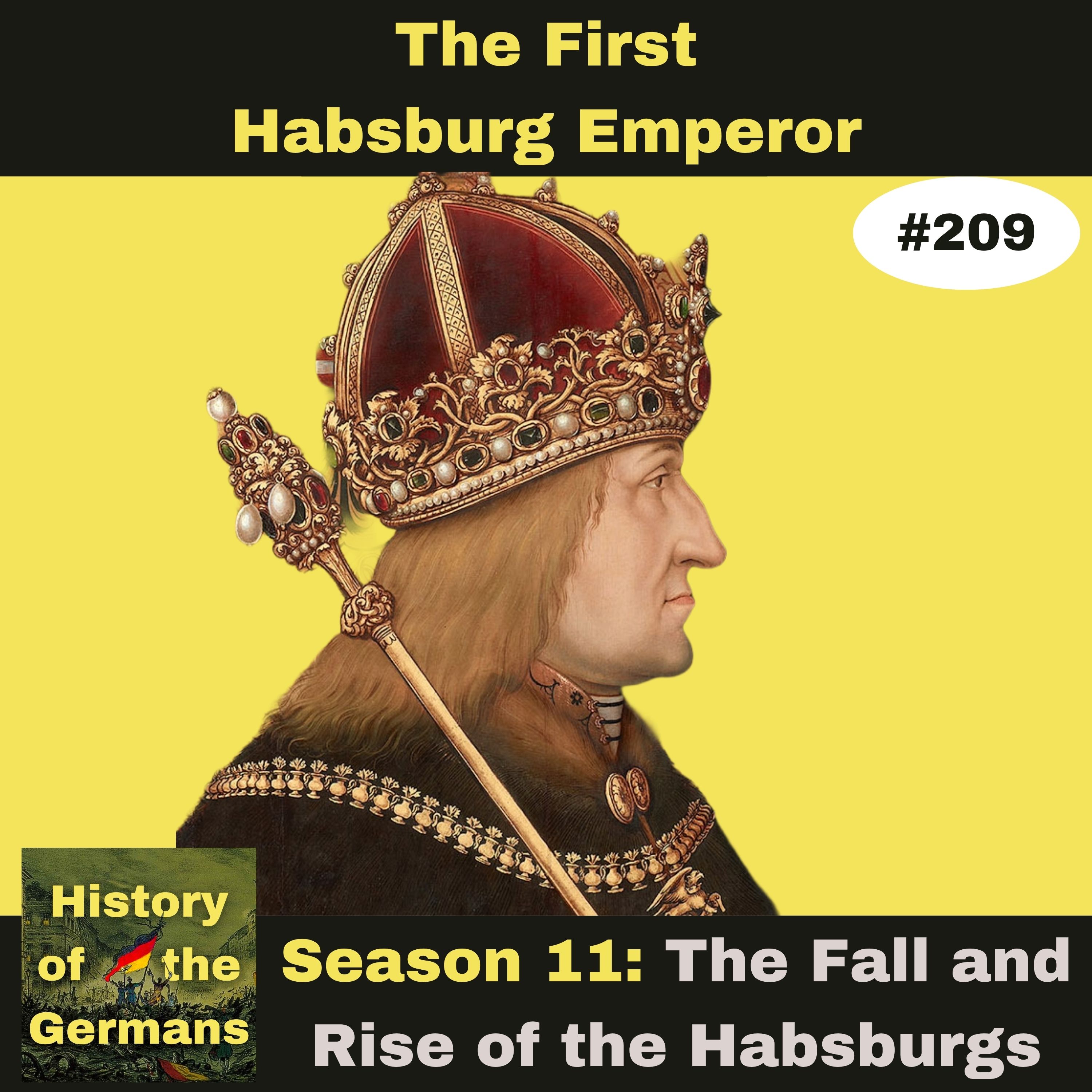
Just before he left Augsburg, the German city he had loved more than any other, he sat for a portrait by Albrecht Duerer, the image you can see in today’s episode artwork. You can see that even at the end of his life, he might be broken in body but he was not the kind of person who would ever give up.

He had not much further to go. From Augsburg he headed to Innsbruck, the city he had made his capital, in as much as that was possible. There he was confronted with unpaid bills amounting to 24,000 florins and there was no more credit to be had with the grocers and innkeepers. He was chased out of his own home. His last stop was the town of Wels, between Salzburg and Linz.

The emperor’s body was finally giving up. I spare you the details, all terribly gross. The day before the end finally came, a delegation from king Henry VIII arrived in Wels. One last time Maximilian demanded to be washed, shaved and clothed. He sat down with the ambassador for 2 hours of negotiations. Business concluded, Maximillian returned to his chambers, that he would never again leave. He signed his last will and testament on January 11th, 1519 passing all his lands and titles to his grandsons, Charles and Ferdinand. He renounced the imperial title, confessed, received the last rites and just before a final stroke took his ability to speak, he said, “I am going on this final journey well prepared”. And then the emperor Maximilian I, the Last Knight was no more.

He had ruled the empire for 26 years. I have not checked in detail, but as far as I can see, there wasn’t more than a handful of years that he had not fought one war or another; most, but not all against the King of France and the Republic of Venice. Few of these wars he won, but he still left behind an enormous legacy.
His first and immediate legacy was an apocalyptical level of debt. It is estimated at 6 million florins, more than 10 times the income from his territories. Translating this into modern parlance that would be 4 times GDP double where the most indebted developed country, Japan is now. He wasn’t lying when he told the electors that he had spent his entire fortune and more in the service of the empire.
Most German historians, from Leopold von Ranke down, took a dim view of Maximilian and his finances.
As in so many things he was both medieval prince who thought money matters were beneath him and early modern ruler with a key interest in the latest ideas and inventions. He introduced modern administrative practices in his lands that formed the basis of the imperial bureaucracy that lasted for centuries.
And what is often forgotten is that the immensely wealthy lands he had taken over had been brutally mismanaged by his predecessors. The duchy of Burgundy he took over from Charles the Bold, the man who lost his entire treasure at Grandson and whose profligacy was legendary. Who can forget the golden hat. Charles himself had sustained a number of tax riots and that was before his lands were viciously attacked by the French. The next territory Maximilian took over was Tyrol, where his cousin Sigismund had run things down in a truly shocking manner, so badly that he had offered the whole lot, including the greatest silver mines in Europe to the Bavarian dukes as repayment for loans. Austria, Styria and Carinthia had literally been through the wringer with the civil war between Friedrich III and his brother, Turkish raids and Hungarian occupations. It s a small miracle there was any money generating activity left. And though Einstein never said it, he, like us, knows that compound interest is the most powerful force in the universe. And imagine how powerful an average 8-12% compound interest can be, it means debt doubles every 7 years unless paid back, and Maximilian in his 26 years could never pay back.
Plus, only some of his costly wars had started out of his own initiative. The French attack on Burgundy was certainly not a war of his choice, nor was the French invasion of Italy.
The debt might not have been his fault, but it took his descendants almost a century to clear it, using methods that did not quite always comply with the chivalric oath to protect widows and orphans.
What did all this death and debt got the House of Habsburg – an empire. This is Maximilian’s great legacy. At his largest extent the Habsburg lands comprised the Netherlands, Belgium and Luxemburg, the so-called further Austria on the upper Rhine, the Franche Comte, Spain, for a time Portugal, including its colonies, aka Latin America, including Brazil and Mexico, the Philippines, Naples, Sicily, Sardinia, Hungary, Czech Republic, and of course, Austria.

Sure, Maximilian could only get to where he got to because his father was the emperor and his ancestors had patiently built their claim on Hungary and Bohemia. And it is also undeniable that Spain, the Netherlands and England had formed a coalition against French hegemony long before Maximilian showed up on the scene. And had the fates spun, measured and cut the threads of life differently, that same empire could have become a Spanish empire, or no empire at all. Equally, a union between the monarchies of central and eastern europe was nothing new at all and would have become inevitable under the Ottoman threat. Who ruled it was again, just chance.
But there were a number of contributions Maximilian made to events that steered history to its actual outcome.
As barely a 17-year old he defended his wife’s and then his son’s claim on the grand duchy of Burgundy against the French and against the locals. In the process he endured insults and incarceration, found himself perennially out of funds, his armies always falling apart just before the great success. And he never gave up. The most remarkable thing about him is I think his resilience. He is the ultimate Stehaufmännchen, the tumbler toy of emperors. He gets knocked over, and he instantly comes back. Knock him again, and he comes back again. Yes, you can say he was a blowhard, a ridiculous optimists who showed up in Livorno with no money and no soldiers and a plan to conquer the world. Yes, he might have lost all his wars, but he was still standing at the end, and so was his empire.

His other great contribution was the imperial reform. Again, a haphazard structure, more imposed on him than created by him. But he made the best out of it, got rid of the ineffective Reichsregiment and introduced the much more functional Kreise. As a lawyer I appreciate that his institutions, the Reichskammergericht and the Reichshofrat established a deep belief in the independence of the judiciary.
What surprised me doing the research was that the thing Maximilian is most famous for, the marriage policy, was the bit he did not drive that hard.
He can barely claim credit for the double wedding between Philip the Handsome and Juana and Margaret and Juan. But where he made his great contribution was in convincing Ferdinand of Aragon to recognize Charles as his heir. That could have easily gone the other way.
Equally, the Hungarian double wedding was not a singular masterstroke, but a process that had been in the making since 1278. Once again it was his ability to pull himself up from the floor after king Wladislaw had his son Louis, dashing Maximilian’s hopes to inherit the crown himself. He accepted that the Habsburgs had once again lost a round. And as the legendary German national coach Sepp Herberger said, “After the game is before the game”. So, back to the table another marriage, another Erbverbruederung, one day it will all work out. And it did.
That leaves only one more part of Maximilian’s legacy we have not talked about. And that is what the art historian Larry Silver called Marketing Maximilian. Maximilian I may have dreamt of chivalric adventures, jousts and mummeries, but he was also the first statesman who used the modern medium of print to communicate his policies and create his image. I know many of you are here for the political history, rather than the cultural stuff, but this one is both and I am very much looking forward to Sunday when I will sit once again in my favorite armchair and design next weeks episode, hopefully this time, uninterrupted.
I hope you will join us again, and – well I do not have to say it. You know where to go and you know what to do.